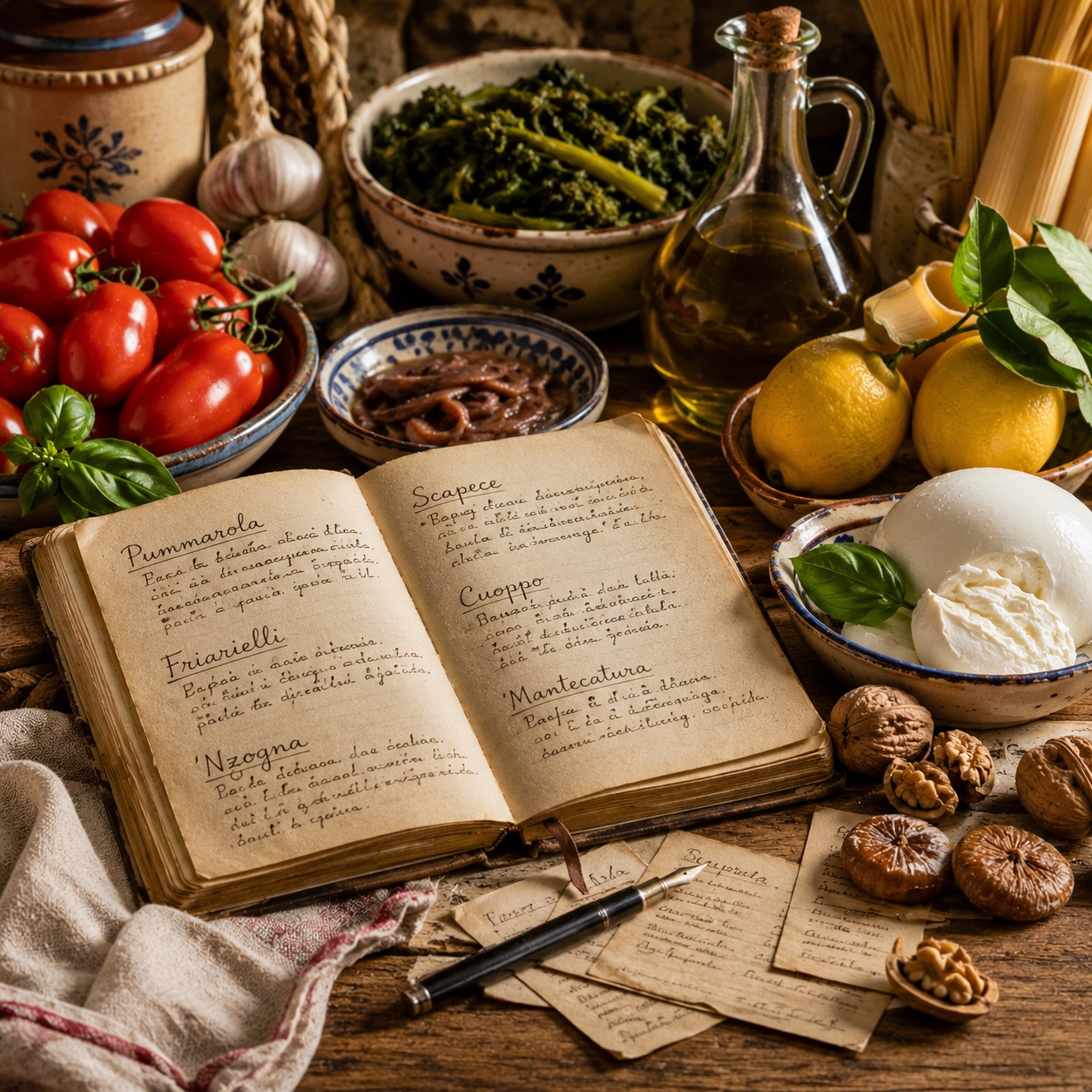
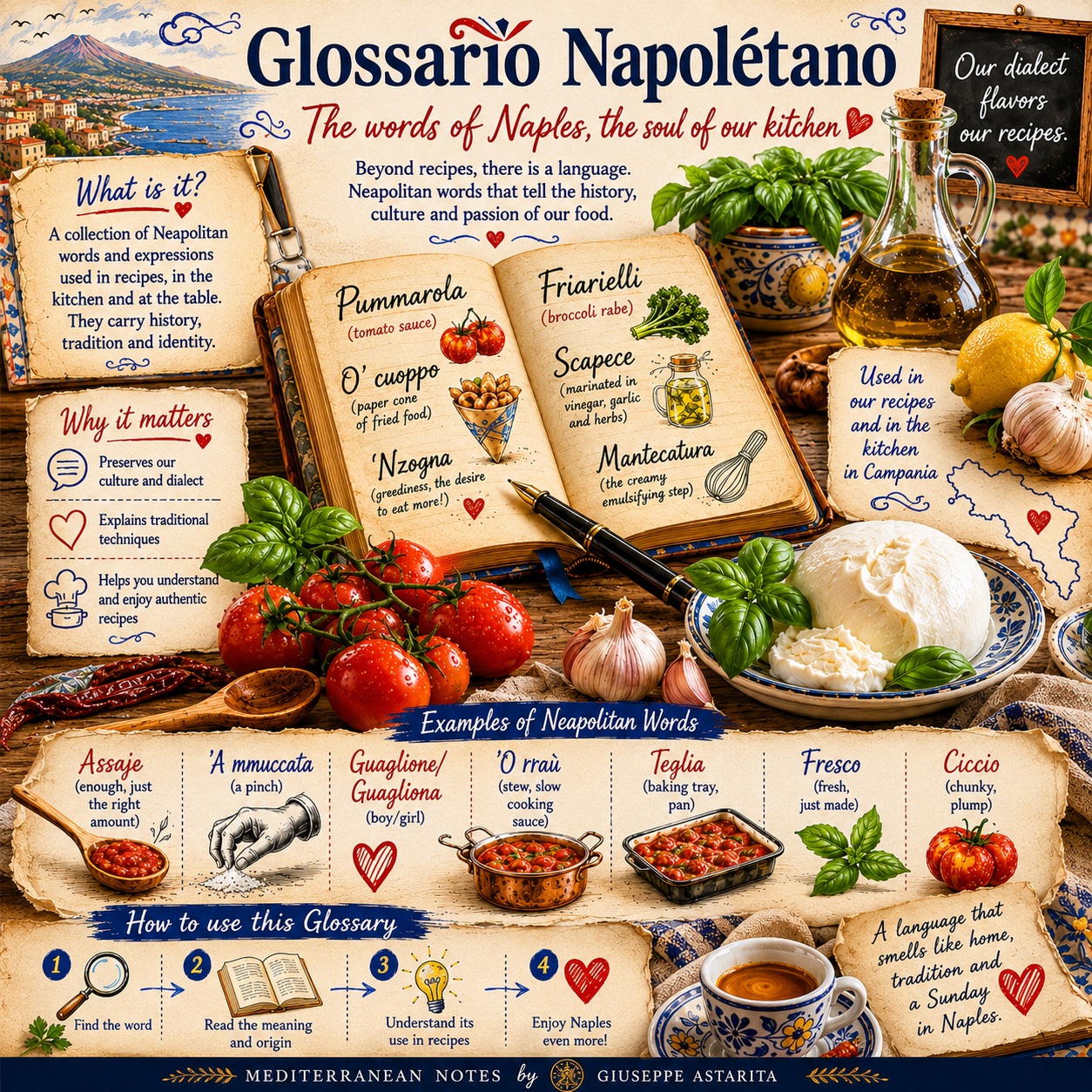
Dialect words, local ingredients, classic preparations, and the techniques behind them — the vocabulary of the Neapolitan and Campanian kitchen, explained from inside it.
Every kitchen has its own language. The Neapolitan one is particularly rich — a mixture of Italian, Neapolitan dialect, French borrowings from the Bourbon court, Spanish echoes, and Arabic traces in the sweets. Some words describe ingredients that exist nowhere else. Others name techniques that are standard in this kitchen but have no precise equivalent in Italian proper. This glossary covers the words you will encounter most often in this collection — and a few that are worth knowing even if they appear rarely, because understanding them is part of understanding the food.
A
Acqua pazza
technique · fish preparation
Literally "crazy water." A technique for cooking whole fish or fillets by poaching them in a light broth of water, olive oil, crushed tomatoes, garlic, and sometimes capers or olives. The water is "crazy" in the sense of being flavored and alive rather than plain. It produces a clean, delicate dish that keeps all the flavor of fresh fish without masking it. Common all along the Campanian coast.
Affogata
technique · vegetables
"Drowned." Cooking greens — above all escarole — covered in a pot with only the water clinging to the leaves, so they stew slowly in their own moisture with garlic, oil, anchovies, olives, capers, pine nuts and raisins until silky.
Aglio e olio
pasta sauce
The simplest pasta sauce in the Campanian repertoire: garlic sliced thin or crushed, warmed slowly in good olive oil until fragrant but not brown, tossed with pasta and a splash of the pasta cooking water. Sometimes with dried chili (peperoncino), sometimes with parsley. A midnight dish, a poor man's dish, a great dish. The quality of the olive oil matters more here than in almost any other preparation because there is nothing to hide behind.
Alici
ingredient · fish
Fresh anchovies — small, silver, blue-backed pesce azzurro that are one of the foundational fish of the Campanian coast. Not to be confused with the salt-cured product sold in jars, which is a different ingredient. Fresh alici are fried, baked with lemon and breadcrumbs, marinated under vinegar, or pressed flat and eaten raw. They are inexpensive, seasonal, and genuinely difficult to find outside the Mediterranean. Cicinielli (see below) are the newborn version, a separate seasonal specialty.
C
Caciocavallo
ingredient · cheese
A stretched-curd cheese (pasta filata) made from cow's milk, shaped into a distinctive gourd form and tied at the top to hang for aging. The name — literally "cheese on horseback" — refers to the traditional method of hanging the cheeses in pairs over a wooden beam, like saddlebags. Young caciocavallo is mild and slightly elastic, good for melting; aged caciocavallo (stagionato) develops a sharp, complex flavor used for grating. In Campania, Caciocavallo Silano has DOP status, produced across a wide area of southern Italy. Not to be confused with provola or scamorza, which are also pasta filata cheeses but differ in shape, aging, and flavor profile. Caciocavallo impiccato — hung over a flame and eaten as it melts — is a classic antipasto of the southern Italian table.
Caffè napoletano
drink · ritual
Coffee in Naples is a different thing from coffee elsewhere — shorter, hotter, more intense, served in small pre-warmed ceramic cups, drunk standing at the bar. The traditional Neapolitan pot is the cuccumella or caffettiera napoletana, a flip-pot that steeps rather than percolates, producing a coffee with a particular clarity of flavor distinct from the espresso machine. The ritual around it — the bar, the standing, the brief exchange with the barista, the caffè sospeso (a coffee paid forward for a stranger) — is as important as the drink itself.
Calzone
preparation · bread / pizza
A folded pizza — the same dough as pizza napoletana, sealed over a filling, baked or fried. The classic filling is ricotta, salami, and Pecorino. Baked calzone produces a different crust character from flat pizza; fried calzone (calzone fritto) is a street food tradition in Naples, golden and crisp outside, with the filling steaming inside. Not a pizza that didn't fit on the pan — a distinct preparation with its own logic.
Caponata napoletana
dish · vegetables
Not the Sicilian caponata (which is an agrodolce eggplant relish) but the Neapolitan version: a summer combination of roasted and raw vegetables — peppers, tomatoes, celery, olives, capers, sometimes cucumber — dressed with olive oil and vinegar. Served at room temperature. It is closer in spirit to a composed salad or antipasto than to a cooked stew, and it is the Campanian way of eating vegetables at their peak without cooking away what makes them good.
Capitone
ingredient · fish
Large female eel — the traditional centerpiece of the Neapolitan Christmas Eve dinner, part of the Festa dei Sette Pesci (Feast of the Seven Fishes). Capitone is roasted or fried, sometimes marinated in vinegar. In Neapolitan Christmas markets, live capitone were sold in barrels of water, and families would keep them in the bathtub until Christmas Eve — a childhood memory that stayed with a generation. The tradition is less common now but not disappeared.
Casatiello
bread · Easter
A savory leavened ring bread made at Easter, rich with lard ('nzogna), stuffed with salami, pancetta, and sharp cheeses. The distinguishing feature of casatiello (as opposed to tortano) is that whole raw eggs are pressed into the surface of the shaped ring before baking and held in place with crossed strips of dough. The eggs bake in their shells; the crosses are not decoration but are structural and symbolic — a direct reference to Easter. The dough is enriched with rendered pork fat, which gives it a particular softness and depth. See also: Tortano.
Cervella
quinto quarto · vanished dish
Brains — usually veal — soaked, blanched with vinegar or lemon to firm them, then breaded and pan-fried in butter: cervella in padella. Once common home cooking, fed to children because they were "good for the brain." Modern guidance retired the dish; it survives mainly as memory and food history.
Chiacchiere
pastry · Carnival
Thin fried pastry ribbons made for Carnival — the weeks before Lent. The dough is rolled extremely thin, cut into irregular strips, fried in hot oil until they blister and puff, then dusted with powdered sugar. They are eaten immediately; the next day they are not the same. Known as frappe in Rome, cenci in Tuscany, bugie in Liguria — the same pastry, different dialect names across Italy. In Naples the name chiacchiere refers to chatter, gossip — the pastry you eat while talking.
Ciambotta
dish · vegetables · summer
A Campanian summer vegetable stew — eggplant, peppers, tomatoes, potatoes, zucchini — all cooked together in olive oil until everything has softened and the flavors have merged. Similar to ratatouille in its logic but distinctly Southern Italian in its seasoning and texture. It is a dish of abundance: made when the summer garden has more than enough of everything, cooked slowly, eaten at room temperature as well as warm. One of the clearest expressions of the Campanian cucina povera approach to vegetables.
Cicinielli
ingredient · fish · seasonal
Newborn fish — the larvae and fry of anchovies and sardines, translucent and barely formed, harvested from the Tyrrhenian sea in late winter and early spring. A delicacy of the Neapolitan street food tradition: eaten fried (frittura di cicinielli), in frittate, or simply on bread with a drop of lemon. The season is short — a few weeks — and the catch depends on the year. Fishing them is now regulated but the tradition persists. In other parts of Italy they are known as bianchetti or gianchetti. Not available outside the region except occasionally at specialist fishmongers.
Cocozza
dialect · vegetable
Neapolitan dialect for zucca — pumpkin or winter squash (and in some uses any squash, including the long cucuzza). "Pasta e cocozza" is pasta with pumpkin, cooked down creamy the same way as pasta e patate. The dialect word is the one you hear at the market.
Cuoppo
street food · container
The brown paper cone of Neapolitan street food, and by extension everything served in it. The cuoppo di terra holds crocchè, zeppoline and sciurilli; the cuoppo di mare brims with fried small fish, squid rings, shrimp and anchovies. Hot, salted, eaten walking — the cone is the plate, the napkin, and the format.
Crocchè
street food · fried
Fried potato croquettes — mashed potato mixed with egg, Pecorino, parsley, sometimes a small piece of provola or mozzarella inside, shaped into cylinders, coated in breadcrumbs and fried. One of the foundational items of the Neapolitan friggitoria (fry shop) alongside pizzette fritte, sciurilli, and frittatine di pasta. Eaten standing up, in paper, from a street vendor. The outside should be crisp; the inside should be soft, yielding, slightly cheesy if there is a filling. The Neapolitan dialect form is crocchè (from the French croquette).
F
Fegato in padella
quinto quarto · secondo
Liver — veal or pork — flash-cooked over high heat and served over a bed of onions melted slowly in olive oil with bay leaf, finished with a splash of vinegar or white wine. The traditional ratio is one-to-one, liver to onions. A classic quick weeknight dish of Neapolitan home cooking, prescribed for generations as a source of iron for growing children.
Filoscio
dish · eggs
A Neapolitan folded egg, somewhere between a soft omelette and scrambled eggs, cooked in butter or oil and folded around melting mozzarella. A five-minute supper or merenda. The name itself is the dialect rendering of the French filoche — the filoscio is the Neapolitan cousin of the omelette.
Fiordilatte
ingredient · cheese
Fresh stretched-curd cheese (pasta filata) made from cow's milk — the cow's milk equivalent of mozzarella di bufala. Softer and milder than buffalo mozzarella, it melts more cleanly on pizza, which is why pizza margherita in Naples is often made with fiordilatte rather than buffalo mozzarella (the buffalo version has higher moisture and can make the pizza wet). In Campanian cooking the two are used interchangeably in some preparations and distinctly in others. Fiordilatte from the Agerola mountains, above the Amalfi coast, is considered the best.
Fresella
ingredient · bread
A twice-baked bread ring — baked, then split in half and returned to the oven until it dries completely. The result is hard, shelf-stable, and needs to be softened before eating by passing it briefly under cold water or pressing it into a bowl of water for a few seconds. Then dressed with tomato, olive oil, salt, sometimes oregano, sometimes whatever else is at hand. A staple of the Campanian summer — the precursor to bruschetta, simpler, more austere, closer to the tradition of sailors and peasants who needed food that kept. Both a bread and a method of eating.
Friarielli
ingredient · vegetable
The most Neapolitan of vegetables — the flowering shoots of a specific variety of turnip (Brassica rapa) that grows in the volcanic soil around Naples and Caserta. Not the same as broccoli rabe sold in the United States, which is a related but different plant and lacks the distinctive bitter sweetness of the Campanian variety. Friarielli are sautéed with garlic, olive oil, and peperoncino until tender and slightly caramelized at the edges, then eaten as a contorno, stuffed into panini with sausage, or layered onto pizza. The combination of salsiccia e friarielli is one of the defining flavor pairings of the Campanian kitchen.
Fiorilli / Sciurilli
dialect · vegetable · street food
The Campanian dialect names for fiori di zucca — zucchini blossoms. Fiorilli (also spelled sciurilli, from the Neapolitan 'o sciurillo) is the word you hear in Campania, especially at the market and from the friggitoria. The blossoms are battered in a light, cold batter and fried in abundant hot oil. The result is eaten immediately, hot, with a pinch of salt — in paper if you are standing at the street vendor, on a towel-lined plate at home. They appear on menus as frittelle di fiori di zucca and sometimes as pizzette when made small and round, but sciurilli is the name any Campanian recognizes.
Friggitelli
vegetable · summer
The small, thin-walled, sweet green frying peppers of the Campanian summer — from friggere, to fry, because that is what you do with them: whole, in olive oil, until blistered and collapsed. Not to be confused with friarielli, which share the etymology but are bitter turnip greens. Sautéed with cherry tomatoes, garlic and basil and left to cool, they become the peperoni alla napoletana.
Frittura
technique · street food
Frying — specifically the deep-frying tradition that is central to Neapolitan street food. A friggitoria is a shop dedicated to frying: crocchè, pizzette fritte, sciurilli, mozzarella in carrozza, baccalà fritto, frittatine di pasta. The Neapolitan approach to frying uses abundant, very hot oil and cooks quickly, producing a crust that is dry and light rather than greasy. La frittura deve essere asciutta — the fried thing must be dry — is the standard. A mixed plate of fried things is called cuoppo (see below), from the paper cone it is served in.
M
Maccarune
dialect · pasta
The Neapolitan dialect word for pasta — specifically maccheroni, but used broadly for pasta in general. Maccarune 'e casa is homemade pasta. Frittata di maccarune (or frittata 'e maccarune) is the classic leftover pasta frittata, one of the most honest dishes in the Campanian kitchen. The word carries no distinction of shape or format — any pasta can be maccarune in dialect. When someone says voglio i maccaroni in a Campanian household, they mean pasta, in whatever form the day requires.
Mbuttunati
dialect · technique
Neapolitan dialect for "stuffed" — from imbottire, to fill. Used specifically for dishes where a vegetable or piece of meat is hollowed out and filled with a mixture: puparuoli mbuttunati (stuffed peppers), totani mbuttunati (stuffed squid), peperoni imbottiti. The filling typically contains breadcrumbs, capers, olives, sometimes anchovies, sometimes cheese — the classic Neapolitan pantry stuffing that works with almost anything. The dialect form sounds more direct and physical than the Italian imbottiti.
"Mettitelo tra due fette di pane"
expression · table philosophy
"Put it between two slices of bread." The standing verdict of my father — and of fathers all over Campania — pronounced whenever pane casareccio or pane cafone was on the board and something on the table would clearly be improved by it: insaccati, leftover parmigiana, friarielli, the lunch peperoni. Not a recipe; a recognition. The unofficial founding principle of the cuzzetiello.
Mostaccioli
pastry · Christmas
Spiced diamond-shaped Christmas cookies made with flour, honey or sugar, cocoa, almonds, and a blend of spices (cinnamon, cloves, pepper, sometimes nutmeg), coated in dark chocolate. Part of the classic Neapolitan Christmas pastry canon alongside struffoli, roccocò, and susamielli. The name derives from mosto — grape must — which was the original sweetener before sugar became widely available. They are hard, spiced, intensely flavored, not for the faint-hearted. The correct texture is a firm bite that yields, not a crack.
Mozzarella di bufala
ingredient · cheese
Fresh stretched-curd cheese made from the milk of water buffalo (bufala) — one of the most important ingredients of the Campanian kitchen and one of the great cheeses of Italy. About 95% of Italian water buffalo are in Campania, concentrated in the Caserta and Salerno provinces. The milk is richer and more complex than cow's milk, producing a mozzarella with a characteristic sourness, creaminess, and depth that cow's milk versions (fiordilatte) do not have. DOP-protected. Eaten fresh, at room temperature, within a day or two of production. Not primarily a cooking cheese — heat diminishes what makes it exceptional.
N
Nerano (alla Nerano)
preparation · pasta
A preparation originating from the small fishing village of Nerano on the Sorrento peninsula — spaghetti with fried zucchini, basil, and Provolone del Monaco or Pecorino, emulsified with pasta cooking water into a creamy sauce without cream. The zucchini are fried in olive oil and left to rest, which softens them and concentrates their flavor; then they are tossed with pasta and cheese off the heat. One of the most replicated dishes of the Campanian coast, particularly after it was associated with the restaurant Maria Grazia, which claims to have invented it in the 1950s.
Nocillo
liqueur · Campania
Walnut liqueur made by macerating green walnuts (harvested before they harden, traditionally on the feast of San Giovanni, June 24) in alcohol with spices — cloves, cinnamon, sometimes lemon peel. The result is dark, almost black, intensely flavored, slightly bitter, warming. A digestivo of the Campanian countryside. Less internationally known than limoncello but equally embedded in local tradition. Each family that makes it has a slightly different recipe — the proportions of spice, the length of maceration, the choice of alcohol. Homemade nocillo is one of the things brought out at the end of a long Sunday lunch.
'Nzogna
dialect · ingredient · fat
The Neapolitan dialect word for lard — rendered pork fat, known in Italian as strutto or sugna. An essential ingredient in traditional Campanian baking: casatiello, tortano, pastiera, taralli sugna e pepe. Not olive oil, not butter — 'nzogna gives these breads and pastries a specific richness, softness, and savory depth that no other fat produces. In the leaner postwar decades it was replaced by butter or shortening in many households; traditional recipes call for it specifically and the difference is perceptible. Taralli 'nzogna e pepe — ring-shaped crackers made with lard and black pepper — are one of the most beloved Neapolitan street snacks.
P
Paccheri
ingredient · pasta shape
Large, wide tube pasta — the most theatrical pasta shape of Campania. A single pacchero is large enough to fill, large enough to hold a thick ragù, large enough to demand that the sauce go inside it rather than merely coat it. Paccheri are used with ragù napoletano, with a rich seafood sauce, or with a slow-cooked onion sauce (genovese). The name is said to derive from the Neapolitan dialect word for a slap — pacca — referring to the sound the pasta makes when it falls into boiling water, or possibly to the slap of tasting something so good it surprises you. Made in the Gragnano pasta-making tradition, which has been producing pasta in the hills above Naples for centuries.
Papaccelle
ingredient · vegetable
Small, round, ribbed peppers preserved in wine vinegar — a uniquely Campanian ingredient with no real equivalent elsewhere. Bright, acidic, crunchy, intensely flavored. Papaccelle appear in insalata di rinforzo (the Christmas Eve salad), in braciole al ragù, alongside salsiccia campana, and in the insalata mista on any Neapolitan table that takes these things seriously. The vinegar they're preserved in is also used as a condiment. Available at Campanian delis and specialty importers; difficult to substitute.
Polpette
dish · meat
Meatballs — made from ground beef (or a mix of beef and pork), bread soaked in milk, egg, Parmigiano, parsley, sometimes a little garlic. In Campania, polpette are most often cooked directly in the Sunday ragù, where they absorb the sauce and give back fat and flavor in return. They are not typically served as a standalone main course the way they appear abroad — they are part of the ragù system, one of several meats that go in at different stages. Eaten separately as a second course after the pasta. Polpette di tonno (tuna meatballs, no meat) are a separate and entirely different tradition — cold, no-cook, served with mayonnaise.
Parmigiana
dish · vegetables
Fried eggplant layered with tomato sauce, mozzarella (or fiordilatte), basil, and Parmigiano, baked until the layers meld together. Despite the name, it has nothing to do with Parma — it is one of the most Neapolitan of dishes. The name may derive from parmiciana, the Sicilian word for the wooden slats of a shutter, which the overlapping eggplant slices resemble, or possibly from the Parmesan cheese added at the end. A summer dish, made when eggplant is at its peak, requiring time and patience to fry each slice properly. Not a quick preparation; worth every minute.
Passata
ingredient · tomato
Sieved tomato — whole or crushed tomatoes passed through a food mill or sieve to remove seeds and skins, producing a smooth, pourable sauce that is more processed than crushed tomatoes but less cooked than canned tomato purée. The foundational tomato product for Campanian cooking. The best passata is made at home in August from San Marzano tomatoes and bottled for the year — a tradition that organized entire family weekends, with crates of tomatoes, large pots, and everyone involved. Commercial passata varies widely in quality; the flavor of the finished dish depends heavily on it.
Pasta mista
pasta · format
The mixed pasta shapes — pasta ammescata — born from the broken leftovers at the bottom of the grocer’s drawers, sold cheap by weight and now produced as a format in its own right. The traditional choice for dense, creamy one-pot dishes where the irregular shapes cook unevenly on purpose: pasta e patate, pasta e fagioli, pasta fagioli e cozze.
Pastiera napoletana
pastry · Easter
The Easter tart of Naples — a shortcrust pastry shell filled with a mixture of cooked wheat berries (grano cotto), fresh ricotta, eggs, sugar, candied citron and orange peel, and orange blossom water. One of the most complex and deeply flavored pastries in the Italian tradition. It is made on Holy Thursday or Good Friday so that it can rest for a day before Easter Sunday — the flavor deepens overnight. Every Neapolitan family has strong opinions about the correct texture (denser or lighter), the amount of candied fruit, the presence or absence of cinnamon. Making it is an annual ritual that takes a full day.
Peperonata
dish · vegetables · summer
Slow-cooked sweet peppers — red, yellow, and green — stewed in olive oil with tomato, onion, and sometimes olives or capers until they collapse into a soft, intensely sweet-savory preparation. Eaten as a contorno alongside meat, on bread, or as a sauce for pasta. The Neapolitan version leans sweeter and richer than Roman versions; the peppers cook until there is almost no liquid left. A summer dish by necessity, made when peppers are cheap and abundant and the season insists on it.
Pignatiello
equipment · cookware
A small, single-portion terracotta cooking pot — the diminutive of pignatta, the traditional Neapolitan clay pot used for slow cooking. The pignatiello is used for individual portions of slow-cooked dishes: eggs in purgatorio, pasta e fagioli served at the table, small ragù. Terracotta conducts heat gently and evenly, retains it after the flame is off, and adds a faint mineral quality to long-cooked preparations that is impossible to replicate in metal. Pasta e patate and pasta e fagioli cooked and served in a pignatiello are not quite the same dish as when made in a steel pot — the heat behaves differently, and the serving vessel becomes part of the preparation. The pignatiello is also the traditional vessel for gnocchi alla Sorrentina — assembled and baked individually, brought to the table still bubbling. Outside of Campania, pignatiellos are surprisingly hard to find; good Italian kitchenware shops and specialty suppliers are the best option, but expect to look.
Pomodorino del Piennolo
ingredient · vegetable · DOP
The small, intensely flavored tomato of Vesuvius — grown on the volcanic slopes of Mount Vesuvius, harvested in clusters (piennolo means hanging cluster in Neapolitan dialect), and hung to dry slowly through the autumn and winter. The volcanic soil, the heat, the mineral-rich water: all of it concentrates into a tomato with an exceptional balance of sweetness and acidity that no flat-land tomato can replicate. Protected by DOP status since 2009. Used raw in summer, preserved in clusters through winter — a jar of pomodorini del piennolo in January tastes of August. Essential in Neapolitan pizza margherita, in pasta dishes that require concentrated tomato flavor, and anywhere the tomato is the point rather than the background. The datterino is a related elongated variety grown in the same tradition.
Provola
ingredient · cheese
A lightly smoked stretched-curd cheese (pasta filata) from Campania — made from cow's milk, pear-shaped, with a thin golden-brown smoked rind and a firm, slightly elastic interior that melts beautifully. Distinct from the sharper aged provolone of the north; Campanian provola is delicate, milky, with a gentle smokiness. It appears in gattò di patate, pasta al forno, conchiglioni al forno, pizza rustica, and anywhere you want a cheese that melts without becoming stringy or oily. Provola affumicata (smoked) is the standard form; provola fresca (unsmoked) is also made.
Puparuoli
dialect · vegetable
Neapolitan dialect for peperoni — bell peppers. The same word shift that turns Italian into Neapolitan all over the kitchen: a search for one should find the other. Puparuoli 'mbuttunati are stuffed bell peppers — the meat version with ground beef, provola, and ham; the vegetarian version with stale bread, olives, and capers is the peperoni imbottiti.
Pummarola
dialect · tomato sauce
The Neapolitan dialect word for tomato sauce — and, by extension, the tomato itself. O' sugo 'e pummarola is the basic tomato sauce; pummarola 'n coppa is tomato on top (as on pizza). The word captures something that the Italian pomodoro does not quite — it implies the sauce, the tradition, the daily presence of tomatoes in this kitchen. When a Neapolitan says pummarola they mean the sauce made at home, from real tomatoes, not something from a jar. The August ritual of making and bottling tomatoes — preserving the summer in glass — is the root of everything the word contains. Related: passata.
Puttanesca
pasta sauce
A bold, assertive pasta sauce — tomatoes, black olives, capers, anchovies, garlic, peperoncino, cooked quickly and powerfully. The name is Neapolitan in origin (the most commonly cited etymology connects it to the working women of Naples who could make it fast between clients, though this story may be apocryphal). What is not disputed is the flavor: briny, acidic, spicy, intense, done in fifteen minutes. A sauce that asks nothing of you except good ingredients and a hot pan.
Puveriello
dialect · style
Neapolitan dialect for "the poor one" — il poverello in Italian. Used as a descriptor for dishes made in the cucina povera style, with very little: pasta alla puveriello is pasta with minimal sauce, oil, garlic, whatever is at hand. The term carries no pity; it is a statement of resourcefulness. The Neapolitan kitchen at its best does more with less than almost any other tradition — the puveriello dishes are often the ones that show this most clearly.
R
Raffiuolo
dolce · Natale
Soft oval sponge cake of eggs, flour, sugar and lemon zest, covered in brilliant white sugar glaze and often topped with a candied cherry — sometimes filled with apricot jam (raffiuolo con marmellata), or chocolate-coated in the pastry-shop version. Born in convent kitchens; the elegant counterpart to the rustic susamiello on the Neapolitan Christmas tray. Must stay soft and moist, and is served with coffee.
Ragù napoletano
sauce · Sunday
The long Sunday meat sauce of Naples — not a quick meat sauce (that is a bolognese or a sugo di carne) but a preparation that requires four to eight hours of very slow cooking, barely above a simmer, with whole pieces of meat (braciole, sausage, pork ribs, sometimes beef), passata, a little tomato concentrate, and patience. The pippiare — the slow, lazy bubble of the sauce as it cooks — is the sound of Sunday morning in a Neapolitan household. The pasta goes into the sauce to dress it; the meat comes out as a second course. The two are not served together. A ragù that has cooked for less than four hours is not yet a ragù in the Neapolitan sense.
Rococò
pastry · Christmas
Hard, round, ring-shaped Christmas cookies made with almonds, candied orange peel, spices (cinnamon, cloves, pepper, nutmeg), and honey or sugar. One of the oldest Neapolitan Christmas pastries — records of them go back to the 18th century at the conservatory of the Real Convento della Rosa in Naples. Very hard — traditionally softened by dipping in wine or limoncello. Not a cookie for delicate teeth. Along with mostaccioli, struffoli, and susamielli, they form the core of the Neapolitan Christmas pastry table.
S
Scarpetta
gesture · table culture
The act of wiping the plate clean with a piece of bread at the end of a meal — dragging it through the remaining sauce, oil, or juices left behind. Fare la scarpetta — to do the little shoe — is considered by many Italians to be both an act of pleasure and a compliment to the cook. The name comes from the shape of the bread piece as it curves into the sauce, like a small shoe. In formal contexts it is considered bad manners; at the family table it is expected. In Campania, no good ragù, no good acqua pazza, no good soffritto is considered fully eaten until the scarpetta has been done. The bread for the scarpetta should be pane cafone — dense, crusty, able to hold its shape as it works through the sauce.
Salsiccia campana
ingredient · meat
Fresh Campanian pork sausage — coarsely ground pork (shoulder and belly), seasoned with salt, black pepper, and sometimes fennel seeds or chili. Made in a natural casing, sold fresh or lightly dried. The pairing of salsiccia with friarielli is one of the defining combinations of the Neapolitan kitchen — in a pan, on pizza, in a panino. Grilled over charcoal, it is one of the simplest and best things made in this tradition. Not to be confused with the dry-aged southern sausages (soppressata, capicola) — salsiccia campana is for immediate cooking.
Sanguinaccio
dolce · Carnevale
The Carnival chocolate cream of Naples — historically made with fresh pig's blood from the winter slaughter (my grandmother ate that version, bought at the store), reinvented after the 1992 ban on selling blood as a dense, eggless, cinnamon-spiced cream of cocoa and dark chocolate. Served cool, never drunk: the chiacchiere are dipped straight into the bowl.
Sartù di riso
dish · baked · rice
An elaborate baked rice timbale — one of the most complex preparations in the Neapolitan repertoire. A mold lined with breadcrumbs is filled with rice cooked in a meat ragù, layered with meatballs, hard-boiled eggs, peas, salami, provola, and more ragù, sealed, and baked until it holds its shape. When unmolded it comes out as a golden dome. A Sunday dish, a celebration dish, a dish that takes half a day and feeds many. The name is French-derived — surtout, meaning "above all" — from the Bourbon-era French influence on the Neapolitan aristocratic kitchen. A dish born in grand kitchens and adopted completely by the people.
Scamorza
ingredient · cheese
A semi-firm stretched-curd cheese (pasta filata) from Campania, made from cow's milk, pear-shaped with a pronounced neck formed by the string used to hang it during aging. Firmer and drier than mozzarella, with a more pronounced flavor. Available fresh (scamorza bianca) and smoked (scamorza affumicata). Melts well, browns well on the grill — scamorza alla griglia (sliced and grilled until charred and melted) is a classic Campanian antipasto. Used in pasta al forno, frittate, and anywhere a firmer, more flavorful melting cheese is needed than mozzarella provides.
Scapece
technique · preservation
A marinade technique: fried vegetables (most typically zucchini, but also pumpkin, eggplant, peppers) are marinated in white wine vinegar with garlic, mint, and sometimes chili. The result is kept at room temperature and eaten at room temperature — never hot — as an antipasto, contorno, or part of a spread. The technique preserves the fried vegetables for several days and transforms them: the vinegar softens the crust, the mint perfumes everything, the acid balances the oil of the frying. Zucchine a scapece is one of the summer dishes most identified with the Campanian kitchen. The name derives from the Spanish escabeche, brought during the period of Spanish rule.
Scialatielli
ingredient · pasta shape
A handmade pasta from the Amalfi coast — short, thick, slightly irregular flat noodles, wider than spaghetti, shorter than tagliatelle, with a rough surface that holds sauce well. Made from flour and milk or water, without eggs. Invented (or codified) in the 1970s by chef Enrico Cosentino at the Hôtel Miramare in Positano; now the signature pasta of the Amalfi coast, eaten almost exclusively with seafood — mixed seafood sauce, clams, mussels. The roughness is structural, not accidental: it is what makes the sauce adhere.
Sfogliatella
pastry · Naples
The most iconic Neapolitan pastry — a shell-shaped pastry filled with a mixture of semolina, ricotta, sugar, candied citron, and cinnamon. Two versions: sfogliatella riccia, with dozens of thin, crisp, laminated pastry layers that shatter when bitten; and sfogliatella frolla, made with a softer shortcrust pastry, rounder and less dramatic. The riccia is the technically difficult one, requiring a dough stretched to near-transparency and rolled around the filling. Invented at the convent of Santa Rosa on the Amalfi coast in the 17th century; brought to Naples and perfected by pastry makers whose names are still on the city's great pasticcerie. Eaten warm, from a bakery, in the morning.
Sciue sciue
dialect · style
Neapolitan dialect for "quick, quick" — subito subito, in a hurry. Used for fast preparations made without much fuss: pasta sciue sciue is pasta with a quick, barely cooked tomato sauce, garlic, basil, olive oil. The opposite of the long Sunday preparations. The term carries a certain affectionate impatience — the acknowledgment that sometimes the best dinner is the one that asks the least of you, made in the time between thinking of it and being hungry enough to need it immediately.
Soffritto
technique · base
The aromatic base of most Campanian sauces and stews — onion, sometimes with celery and carrot, cooked slowly in olive oil until soft, translucent, and sweet. The foundation of ragù, of pasta e fagioli, of vegetable soups, of almost anything that cooks for a long time. Not to be rushed — the point is to extract sweetness from the onion without browning it. In Naples, soffritto also refers to a specific dish: a stew of pork offal (lung, heart, spleen) cooked with tomato and chili — the cucina povera use of parts that would otherwise be discarded.
Struffoli
pastry · Christmas
Tiny fried dough balls coated in honey, decorated with colored sugar sprinkles (diavulilli), candied orange peel, and sometimes cinnamon. The centerpiece of the Neapolitan Christmas table, piled high in a ring or dome. Made on Christmas Eve or the days before, eaten throughout the holiday period. Every family has its recipe — some make the balls smaller, some larger; some add lemon zest to the dough, some add anise; some coat them several times in honey. The experience is sticky, sweet, aromatic, and entirely specific to this tradition.
Susamiello
dolce · Natale
Dense S-shaped Christmas cookie of almond flour, honey, candied orange peel and spices — deep brown, firm, intensely aromatic. One of the oldest Neapolitan sweets, from convent and medieval kitchens; the name likely recalls sesame seeds or ancient honey cakes, though modern versions rarely contain sesame. Best after resting several days, with dessert wine, alongside roccocò and mostaccioli.
T
Tegamino
technique · cookware
A small skillet or individual pan; al tegamino means cooked in one — most often eggs slipped into a hot buttered pan over day-old mozzarella, the yolks left soft inside a lake of melted cheese.
Telline
ingredient · shellfish
Small wedge clams — Donax trunculus — found just below the surface of sandy beaches along the Tyrrhenian coast. Smaller and more delicate than vongole veraci, with a sweeter, more mineral flavor. In Campania they were gathered by hand at low tide by children and adults alike, rinsed in sea water, then kept in salted water to purge the sand. Cooked simply: opened in olive oil with garlic, finished with parsley and a drop of white wine, tossed with spaghetti. The same logic as spaghetti alle vongole but more delicate, more coastal, more tied to a specific memory of summer beaches.
Timballo
dish · baked
A baked preparation in a mold — pasta or rice layered with meat, vegetables, cheese, and sauce, sealed and baked until it holds its shape when unmolded. Timballi in Naples range from the grand (sartù di riso, timballo di ziti con melanzane) to the everyday (pasta al forno), but the defining characteristic is the mold: the preparation is packed in, baked tight, then turned out onto a plate as a unified form. A dish of occasion and effort, made when the table calls for something more than a simple plate of pasta.
Tortano
bread · Easter
The savory Easter ring bread of Campania — made with the same lard-enriched dough as casatiello, stuffed with the same mix of salami, pancetta, and sharp cheeses, but with the hard-boiled eggs mixed through the filling inside the dough rather than pressed onto the surface. The result looks simpler than casatiello but is equally rich. In some Campanian families tortano and casatiello are used interchangeably; in others the distinction matters and is defended. Both are made in the days before Easter and eaten throughout the holiday. See also: Casatiello, 'Nzogna.
Totani
ingredient · seafood
Flying squid — Todarodes sagittatus — larger and slightly chewier than calamari (Loligo vulgaris), with a more pronounced flavor. Common in Campanian fish markets, particularly in summer. Totani are stuffed (totani mbuttunati or totani ripieni) with breadcrumbs, garlic, parsley, capers, and sometimes provola, then baked or braised in tomato. The difference between totani and calamari matters in this kitchen — the two are not interchangeable.
This glossary covers the terms most commonly encountered in this collection. It will grow as new recipes are added. For a full index of recipes by category, see the Recipe Index.