Pizza Margherita: from dough to dinner, the Italian way
Flour, water, yeast, salt, oil, and time. Make the dough in the morning and bake a perfect Margherita for dinner. Or make it the night before and barely think about it at all.
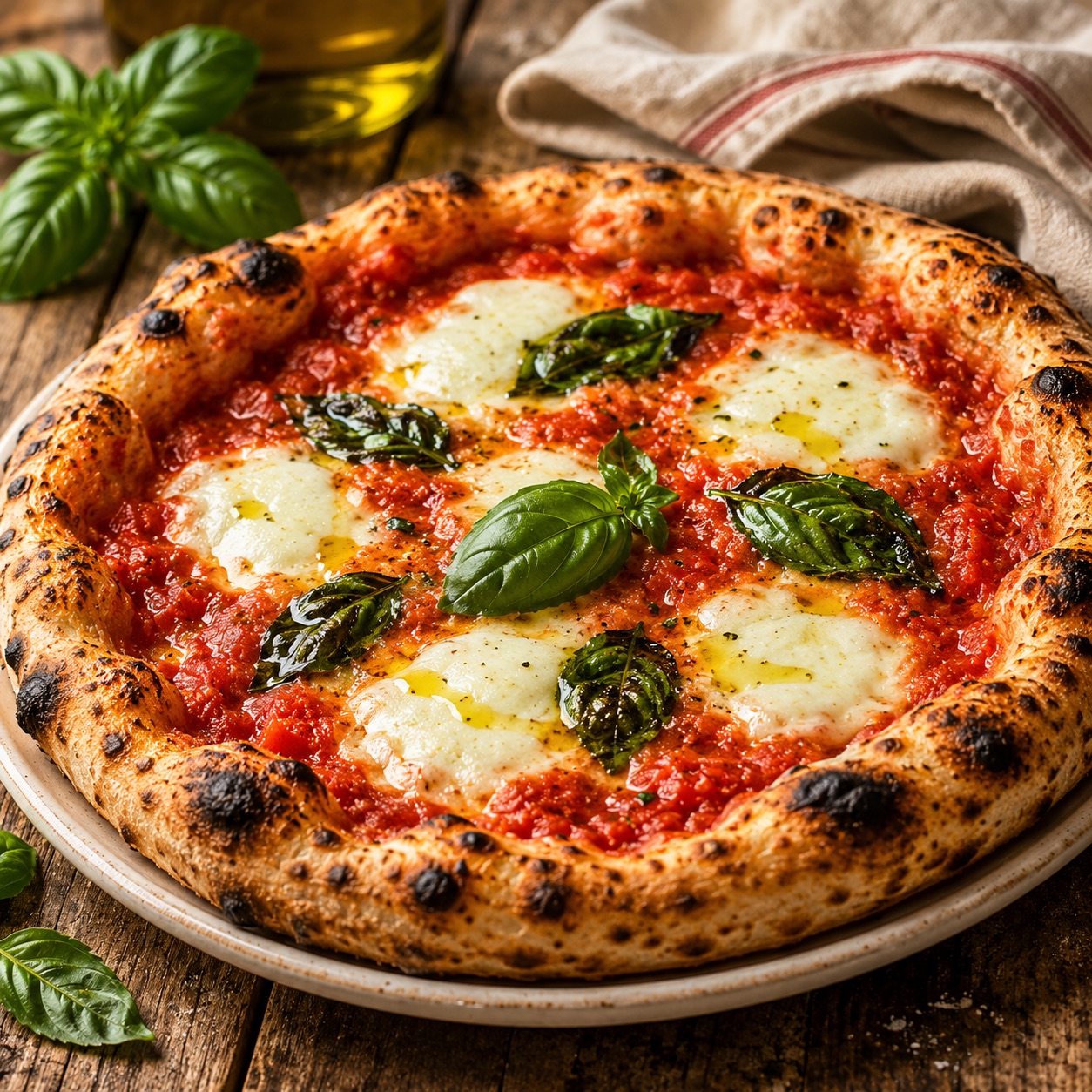
In Naples, pizza is not a special occasion. It is Tuesday. It is the thing you pick up on the way home, eat standing at the counter, finish in four minutes. The Margherita — tomato, mozzarella, basil, a thread of olive oil — is the standard by which everything else is measured, and the standard is extremely high.
Making it at home is a different project, but not a more complicated one. You are not competing with a wood-fired oven at 450°C. You are cooking in your kitchen, with what you have, for people you like. The goal is not authenticity in the strict sense — it is a good pizza, made with good ingredients, by your own hands. That goal is completely achievable.
The dough takes five ingredients and almost no active time. You mix it in the morning, fold it a few times over the course of an hour, and leave it alone. Two hours before dinner you divide it into balls and let it rest. Then you stretch, top, and bake. The process is mostly waiting — which is fine, because the waiting is where the flavor develops.
My daughters have learned that they can make their own mini pizzas. Fifty grams of dough each — small, manageable, the right size for eight-year-old hands to stretch without tearing. They choose their toppings. They eat what they made. It works remarkably well as both a cooking lesson and a dinner strategy.
Yeast fermentation, organic acids, and what slow rising does to flavor and digestion
Pizza dough fermentation is a metabolic process. Yeast consumes simple sugars and produces carbon dioxide — the gas that makes the dough rise — along with ethanol and organic acids that contribute to flavor. Longer fermentation times (cold proofing overnight at 4°C) allow more complete development of these aromatic compounds, which is why an overnight dough tastes noticeably more complex than one made in a few hours. The Maillard reaction between amino acids and reducing sugars, accelerated by high oven temperatures, is responsible for the char and browning on the crust — and for much of the flavor that makes pizza smell the way it does. Tomatoes contribute lycopene — a carotenoid antioxidant whose bioavailability actually increases with heat and in the presence of fat. Olive oil, added to the dough and drizzled at the end, improves lycopene absorption and adds its own complement of oleic acid and phenolic antioxidants.
The dough
Ingredients · makes 4 pizzas (or more mini ones)
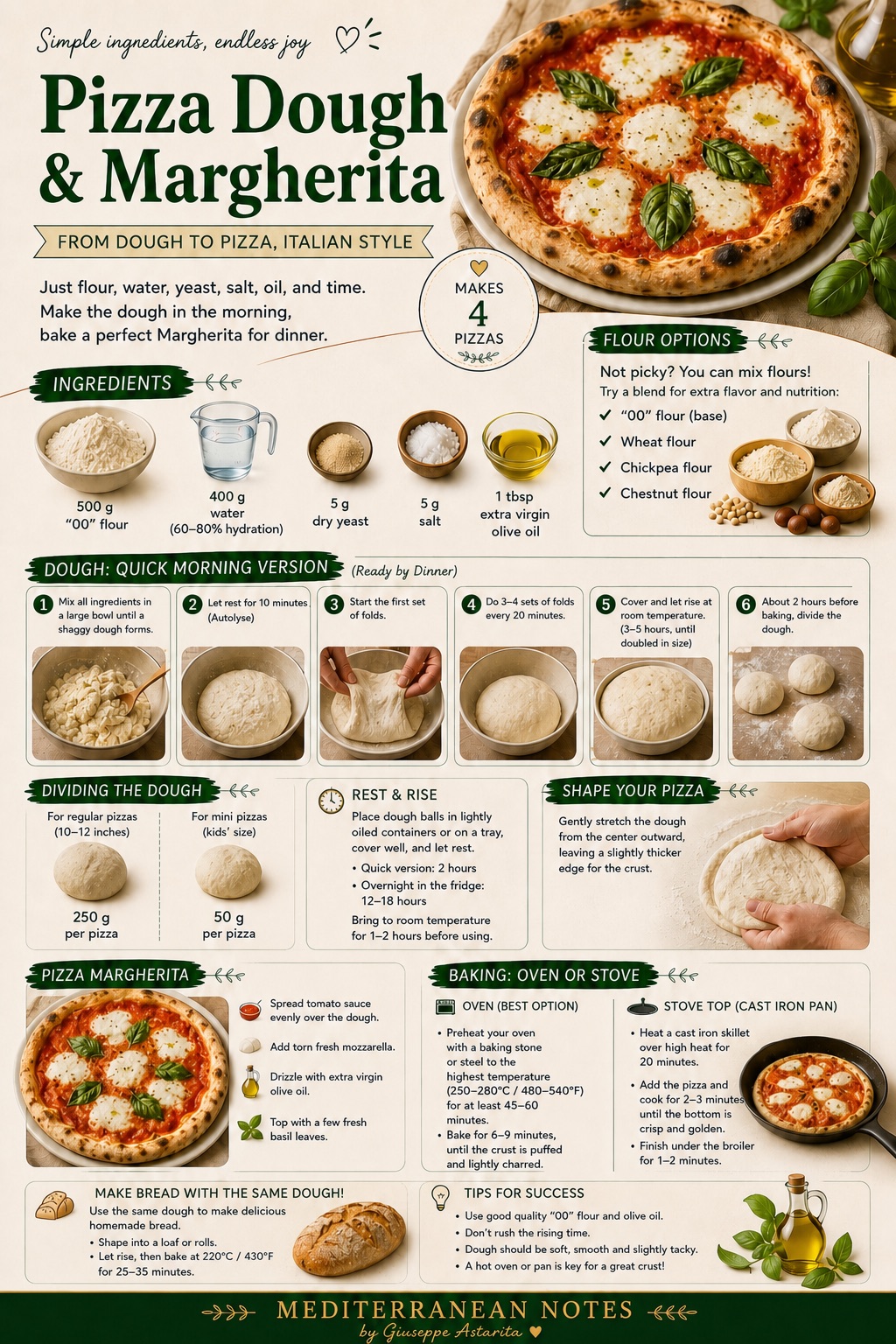
Method — quick version (morning to dinner)
Combine flour, yeast, salt, oil, and water in a large bowl. Mix until a shaggy dough forms — no dry flour remaining. It will look rough. That is fine.
Add the salt and yeast on opposite sides of the bowl before mixing — direct contact can inhibit the yeast.
Cover the bowl and let it rest for 10 minutes. This is the autolyse — the flour absorbs the water and the gluten begins to develop on its own, without any kneading.
Perform 3–4 sets of folds, spaced 20 minutes apart. Each set: wet your hand, grab one side of the dough, stretch it up and fold it over the center. Rotate the bowl a quarter turn and repeat four times. Cover and wait 20 minutes. Repeat.
After the last fold the dough should feel noticeably smoother and more elastic — it will hold its shape when you pull it.
Cover tightly and let the dough rise at room temperature until doubled — roughly 3–5 hours depending on the temperature of your kitchen.
About 2 hours before baking, divide the dough and shape into balls. For standard 10–12 inch pizzas: 250 g per ball. For mini pizzas the kids can stretch themselves: 50 g per ball. Place in lightly oiled containers or on a tray, cover well, and rest at room temperature.
Overnight option
After the folds, cover the dough and refrigerate overnight (12–18 hours). The cold slows fermentation dramatically, allowing the dough to develop more complex flavor with far less yeast activity. Take it out 1–2 hours before dividing to come back to room temperature. The overnight dough is more forgiving, more flavorful, and easier to plan around than the same-day version. If you have the foresight to make it the night before, do.
The Margherita
Toppings · per pizza
Baking — oven method
Place a baking stone, steel, or heavy sheet pan on the top rack of the oven. Preheat to the highest temperature your oven reaches — 250–280°C (480–540°F) — for at least 45–60 minutes. The surface must be fully saturated with heat.
Stretch the dough ball by hand on a lightly floured surface — press from the center outward, leaving a slightly thicker rim for the crust. Do not use a rolling pin; it presses out the air.
Spread a thin layer of tomato sauce over the dough. Add the torn mozzarella. Transfer to the hot surface and bake for 6–9 minutes, until the crust is puffed and charred in spots and the cheese is bubbling.
Less tomato than you think. Less mozzarella than you want. A wet pizza will not bake properly.
Remove from the oven. Drizzle immediately with extra-virgin olive oil. Add the basil leaves. Eat at once.
Stovetop method — cast iron pan
Heat a cast iron skillet over the highest heat possible for 20 minutes. It should be extremely hot — not merely warm.
Lay the stretched dough into the dry pan. Add tomato and mozzarella. Cook for 2–3 minutes until the bottom is golden and crisp.
Transfer the pan to the broiler for 1–2 minutes to finish the top. Watch it — it moves fast. Drizzle with olive oil, add basil, serve immediately.
Flour — and what to do if you want to mix things up
"00" flour is the standard for pizza — finely milled, low in bran, high enough in protein to build a strong, extensible gluten network. It gives the crust its characteristic chew and delicacy. Use it as the base whenever possible.
That said, if you are curious or running low, you can substitute a portion of the "00" with other flours without losing the structure of the dough. The flavor becomes more complex, the crust slightly denser and more rustic — which is not a bad thing at all.
Buon appetito.