Pizzette fritte: the Christmas Eve snack, the party food, the thing you can't stop eating
I remember eating them at lunch on the 24th of December, before the long dinner of the Vigilia di Natale. And making them with friends so everyone could add their own toppings — better than tacos. The classic with tomato, Parmesan, and basil is still the best.
In Naples, the 24th of December is a serious affair. The Vigilia di Natale — Christmas Eve — is traditionally a fish dinner, a long one, with multiple courses and extended family and the kind of meal that takes the whole day to prepare. What happens in the hours before that dinner, in the kitchen, while things are being cooked and the table is being set and everyone is moving around and getting in each other's way, is the pizzetta fritta.
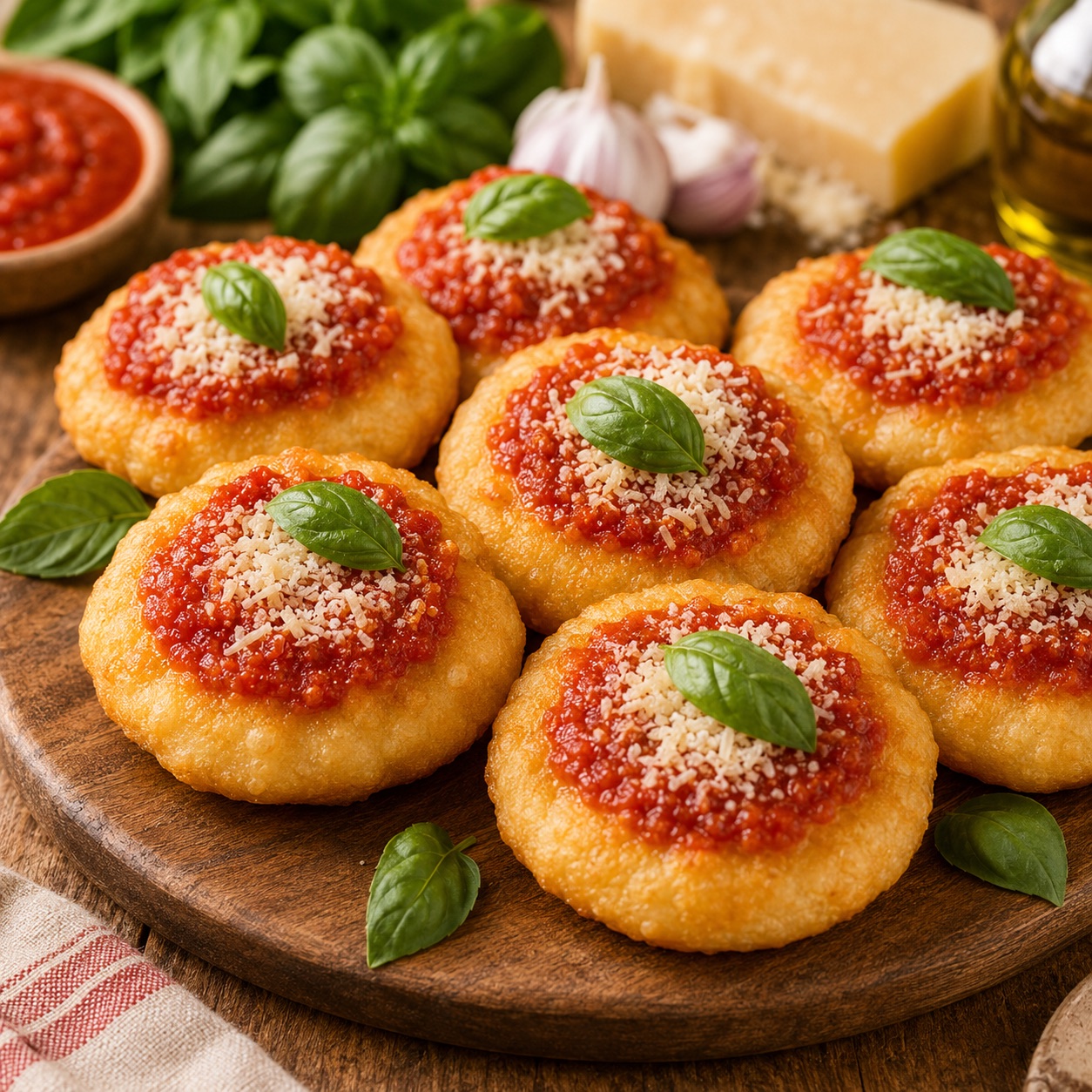
It is not exactly a meal. It is what you eat standing up, at the stove, passing time until the real thing starts. The dough is made in the morning — simple pizza dough, left to rise — and in the early afternoon, small balls are stretched by hand and dropped into hot oil. They puff immediately, turn golden in under two minutes, come out onto paper towels, and go directly from the paper to the hand to the mouth while they are still hot and the inside is still soft and almost airy. A spoonful of tomato sauce, a snow of grated Parmesan, a basil leaf. That is the classic. That is the best one.
They are also known as montanare — a word that refers, somewhat mysteriously, to the mountains, though this is entirely a coastal and urban Neapolitan tradition. The name is old; the practice is older. Fried pizza dough has been eaten in Naples since long before the baked pizza was standardized, and in some ways it is the more honest version: the dough, the oil, and whatever you put on top, with no oven required.
Later, making them with friends in a different country and a different decade, I discovered that the format works even better as a group activity than as a solo cooking project. Everyone stands around the stove. Someone fries. Everyone tops their own — which is where it becomes better than tacos, as I maintain. The Neapolitan logic of making a large batch of fried dough and letting people decide for themselves what goes on top is, it turns out, a universally appreciated party format. The only requirement is that someone stays at the stove and keeps frying, and that the oil temperature does not drop.
The dough is the same pizza dough used for the Margherita post on this blog — flour, water, yeast, salt, sugar, a little olive oil — made in the morning and left to rise for two hours. No special technique is required. What is required is that the oil be genuinely hot before the first pizzetta goes in, and that you fry in small batches so the temperature stays consistent. Everything else is simple.
Steam pressure, thermal shock, and how hot oil creates the pocket without a rolling pin
The puffing of the pizzetta in hot oil is a rapid steam explosion: water vapor trapped inside the dough expands dramatically when the dough hits oil at 170–180°C, inflating the internal structure before the outside sets. This produces the characteristic hollow, airy interior — structurally similar to a choux pastry but achieved through fermentation-derived CO₂ and steam rather than egg protein. The Maillard reaction between the surface amino acids and reducing sugars in the dough produces the golden color and the complex aromatic compounds (pyrazines, furans, aldehydes) that give fried dough its characteristic smell — one of the most appetite-stimulating aromas in the human olfactory repertoire. Vegetable oil for frying — with a smoke point typically above 200°C — maintains stable chemistry throughout the frying process, with minimal formation of polar compounds or oxidation products compared with oils held at excessive temperatures. The tomato sauce on top contributes lycopene, whose bioavailability is enhanced by the heat of the freshly fried dough and the fat remaining on the surface. Parmesan or Pecorino adds calcium, glutamate (the amino acid responsible for umami, which deepens the flavor perception of the tomato and the dough together), and concentrated protein. Fresh basil, added at the end over hot sauce, releases its aromatic volatile compounds — linalool and eugenol primarily — into the steam that rises from the surface, contributing to the overall sensory experience in a way that is disproportionate to the quantity used. The pizzetta fritta is not a health food, but it is not nutritionally empty either. It is fried bread with cooked tomato, aged cheese, and fresh herbs — which is, stripped of context, a reasonable combination of ingredients.
The recipe
For the dough · makes 12–15 pizzette
For the classic tomato topping
Method
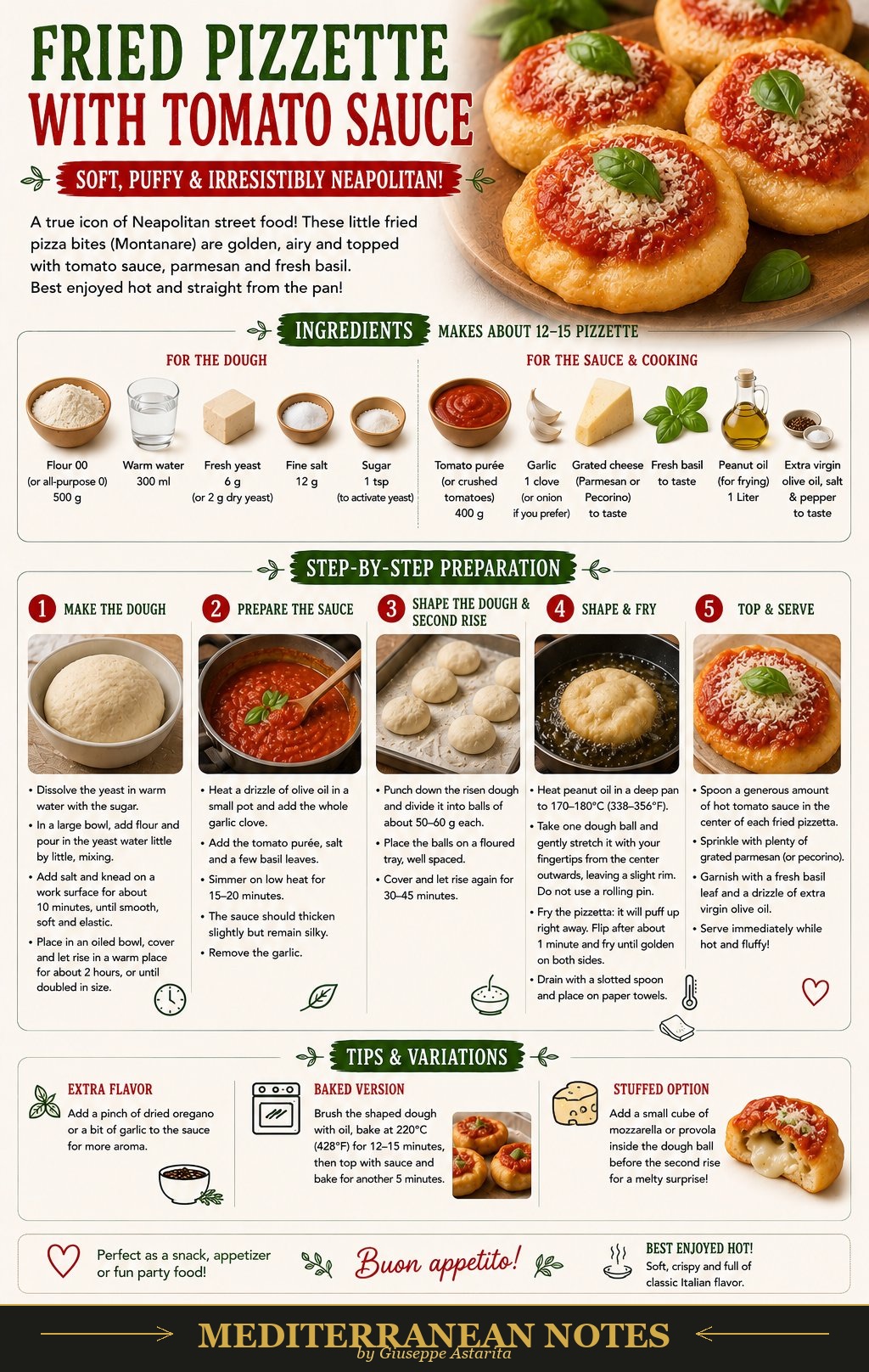
Make the dough. Dissolve the yeast and sugar in the warm water and let it sit for 5 minutes until slightly foamy. Pour the flour into a large bowl, add the yeast water gradually, mixing as you go. Add the salt and olive oil. Turn onto a work surface and knead for about 10 minutes until the dough is smooth, elastic, and slightly tacky but not sticky. Place in a lightly oiled bowl, cover with a cloth or plastic wrap, and leave to rise in a warm spot for about 2 hours — until doubled in size.
The same dough as the pizza Margherita. If you have already made pizza dough that day, use it for the pizzette too. One dough, two uses.
Make the tomato sauce. Heat a drizzle of olive oil in a small saucepan. Add the whole garlic clove and let it turn golden. Add the tomato purée, salt, a few basil leaves, and pepper. Simmer on low heat for 15–20 minutes until slightly thickened but still loose and bright. Remove the garlic. The sauce should be warm and ready when the pizzette come out of the oil.
Shape and second rise. Punch down the risen dough and divide it into balls of about 50–60 g each. Place them on a lightly floured tray, spaced well apart, cover, and let rise again for 30–45 minutes. This second rise is what gives the pizzette their characteristic puff when they hit the oil.
Shape and fry. Heat the vegetable oil in a deep pan to 170–180°C — test with a small piece of dough; it should sizzle and rise to the surface immediately. Take one dough ball and stretch it gently with your fingertips from the center outward, leaving a slightly thicker rim. Do not use a rolling pin. Lower carefully into the oil — it will puff up within seconds. Fry for about 1 minute per side until golden on both sides. Fry 2–3 at a time maximum; crowding drops the oil temperature and produces greasy, pale pizzette. Remove with a slotted spoon and drain on paper towels.
Maintain the oil temperature between batches. If it drops, wait for it to return before adding the next batch. Consistency of temperature is what produces the puff.
Top and serve immediately. Spoon a generous amount of hot tomato sauce onto each pizzetta. Sprinkle with grated Parmesan or Pecorino. Add a fresh basil leaf. A drizzle of extra-virgin olive oil over the top. Eat at once, while the dough is still soft and the cheese is melting into the sauce. Do not wait.
The party format — everyone tops their own
Set up the fried pizzette on a large board, plain, with no topping. Put bowls of toppings around it — tomato sauce, various cheeses, a few options for each person to choose from. Let people build their own. This is where the format becomes something social and genuinely fun: the equivalent of a taco bar, but with fried pizza dough, which is an unambiguous improvement.
The classic
Tomato sauce, grated Parmesan or Pecorino, fresh basil, drizzle of extra-virgin olive oil. The standard. The best. Nothing to improve.
Mozzarella + tomato
A slice of fresh mozzarella laid on the hot sauce — it melts slightly from the heat. Add basil on top. Richer and more substantial than the classic.
Provola filante
Smoked provola melted directly onto the pizzetta — add it before the sauce, while the dough is still very hot, so the cheese begins to melt. Then sauce on top.
Ricotta + basil
A spoonful of fresh ricotta instead of sauce. A drizzle of olive oil, a leaf of basil, a grind of pepper. The white version — light, delicate, good.
Aglio, olio e peperoncino
The simplest: just a drizzle of olive oil in which garlic and chili have been warmed, over the plain fried dough. Nothing else. The flavor of the dough alone, emphasized.
Stuffed before frying
Tuck a cube of mozzarella or provola inside the dough ball before the second rise. Seal well. When fried, the cheese inside is fully molten. Add sauce and Parmesan on top. The melty-center version.
Fried, baked, or air-fried
The pizzetta fritta belongs to Christmas Eve the way that certain smells belong to certain rooms — you encounter it and you are immediately somewhere else, at a specific age, in a specific kitchen. But it does not need Christmas to justify itself. It is good in July with friends around the stove and a glass of something cold nearby. It is good at any time someone has made pizza dough and realized that frying a portion of it is a better idea than waiting for the oven.
Make more than you think you need. This is the consistent instruction across every fried thing on this blog, and it is especially true here.
Buon appetito — e buona Vigilia.