Pasta e Patate
Every family makes it differently — and they are all right
A bowl of pasta with potatoes sounds like nothing — until you make it right. This is the dish that shows how different the same recipe can be from family to family.
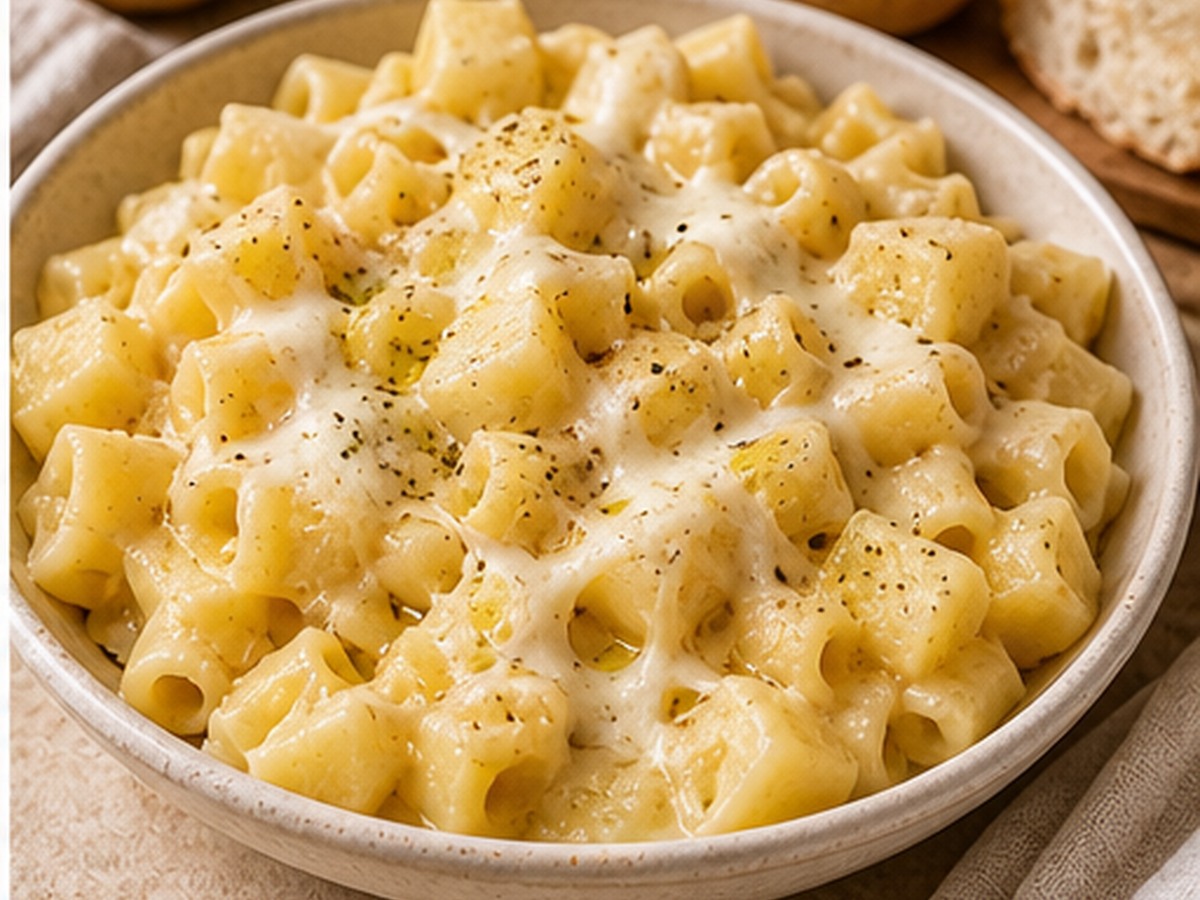
More than almost any other dish in this collection, pasta e patate shows how specific family food culture can be, from Caserta to Naples, from my mother's instinct to my father's family's tradition. My mother made it azzeccata — thick, starchy, the spoon leaving a slow trace through the pot. My father's family made it more brothy. At home we ended up eating mostly the brothy version, somewhere between the two. This is not an unusual story: when two families with two different kitchen traditions come together, the negotiations happen dish by dish, and sometimes you end up in the middle, and sometimes one version simply prevails. Beyond that one question — brothy or dense — the room for further variation is enormous.
My mother's version was more azzeccata — the starch allowed to thicken fully, the consistency moving toward dense, the spoon leaving a trace when you pulled it through. My father's family made it more brothy: still substantial, still clearly pasta e patate, but with more liquid, lighter, closer to a thick soup than a dense pasta. At home we ended up using my father's family's version mostly — my mother cooked it the brothy way for us, somewhere between the two extremes, with the azzeccatura present but not dominant. That specific consistency — the Neapolitan term is pippiare, a gentle slow bubble — was the target. Not defined precisely. Felt in the wrist, understood in the watching. Traditionally the dish was made and served in a pignatiello, the small terracotta pot that conducts heat gently and retains it after the flame is off; the pasta arrived at the table still slowly pippiando inside it.
This is what the post on ogni famiglia ha la sua ricetta — every family has its own recipe — describes in the abstract. Pasta e patate is the clearest example of it in concrete form. There is a base logic that everyone agrees on: potatoes, pasta, olive oil, some form of soffritto, some liquid, some cheese at the end. Beyond that, the room for legitimate variation is enormous.
The variations — every family, every season
The version we used at home · Father's family
Pasta e patate — più brodosa
More brothy than dense — the version that prevailed at home, from my father's family. Soffritto of onion, carrot, celery. Potatoes added and coated in the oil. A fresh tomato or two tablespoons of passata. Water, not broth. Pasta mista — the traditional mix of whatever short shapes are in the cupboard, broken pieces and all — cooked directly in the pot. Parmigiano off the heat — generously. The consistency moves lazily but pours; not stiff. Fresh basil in summer. A thread of raw olive oil to finish.
The classic Neapolitan · Baked version
Pasta e patate con provola al forno
Made as above but finished with generous cubes of provola affumicata — smoked provola — stirred through the hot pasta at the end, then transferred to a baking dish and passed under the grill until the cheese melts and browns in spots. The smoked provola changes the dish completely: richer, deeper, with that specific flavor of smoked cheese melted through potato starch. A different preparation from the same base.
Summer version · June to September
Con pomodoro fresco e basilico
When a fresh ripe tomato is available — and in summer in Campania, a good fresh tomato is always available — it goes in. Not passata, not canned: a real summer tomato, crushed by hand into the pot. Fresh basil added at the very end, torn, not cooked. The dish becomes lighter, more acidic, more perfumed. Less dense. A summer pasta e patate is almost a different dish from the winter one.
Winter version · October to March
Più azzeccata, più densa — my mother's way
My mother's version leaned here: the starch fully integrated, the consistency dense enough that the spoon leaves a trace. Less fresh tomato or none; passata in winter, or no tomato at all. No basil — not available, not right for the season. Heavier, more substantial, the kind of thing that heats a cold kitchen. The potato-to-pasta ratio may shift slightly toward more potato. The azzeccatura is not a flaw — it is the point.
The azzeccatura — the degree of stickiness, the thickening of the starch — is what divides families most sharply. Some like it almost pourable, others like it thick enough to hold the shape of the spoon when you serve it. Neither is wrong. The target is a consistency the Neapolitans describe as pippiare: a lazy, slow bubble, the pot barely moving. When it pippia, it is ready.
This dish belongs to the tradition of cucina povera — the poor kitchen — which is perhaps the most intellectually honest culinary tradition I know. You use what you have. You waste nothing. Broken pasta from different packages goes in together. The Parmigiano rind that would otherwise be thrown out becomes the depth of the broth. The starch from the potatoes does the work of thickening. The result rewards patience in a way that more elaborate cooking often does not, which is the particular dignity of dishes that were invented out of necessity: when you have nothing to hide behind, the technique has to be right.
My version now, made in Massachusetts, is close to my mother's — the same soffritto, the same pasta mista, the same proportion of azzeccatura, the Parmigiano rind in the pot. I add the fresh tomato in summer and skip it or use passata in winter, as the season requires. The daughters eat it. They have opinions about the correct consistency. This is how the tradition continues: not by following a written recipe but by developing a preference, then defending it.
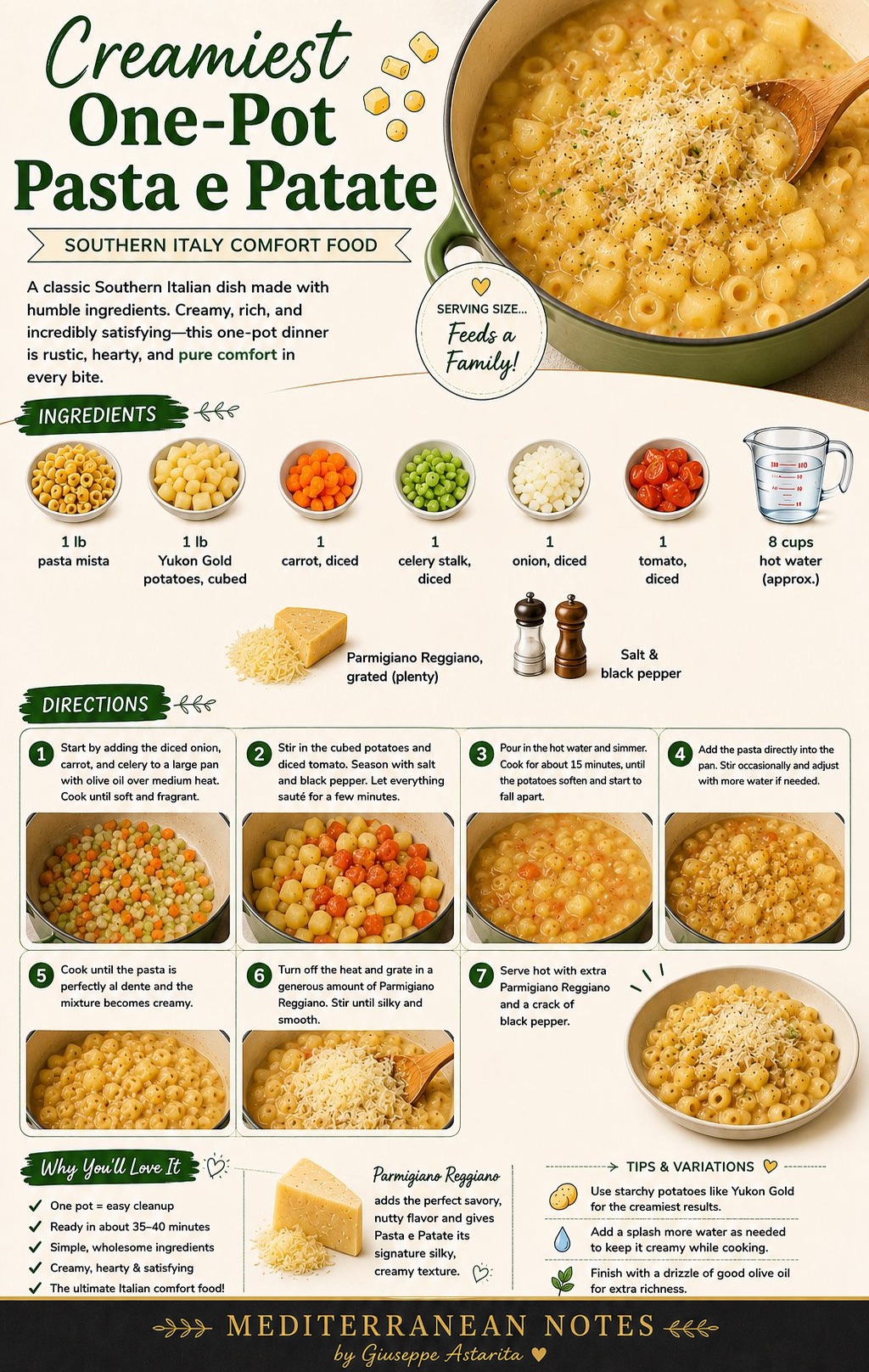
The recipe — base version, serves 3–4
This is the version I make most often — close to my mother's, adjusted for the American kitchen. From here, follow the variation that matches your season and your preference.
Ingredients
2 large, peeled and cubedStarchy potatoes — Yukon Gold or similar
200 g / 7 ozPasta mista, tubetti, ditalini, or broken spaghetti — any short shape works on its own, but pasta mista is the traditional Campanian choice: a mix of whatever different short shapes and broken pieces are left in the cupboard, all cooked together in the same pot. Not a compromise — the varied shapes absorb the starchy broth at slightly different rates, and the result is more interesting than a single shape.
1 medium, finely slicedYellow onion
1 stalk + ½ carrotCelery and carrot — optional but good
3 tbsp + more to finishExtra-virgin olive oil
1 fresh, or 2 tbsp passataTomato — fresh in summer, passata in winter
generous handful, freshly gratedParmigiano Reggiano
1 piece, rind onlyScorza di Parmigiano — the rind, added to the pot while cooking
a pinchDried peperoncino, to taste
in summer onlyFresh basil — a few leaves torn at the end
1
Warm the olive oil in a heavy-bottomed pot over medium heat. Add the onion — and the celery and carrot if using — and cook slowly until soft and translucent, 8–10 minutes. Don't rush this. The soffritto is the foundation of the flavor.
2
Add the potato cubes and stir to coat them in the oil. Add the tomato crushed by hand (or the passata), a pinch of peperoncino, and the Parmigiano rind if using — drop it in whole and let it soften and release its flavor into the liquid as the dish cooks. Add 4 cups of water, season with salt, and bring to a steady simmer. Cover and cook for 12–15 minutes until the potatoes are just fork-tender.
The Parmigiano rind — the scorza — softens slowly in the cooking liquid and releases a rich, concentrated umami that deepens the broth without any other addition. Fish it out before serving or leave it in the bowl as a reward for whoever finds it. It is one of those domestic details that turns a simple dish into something specific.
3
Add the pasta directly to the pot. Add just enough hot water to barely cover — you want density, not a soup. Cook uncovered, stirring frequently, until the pasta is al dente. The starch from the potatoes and pasta will thicken everything as it cooks — adjust consistency with small additions of hot water if needed.
The target consistency is what the Neapolitans call pippiare: a lazy, slow bubble, the mixture moving thickly when you tilt the pot. If it flows freely, it needs more time. If the spoon stands up on its own, add more water.
4
Pull the pot off the heat. Remove the Parmigiano rind. Stir in the grated Parmigiano generously — it melts into the starch and makes the consistency silky. Add a thread of your best raw olive oil. Let it sit covered for 2 minutes before serving. The pasta will absorb a little more liquid and the flavors will settle.
5
Serve in deep bowls. Black pepper, another drizzle of oil. If it is summer and you have fresh basil: a few torn leaves on top, added at the last moment. Not much. Just enough to perfume the surface.
For the provola version: stir cubes of smoked provola affumicata through the finished pasta off the heat, transfer to an oven-proof dish, and pass under the grill for 5–8 minutes until the cheese melts and colors. Serve directly from the baking dish. This is a complete transformation of the same base into a richer, baked, deeply flavored preparation.
![]()
Why pasta e patate gets creamy — starch gelatinization and the scorza di Parmigiano
The characteristic dense, creamy texture of pasta e patate — what makes it fundamentally different from pasta in a broth with potatoes — comes from starch gelatinization. Both the potato starch (amylose and amylopectin) and the pasta starch are released into the cooking liquid as they break down under heat. These starch polymers absorb water and swell, forming a colloidal gel that gives the dish its body without any cream or butter. The potato contributes additional pectin that further thickens the liquid; this is why starchier potato varieties (Yukon Gold, russet) produce a creamier result than waxy potatoes, which release less starch and maintain their shape more stubbornly.
The Parmigiano rind added during cooking contributes glutamates — the same compounds responsible for the umami flavor of aged cheese — which dissolve slowly into the liquid and deepen the flavor of the broth without any visible addition. The rind's protein structure does not fully melt but softens into a rich, gelatinous mass that can be eaten as a bonus for whoever finds it in the bowl. The final addition of grated Parmigiano off the heat is the mantecatura equivalent for this dish: the cheese proteins and fat emulsify into the hot starch gel, producing the silky, unified finish that distinguishes a properly made pasta e patate from a sloppy one.
Pasta e patate — ogni famiglia la fa a modo suo.
And that is as it should be.