Pasta e cavolfiore: the dish everyone loved and I watched them eat
It was not my favorite as a child. I was not particularly drawn to cauliflower, and the thick, unified texture of the finished dish — which is precisely its defining quality — was not what I would have chosen. But I was always struck by how much everyone else in the family loved it. Bowls scraped clean, seconds requested, a quiet satisfaction around the table that the dish produced reliably. I understand it better now.
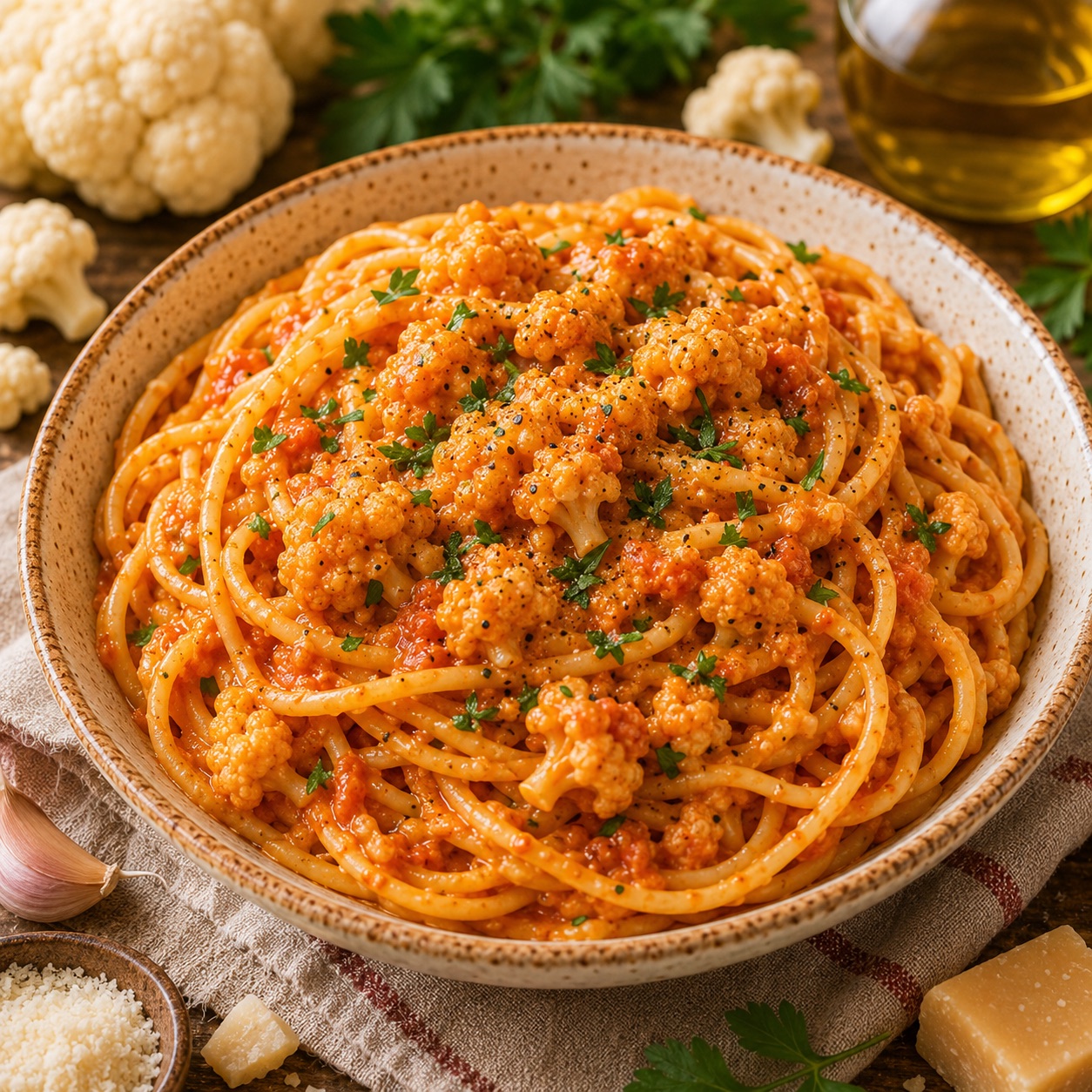
Pasta e cavolfiore alla napoletana is one of the canonical dishes of the Neapolitan cucina povera tradition — a first course built from a single humble vegetable, cooked slowly until it partially dissolves into the liquid, and then finished with pasta cooked directly in the same pot so that the starch from the pasta and the broken-down cauliflower combine into something thick and velvety and indivisible. The Neapolitan word for this texture is azzeccata — literally "stuck," referring to the thick, almost risotto-like consistency that is neither a soup nor a dry pasta but something specific to this family of Neapolitan vegetable-and-pasta preparations. Not soupy. Not dry. Dense, creamy, unified.
The version here uses long pasta — linguine, snapped by hand into shorter lengths straight into the pot. The traditional choice was pasta mista, the assorted short shapes Neapolitan households accumulated from the bottoms of multiple packages — a handful of ditalini, some broken spaghetti, a few rigatoni — because in a cucina povera tradition nothing was wasted. But broken linguine works beautifully too: the flat strands hold the starchy, broken-down cauliflower and finish creamy rather than soupy, and breaking them by hand gives the same uneven lengths that make each forkful a little different — some pieces more al dente, others softer — which is exactly the varied texture that makes the dish satisfying.
The Parmigiano or Pecorino rind — the same trick used in the minestrone — goes in with the cauliflower and releases its flavor slowly into the liquid over the long cooking time. A small amount of tomato purée gives color and a gentle acidity. Garlic, olive oil, chili if you want it. The cauliflower stews until completely tender, at which point it is partially mashed with a fork or wooden spoon to create the creamy base. The pasta then cooks directly in this — not separately, not drained and added — so that its starch becomes part of the whole. The result is stirred constantly, like a risotto, water added in small quantities as needed. It takes attention but not skill. You watch it thicken and you understand what you are making.
I make this now. I am not sure when my relationship with cauliflower changed — at some point between childhood and now the texture and flavor that I found unconvincing became something I appreciate precisely for those qualities. The azzeccata consistency that I did not choose as a child is, I understand now, the whole point. It is warm and dense and deeply flavored and it fills a bowl in a way that feels like it is doing something deliberate and good. My daughters are more receptive to cauliflower than I was, which is either a sign of good parenting or good luck, and probably both.
Cauliflower glucosinolates, isothiocyanates, and the Brassica evidence base
Cauliflower belongs to the Brassicaceae family alongside broccoli, kale, and cabbage, and shares their characteristic glucosinolate profile — sulfur-containing compounds that are converted by myrosinase to sulforaphane and other isothiocyanates with documented Nrf2-pathway induction activity. The slow stewing of the cauliflower in this recipe partially inactivates myrosinase (the enzyme responsible for glucosinolate conversion), but the gut microbiome continues the conversion in the large intestine. Cauliflower also provides vitamin C, folate, vitamin K, and choline — one of the richest plant sources of choline, a nutrient essential for cell membrane integrity, neurotransmitter synthesis, and hepatic fat metabolism that most people consume in insufficient quantities. The pasta cooked directly in the cauliflower liquid creates a starch-rich cooking medium that concentrates rather than discards the water-soluble B vitamins and potassium leached from the vegetable during cooking — which would be lost if the cauliflower were boiled separately and the water discarded. The Parmigiano rind releases glutamate into the cooking liquid, enhancing umami perception and allowing the dish to taste significantly more complex and savory than its ingredient list suggests. The final drizzle of raw extra-virgin olive oil provides oleic acid and phenolic antioxidants (hydroxytyrosol, oleuropein) and is the fat source that enables absorption of the fat-soluble carotenoids and vitamin K from the cauliflower. The azzeccata texture — thick, starchy, creamy — is the product of pasta starch gelatinizing in the cooking liquid rather than being rinsed away in pasta water; this is nutritionally equivalent to the risotto technique and produces a dish with more of the cooking nutrition retained per serving than pasta drained in the conventional way.
The recipe
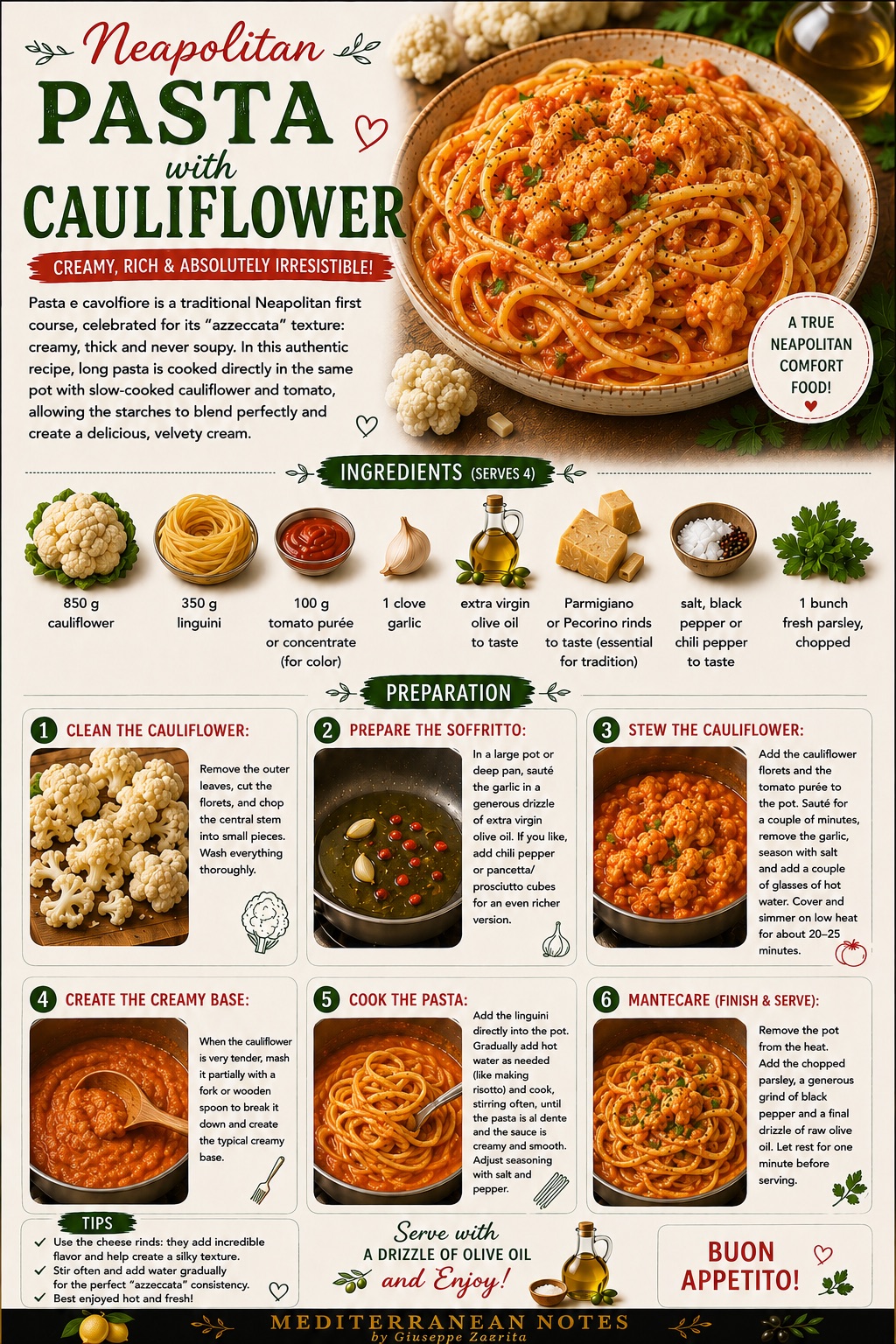
Ingredients · serves 4
Method
Build the soffritto. In a large, deep pot, heat a generous drizzle of olive oil over medium-low heat. Add the garlic clove and chili if using — sauté gently until the garlic is golden and fragrant. For a richer version, add a few cubes of pancetta or prosciutto at this stage. Add the tomato purée and stir for a minute.
Stew the cauliflower. Add the cauliflower florets and chopped stem to the pot. Add the cheese rind. Season with salt and add about 2 large glasses of hot water — enough to partially submerge the cauliflower. Stir, cover, and simmer over low heat for 20–25 minutes, until the cauliflower is completely tender and beginning to break apart at the edges. Check occasionally and add a splash of water if it dries out too much.
The cauliflower should be very soft — slightly overcooked by normal standards. This is the point; it will be partially mashed in the next step.
Create the creamy base. Remove the garlic clove. With a fork or wooden spoon, mash a portion of the cauliflower against the side of the pot — roughly half, leaving the rest in visible pieces. The mashed part dissolves into the liquid and creates the creamy base that will coat the pasta. The pot should now look thick and orange-tinged and fragrant.
Cook the pasta directly in the pot. Bring the cauliflower base to a gentle boil. Add the pasta directly — do not cook it separately. Stir frequently, almost constantly, like a risotto. Add small ladles of hot water as needed to keep the pasta moving and prevent sticking. Cook for the time indicated on the pasta package, or slightly less — the pasta will continue to absorb liquid after the heat is off. The finished dish should be thick and dense, not liquid.
The azzeccata consistency is achieved when the spoon leaves a visible trail through the pot that closes slowly. Too liquid: keep cooking uncovered. Too thick: add a splash of hot water. The line between the two is narrow and moves quickly.
Mantecare and serve. When the pasta is al dente and the consistency is right, turn off the heat. Add the chopped parsley, a grind of black pepper, and a generous drizzle of raw extra-virgin olive oil. Stir once. Let rest for one minute — this is the mantecatura, the final emulsification that brings the dish together. Serve immediately in deep bowls with grated Parmigiano or Pecorino and another thread of oil. This dish does not wait.
Pasta e cavolfiore is best eaten immediately, hot, directly from the pot into the bowl. Unlike the summer cold dishes in this collection, it does not improve with time — the pasta continues to absorb the liquid and the dish thickens past the point of azzeccata into something heavier. If you have leftovers, reheat with water and serve again, which is acceptable, but the first bowl straight from the stove is the definitive version.
I did not choose this dish as a child. I watched my family eat it with a specific and repeated enthusiasm that I noted with some curiosity. Now I make it and I understand — the texture that seemed uninviting then is the whole point, and the flavor that develops from cauliflower cooked this way, in olive oil and tomato and cheese rind until it becomes the base of something rather than a separate ingredient, is not the flavor of plain cauliflower at all. It is the argument for the dish. Served, not just observed.
Buon appetito.