Risotto ai fiori di zucchina: the refined first course
The blossom is used twice in the same risotto. The bases and the thinly sliced stems go into the soffritto at the beginning, building the flavor into the foundation. The petals — the fragile orange-yellow part — are reserved and added only in the last two minutes, when the heat of the risotto is enough to wilt them gently without destroying their color or their texture. Two moments, two uses of the same flower. The risotto tastes of it completely.
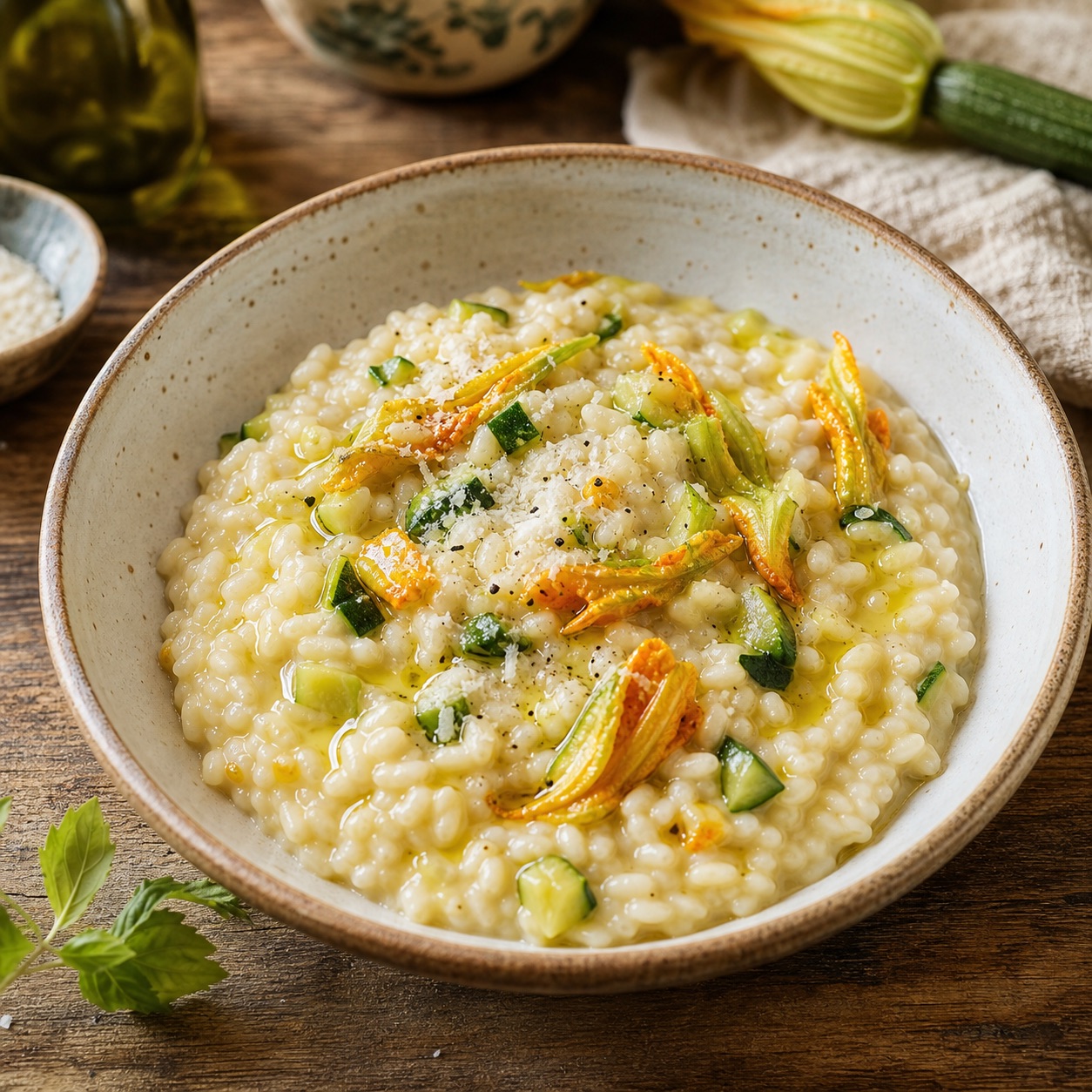
Risotto is not a Neapolitan preparation in its origins — it belongs to the north, to Lombardy and Piedmont and the Po Valley, where the short-grain rice varieties that make the characteristic creamy texture are grown. But Naples has always absorbed what comes from elsewhere and made it its own, and the risotto ai fiori di zucchina is genuinely Neapolitan in character even if not in genealogy: the blossom, the vegetable stock built on southern vegetables, the finishing with Parmigiano and butter that respects the northern technique while working with an ingredient that belongs entirely to the Campanian summer. It is a dish for Sunday lunch when the flowers are at their best and the appetite is for something both elegant and seasonal.
The technique is classical risotto technique with one significant addition: the decision about when to add the flower. Adding all of it at the beginning — as you would with a harder vegetable — produces a risotto where the blossom has dissolved into the rice and given its flavor but left nothing visible. This is not wrong but it is not the best use of the flower. Adding all of it at the end preserves the appearance but sacrifices the depth of flavor that comes from the bases cooking into the soffritto from the start. The solution that works best is the split: bases early, petals late. The flavor is in the rice from the beginning. The color and the texture of the petals remain at the end.
Risotto creaminess from starch, not cream — amylopectin and the Carnaroli effect
The creaminess of a properly made risotto is the result of starch gelatinization and amylose solubilization, not the addition of cream. Carnaroli and Arborio rice contain high concentrations of amylopectin — the branched form of starch — in their outer layers, and moderate concentrations of amylose — the linear form — in their inner core. During risotto cooking, the continuous stirring and gradual stock addition causes progressive gelatinization of the surface starch granules: water penetrates the granule, the starch chains swell and partially dissolve into the surrounding liquid, and the released amylopectin creates a viscous, gel-like aqueous phase that surrounds each grain. This is the "cream" of the risotto — pure starch in solution, with no dairy until the mantecatura. Toasting the rice before adding liquid (step 3) is essential: the brief high heat closes the surface of the grain and prevents premature starch dissolution, maintaining grain integrity through the long cooking while still allowing controlled starch release during stirring. The cold butter added during mantecatura undergoes rapid partial emulsification with the hot starchy liquid: the lecithins in the butter act as emulsifiers, and the vigorous motion breaks the butter fat into fine droplets that remain suspended in the starchy phase, creating the characteristic silky, flowing texture. Adding warm or melted butter produces a broken emulsion rather than a suspension. The two-stage flower addition exploits the different heat tolerance of the blossom's structural components: the base and stem, which contain more cellulose and chlorophyll, can sustain 15–20 minutes of cooking without significant color loss. The petals, which are almost entirely water and carotenoid pigment with minimal structural protein or fiber, degrade rapidly above 80°C — two minutes in the residual heat of the risotto (which has dropped below that threshold after the heat is turned off) preserves their color and texture while allowing the carotenoids to dissolve partially into the butter fat during mantecatura, increasing their bioavailability.
The recipe — risotto ai fiori di zucchina
Ingredients · serves 4
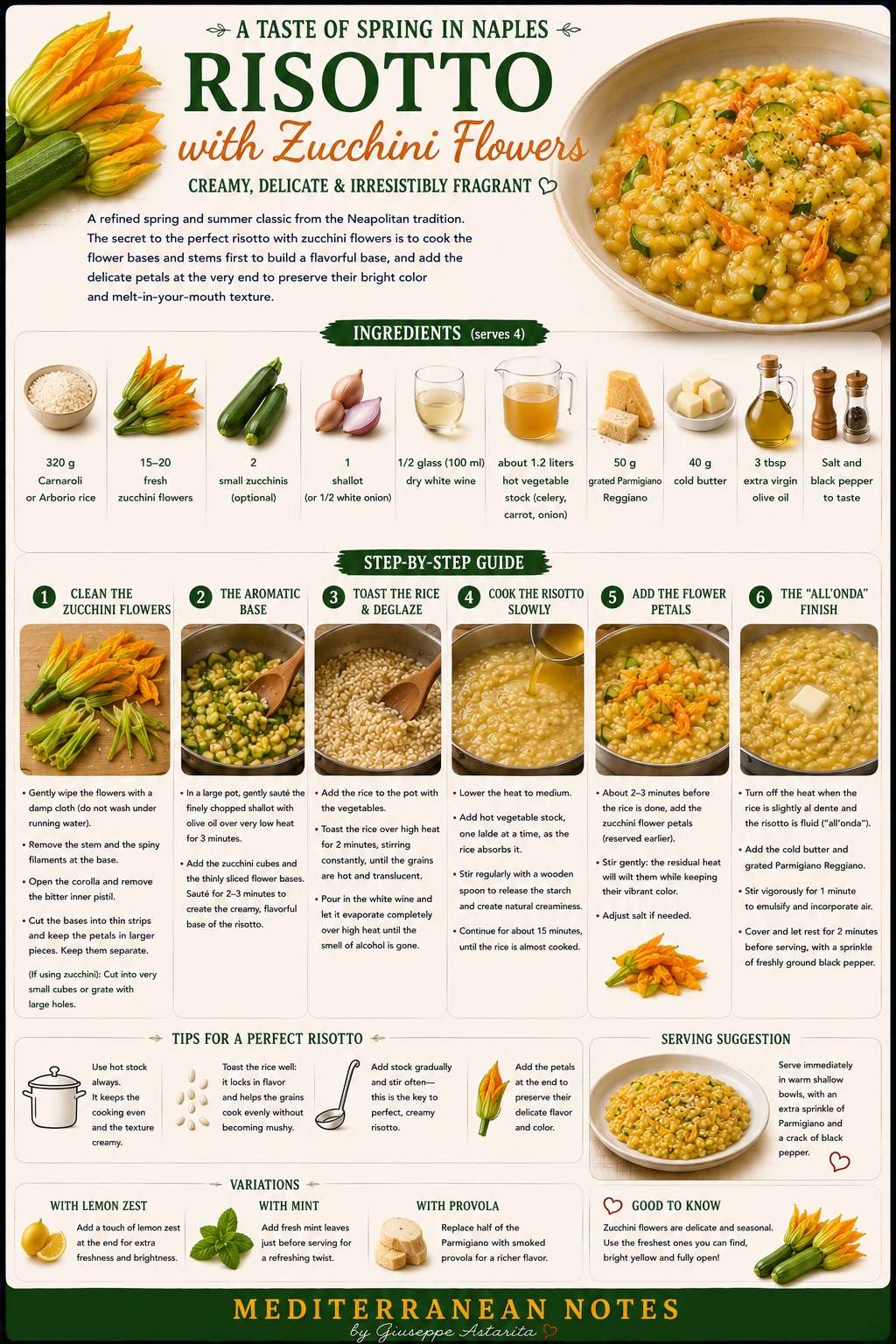
Method
Prepare the blossoms — two stages. Open each flower gently, remove the bitter pistil, and wipe clean with a damp cloth. Separate the petals from the bases and stems. Slice the bases and stems into thin strips — these go into the soffritto. Keep the petals whole and set them aside in a separate bowl — these go in at the very end.
Build the aromatic base — soffritto. In a large, wide, heavy pot, gently sauté the finely chopped shallot in olive oil over the lowest possible heat for 3 minutes until soft and translucent but not colored. Add the zucchini (if using) in very small cubes and the thinly sliced blossom bases and stems. Sauté gently for 2–3 minutes until softened. This is the flavor foundation of the risotto — it should smell fragrant and sweet, not browned.
Toast the rice and deglaze. Add the rice to the pot and increase the heat to high. Stir constantly for 2 minutes — the rice grains should become hot throughout and slightly translucent at the edges. Pour in the white wine in one addition. Stir and let it evaporate completely, until no alcohol smell remains. This step takes 1–2 minutes over high heat. The toasting seals the grain surface; the wine adds acidity and complexity.
The wine must evaporate completely before stock is added. Residual alcohol makes the risotto bitter. The smell test is reliable — when the sharp wine smell is gone, the alcohol has gone with it.
Cook the risotto — 15 minutes of attention. Reduce the heat to medium. Begin adding the hot stock one ladle at a time, stirring constantly and waiting for each addition to be almost fully absorbed before adding the next. The stirring is not decoration — it is the mechanism that releases the starch from the grain surface into the cooking liquid and creates the creaminess. Continue for approximately 15 minutes until the rice is almost cooked — tender throughout but with the faintest resistance at the very center. Adjust salt.
The stock must be hot throughout. Adding cold stock stops the cooking and damages the starch release. Keep the stock simmering in a separate pot on the next burner.
Add the flower petals. About 2 minutes before the rice is done, add the reserved whole petals to the risotto. Stir gently once. The residual heat — still well above 70°C — will wilt them and soften them while preserving their color. They are fragile; do not stir aggressively or they will shred.
The mantecatura — all'onda. Turn off the heat when the rice is slightly al dente and the risotto is still visibly fluid. Add the cold butter cubes and the grated Parmigiano immediately. Stir vigorously for one minute, then move the pot back and forth with a rapid, decisive wave motion to emulsify the butter and cheese into the starchy liquid. The risotto should flow in a slow wave when the pot is tilted — this is the all'onda consistency. Cover and rest for 2 minutes. Serve immediately in warm shallow bowls with a crack of black pepper.
Warm bowls are not optional. A cold bowl drops the risotto temperature in seconds and the texture changes. Rinse the bowls with hot water and dry them just before plating.
The risotto ai fiori di zucchina is the preparation that asks the most of the cook and gives the most back. The frittata is forgiving — it can be left to cook under the lid and attended to occasionally. The sciurilli require attention at the oil stage but are otherwise straightforward. The risotto requires sustained presence for twenty minutes: the stirring cannot be delegated, the stock additions cannot be rushed, the mantecatura cannot be skimped. In exchange it produces the most refined result — a plate that tastes entirely of the blossom, with a creaminess and a flow that no other preparation achieves. Eat it immediately. It does not improve with waiting, and it does not reheat well. This is the one dish in this series that must be eaten the moment it is made.
Buon appetito — e buona mantecatura.