Crocchè di patate: Naples street food, my mother's kitchen
My mother made crocchè at home, and I ate them alongside a simple lattuga salad dressed with olive oil and lemon. Fried was the treat. The oven version was the everyday. Both were good — one was just more of an occasion.
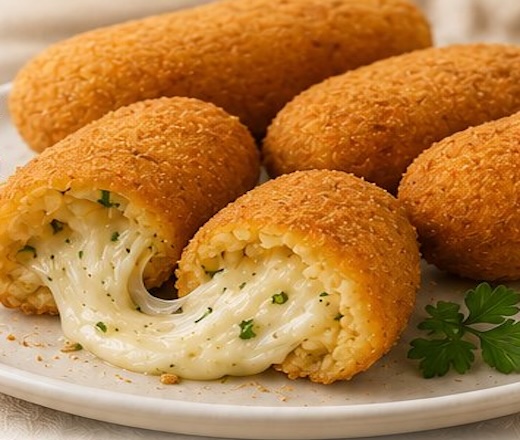
In Naples, the crocchè — also called panzarotti depending on the neighborhood and who you ask — is street food. You buy it from a friggitoria, wrapped in paper, eaten standing up, burning your fingers because you could not wait. It is a Neapolitan institution on the same level as pizza fritta and cuoppo: something the city has been making and eating in public, without apology, for a very long time.
My mother made them at home. This was not unusual — most Neapolitan families do, the way families everywhere reproduce the street foods of their city in their own kitchen, adjusting slightly, making it their own. Hers were made with starchy old potatoes, mashed while still hot, mixed with egg yolks, grated Pecorino, chopped parsley, salt, pepper, and nutmeg. The classic version has a heart of smoked provola — a piece of it tucked into the center before the crocchè is sealed and shaped — which melts during frying into a thread of cheese that pulls when you break it open. This is the thing people photograph now. It was just how they were always made.
Because they were fried, they were not an everyday thing. Frying takes time, takes oil, takes attention. My mother treated the fried crocchè as what it was — a bit of a special occasion, something that appeared on a Friday or when there was a reason. The rest of the time she made the oven version: the same mixture, shaped and breaded and baked until golden, no filling inside. Simpler, lighter, easier to make on a weeknight. I ate both happily, but I always knew which one I was getting.
The salad was always the same: a head of lattuga, the loose-leaf kind, dressed simply with extra-virgin olive oil and lemon juice, a pinch of salt. Nothing else. This combination — the fried richness of the crocchè against the cold, sharp salad — is not written in any cookbook. It was just what my mother served alongside them. It worked then and it still works now, and I have not found a reason to change it.
Potatoes, resistant starch, and the nutrients hiding in the plain vegetable
Potatoes are among the most nutritionally underappreciated foods in the Italian diet. A medium starchy potato contains significant amounts of potassium (more per serving than a banana), vitamin B6, vitamin C, and resistant starch — a type of dietary fiber that resists digestion in the small intestine, reaches the colon intact, and serves as a prebiotic substrate for beneficial gut bacteria. Resistant starch content is highest in potatoes that are cooked and then cooled before eating, which is why the mashed-potato mixture for crocchè, cooled completely before shaping, may be more beneficial than freshly made mash. The egg yolks contribute choline, the fat-soluble vitamins A, D, E, and K, and additional protein. Pecorino Romano provides calcium and a concentrated source of conjugated linoleic acid (CLA), a naturally occurring trans fatty acid found in ruminant dairy with documented anti-inflammatory and anti-carcinogenic properties in animal and epidemiological studies. The smoked provola filling adds casein protein and additional fat-soluble nutrients. The accompanying lettuce salad dressed in extra-virgin olive oil and lemon delivers additional vitamin C (from the lemon, which also improves iron absorption from the meal) and the polyphenols and monounsaturated fats of the olive oil. As a complete plate, the crocchè with salad is considerably better balanced than its street-food origins might suggest.
The recipe
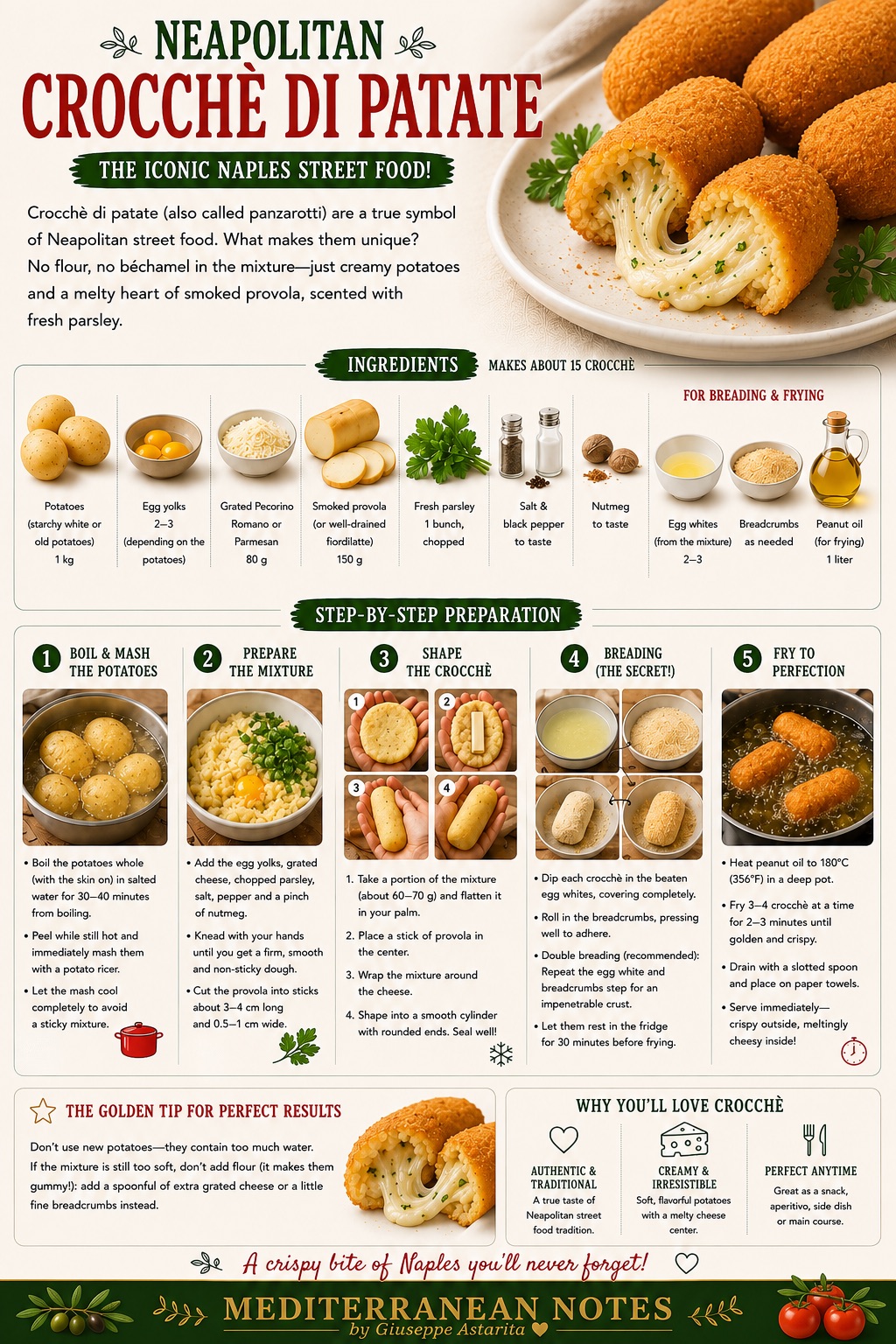
Ingredients · makes about 15 crocchè
Method
Boil and mash the potatoes. Cook the potatoes whole, skin on, in well-salted boiling water for 30–40 minutes until completely tender. Peel them while still hot — the skin slips off easily when hot, becomes adhesive when cold — and pass them immediately through a potato ricer or food mill directly into a large bowl. Do not use a food processor; it makes the starch gluey. Spread the mash out and let it cool completely before adding anything else.
Old, starchy potatoes are essential. New potatoes contain too much water and make the mixture too soft to shape. If the mash is still too loose after cooling, add a little extra grated cheese or a spoonful of breadcrumbs — never flour, which makes them gummy.
Make the mixture. Add the egg yolks, grated cheese, chopped parsley, salt, pepper, and a good grating of nutmeg to the cooled mash. Work everything together with your hands until you have a smooth, firm, non-sticky dough. Taste it — the seasoning should be assertive, since the breading will mute it slightly.
Shape the crocchè. Take a portion of the mixture — about 60–70 g — and flatten it in your palm. Place a stick of provola in the center. Wrap the potato mixture around the cheese and seal the edges completely, rolling the crocchè into a smooth cylinder with rounded ends. The seal must be tight; any gap and the cheese escapes into the oil during frying. Repeat until the mixture is used up. Refrigerate the shaped crocchè for at least 30 minutes — this firms them up considerably and makes breading much easier.
For the plain version (no filling): simply shape into cylinders without adding cheese inside. This is the everyday version — simpler, lighter, still completely satisfying.
Bread them. Lightly beat the egg whites in a shallow bowl. Spread breadcrumbs in a separate plate. Dip each cold crocchè in egg white, covering it completely, then roll in breadcrumbs, pressing firmly so they adhere. For the strongest crust — and this is the detail that matters — double bread: dip again in egg white and again in breadcrumbs. This second coat is what keeps the crocchè intact during frying and produces the shatter you are looking for when you bite in.
Fry or bake. See the two versions below. Either way: drain on paper towels, salt lightly while hot, and serve immediately. Crocchè do not wait well.
Two versions: the treat and the everyday
The treat
Fried — the classic
Heat a generous depth of olive oil in a heavy pan to around 175–180°C. Fry 3–4 crocchè at a time, without crowding, for 2–3 minutes until deeply golden and crispy on all sides. Remove with a slotted spoon and drain immediately on paper towels. The provola filling will be fully melted and stringy. Eat within minutes.
The everyday
Baked — my mother's lighter version
Brush the breaded crocchè with a little olive oil and arrange on a baking sheet. Bake at 200°C (400°F) for 20–25 minutes, turning once halfway through, until golden and crisp. No filling required — the plain potato version works especially well here. Lighter, easier, and still very good with the lattuga salad alongside.
The salad that goes with them
This is not a complicated instruction. Take a head of loose-leaf lettuce — lattuga, the soft kind, not romaine, not iceberg. Wash it well and dry it. Dress with extra-virgin olive oil, fresh lemon juice, and a pinch of salt. Nothing else. Serve cold, alongside the hot crocchè. The contrast is the point: crispy and rich against cool and sharp. It cleans the palate between bites and makes the whole plate feel more balanced than it has any right to be.
This pairing is not in any cookbook. It was just what my mother served, and what I grew up eating. I pass it along in that spirit — not as a rule, but as a suggestion from experience.
Buon appetito.