Fave e pecorino: the spring snack I discovered late — and now cannot imagine May without
Every spring in Italy, fresh fava beans appear in the markets for a few weeks. I came to this pleasure later in life — sitting somewhere in May, opening pods by hand, peeling each bean, eating it with a chip of Pecorino Romano. No cooking, no preparation beyond the peeling. The combination is one of the most purely seasonal things in the Italian table.
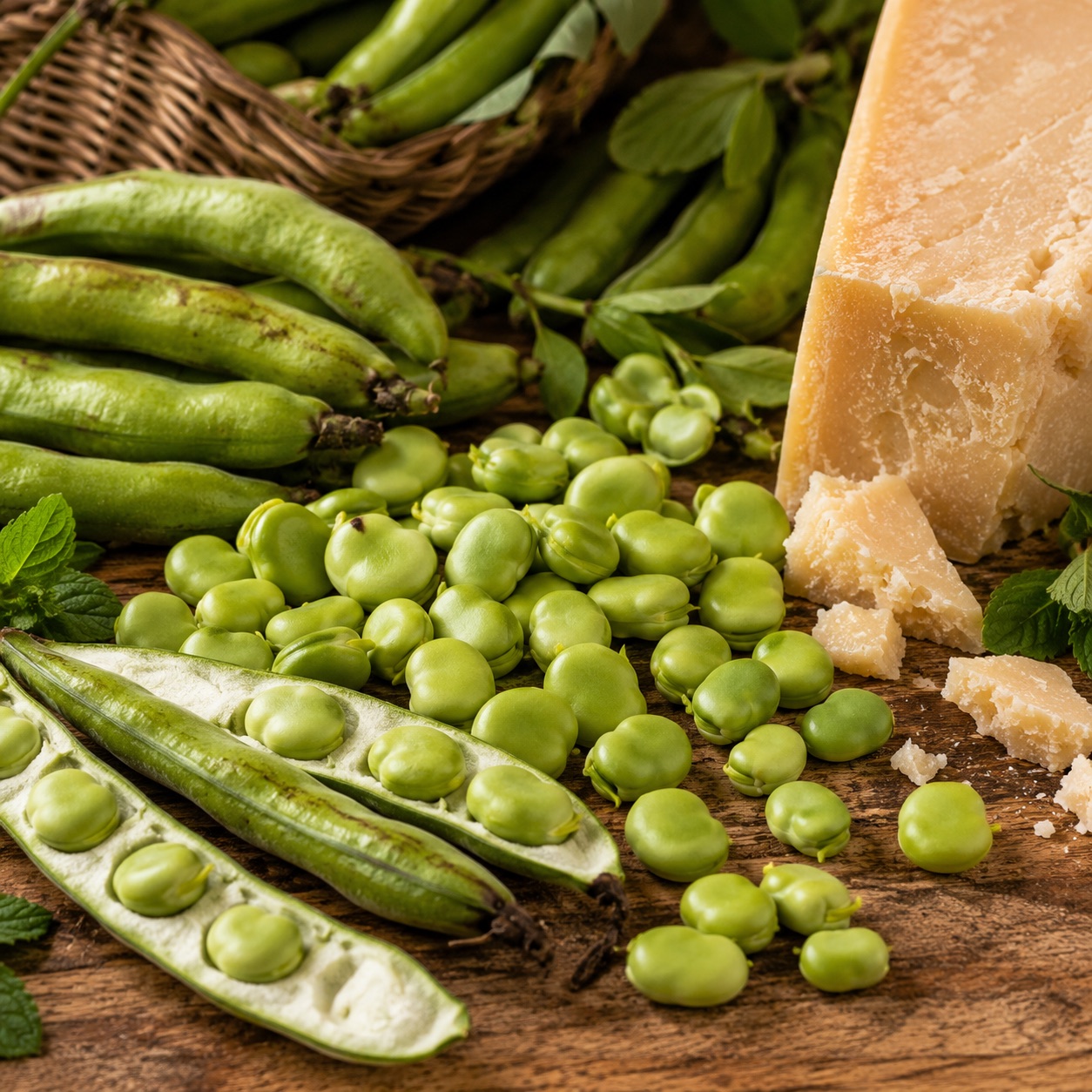
There are foods that require no cooking and almost no recipe, and that are nevertheless completely specific to a season, a place, and a moment. Fresh fava beans with Pecorino is the most extreme example I know: two ingredients, no heat, no technique, nothing but the act of opening a pod with your thumbs and eating what is inside with a piece of cheese. And yet it is specific to May in Italy in a way that makes it unavailable — not just hard to find, genuinely different — at any other time of year or in any other context. The freshness of a just-picked fava bean, still sweet and slightly grassy and tender enough to eat raw without the inner skin, is not reproducible by any other preparation or preservation method. You eat it in its window or you do not eat it.
The combination is traditional across central and southern Italy — in Campania, in Lazio where it is called vignarola in a more elaborate form, in Calabria and Sicily where fava beans are grown and eaten in quantity. It appears at picnics, at aperitivo tables in spring, at farm tables where the pods come from the garden. It is eaten standing up, sitting on grass, in gardens. The unshelled pods are brought to the table and everyone opens their own — the peeling is part of the experience, the slowness of it deliberately built into the eating. You cannot rush fava beans and Pecorino. The pod opening is the pace at which the meal happens.
In the United States, fresh fava beans in the pod are genuinely difficult to find — farmers' markets in May occasionally carry them, Italian specialty grocers sometimes have them, some Middle Eastern and Latin American markets stock them (fava beans are important in many food cultures, not only Italian). When you find them, buy more than you think you need: one kilogram of pods yields roughly 250–300 grams of shelled beans, and the shelled weight shrinks further if you peel the inner skin. The yield per pod is lower than you expect the first time, but the pods themselves are part of the experience — the satisfying press of the thumb along the seam, the line of beans inside like green pearls in a velvet lining. The waste is part of the occasion.
The question of whether to peel the inner skin depends on the bean's age. Very young, very small fava beans — the earliest of the season, picked before the pod has fully matured — have a thin, tender inner skin that is pleasant to eat raw, slightly sweet, no bitterness. As the beans mature and enlarge, the inner skin thickens and becomes starchy and slightly bitter; at this point it is worth peeling. The method is simple: make a small nick at the top of the bean with your fingernail and squeeze — the bright green inner bean pops out cleanly. The color difference is immediate: the peeled bean is a vivid, saturated green, much brighter than the skin that enclosed it.
Fava beans: complete protein, L-DOPA, and the case for spring legumes
Fresh fava beans are nutritionally one of the most complete plant foods available in the Italian spring kitchen. They provide complete protein at meaningful concentrations — approximately 7–8 g per 100 g of shelled weight (raw) — with an amino acid profile that is particularly rich in lysine (the limiting amino acid in most grain-based diets) and methionine. They are one of the best plant sources of L-DOPA (levodopa), a precursor to the neurotransmitters dopamine and norepinephrine — a pharmacologically relevant compound found at concentrations of approximately 50–100 mg per 100 g of fresh beans. L-DOPA from fava beans has been studied in the context of Parkinson's disease management, where it produces measurable motor improvements. For the general population eating occasional servings, the L-DOPA contribution is subtherapeutic but metabolically relevant as a dopamine precursor. Fava beans are also a significant source of folate (approximately 150–180 μg per 100 g raw — 35–45% of the adult daily requirement), iron (approximately 1.5–2 mg per 100 g), magnesium, phosphorus, zinc, and B vitamins including thiamine and riboflavin. The outer skin of the bean contains vicine and convicine — glycosides that are cleaved in the gut to produce compounds that can cause hemolytic anemia in individuals with G6PD deficiency (a genetic condition affecting approximately 400 million people worldwide, more prevalent in Mediterranean, African, and Middle Eastern populations, where the condition is called favism after the bean). In individuals without G6PD deficiency, these compounds are metabolized normally without adverse effects. The inner peeled bean has substantially lower concentrations of vicine and convicine than the outer skin — one reason why peeling the inner skin is recommended for older, larger beans. The Pecorino Romano eaten alongside contributes calcium at very high concentration, glutamate (which amplifies the natural umami of the fresh beans), conjugated linoleic acid, and fat-soluble vitamins. The olive oil drizzled over contributes oleic acid and phenolic antioxidants that enhance absorption of the fat-soluble carotenoids in the beans. Eating raw fava beans in season, with Pecorino and olive oil, is nutritionally one of the best things you can eat in May.
The two preparations
Version one — raw, as a snack or antipasto · serves 4
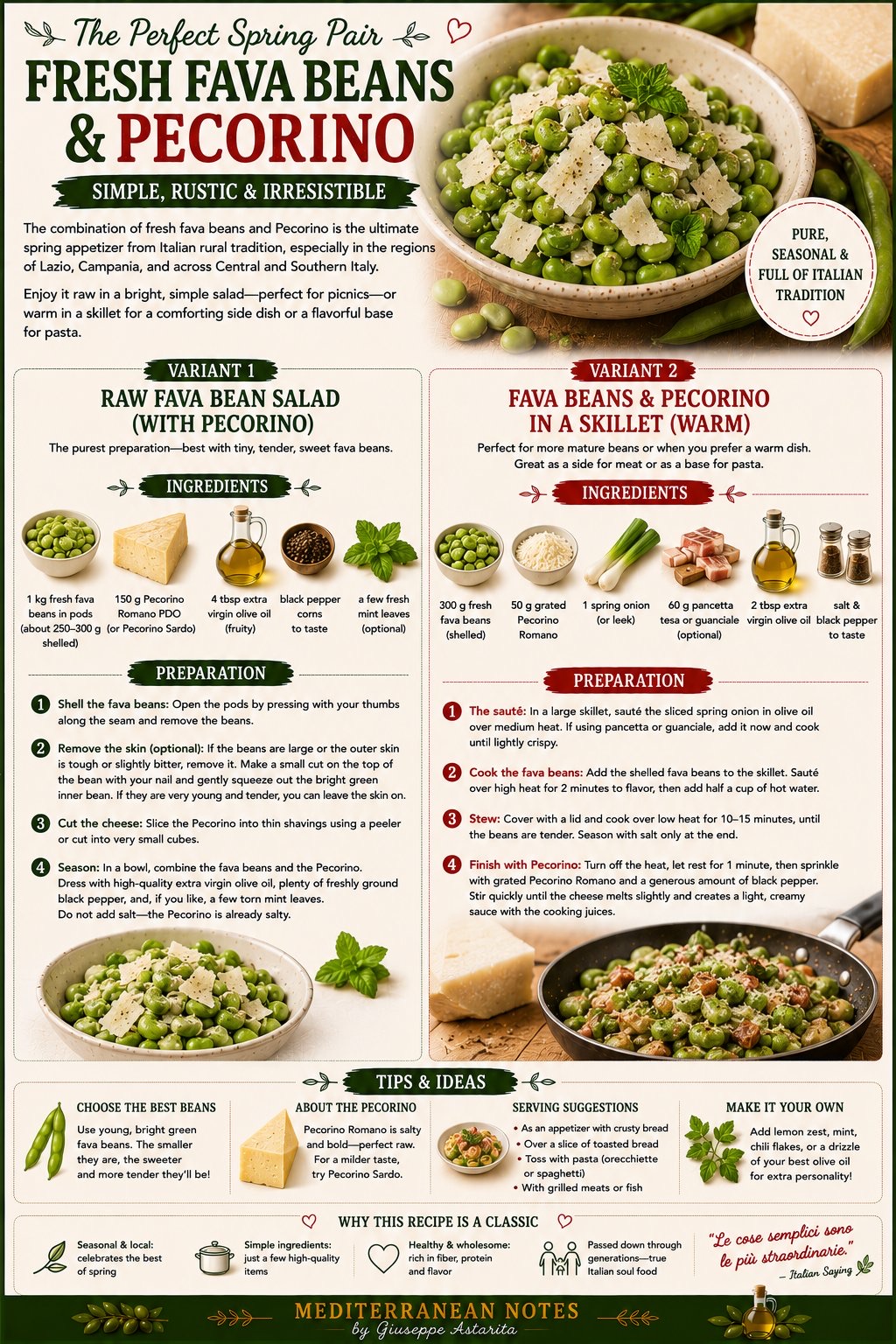
Method — the raw version
Shell the pods. Press your thumb along the seam of each pod and open it — the beans sit in a line inside, each cushioned in a pale inner lining. Remove the beans. This is the whole first step and it is also, for very fresh pods, pleasurable in itself.
Decide about the inner skin. If the beans are very small and young — the early season ones, still sweet and tender — leave the inner skin on. If the beans are larger or show any bitterness, peel them: make a small nick at the top with your fingernail and squeeze the bright green inner bean out. The peeled bean is a vivid green and notably sweeter.
Do not add salt — the Pecorino is already quite salty and the combination does not need more. This is one of the few dishes where the cheese's saltiness is the seasoning.
Assemble and eat. Place the shelled beans in a bowl or on a plate. Lay shavings or small cubes of Pecorino Romano alongside or scattered over. Drizzle with good olive oil, grind black pepper generously, and add a few torn mint leaves if using. Eat immediately — with bread, with wine, in the garden, in May. This is a dish that has a setting and a season, and both are part of it.
Version two — warm, in a skillet · serves 4
Warm version method. Sauté the spring onion in olive oil until soft. Add the pancetta if using and cook until lightly crispy. Add the shelled fava beans and sauté over high heat for 2 minutes. Add half a cup of hot water, cover, and stew over low heat for 10–15 minutes until tender. Turn off the heat, rest for 1 minute, then sprinkle with grated Pecorino and black pepper. Stir until the cheese melts into a light creamy sauce with the cooking juices. Good as a side dish, as a pasta sauce, or on toasted bread.
Fresh fava beans are completely underappreciated in the United States — not absent, but not understood as the seasonal event they are in Italy. When May arrives in Italy, the fava bean is everywhere for a few weeks: in the markets, in the gardens, on the table at outdoor lunches, in paper bags brought to picnics. Then they are gone until next year. The window is part of the pleasure — the knowledge that this will not be available in June makes it more present in May. This is the logic of eating seasonally: the limitation is the flavor.
If you find fresh fava beans in a farmers' market or an Italian grocery in May, buy them. Bring them to a table outdoors with a piece of Pecorino Romano and some good olive oil. Open the pods by hand while talking to someone. This is the whole recipe, and it needs nothing added.
Buon appetito — e benvenuta primavera.