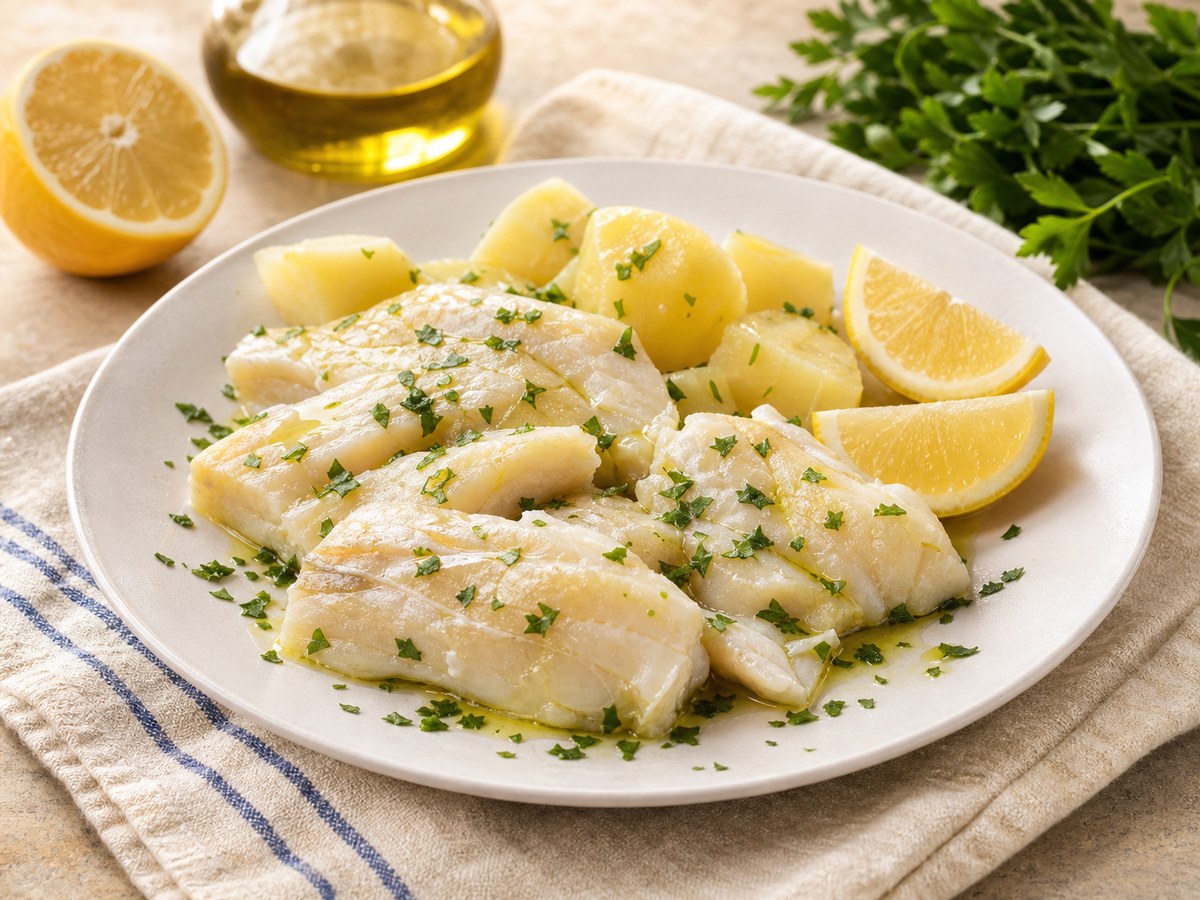
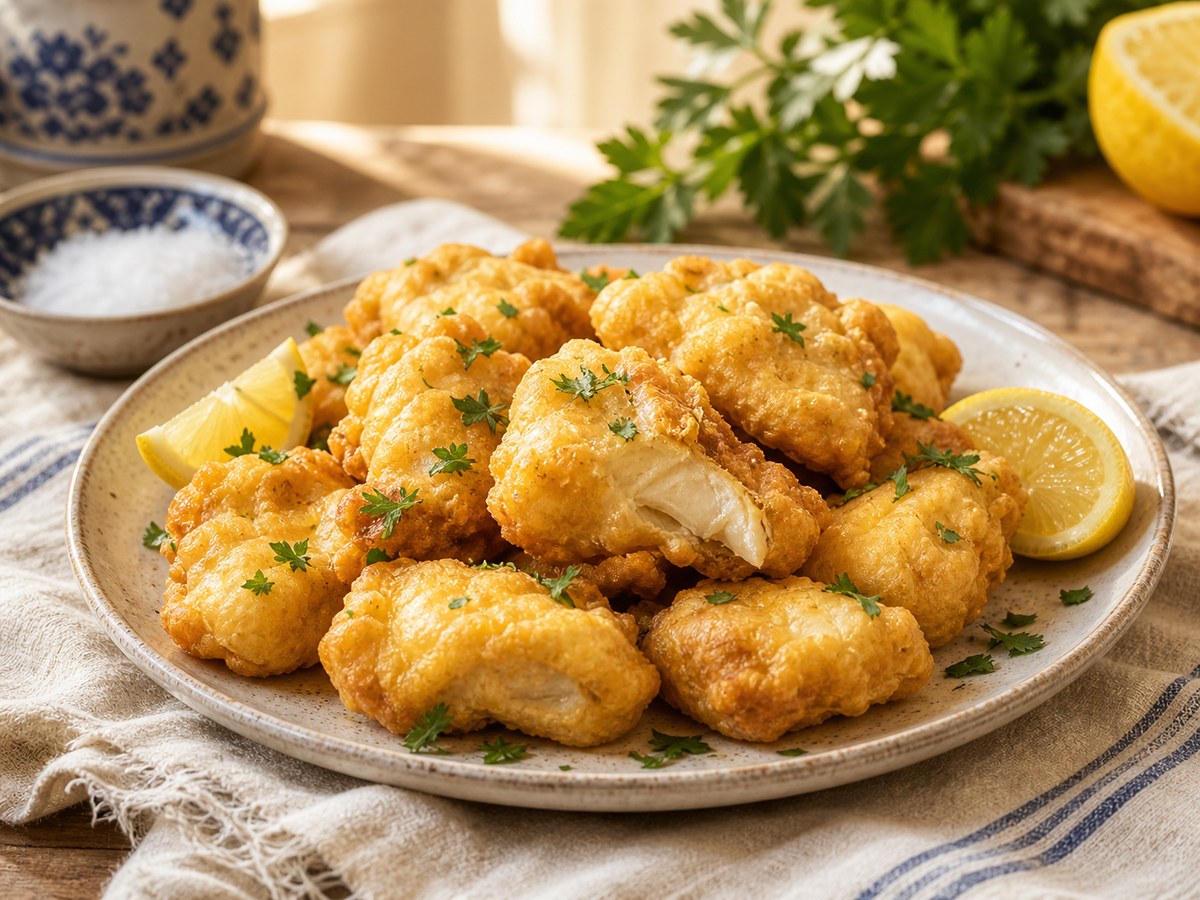
Baccalà alla napoletana
The more elaborate of the three preparations: the fish floured and fried until golden, then simmered briefly in a tomato sauce built with Gaeta olives and capers. Two textures in every bite. Better the next day, when everything has had time to integrate.
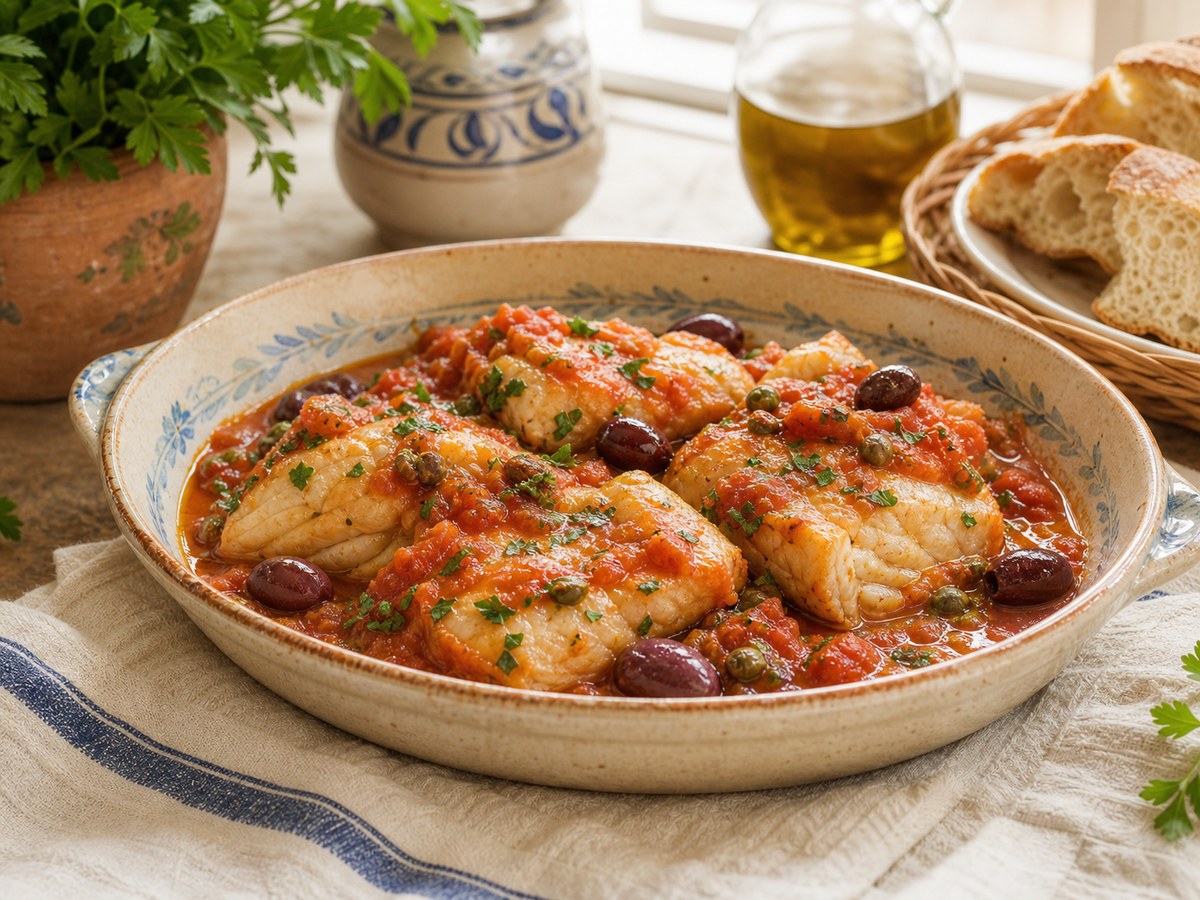
This was the version my mother made when there were more people at the table, or when Friday had a more deliberate character — the Fridays of Lent, the Christmas Eve cenone della Vigilia, any occasion where the fish needed to be something more than a quick weeknight meal. The alla napoletana preparation involves two stages that the lesso does not: frying and sauce-making. Neither is complicated, but together they produce something with considerably more presence on the plate.
The frying step is not optional even though the fish then goes into a sauce. It is precisely because it goes into a sauce that it matters: the flour crust creates a surface that the tomato can penetrate at the edges without dissolving the fish entirely. You end up with two distinct textures — the slightly firm exterior where the sauce has worked in, and the saline, flaky interior that remains separate. Without the frying, the fish would disintegrate into the sauce within minutes. The frying step also adds a layer of Maillard-reaction flavor — the browned flour and outer fish — that the tomato sauce alone cannot produce.
The sauce itself is one of the great baccalà sauces of the Neapolitan kitchen. Concentrated tomato, Gaeta olives, rinsed capers, a touch of chili, very little else. It is a strong sauce — the olives and capers are briny and assertive — and the baccalà is the only fish that can hold up to it without being overwhelmed. The dish should be made the day before if possible. Cold from the refrigerator in the morning, returned to room temperature by lunch, eaten with bread: this is the best version.
Why the frying crust survives sauce-simmering — and why overnight improves the dish
When floured baccalà is fried in hot oil, the Maillard reaction converts reducing sugars and amino acids in the flour coating into hundreds of new aromatic compounds — the characteristic toasted, savory, slightly nutty character of browned flour on fish. More importantly, the frying gelatinizes the starch in the flour coating, creating a semi-permeable layer: the sauce penetrates at the edges but cannot reach the interior in the short simmering time. This two-zone structure is what produces the textural contrast that defines the dish. Overnight refrigeration allows continued diffusion of the olive-derived phenolics and tomato acids into the outer layer of the fish, while the olives and capers continue releasing their aromatic compounds into the sauce. The integrated result the next day is not just a matter of flavor mixing — it is the completion of chemical processes that began during cooking. The dish is genuinely, not subjectively, better the second day.
Recipe — serves 4
This recipe assumes the baccalà has already been soaked for 48 hours with water changed twice daily, and is fully desalted. See the hub page for the soaking method.
Ingredients
Method
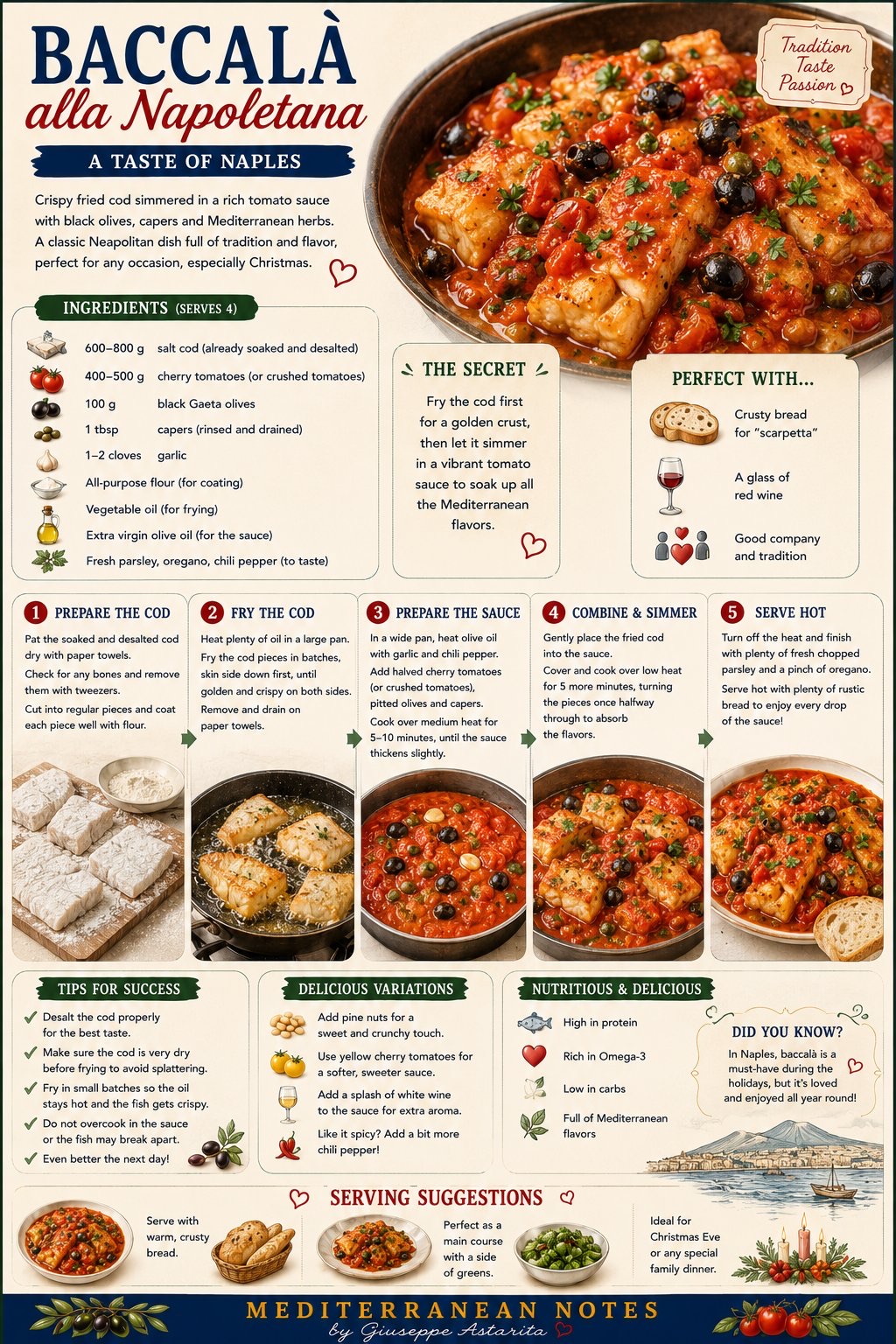
Flour and fry the baccalà. Pat the fish pieces thoroughly dry with kitchen paper. Dust in flour on all sides, shaking off excess. Heat 4 tbsp olive oil in a wide pan over high heat until shimmering. Fry the baccalà pieces for 2–3 minutes per side until golden. Work in batches — do not crowd. Remove to a plate.
The pan must be properly hot before the fish goes in. A cool pan means the flour absorbs oil rather than crisping.
Build the sauce. In the same pan (wiped of excess oil), heat 2 tbsp fresh olive oil over medium heat. Add the crushed garlic and chili. Cook 60–90 seconds until fragrant, then remove the garlic. Add the tomatoes. Cook over medium-high heat for 8–10 minutes, stirring occasionally, until the sauce thickens and darkens slightly. Add the olives and rinsed capers. Stir to combine. Taste for salt — the baccalà and capers are already salty, so the sauce may need none.
Combine and simmer briefly. Nestle the fried baccalà pieces into the tomato sauce. Spoon the sauce over the fish. Simmer gently for 5–7 minutes — enough for the fish to absorb the surface flavors but not so long it breaks apart entirely. The crust should still be visible at the edges.
Rest and serve. If eating the same day, let it rest 15 minutes before serving — the dish benefits from cooling slightly. Serve with rustic bread to work through the sauce. If eating the next day: cool completely, refrigerate, bring to room temperature for 30 minutes before serving cold. Do not reheat; serve at room temperature.
The next-day version at room temperature is the best one. If you are making this for a specific occasion, plan to make it the day before.
The other preparations
Meglio domani — e il pane non è opzionale.