Peperonata alla Napoletana
I Peperoni in Padella
The color of the sun sitting on the kitchen counter in summer. Always there during those hot months, cold in the pan, never lasting more than a day. Best inside bread — a piece of pane cafone, the oil dripping through before you had finished making the sandwich.
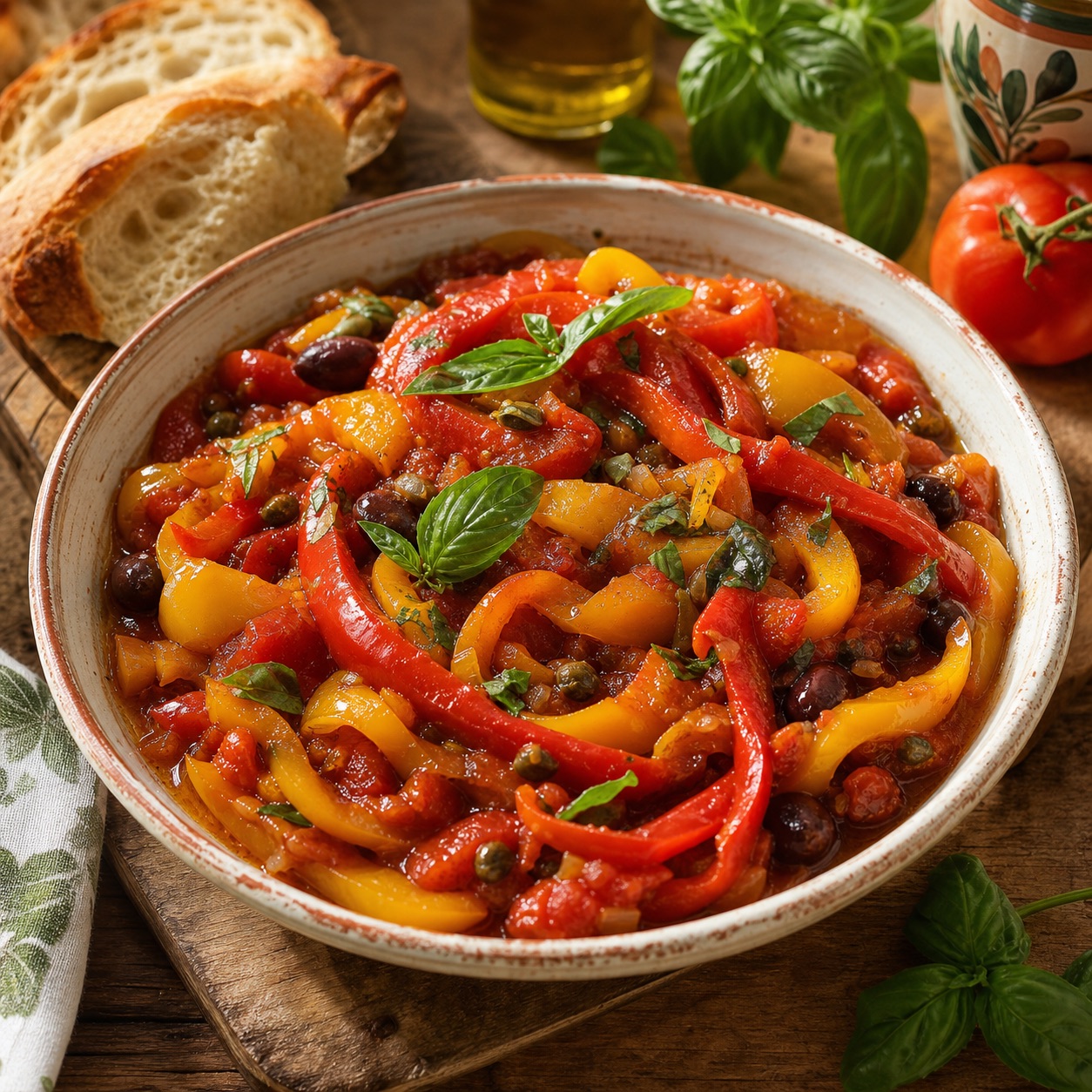
There are dishes associated with specific seasons in a way that goes beyond ingredient availability — they belong to a particular time of year in the memory not just because that is when you make them but because of everything that surrounded them. The peperonata is a summer dish in this sense. Bell peppers in red and yellow, the copper onions that give the Neapolitan version its characteristic sweetness, the Gaeta olives that are black and slightly wrinkled and taste nothing like the olives in a jar, the capers rinsed of their salt — all of these were present in the kitchen in summer, often prepared in the morning and left to cool on the counter, available through the day and into the evening.
It was always there during those months. Not on the table necessarily, not plated — just on the counter in the pan it was cooked in, covered with a plate or a cloth, cooling down. You went to get something from the kitchen and there it was, and you took a little on a piece of bread. This happened multiple times through the day without anyone making a decision about it. The peperonata did not need to be served. It served itself.
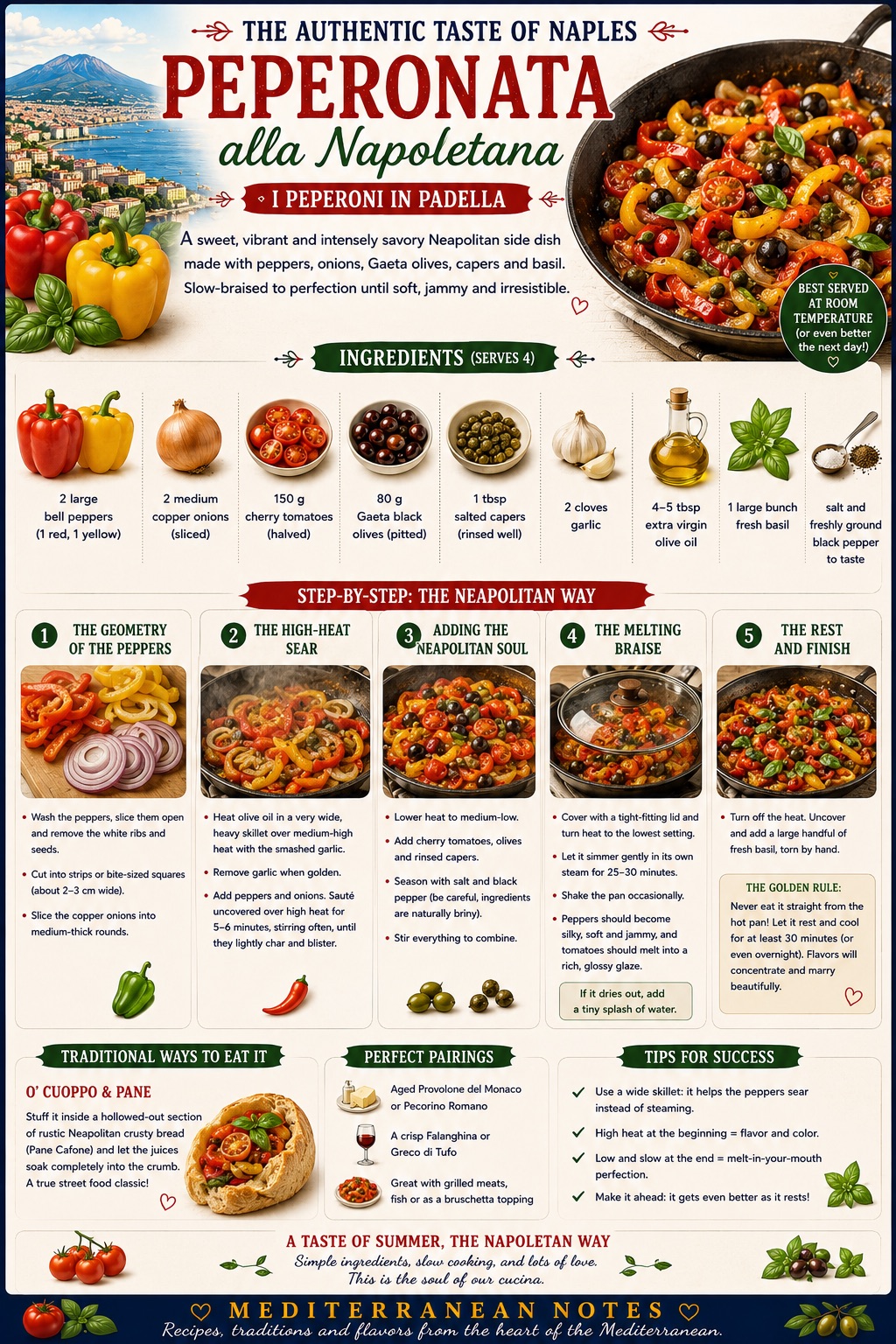
The version at home was simpler than what the infographic shows — and in some ways better. Just the bell peppers, the onion, a little garlic, the tomatoes, olive oil, and basil at the end. No olives, no capers. The peppers alone, cooked long enough, produce a flavor that is completely sufficient and that allows the sweetness of the vegetable itself to be the point. The olives and capers appear in the more elaborate Neapolitan versions — street food, restaurant preparations, the kind you find at a rosticceria — and they are good additions, but they also change the dish's character toward something briny and complex that can overshadow the peppers. At home, the peppers were the subject. The copper onions — cipolle ramate — matter in both versions. They are sweeter and more delicate than standard yellow onions and melt almost completely into the dish during the long braise, contributing a sweetness that is inseparable from the final flavor. The technique has two distinct phases that the infographic correctly identifies: a high-heat sear at the beginning to blister the peppers and develop color and flavor, then a very low, slow braise with the lid on to melt everything together into something jammy and unified. This two-phase logic is the same regardless of which version you make.
They never lasted more than a day. This is the reliable report from every household that made them in summer: you made what seemed like a generous quantity, and by the following morning the pan was either empty or close to it. The explanation is simply that they are very good eaten cold at room temperature — arguably better than hot — and that bread and peperonata requires almost no decision or preparation, which means it happened repeatedly and informally throughout the day and evening. The dish disappears without anyone noticing they have eaten it.
Raw bell peppers are crisp because of their cell walls — pectin-rich structures that hold water inside the cells and give the pepper its texture. At low heat over extended time, two things happen: the pectin chains hydrolyze partially, softening the cell walls and releasing cellular water into the surrounding oil, and the pepper's natural sugars concentrate as that water evaporates. The result is the characteristic jammy, slightly caramelized texture of a properly braised peperonata — nothing like the crisp pepper in a salad and nothing like the soggy pepper of an overcooked stir-fry. The high-heat sear at the beginning creates Maillard browning on the pepper's surface before this process begins, adding bitter, complex notes that prevent the slow-cooked sweetness from becoming cloying.
Gaeta olives are the small, dark, wrinkled olives from the Lazio coast, cured in brine and sometimes in oil, with a flavor that is simultaneously bitter, fruity, and slightly fermented. The fermentation is the key: Gaeta olives are cured in a way that preserves more of the olive's natural phenolic compounds — oleuropein and hydroxytyrosol — than the large pitted olives processed for American supermarkets, which are oxidized with lye and canned in a process that strips most of these compounds out. The phenolics contribute significantly to the flavor depth of the peperonata — a bitterness that balances the sweet pepper and sweet onion — and they also have well-established antioxidant properties that make Gaeta olives one of the more nutritionally dense olive varieties. The flavor difference is not subtle. If you cannot find Gaeta, Kalamata is the closest widely available substitute in the US, though the flavor is sharper and less fruity.
The recipe — serves 4
The home version — just peppers, onion, tomato, oil, basil. This is the one that sat on the kitchen counter in summer. The olives and capers below are optional additions for the more elaborate version.
Variations and notes
The peperonata is one of those dishes that has almost no wrong versions. The technique is forgiving, the ingredients are inexpensive and widely available in summer, and the result scales easily — you can make twice the quantity for the same effort and have it available for two days rather than one. The problem is that it still disappears in a day, because it is sitting on the counter and the bread is right there and summer evenings in a Campanian kitchen have a particular warmth that makes you want to go back to the pan one more time.
Buona estate — e teneteli sul bancone.