Ciambotta napoletana: why we fried, not roasted
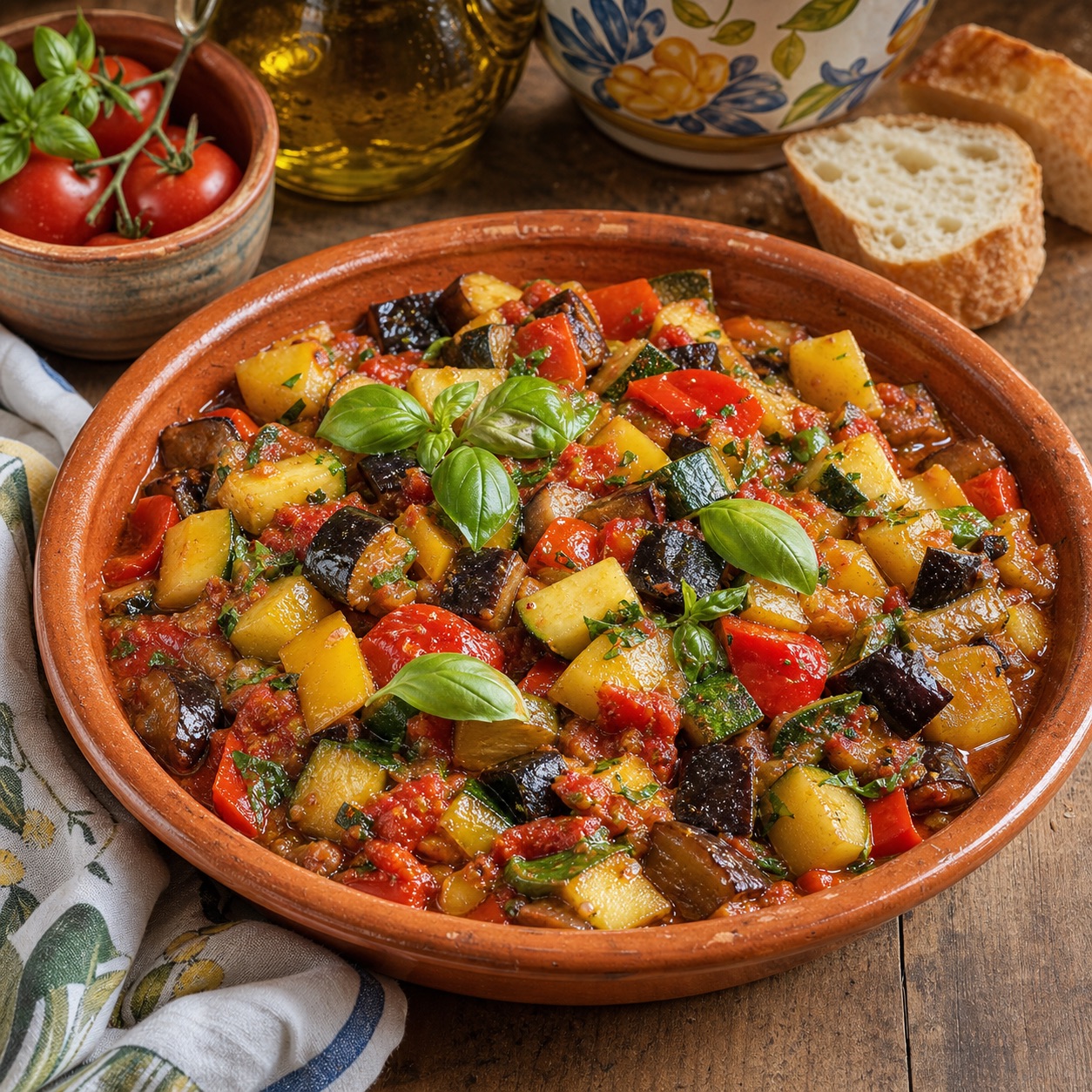
The ciambotta is the Sunday summer vegetable stew of Campania — eggplant, peppers, zucchini, potatoes, cherry tomatoes, each fried separately and then united in a light tomato sauce with basil. A classic on our table growing up in Caserta. Better warm or at room temperature. Best the next day. And it made me realize something: growing up in Campania, we never roasted vegetables in the oven. It took living in the United States to notice that we hadn't.
Here in the United States, roasted vegetables are everywhere — roasted broccoli, roasted cauliflower, sheet-pan everything. The oven is the default destination for almost any vegetable that needs cooking. When I first arrived in the US I started noticing that this was the normal way to cook vegetables here, and at some point I started wondering why we had never done it growing up. We fried things. We sautéed things. We boiled things. We stewed things on the stovetop. But the oven, in the Neapolitan kitchen, was for pizza and bread — and both of those came from the wood-fired oven at the bakery or the pizzeria, not from the home oven, which was used relatively rarely. I did not have a vocabulary for this difference until I started thinking about it more carefully.
The Neapolitan kitchen is fundamentally a stovetop kitchen, and there are several converging reasons for this. The first is historical: in a city that was historically poor and densely populated, fuel for a home oven was expensive and impractical. The stovetop — which can be managed with a small flame, which heats quickly, which can be turned off the moment cooking is done — was the efficient choice. The oven, which requires preheating, which wastes heat at the edges and corners, which burns fuel while you wait for it to reach temperature, was the inefficient one. Historical poverty chose the stovetop, and the cuisine that developed from that constraint was built around it.
The second reason is the produce itself. Naples and Campania enjoy a warm, coastal Mediterranean climate, and the summer produce — eggplant, peppers, zucchini, tomatoes, basil — is so good when it is in season that slow dry oven heat, which concentrates and caramelizes but also diminishes and slightly chars, is not the right treatment. A ripe Neapolitan eggplant in July does not need an hour in a 200°C oven to taste good. It needs three minutes of high-heat oil, which develops a golden exterior while preserving the tender interior. The ingredient is good enough that the cooking should be fast, preserving rather than transforming. This is the same logic that governs the raw marinated vegetables, the quickly sautéed seafood, the barely-cooked cherry tomatoes in the vongole and the ortolana — freshness and brevity over transformation and concentration.
The ciambotta is the great summer stew that synthesizes all of this. Every vegetable fried separately, in its own oil, for its own correct time — the potatoes until golden and crispy, the eggplant until melt-in-your-mouth soft, the peppers until yielding, the zucchini just 3–4 minutes to stay bright. Each vegetable cooked to its own ideal rather than all cooked together to a common average. Then everything united in a light tomato sauce, simmered briefly to marry the flavors, and turned off. Better warm. Better still at room temperature. Best the next day when the flavors have had time to deepen and settle into each other.
Why each vegetable needs its own pan — heat, moisture, and cell structure
The ciambotta's separate frying technique is not just culinary preference — it reflects genuine differences in how each vegetable responds to high-heat oil. Eggplant has a highly porous cellular structure with large air pockets that absorb oil rapidly when cut; it requires brief high-heat frying (which creates a surface crust that partially limits further oil absorption) rather than slow roasting (which collapses the structure and produces a waterlogged texture). Potatoes require enough time at high heat to gelatinize their starch fully and develop the crispy exterior that comes from the Maillard reactions between reducing sugars and amino acids at the surface — a process that happens more completely in deep frying than in oven roasting at standard temperatures. Zucchini, with its high water content, benefits from extremely brief high-heat cooking that evaporates surface water quickly before the vegetable goes soft — 3–4 minutes maximum. Bell peppers need enough time to soften their fibrous cell walls without going mushy. Each of these temperature-time requirements is different, and cooking all vegetables together would mean optimizing for one at the expense of the others. The light tomato sauce that unites everything in the final step provides acidity (from the tomatoes' citric and malic acids) that brightens all the fried flavors and contributes to the dish's characteristic improvement overnight — the acid gradually softens and integrates the fried vegetable textures as the dish rests, producing the more cohesive, deepened flavor of the next-day version. Nutritionally, the frying process in good olive oil or olive oil at the correct temperature (around 175–180°C) adds far less fat than is commonly assumed: at the correct frying temperature, the rapid evaporation of surface water creates an outward pressure that limits inward oil penetration, and the fat absorbed is primarily at the surface crust. The combination of summer vegetables in this preparation provides a spectrum of carotenoids, flavonoids, polyphenols, and vitamins C and K that mirrors the nutritional profile discussed in the ortolana and the peperoni posts — the ciambotta being, in essence, the same summer vegetables prepared by the technique that Neapolitan cooking developed for them over centuries.
The recipe — the traditional Neapolitan way
Ingredients · serves 4–6
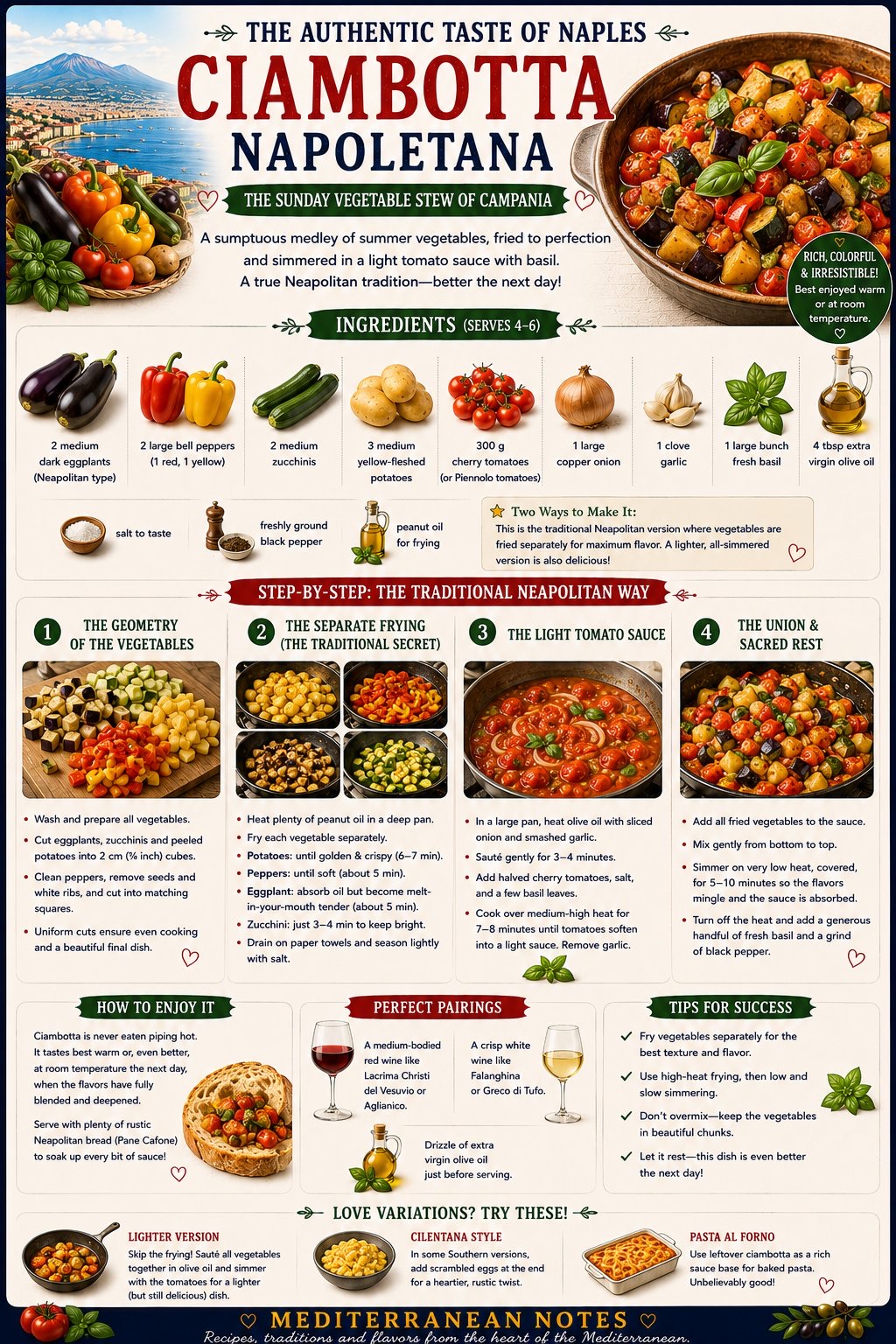
Method
Cut everything to the same size. Uniform 2 cm cubes ensure even cooking and a beautiful final dish. Remove the white inner ribs from the peppers completely.
Fry each vegetable separately — the traditional secret. Heat plenty of olive oil in a deep pan. Fry each vegetable in batches at around 175–180°C, keeping each one separate:
Potatoes — 6–7 minutes until golden and crispy.
Bell peppers — about 5 minutes until soft and slightly blistered.
Eggplant — about 5 minutes until completely soft and melt-in-your-mouth.
Zucchini — just 3–4 minutes to keep bright and slightly firm.
Drain each batch on paper towels and season lightly with salt immediately after frying, while still hot. Do not mix them yet — each vegetable has its own flavor and texture that should be preserved until the final union.
Make the light tomato sauce. In a large pan, heat the olive oil over medium heat with the sliced onion and smashed garlic. Sauté gently for 3–4 minutes until soft. Add the halved cherry tomatoes, a pinch of salt, and a few basil leaves. Cook over medium-high heat for 7–8 minutes until the tomatoes soften into a light, fragrant sauce. Remove the garlic.
The union and the sacred rest. Add all the fried vegetables to the tomato sauce. Mix gently from the bottom — don't break the pieces. Simmer on the lowest possible heat, covered, for 5–10 minutes so the flavors mingle and the sauce is absorbed. Turn off the heat. Add a generous handful of torn fresh basil and a grind of black pepper. Do not stir again. Let it rest.
The ciambotta is never eaten piping hot. Serve warm or at room temperature — the flavors are better. Best of all the next day, when the acid from the tomatoes has had time to integrate everything. Make it the day before. It will be noticeably better.
My mother made this in Caserta every summer, always in a large quantity so it lasted two or three days, improving each time it was reheated. Cold from the refrigerator on a hot afternoon it became something close to a vegetable salad. Warm with bread it was a complete meal. She said this about it every time: meglio il giorno dopo — better the next day. It was always true.
Variations and uses
Versione leggera — the cianfotta way
Skip the frying entirely. In a large pan with olive oil, sauté garlic and onion, then add vegetables in order of cooking time: potatoes and celery first (5 min), then eggplant, zucchini, and peppers (5 min more), then tomatoes last. Cover and cook on low heat 30–40 min. This is the version sometimes called cianfotta even in Campania — softer, lighter, less oil, and genuinely good. The separate frying produces a more complex result, but this one is the version you make on a Tuesday.
Stile cilentano — with eggs
In some versions from the Cilento coast south of Naples, scrambled eggs are added to the warm ciambotta at the very end, stirred in off the heat. The egg enriches the sauce and makes the dish a complete one-pot meal. Rustic, hearty, and — if you have never tried it — surprising how well the egg works against the fried vegetables and tomato.
Pasta al forno con la ciambotta
Use leftover ciambotta as a rich sauce base for baked pasta — toss with short pasta (rigatoni, penne), add cubes of provola or scamorza, cover with Parmigiano, and bake at high heat until the top is golden and bubbling. One of the best uses of a day-old ciambotta. The fried vegetables, which have had time to absorb the tomato sauce overnight, become the best possible pasta sauce.
With bread — the complete meal
Serve with plenty of rustic Neapolitan bread — pane cafone — to soak up every bit of sauce. A bowl of room-temperature ciambotta with good bread is a complete summer lunch that requires nothing else. The bread absorbs the oil from the frying and the acid from the tomato and produces something that is greater than both separately. This is how it was always eaten at home.
The ciambotta made me understand something about regional cooking that is easy to miss: a cuisine is not just its ingredients or its recipes. It is also its techniques, and those techniques developed in response to specific conditions — the climate, the economics of fuel, the quality of the local produce, the physical architecture of the kitchen. The Neapolitan stovetop tradition is not an accident or a limitation. It is the correct response to the specific situation of cooking in Naples with summer produce at its peak. The oven is for other things, other climates, other vegetables. The ciambotta is for this one.
Buon appetito — meglio il giorno dopo.