Peperoni Imbottiti
Stuffed Peppers alla Napoletana
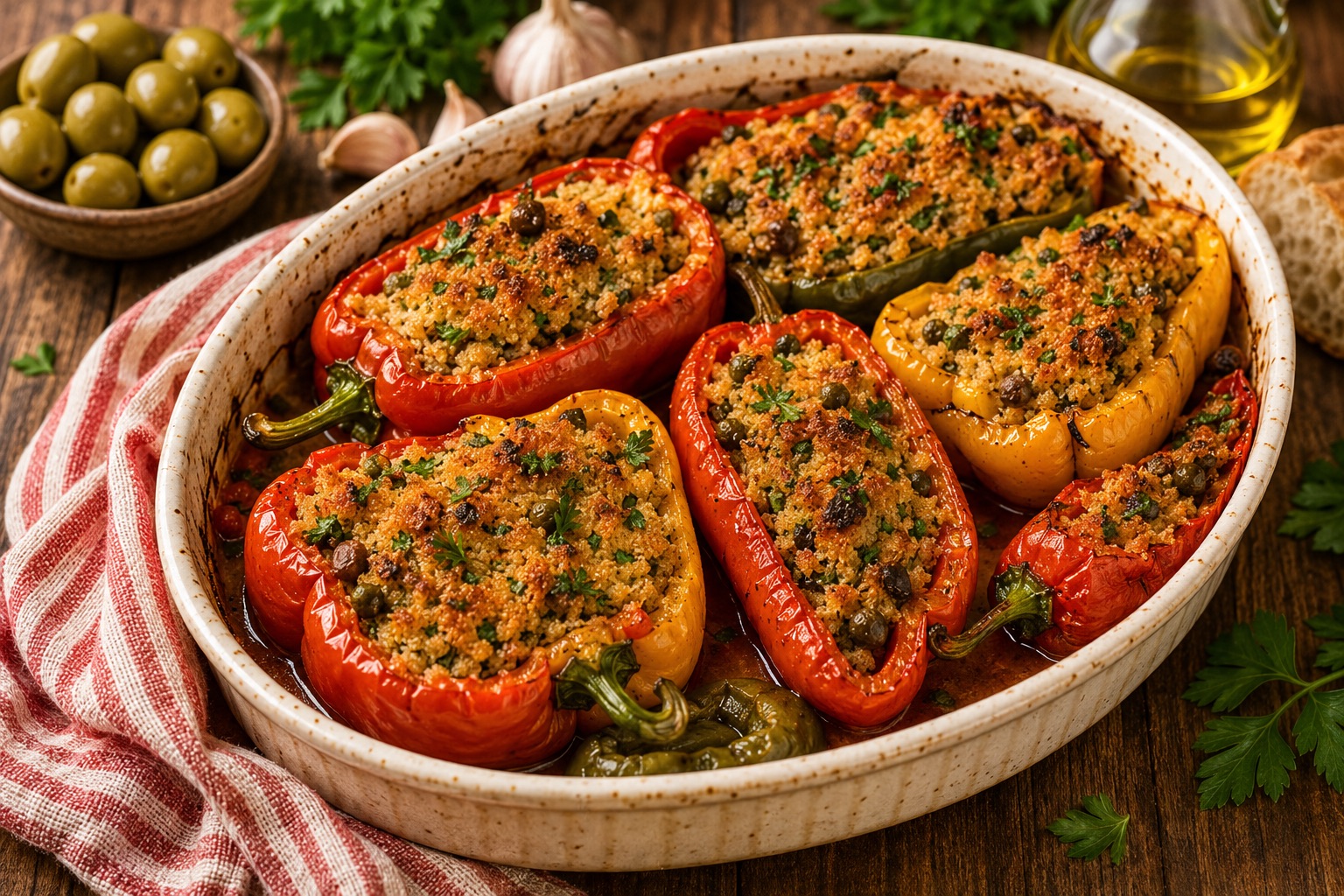
Known in dialect as puparuoli 'mbuttunati. The version I remember is the vegetarian one: soaked stale bread, capers, and black olives packed inside, baked until the pepper's skin wrinkles and the stuffing has absorbed every drop of juice from the inside. Cucina povera at its most satisfying.
The Neapolitan stuffed pepper exists in two main versions, and the one I knew best was not the one with ground meat. Our family, like many Campanian families, had a tradition of making the carne fjuta — the meatless, "fake meat" version of any recipe where meat could be replaced with cheaper, more available ingredients while preserving the essential character of the dish. The finto ragù, the meatless versions of various stuffed preparations, the bread-and-olive fillings that substituted for the ground meat ones — these were not concessions or lesser versions. They were the actual tradition of the cucina povera, the cooking of people who made extraordinary food from humble ingredients and who had been doing so for so long that the meatless version was often better than the meat version that inspired it.
The vegetarian stuffed pepper is a good example. The filling is stale bread soaked in water and squeezed thoroughly dry, mixed with black olives — Gaeta if possible, small and wrinkled and complex — rinsed capers, a clove of garlic, fresh parsley, a good pour of olive oil, salt and pepper. This is packed firmly inside hollowed red or yellow peppers, the tops replaced as lids, and the whole thing baked in the oven for forty to fifty minutes until the pepper skin blisters and wrinkles and the flesh inside has given up its juice entirely into the stuffing. The breadcrumb absorbs everything: the pepper juice, the olive oil, the caper brine that lingers after rinsing, the garlic and parsley flavors. By the time it comes out of the oven the stuffing is no longer dry breadcrumb and olive and caper — it is a single dense, complex, deeply flavored thing that is one of the most satisfying results you can get from such simple ingredients.
The stale bread is not incidental. Fresh bread would retain too much water after soaking and produce a wet, heavy filling that does not absorb the pepper juices properly during baking. Stale bread — two or three days old, dried out sufficiently that it can absorb liquid fully and be squeezed almost dry — becomes a neutral, porous matrix for the other flavors. When packed inside the pepper and baked, this matrix acts as a sponge for everything the pepper releases during cooking. The technique is the same reason the potatoes in the carciofi in pentola a pressione and the pollo alla cacciatora cook in the braising liquid rather than separately — the starch matrix absorbs flavor from the surrounding medium rather than from dressing applied afterward. The principle recurs throughout the cucina povera because it is sound.
My mother made these in summer, when the large sweet peppers were at the market — red and yellow, already concentrated in sweetness at the height of the season — or sometimes with the long narrow cornetti, the horn-shaped sweet Italian peppers that are particularly prized around Caserta and in the surrounding hills. The cornetti are stuffed whole: the top is cut off and reserved as a cap, the seeds and white ribs removed through the opening, and the filling spooned in until the pepper is generously full. Large bell peppers are halved lengthwise and filled in the open cavity. Both versions go into the same oven with the same result: tender sweet pepper, savory bread filling, golden breadcrumb surface, the anchovy and olive flavors having penetrated everything during the forty minutes of baking.
The two versions — which one we made
When a bell pepper is baked whole at 180°C, several things happen simultaneously. The cell walls of the pepper flesh begin to break down as pectin hydrolyzes under heat, releasing cellular water and softening the flesh progressively from the outside inward. The pepper's natural sugars — primarily fructose and glucose — concentrate as this water evaporates from the skin side while the interior remains sealed, producing the sweetness that characterizes a roasted pepper. At the same time, the interior of the pepper creates a humid, essentially steamed environment: the moisture released from the flesh cannot escape through the sealed top, and it instead migrates inward toward the lower-humidity stuffing.
This is where the stale bread stuffing performs its function. Stale bread — specifically the porous, dehydrated crumb structure of bread that has lost most of its moisture — acts as a powerful capillary absorber. The open cell structure created by the yeast fermentation during baking has dried out, creating a matrix with enormous surface area relative to its volume. When this matrix contacts the humid interior of the cooking pepper, it draws in the moisture rapidly and holds it within its cell structure rather than allowing it to pool at the bottom of the pepper. The result, after 45 minutes of baking, is a stuffing that has absorbed the pepper's own juice along with the olive oil and the dissolved flavor compounds from the capers and olives, producing a filling with the flavor density of a long-cooked preparation achieved in less than an hour. Fresh bread, by contrast, retains too much of its own moisture to absorb much from the surrounding pepper, and the stuffing comes out wet and undifferentiated.
The recipe — vegetarian version, serves 4
The bread-olive-caper filling — the Caserta cucina povera tradition. For the meat version with ground beef, ham, and smoked provola, see Puparuoli 'mbuttunati con carne.
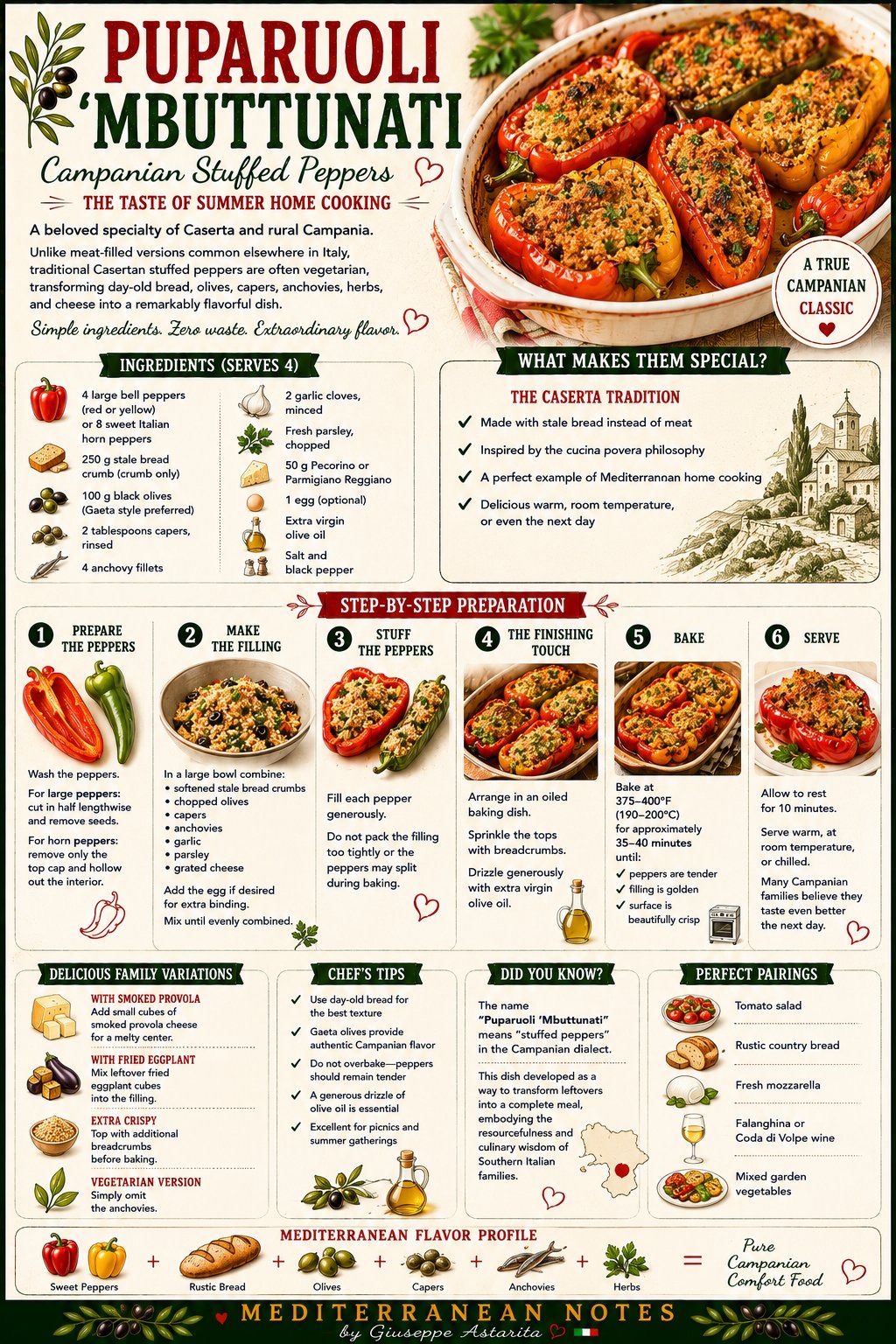
The stuffed pepper with bread and olives is a better argument for this than almost any other dish: a red pepper stuffed with stale bread and Gaeta olives and capers and olive oil, baked for fifty minutes, tastes like something that took far more effort and far more expensive ingredients than it did. The cucina povera invented it because necessity required it. It stays because it is genuinely good.
Notes on variations and eating
The stuffed pepper is one of those dishes that demonstrates the cucina povera's central insight: the transformation of humble ingredients into something greater than their sum is not a trick of technique or of expensive additions — it is a function of time, heat, and understanding what each ingredient does when it is placed alongside the others in a closed environment. The pepper contains the stuffing. The stuffing absorbs the pepper. They become each other. That is the whole preparation.
The distinction between these two traditions reflects a broader pattern in Campanian food culture: the coastal and urban areas closer to Naples tend toward richer, meat-based preparations, while the inland territories — Caserta, Benevento, the hill towns of the province — developed a more austere cucina povera tradition where bread and preserved ingredients (olives, capers, salted anchovies) do the work that meat does elsewhere. This is not poverty as deprivation but poverty as ingenuity — the kind of cooking that produces extraordinary flavor from limited ingredients because every element is used correctly and nothing is wasted. The stale bread absorbs the olive oil, the pepper juices, and the anchovy fat during baking, and the result has a density and savory depth that fresh bread would not produce.
Buon appetito — e viva la carne fjuta.