Sciuè Sciuè
sciuè sciuè
Neapolitan dialect: "quick quick" — shoo-eh shoo-eh. The name says everything you need to know about the sauce.
The summer version of the quick sauce — when fresh tomatoes are ripe and abundant and it would be a waste to use a can. A few times a week in July and August. Garlic, cherry tomatoes, olive oil, basil. Done in the time it takes to cook the pasta, sometimes less.
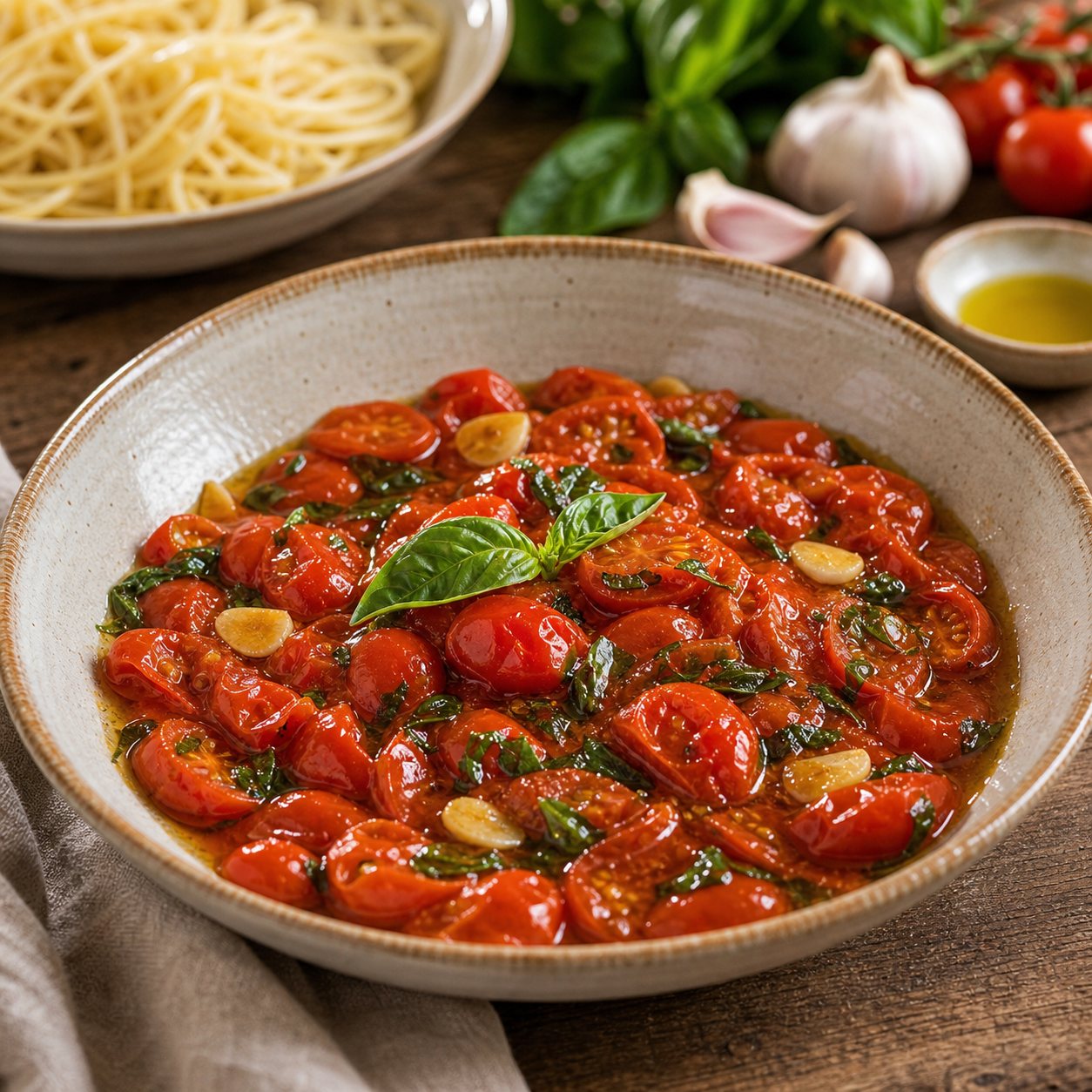
This is the sauce that belongs specifically to summer, to the months when the cherry tomatoes are small and very red and properly sweet — the ones at the market in July that taste nothing like the cherry tomatoes sold in plastic clamshells in January in Massachusetts. When tomatoes are in season and genuinely good, you do not need a can of passata. You halve them and throw them in the hot pan and they cook themselves in their own juice in seven minutes and the result is something fresher and more alive than any canned tomato sauce can produce, because the volatile aromatics that evaporate during industrial processing are still present.
Sciuè sciuè is the Neapolitan dialect term for "quick quick" — the doubling of the word for emphasis, the way Neapolitan dialect works, making the concept more urgent and more affectionate simultaneously. It describes both the speed of the sauce and the spirit in which it is made: no planning, no commitment, just the tomatoes that are there, the garlic in the pan, the pasta already in the water. The sauce is a summer routine rather than a recipe — something you make several times a week without thinking of it as cooking, which is the highest compliment you can give a preparation.
When the tomatoes are right, in July and August, this is the only sauce you need. The cherry tomatoes burst open in the hot oil and release their juice and the basil goes in at the end and you toss everything with the drained pasta and a splash of the pasta water. Ten minutes. Summer on a plate.
The sauce has two legitimate versions depending on how much cooking you want and how ripe the tomatoes are. The hot version — garlic in oil, tomatoes in the pan, five to seven minutes on high heat until they soften and create a light, chunky sauce — is the standard. The semi-raw version, which works only when the tomatoes are at their absolute peak ripeness, is even simpler: you halve the tomatoes, season them with salt, olive oil, and fresh basil while the pasta cooks, and toss the just-drained pasta directly into this raw mixture. The heat of the pasta finishes the tomatoes just enough. The result is somewhere between a sauce and a salad, completely fresh, and it is one of the best things you can eat in August.
The hot version
Cooked — 7 minutes in the pan
Garlic golden in olive oil, tomatoes halved and cooked on high heat until they burst and create a light sauce. Basil at the end, off the heat. Tossed with pasta in the pan with a splash of pasta water. Works year-round with cherry tomatoes.
The semi-raw version
Barely cooked — only when tomatoes are perfect
Tomatoes halved, seasoned with salt, olive oil, torn basil. Hot drained pasta poured directly over them. The pasta heat cooks the tomatoes just enough. Only works in peak summer. The freshest possible result.
Why peak-season fresh tomatoes taste different — and why the pasta water matters
A ripe summer cherry tomato contains significantly more free glutamates than a hothouse tomato harvested underripe for shipping — sometimes three to four times more. Glutamate is the primary carrier of umami flavor, and it develops in the tomato as it ripens on the vine under real sunlight. This is the chemical reason why an August cherry tomato from a garden or a good market tastes qualitatively different from the same variety sold in winter: it has more of the compound that the palate registers as depth and savory satisfaction. The volatile aromatic compounds — the terpenes and esters that give a fresh tomato its characteristic smell — are also more concentrated in a properly ripened fruit, and they are present in fresh tomatoes but largely absent in canned or cooked preparations because they evaporate readily with heat.
The pasta cooking water is not a trick or a cliché — it has a specific function. Pasta releases starch into its cooking water as it boils, producing a slightly cloudy, starchy liquid. When this liquid is added to the sauce and the pasta is tossed together over heat, the starch acts as an emulsifier, binding the olive oil and the tomato juice into a coherent sauce that clings to the pasta rather than sliding off. Without pasta water the sauce tends to pool at the bottom of the bowl; with it, the sauce coats evenly. The amount needed is usually just a few tablespoons — a ladleful is enough — and it is worth reserving before draining the pasta.
The recipe — serves 2–4
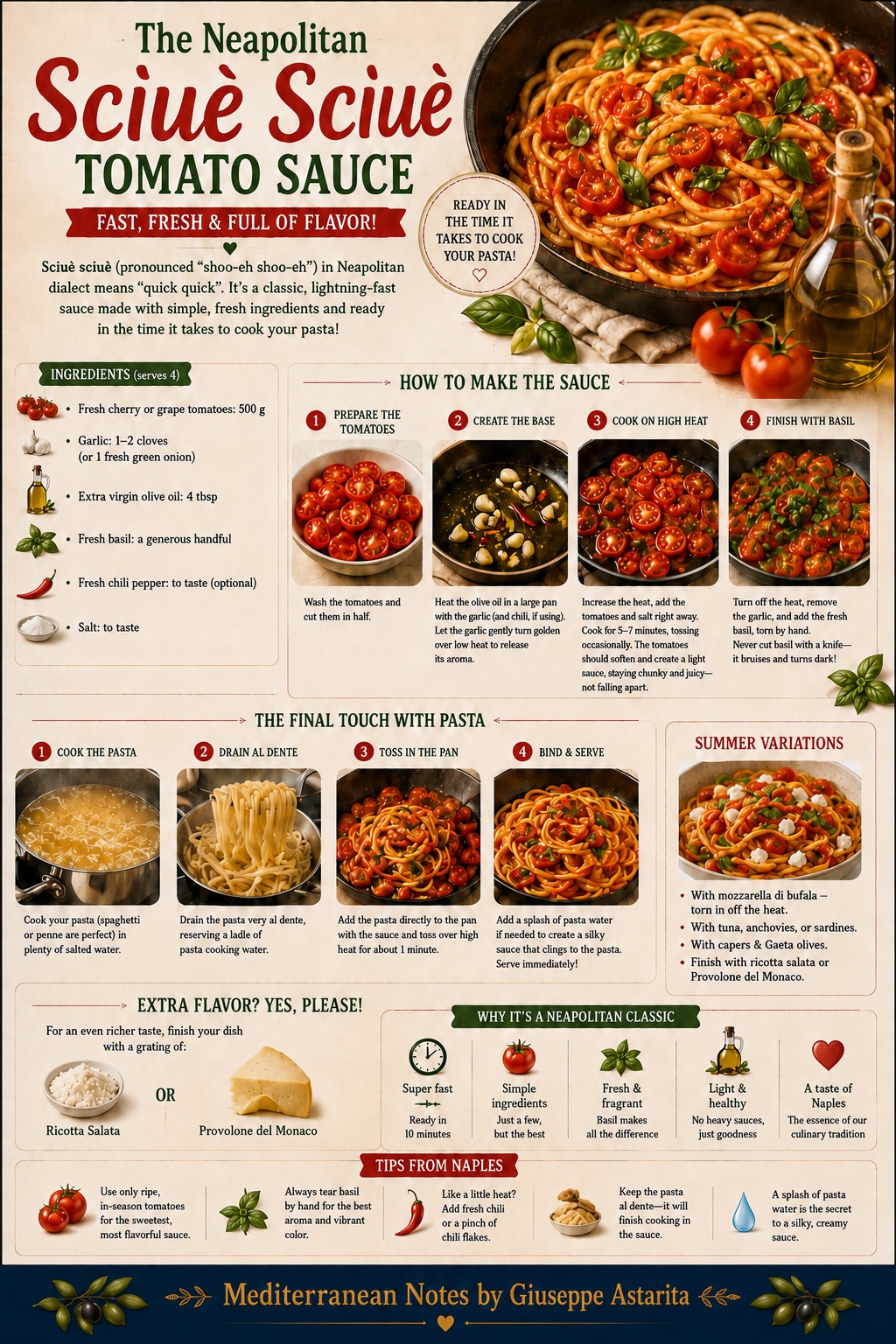
Sciuè sciuè — pronto nel tempo che cuoce la pasta. Click to enlarge.
500 g
Fresh cherry or grape tomatoes, halved — only ripe, in-season ones
1–2 cloves
Garlic, left whole and smashed — removed before serving
4 tbsp
Extra-virgin olive oil — your best
generous handful
Fresh basil, torn by hand — never cut with a knife
to taste
Salt
optional
Fresh chili or pinch of chili flakes
1 ladle, reserved
Pasta cooking water — before draining
320–400 g
Spaghetti, penne, or rigatoni
1
Put the pasta water on to boil. Wash and halve the tomatoes. Heat the olive oil in a large pan over low heat. Add the smashed garlic (and chili if using) and let it turn gently golden — 5 minutes. The oil should smell of garlic, not burn.
The garlic is there to flavor the oil, not to eat. Remove it when golden. Burned garlic makes the whole sauce bitter and there is no recovering from it.
2
Raise the heat to high. Add the tomatoes and salt. Cook for 5–7 minutes, tossing occasionally. The tomatoes should soften, burst, and create a light, chunky sauce — they should keep some texture, not dissolve completely. Do not cover the pan.
High heat is the key. Low heat steams the tomatoes and makes them watery. High heat concentrates their juice quickly and gives the sauce a slightly roasted quality at the edges.
3
Turn off the heat. Remove the garlic. Add the torn basil — always by hand, never a knife, which bruises the leaves and turns them dark. Cook the pasta al dente, reserve a ladle of cooking water before draining.
4
Add the drained pasta directly to the pan with the sauce. Toss over medium-high heat for one minute. Add the pasta water a splash at a time if needed — the sauce should cling to the pasta, silky and coherent. Serve immediately. Do not wait.
Sciuè sciuè waits for no one. The pasta goes directly from the pan to the plate and from the plate to the mouth. This is not a sauce that improves by sitting.
Variations — the endless summer additions
The sciuè sciuè is the base. Because it is simple and light, it accepts additions naturally — whatever is at hand, whatever the market had, whatever the season is producing alongside the tomatoes. This is how summer cooking actually works: not from a planned recipe but from what is there.
With mozzarella di bufala
Torn mozzarella added off the heat, after the basil. The residual warmth softens it without melting it fully — it becomes slightly yielding, part cream, part solid. One of the best combinations in the summer kitchen. See also the
mozzarella post on the correct temperature for serving.
With canned fish
Tuna in oil, good-quality anchovies, or sardines added to the sauce when the tomatoes have softened. The fish dissolves partially into the sauce, adding depth and protein without changing the essential character of the preparation. The tuna version in particular is a genuinely satisfying summer pasta that takes twelve minutes and requires no planning.
With capers and olives
The puttanesca direction — capers rinsed of their salt and Gaeta olives added with the tomatoes. The brininess of both integrates into the fresh tomato sauce and produces something more complex without requiring more time. Good with spaghetti specifically.
With ricotta salata or provolone
Grated ricotta salata or provolone del Monaco over the finished pasta instead of Parmigiano. Both are sharper and saltier than Parmigiano and work particularly well against the freshness of the summer tomato. The infographic suggests both. Either is correct depending on what is at hand.
With zucchini flowers
Sliced fresh zucchini or zucchini flowers added to the pan with the tomatoes. They cook in the same time and add a sweetness that complements the tomato without competing. A summer-specific addition that belongs entirely to the season.
With eggplant
Small cubes of eggplant, fried separately in oil until golden, then added to the finished sauce. The pasta alla Norma direction — without the full preparation that dish requires. The eggplant brings richness and body. A more substantial version of the sauce for when the appetite calls for something denser.
The quick sauce family
The two quick sauces are complementary — one for every day of the year, one for the two months when fresh tomatoes justify the simplicity. Together they cover the full range of the Italian instinct for pasta col sugo: something honest, fast, and satisfying, made from what is in the kitchen or what the season provides, requiring no planning and producing something genuinely good. Every day of the week, any time you want it. This is the kitchen at its most useful.
Sciuè sciuè — buona estate, buona pasta.