Sugo al Pomodoro
The Sweet & Simple Tomato Sauce with Onion and Carrot
Sometimes you are just in the mood for pasta col sugo — pummarola, as they say in Naples: the everyday tomato sauce, the one that needs no occasion. Not the Sunday ragù, not the Genovese, not anything that requires planning or patience. Just the quick version — the one that cooks in exactly the time it takes to boil water and cook the pasta. As comforting as a pizza and done in 25 minutes.
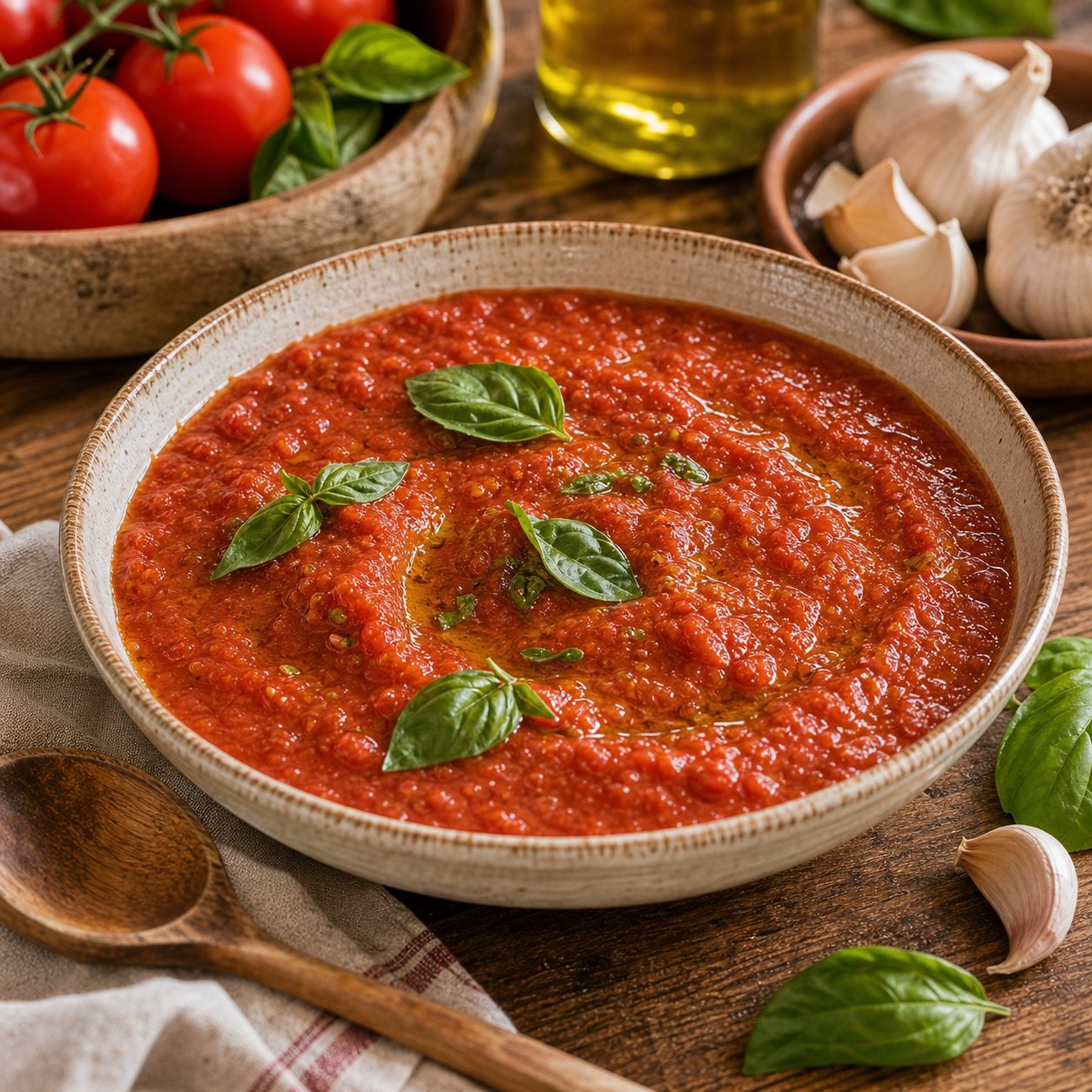
This is the everyday sauce — the one you make when there is no particular occasion, no time to wait for something long, no plan beyond the fact that pasta is what you want. It belongs to the weekday table in a way that the Sunday sauces do not. The ragù and the Genovese are preparations you decide on in the morning and commit to for hours. This sauce you decide on when the hunger arrives, and it is done before the decision has had time to feel like effort.
The carrot is the secret and it is worth understanding why. A tomato sauce made with only onion and passata will often taste slightly sharp or acidic, particularly if the passata is not from the sweetest tomatoes. The standard solution — adding sugar — works but it is a shortcut that produces a different flavor character: distinctly sweet rather than naturally balanced. The carrot does something more honest. You add a whole, peeled carrot to the softening onion and it cooks in the sauce for the entire fifteen minutes, releasing its natural sugars slowly into the surrounding liquid. These sugars — primarily sucrose and glucose — buffer the tomato's acidity and produce a gentler, rounder flavor that does not register as sweet so much as balanced. At the end you remove the carrot, which has given everything it had. No sugar, no residue, no shortcut.
The tomato is flexible — passata is the most convenient, a can of whole peeled tomatoes crushed by hand works equally well, and in summer when fresh tomatoes are ripe you can chop a few and use those instead (though fresh tomatoes need a couple of extra minutes to release their juice). Whatever form the tomato takes, the carrot and the onion do the same work.
This is also the sauce from the pasta di tutti i giorni post — specifically Thursday's pasta, the mid-week red sauce that appeared on the weekday table when there was no particular reason for something more elaborate. In a family that had pasta every day of the week, this was the default red: quick, satisfying, made from things always in the kitchen, reliable every time. It is one of those preparations that proves you do not need complexity to produce something genuinely good. Four ingredients. Twenty-five minutes. Done.
Tomatoes are naturally acidic — their pH sits between 4.0 and 4.5, driven primarily by citric acid, malic acid, and ascorbic acid. In a cooked tomato sauce this acidity concentrates as water evaporates, which is why a quick sauce can taste sharper than a long-cooked one. The conventional solution of adding sugar introduces sucrose, which the palate perceives as sweetness and which partially masks — but does not neutralize — the acidity. The perceived result is a sauce that is both acidic and sweet, rather than a sauce that is neither.
The carrot works differently. Carrot tissue contains sucrose, glucose, and fructose in significant concentrations — a medium carrot holds roughly 4–6 g of naturally occurring sugars. As the carrot cooks in the acidic tomato sauce, these sugars migrate slowly out of the carrot cells into the surrounding liquid. Simultaneously, the carrot acts as a mild pH buffer: its mineral content (particularly potassium) helps neutralize some of the free acid molecules rather than simply sweetening over them. The result is a sauce with genuinely lower acidity and a more balanced flavor profile — not sweeter, but rounder. The carrot is removed at the end because its role was extraction, not texture. Leaving it in would produce an uneven sauce and a slightly vegetable-forward character that is not the point here. The technique is old, widely used in Italian home kitchens, and fully justified by the chemistry.
The recipe — serves 2–3
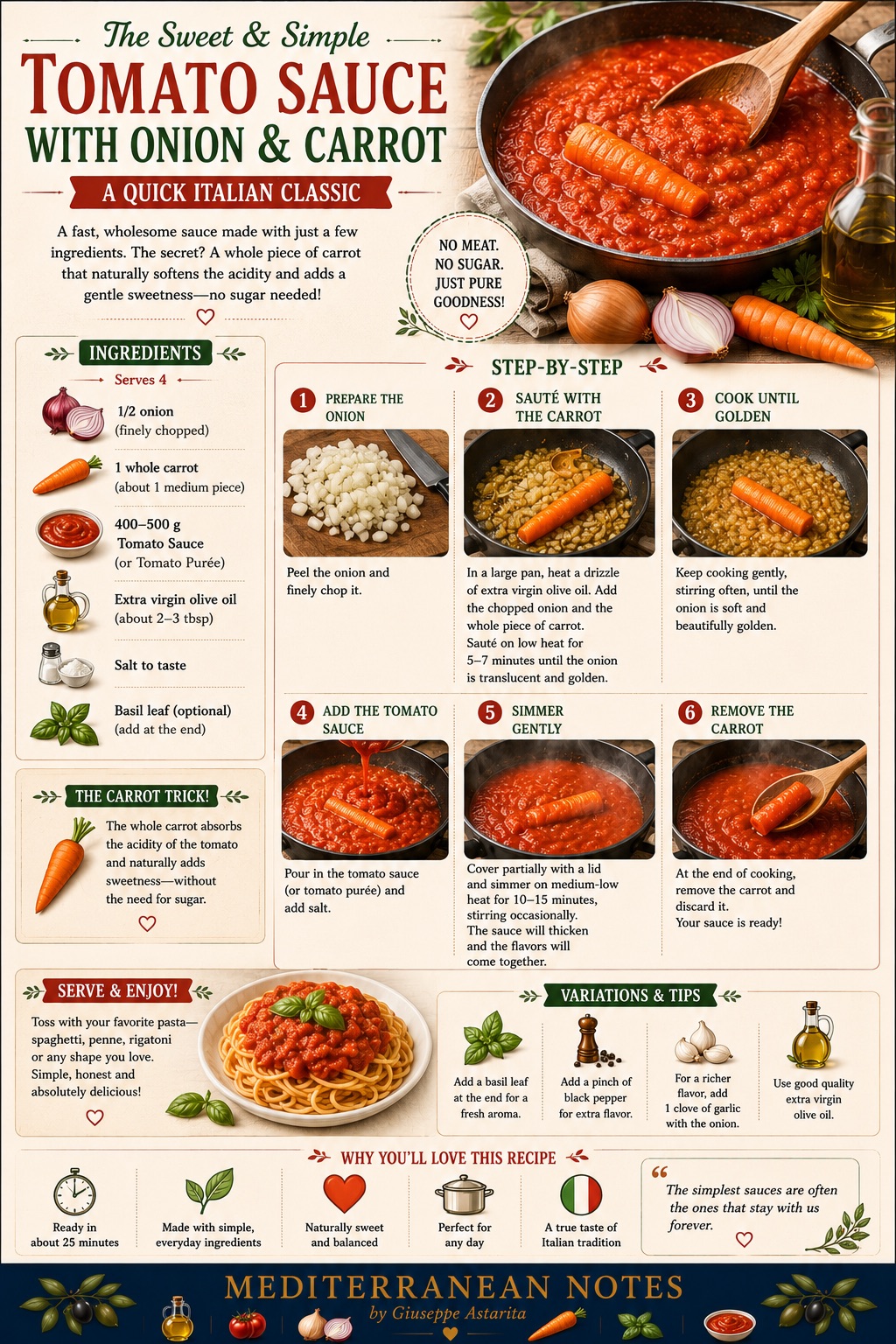
Variations — simple additions that change nothing fundamental
The best recipes are not the most complicated but the most honest. A sauce that is ready in the time it takes to boil water and cook pasta, made from four ingredients, that produces something genuinely satisfying — this is what honest cooking looks like. It does not need occasion or planning or special ingredients. It needs a pan, a carrot, passata, and twenty-five minutes. Every day of the week, any time you want it. As comforting as a pizza and made in the kitchen.
Buon appetito — ogni giorno, tutte le volte che vuoi.