CoursesBasicsFirst CoursesSecond CoursesSides & VegetablesSoupsSaucesEggs & FrittatePizza & BreadBreakfastSnacksStreet FoodDesserts
DietVegetarianVegan
SeasonSpringSummerAutumnWinter
MainSeafoodMeatEggs
MoreCulture & TraditionsGlossaryAbout

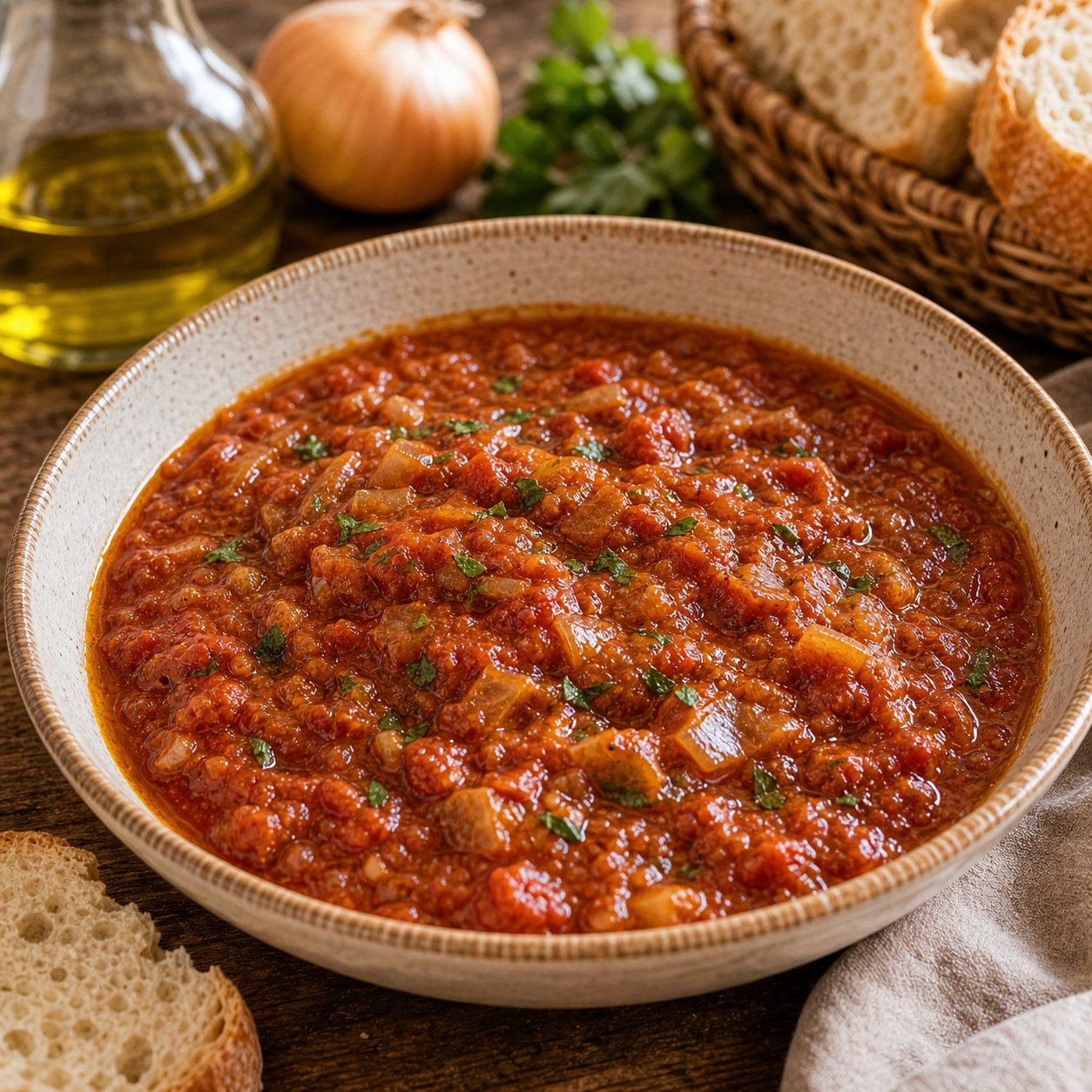
Sugo di Pomodoro con Salsiccia
The Soul of Sunday in Naples

Sunday's other option when it wasn't ragù. The fennel seeds in the sausage, two hours of slow pappuliare on the stove — then the sausages pulled out and saved for dinner with friarielli. First on bread, then on pasta, then on bread again.
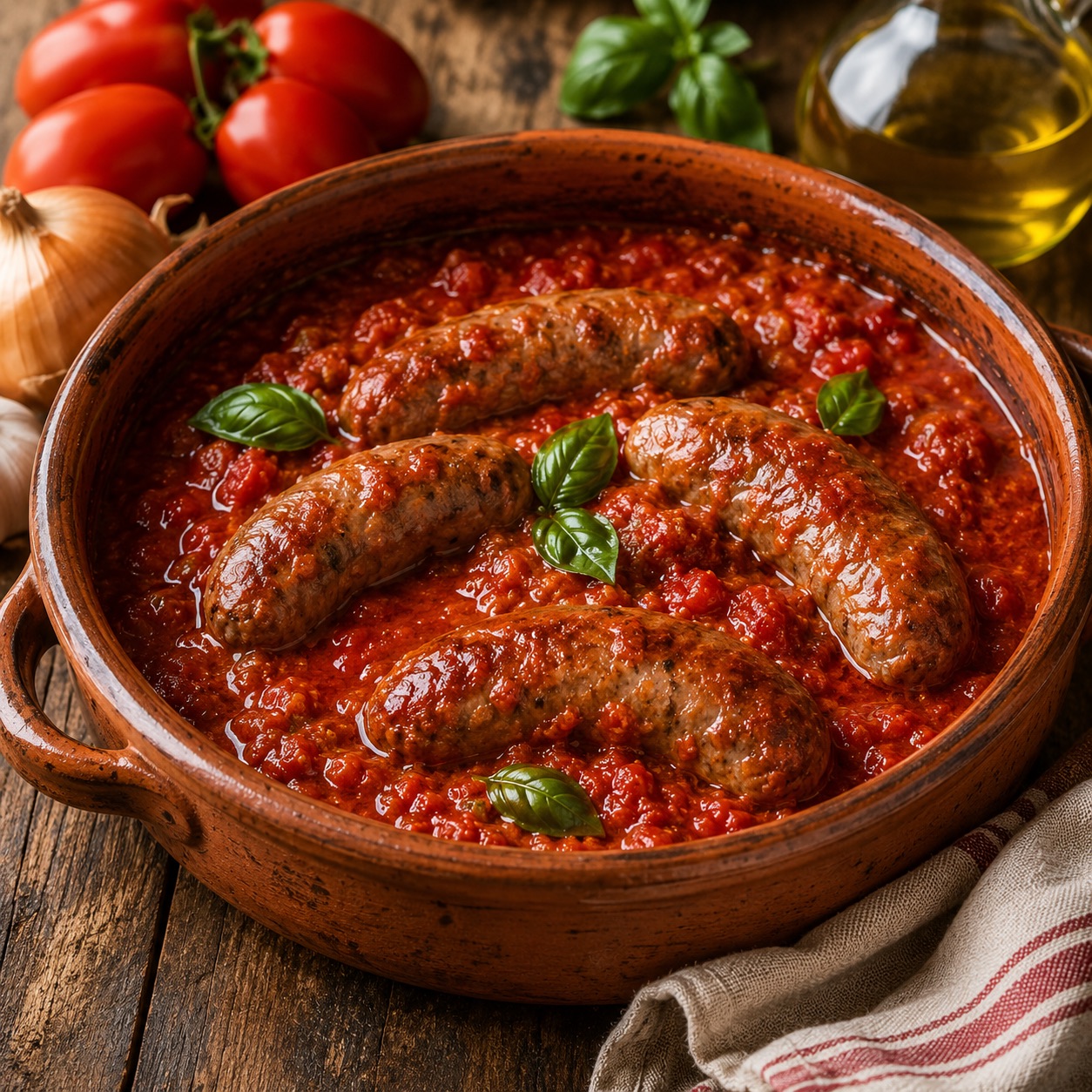
Red Sauce Sausage

Sunday mornings in Caserta had a particular smell depending on which sauce was on the stove. There were three options in regular rotation — the ragù napoletano, the finto ragù, and this one, the sugo con salsiccia. Each had its own character, its own length of cooking, its own way of filling the house. The ragù was the most serious undertaking — hours, multiple cuts of meat, the deep-brown sauce that coats pasta like nothing else. The sugo con salsiccia was the more approachable Sunday: it still took two hours, still demanded the low, patient simmer the Neapolitans call pappuliare, but it was faster to assemble and the result was lighter in texture if not in flavor.

The sausage matters here more than in almost any other preparation, because the sauce is essentially built from it. Neapolitan sausage — punta di coltello, meaning the coarser grind made with the knife tip rather than a machine — contains fennel seeds, and those seeds define the aromatics of the whole pot. As the sausages brown and then simmer, the fennel releases into the fat, which releases into the tomatoes, and the sauce ends up tasting simultaneously of pork and of something green and faintly anise-like that is entirely characteristic. I can still identify that smell precisely. It is the smell of this particular sauce and nothing else.

The sauce went on pasta — typically ziti spezzati or rigatoni, the shapes that hold a thick sauce in their ridges and their hollow centers. But the sausages themselves were set aside. They appeared at dinner, not at lunch. My mother would take them out of the sauce before dressing the pasta, keep them warm, and that evening they came back to the table with friarielli — the Neapolitan bitter greens, sautéed in olive oil and garlic with a little chili, which cut through the fat of the sausage cleanly. The pairing is one of the great combinations of the Campanian kitchen, and it works because the friarielli's bitterness and the sausage's fennel and fat balance each other without either disappearing.

It was a competition between the three Sunday sauces — ragù, sugo con salsiccia, finto ragù. They all ended up first on bread, then on pasta, then on bread again. The bread at the end was not a concession. It was the point.

The bread sequence deserves its own sentence. Before the pasta was dressed, before the table was fully set, a piece of bread went into the pot. This was the scarpetta — the little shoe — the piece of bread used to clean the sauce from the bottom of the pot or from the plate, and it happened at every stage: a taste of the sauce mid-cooking on bread to check the seasoning, then a proper scarpetta from the serving pot before the pasta was dressed, then again at the end with whatever was left on the plate. The sauce was never wasted and the bread was never merely accompaniment. The two things worked together in both directions.

Parmigiano Reggiano went on at the end — freshly grated, generously, the kind of grating where the cheese forms a visible layer rather than a dusting. On a tomato and sausage sauce this might seem redundant given how much flavor is already there, but it is not: the Parmigiano adds a nutty, crystalline note that the sauce does not have on its own, and it binds slightly to the pasta rather than sliding off. This was consistent across all three Sunday sauces. Whatever went on pasta ended with Parmigiano, without exception.


What two hours of pappuliare actually does to a tomato sauce

Pappuliare is the Neapolitan verb for the particular sound a sauce makes at the correct low simmer — a slow, irregular bubble that breaks the surface gently every few seconds rather than a rolling boil. The distinction is not aesthetic. At a full boil, water evaporates rapidly, the sauce concentrates quickly, and the tomatoes and meat cook under turbulent conditions that can toughen protein and produce a harsher flavor. At pappuliare temperature — roughly 85–90°C — evaporation is slow and steady, the collagen in the sausage casing and the connective tissue of the meat has time to hydrolyze into gelatin, and the Maillard compounds from the initial browning of the sausage have time to distribute evenly through the sauce rather than staying concentrated near the meat.

The fennel seeds in Neapolitan sausage contain anethole — the compound responsible for the characteristic anise flavor — along with fenchone and limonene. These are fat-soluble aromatic compounds: they dissolve into the pork fat during cooking and are then carried throughout the tomato sauce as the fat distributes. This is why a sauce made with fennel-seed sausage tastes of fennel even in the parts of the pot far from the sausages themselves. The tomatoes also change over two hours: their cell walls break down completely, the natural sugars concentrate, and the acidity mellows as volatile acids evaporate. A sauce that tastes sharp and bright at thirty minutes tastes round and deep at two hours. The time is the ingredient.


The recipe — serves 4
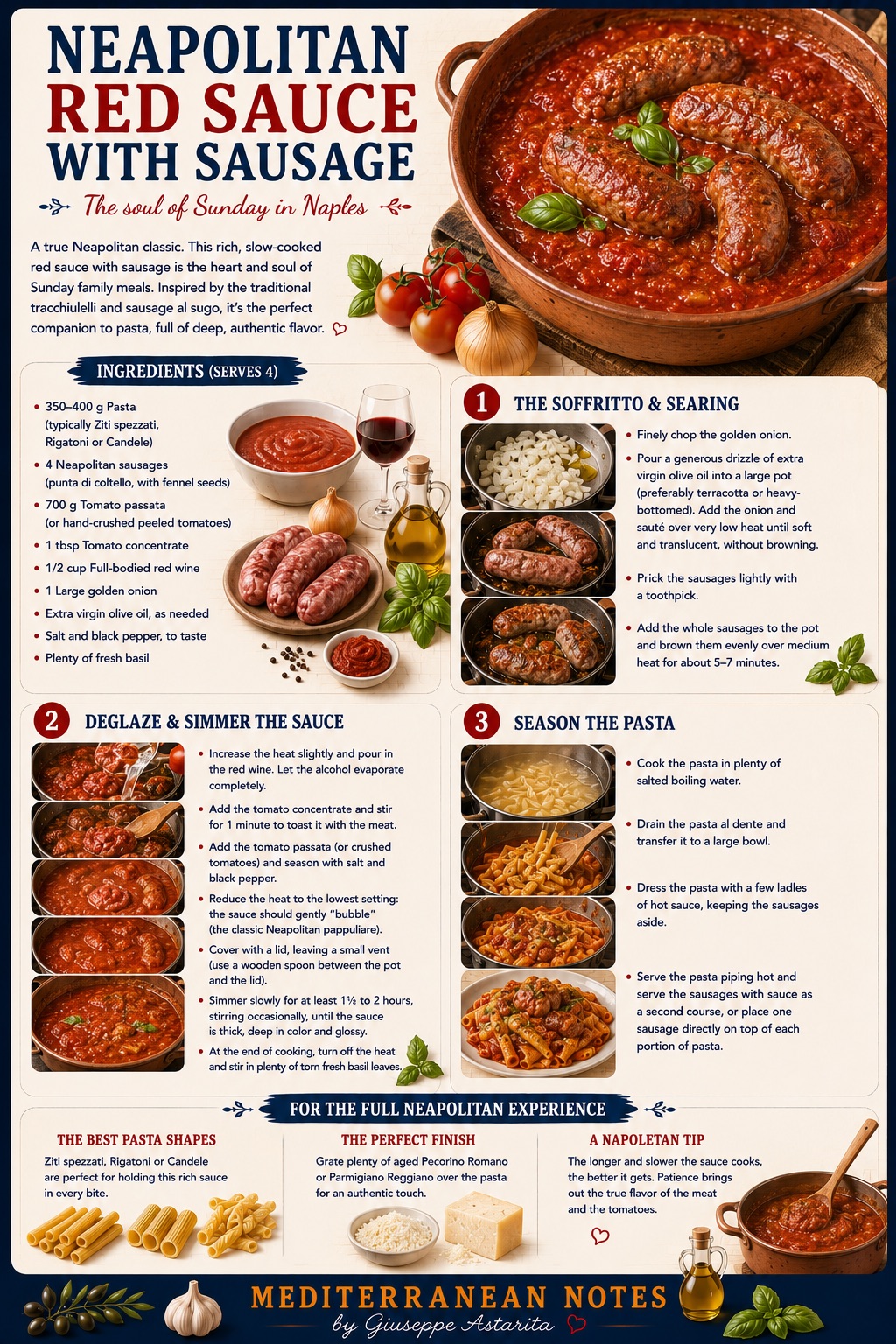
Neapolitan Red Sauce with Sausage — step-by-step infographic
Sugo di pomodoro con salsiccia — il classico della domenica. Click to enlarge.
4 links Neapolitan sausage with fennel seeds (punta di coltello)
700 g Tomato passata or hand-crushed peeled tomatoes
1 tbsp Tomato concentrate
½ cup Full-bodied red wine
1 large Golden onion, finely chopped
generously Extra-virgin olive oil
large handful Fresh basil, torn at the end
to taste Salt and black pepper
350–400 g Ziti spezzati, rigatoni, or candele
freshly grated, generously Parmigiano Reggiano
1
Pour a generous drizzle of olive oil into a heavy pot — terracotta if you have it, otherwise a heavy-bottomed pan. Add the onion and cook over very low heat, stirring occasionally, until completely soft and translucent, about 15 minutes. Do not let it brown. Prick the sausages lightly with a toothpick to let the fat release during browning.
2
Raise the heat to medium and add the whole sausages. Brown them evenly on all sides, 5–7 minutes — you want real color, not just pale grey. Raise the heat slightly and pour in the red wine. Let the alcohol evaporate completely, scraping up any browned bits from the bottom of the pot.
The browned bits on the bottom of the pot are concentrated flavor. The wine deglazes them back into the sauce. Do not skip this step and do not rush the alcohol off — raw wine smell in a finished sauce means the alcohol did not fully evaporate.
3
Add the tomato concentrate and stir for one minute to toast it lightly with the meat. Pour in the passata, season with salt and black pepper, and stir everything together. Reduce the heat to the lowest setting. The sauce should bubble very slowly — the pappuliare. Place a wooden spoon across the pot and rest the lid on it, leaving a small gap for steam to escape.
4
Simmer for at least 1½ to 2 hours, stirring occasionally, until the sauce is thick, deep in color, and glossy. The sausages will be fully cooked and very tender. Turn off the heat and stir in the torn basil leaves. Remove the sausages and set them aside — they are dinner.
Taste the sauce after an hour and again at the end. It should taste round and deep, not sharp or acidic. If it still tastes bright at 90 minutes, give it another 30. The acidity mellows with time and the sweetness of the tomatoes comes forward.
5
Cook the pasta in plenty of well-salted boiling water until al dente. Drain and transfer to a large bowl or back into the pot. Dress with several generous ladles of the hot sauce and toss well. Serve immediately with a heavy hand of freshly grated Parmigiano Reggiano over each plate.
Before dressing the pasta, take a piece of bread and run it through the sauce left in the pot. This is not optional. It is how you know the sauce is ready.
The sausages at dinner — with friarielli
The sausages that cooked in the Sunday sauce do not appear at Sunday lunch. They come out for dinner, reheated briefly, alongside friarielli — Neapolitan turnip greens sautéed in olive oil with garlic and a little dried chili until wilted and slightly charred at the edges. The bitterness of the greens cuts through the fat of the sausage. The fennel seeds in the sausage work differently against the greens than they did inside the tomato sauce — sharper, more aromatic. The two courses of the same ingredient on the same day, lunch and dinner, each producing something different. Nothing is wasted on Sunday.

The Sunday sauce competition

The three Sunday sauces
In our house the rotation was ragù napoletano, sugo con salsiccia, and finto ragù. The ragù was the longest and the most serious — hours, multiple meats, the dark concentrated sauce described in its own post. The finto ragù — "fake ragù" — was a faster sauce that used the same technique but with less meat and a shorter simmer, for Sundays when there wasn't enough time for the real thing. All three were treated with equal seriousness once they were on the stove.
The bread — before, during, and after
The bread sequence was consistent across all three sauces. A piece of bread mid-cooking to check the seasoning. A scarpetta from the pot before the pasta was dressed — the best taste of all, because the sauce is at its peak and the bread absorbs it without competition from pasta. Then again from the plate at the end, to finish what the fork could not reach. The sauce was never poured and abandoned.
On pasta shapes
Ziti spezzati — ziti broken by hand into shorter pieces — are the traditional choice. The irregular break means the ends splay slightly and catch sauce differently from machine-cut pasta. Rigatoni and candele work equally well. The common quality is the ridged exterior and the hollow center, which together hold a thick, oily sauce. Do not use smooth pasta with this sauce. It will slide off.
On the Parmigiano
Freshly grated, not pre-grated, not from a container. On a Neapolitan tomato sauce with pork this might seem redundant — there is already abundant flavor — but the Parmigiano adds a nutty, crystalline layer that the sauce does not have on its own and that changes the texture of the final bite. It was not optional. It went on every Sunday sauce, always at the table, always freshly grated.

The Sunday sauce with sausage was in some ways the most versatile of the three: quicker than the ragù, more substantial than the finto ragù, and the sausages' second life with friarielli meant that one pot produced two complete meals. This kind of efficiency was not accidental in a family kitchen. It was built into how the recipe worked.

Buona domenica — e buon sugo.
More from Sugù e ragù
Finto ragù
Finto ragù
No meat, full of soul. Onion, tomato, oil, and time.
Sugo al pomodoro
Sugo al pomodoro
The base tomato sauce, with onion and carrot.
La Genovese napoletana
Hours of onion and beef — Naples' great onion ragù.