La Pasta di Tutti i Giorni
The Weekly Rotation — Every Day Its Kind, Every Kind Its Sauce
The debate about pasta — whether it is good for you, whether it makes you fat, whether wheat itself is the problem — tends to miss what the Italian daily pasta tradition actually looked like. The plate was not large. It was a first course, not the whole meal. What came after it — the secondo, the salad, the fruit — provided the protein and the fiber and the vitamins that the pasta alone could not. The pasta was the vehicle, the comfort, the beginning of the meal. The rest of the table was the nutrition.
I still eat pasta most days. Less than I did as a child, partly because the second and third courses that made the daily pasta make sense are harder to sustain alone than they were in a family kitchen. But the logic holds: a small plate of good pasta, made with attention, as the opening of a meal that has something real after it, is not a dietary problem. It is a dietary tradition that has fed people well for a very long time and that the research on Mediterranean diet patterns consistently vindicates. The people arguing about pasta tend not to be the people who grew up eating it daily in the way it was actually eaten. Context, as with almost everything in food, is most of the answer.
Growing up in Caserta we had pasta every single day of the week. There was a kind of pasta for every day — each one determined by what the kitchen had, what the week required, and what the day before had left. Monday was the ragù reheated. Friday was fish. Sunday was the real thing. The rotation was not written down. It was simply understood.
When I was a kid growing up in Caserta, we rarely went a single day without pasta. This is not a generalization — it was the structure of the weekday kitchen, as consistent and as taken for granted as the table itself. The rotation was informal but real: each day had its kind, each kind had its logic, and the whole thing made nutritional and economic sense in a way that no one was thinking about consciously at the time. The pasta was simply what came before the secondo, every day, without discussion.
| Day | Pasta |
|---|---|
| Monday | Leftover pasta from Sunday — reheated, sometimes fried in a pan, always better than it had any right to be |
| Tuesday | Pasta with legumes — pasta e fagioli, pasta e lenticchie, pasta e ceci, depending on the week |
| Wednesday | Pasta with vegetables — pasta e patate, pasta e zucchine, whatever was in the kitchen |
| Thursday | Pasta with red sauce — a quick tomato, sometimes with a little meat, sometimes not |
| Friday | Pasta with fish — spaghetti alle vongole, pasta con le alici, spaghetti al tonno on a faster Friday |
| Saturday | Pasta in broth — small pasta or pastina cooked directly in the meat broth, the lighter preparation before Sunday |
| Sunday | The real thing — big pasta with the ragù that had been cooking since morning, or the sugo con salsiccia, or the finto ragù. The table that the whole week was organized around. |
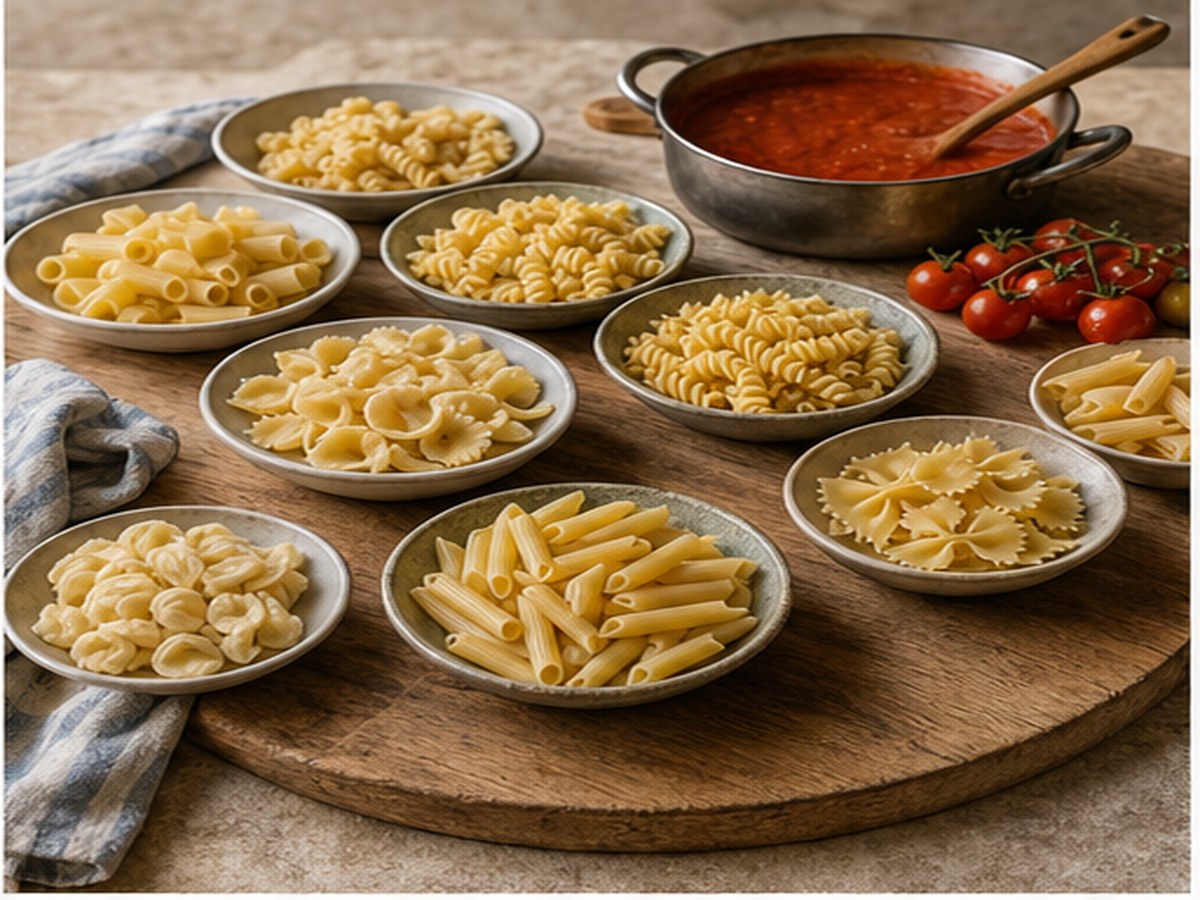
The funny thing is that every shape of pasta is meant for a particular kind of sauce — rigatoni and paccheri for the thick Sunday ragù, spaghetti for clams or anchovies where the sauce needs to coat rather than cling, ditali for the legume soups where pasta and beans finish cooking together into a third thing that is neither. The infographic below maps both the weekly rotation and the shape logic.
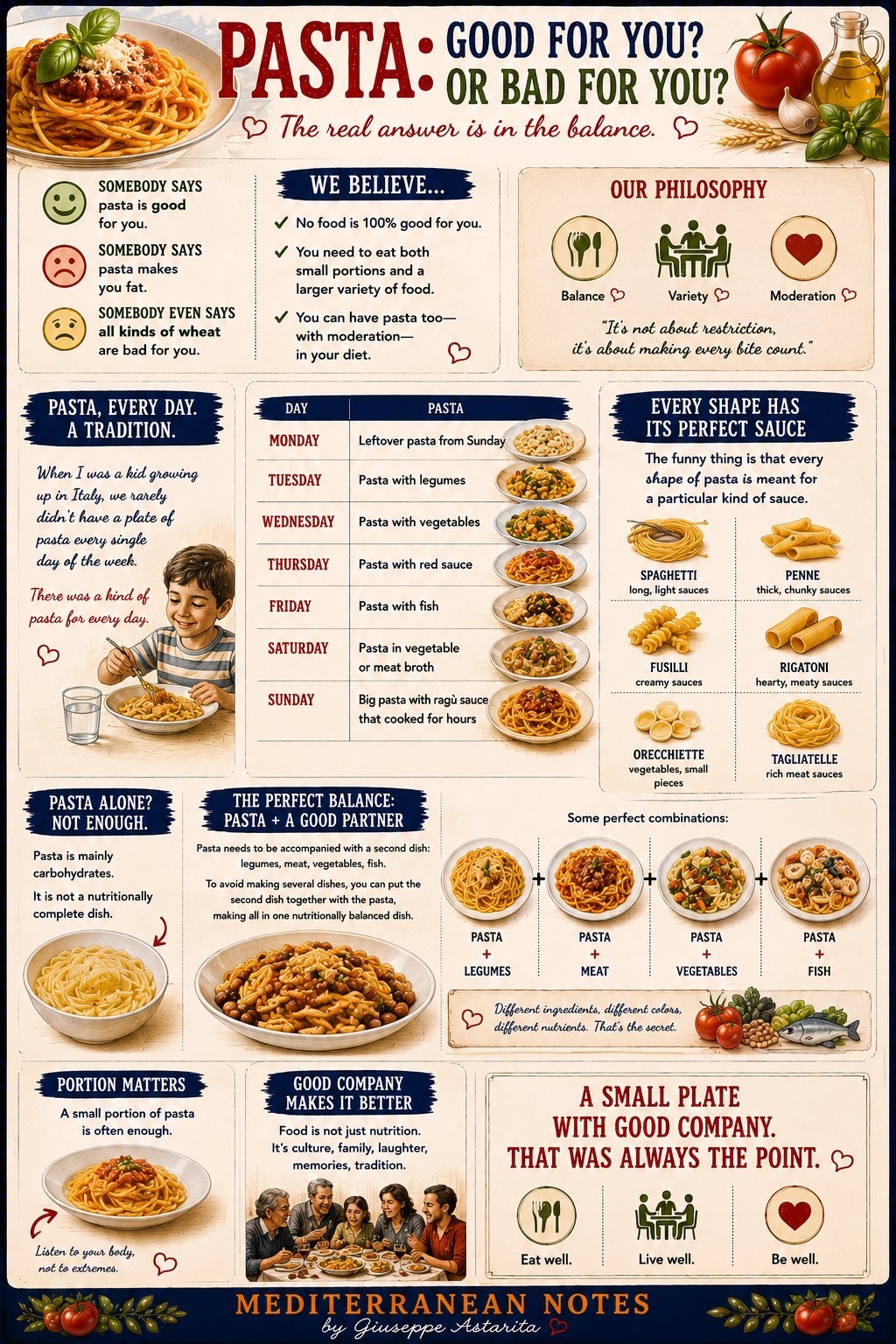
The nutritional case against pasta is almost always a case against pasta eaten in large quantities as an entire meal, or pasta eaten as part of a caloric surplus, or pasta made from highly refined flour with a high glycemic index and no accompanying fiber or protein to slow glucose absorption. These are real concerns, but they describe a different eating pattern from the one this collection documents. Traditional Campanian pasta portions were small by modern American standards — perhaps 80–100 g dry per person — and they were followed by a protein-rich secondo and a fiber-rich salad, which together produced a meal with a glycemic load significantly lower than the pasta course alone would suggest.
The Mediterranean dietary pattern — of which daily pasta as a first course is a component — consistently shows favorable outcomes in cardiovascular, metabolic, and longevity research precisely because it is a pattern rather than a single food. The pasta matters less than what surrounds it. Monday's leftover ragù pasta eaten cold from the refrigerator, reheated or pan-fried, actually has a lower glycemic index than freshly cooked pasta because the starch partially retrogrades during cooling, becoming more resistant to rapid digestion. This is one of those cases where what looked like simply using leftovers turns out to have a metabolic rationale as well. The tradition got it right without knowing why.
The posts in this collection describe specific sauces with their specific pasta pairings — the ragù napoletano with ziti spezzati or rigatoni, the finto ragù with paccheri, the Sunday sugo with candele broken by hand. In each case the shape is part of the dish, not a suggestion that can be swapped without consequence. The table above tells you which day, which sauce, which occasion. The other posts tell you how to make them.
Buon appetito — tutti i giorni.