Spaghetti al tonno alla napoletana: late night, canned tuna, no Parmigiano
Tomato, capers, Gaeta black olives, good tuna in olive oil, fresh parsley. One of the fastest and most reliable pasta dishes in the Italian pantry. Also the one I used to make late at night with friends, in the version with panna instead of tomatoes. But please — no Parmigiano.
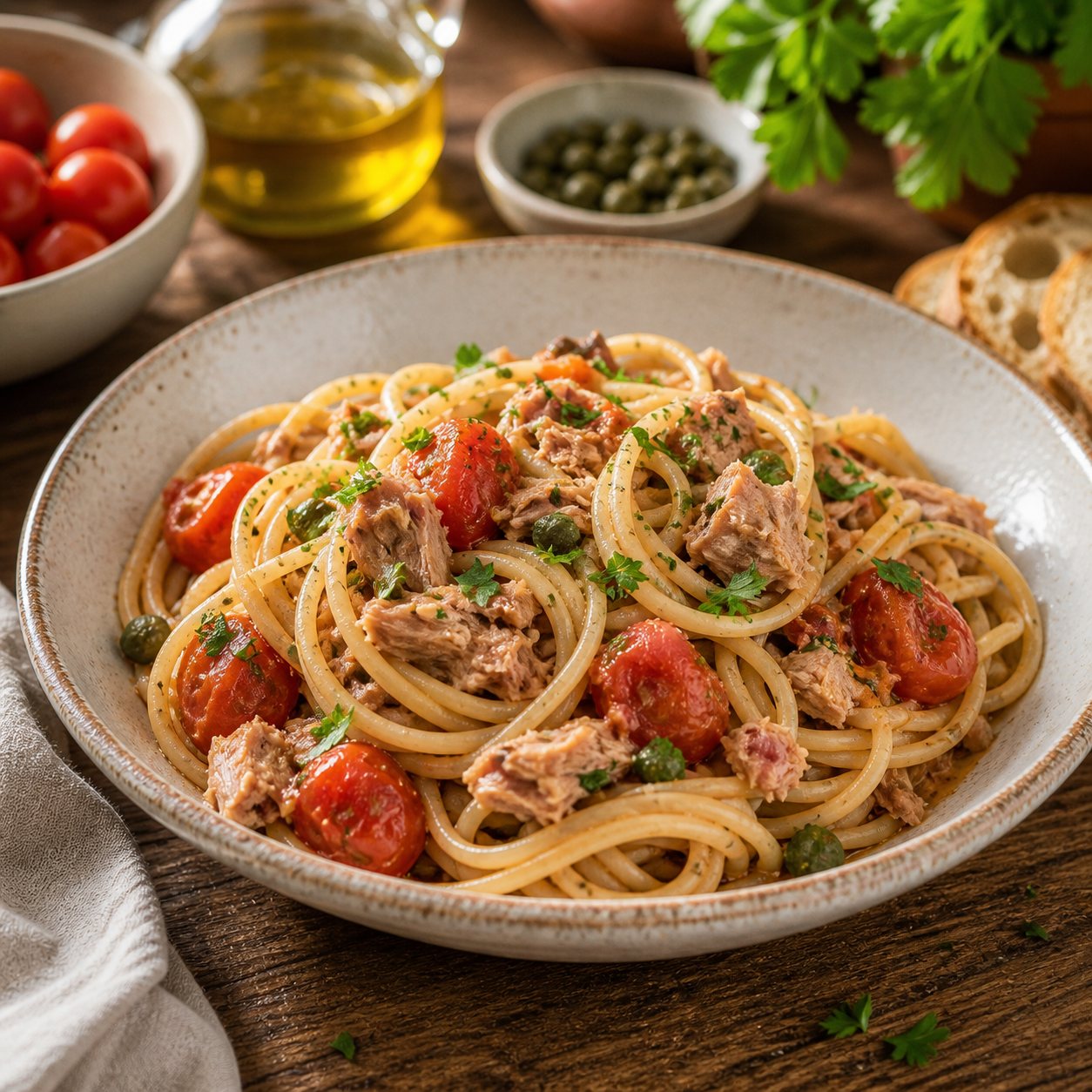
The spaghetti al tonno alla napoletana is a cucina povera classic that behaves like a luxury dish. The ingredients are entirely pantry-based — canned tuna, a can of peeled tomatoes or a jar of passata, olives, capers — and the sauce is ready in the time it takes to boil the pasta. It was traditionally a meatless dish for special days, including Christmas Eve, when the Neapolitan table required fish and simplicity simultaneously. It now appears on the regular weeknight table because it is fast, reliable, and significantly better than its effort level would suggest.
The Neapolitan version is specifically the one with tomato, capers, and Gaeta olives — distinguished from the in bianco version (white, no tomato) that is equally common elsewhere in Italy. The capers are salted and must be rinsed well before using — they should add a sharp, briny complexity to the sauce, not saltiness that overwhelms everything else. The Gaeta olives are the small, wrinkled black olives from the Lazio-Campania border, with a flavor that is more complex and slightly bitter than the bland pitted black olives from a can. If you cannot find Gaeta olives, use Kalamata — the flavor profile is similar enough. Do not use generic pitted black olives from a can. They are a different ingredient.
The late-night version with cream (panna) instead of tomatoes exists in a different register entirely. No capers, no olives — just tuna, onion or garlic, cream, and spaghetti. It is richer, softer, more immediately comforting at midnight, and it requires even less from the cook. It is also the version that would make a Neapolitan grandmother raise her eyebrows — not because it is wrong, exactly, but because it is not the dish. Both versions have their place. The tomato version is the classic. The panna version is what you make when you want something warm and creamy at midnight with whatever is in the house.
Canned tuna is having a moment — deservedly, given that good oil-packed tuna is a genuinely excellent ingredient that is nutritionally dense, long-lasting, and versatile. The quality difference between good tuna (albacore or yellowfin, packed in extra-virgin olive oil) and supermarket generic (packed in water or refined vegetable oil) is substantial — the oil-packed version has a texture and flavor that holds up in a hot sauce, while the water-packed version tends to dry out and become stringy. Buy the best tuna you can find for this dish. It is the primary ingredient and it shows.
The rule — not negotiable
No Parmigiano on pasta with fish. This is not a preference or a suggestion — it is one of the few genuine rules of Italian pasta tradition that is universally maintained across regions. The reason is not merely custom: aged cow's milk cheese has strong, persistent flavor compounds that clash with the delicate, volatile aromatics of fish and seafood. The combination produces something that tastes off in a way that is difficult to articulate but immediately perceptible. Butter is acceptable — it is neutral enough not to conflict. Heavy cream (panna) is acceptable, for the same reason. Parmigiano is not. If you feel the dish needs something to finish it: more olive oil, a squeeze of lemon, extra parsley, or simply pasta cooking water to bind the sauce. Not Parmigiano.
Canned tuna: complete protein, omega-3s, and the difference oil-packed makes
Canned tuna in olive oil is one of the most nutritionally efficient ingredients in the pantry. A single 80 g serving (drained weight) provides approximately 20–22 g of complete protein, including all essential amino acids at adequate concentrations. It also provides EPA and DHA — the long-chain omega-3 fatty acids found almost exclusively in fatty fish and seafood — at approximately 200–400 mg per serving depending on the species and packing liquid. This is meaningful: most health authorities recommend 250–500 mg EPA+DHA per day, and a single portion of this pasta dish approaches or meets that target. Tuna also contributes selenium (one of the richest dietary sources, with a single serving providing 70–100% of the adult daily requirement), niacin (B3), B12, and potassium. The olive oil in which the tuna is packed contributes additional oleic acid and phenolic antioxidants and is worth draining into the sauce rather than discarding — the tuna oil is infused with the fish's fat-soluble compounds and adds depth to the sauce. Capers, rinsed of their salt, contribute quercetin and kaempferol — two flavonols whose combined antioxidant and anti-inflammatory activity has been studied in relation to cardiovascular and metabolic health. Gaeta olives contribute oleic acid and phenolic antioxidants characteristic of all olive varieties. Tomatoes provide lycopene, vitamin C, and potassium. The rule against Parmigiano on fish pasta has a flavor-chemistry basis: the volatile sulfur compounds in aged cheese (methanethiol, dimethyl sulfide) react with the amines in fish to produce compounds with distinctly unpleasant odor profiles — a genuinely adverse flavor interaction, not merely Italian cultural preference.
The recipe — alla napoletana (with tomato)
Ingredients · serves 4
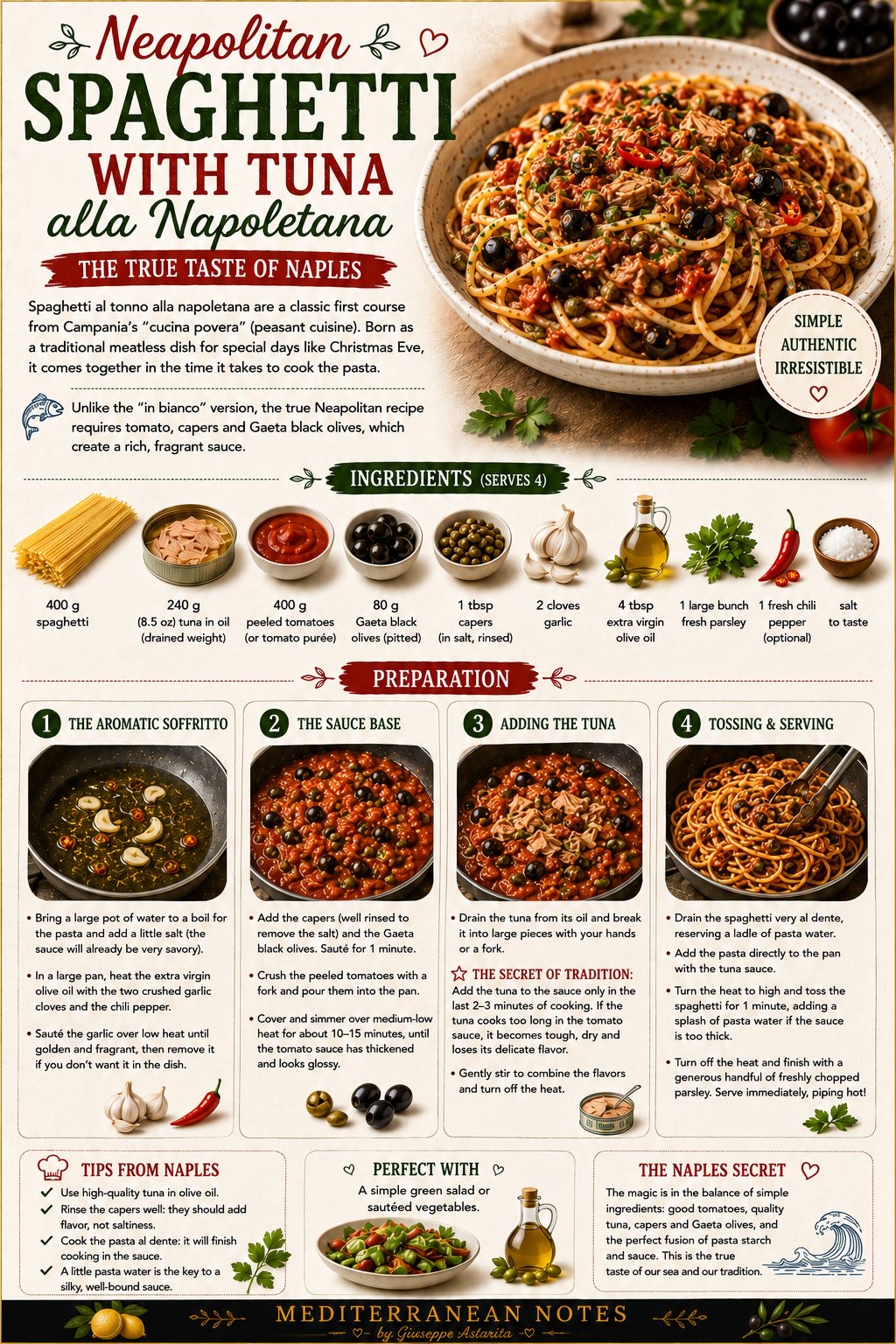
Method
Build the soffritto. In a large pan, heat the olive oil over low heat. Add the whole garlic cloves and chili if using. Sauté gently until the garlic is golden and fragrant — 3–4 minutes. Remove the garlic if you prefer (leave it in if you like it). Add the rinsed capers and pitted olives. Stir for 1 minute.
Add the tomatoes. Add the crushed peeled tomatoes or passata. Stir, season lightly with salt (taste first — the capers and olives are already salty), and simmer over medium-low heat for 10–15 minutes until the sauce has thickened and is glossy. Meanwhile, bring a large pot of well-salted water to a boil and cook the spaghetti.
Add the tuna — at the right moment. This is the critical step: drain the tuna and break it into large flakes with a fork. Add it to the sauce only in the last 2–3 minutes of pasta cooking time. If the tuna cooks too long in the tomato sauce it becomes tough, dry, and loses its delicate flavor. Add it late, fold it gently, and turn off the heat as soon as the pasta goes in.
Pour the reserved tuna oil into the sauce when you add the tuna — it adds depth and binds the sauce.
Finish and serve. Drain the spaghetti al dente, reserving a ladle of pasta water. Add the pasta directly to the pan with the tuna sauce. Turn the heat to high and toss for 1 minute, adding a splash of pasta water if needed to loosen. Turn off the heat. Finish with the chopped parsley — generously. Serve immediately, piping hot. No Parmigiano.
Variations — the tuna is the base
In bianco — white, no tomato
Garlic, olive oil, capers, olives, tuna — no tomato. A cleaner, more delicate version where the tuna flavor is the primary note rather than the background. Often preferred in summer. Finish with lemon zest and extra parsley. Still no Parmigiano.
Con la panna — the late-night version
Sauté a little onion in butter. Add the tuna and warm through. Add 150 ml of heavy cream and let it thicken for 2 minutes. Toss with the drained pasta. No capers, no olives, no tomato — a completely different dish, soft and immediate and appropriate for midnight. Butter and panna are allowed with fish; Parmigiano is not.
Con le zucchine
Add diced zucchini to the soffritto before the tomatoes — cook until golden and slightly caramelized. The sweetness of the zucchini against the saltiness of the capers and tuna is one of the more interesting combinations in this family of sauces. A summer version.
Con i capperi e limone
White version — garlic, capers, tuna — finished with a squeeze of fresh lemon and extra olive oil instead of pasta water to bind. Bright, sharp, the most Mediterranean version. Works well with linguine or spaghetti. The simplest combination in this collection and the one that shows most clearly what good tuna tastes like.
Buon appetito — e niente Parmigiano.