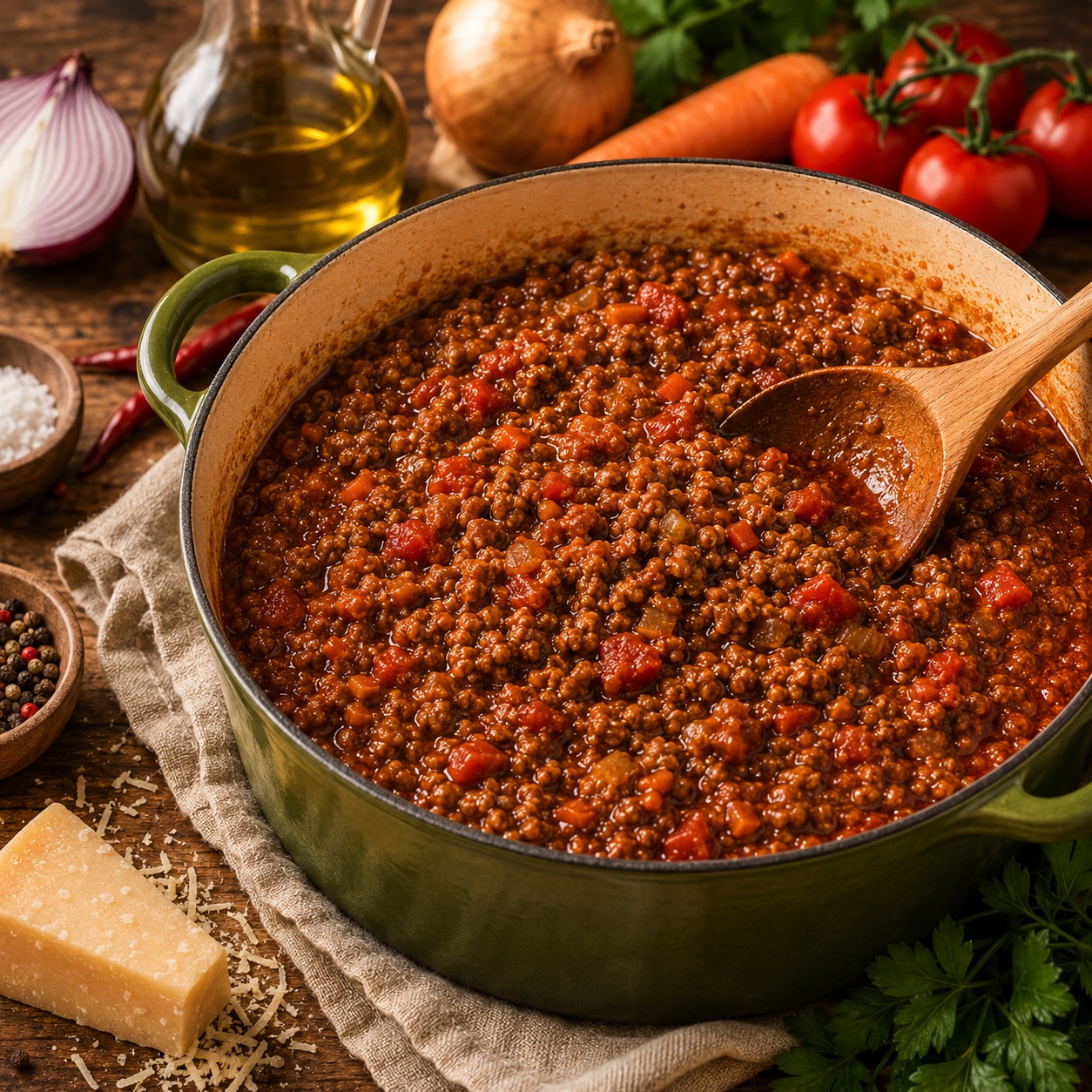
Ragù alla Bolognese: the version without pancetta — and always with fresh tagliatelle
The official recipe registered at the Bologna Chamber of Commerce in 1982 includes pancetta tesa di maiale. This version omits it — lighter, cleaner in flavor, but equally rich and deeply satisfying after three hours on the stove. Fresh egg tagliatelle or pappardelle only. Never spaghetti. This is not a preference, it is a pasta law.
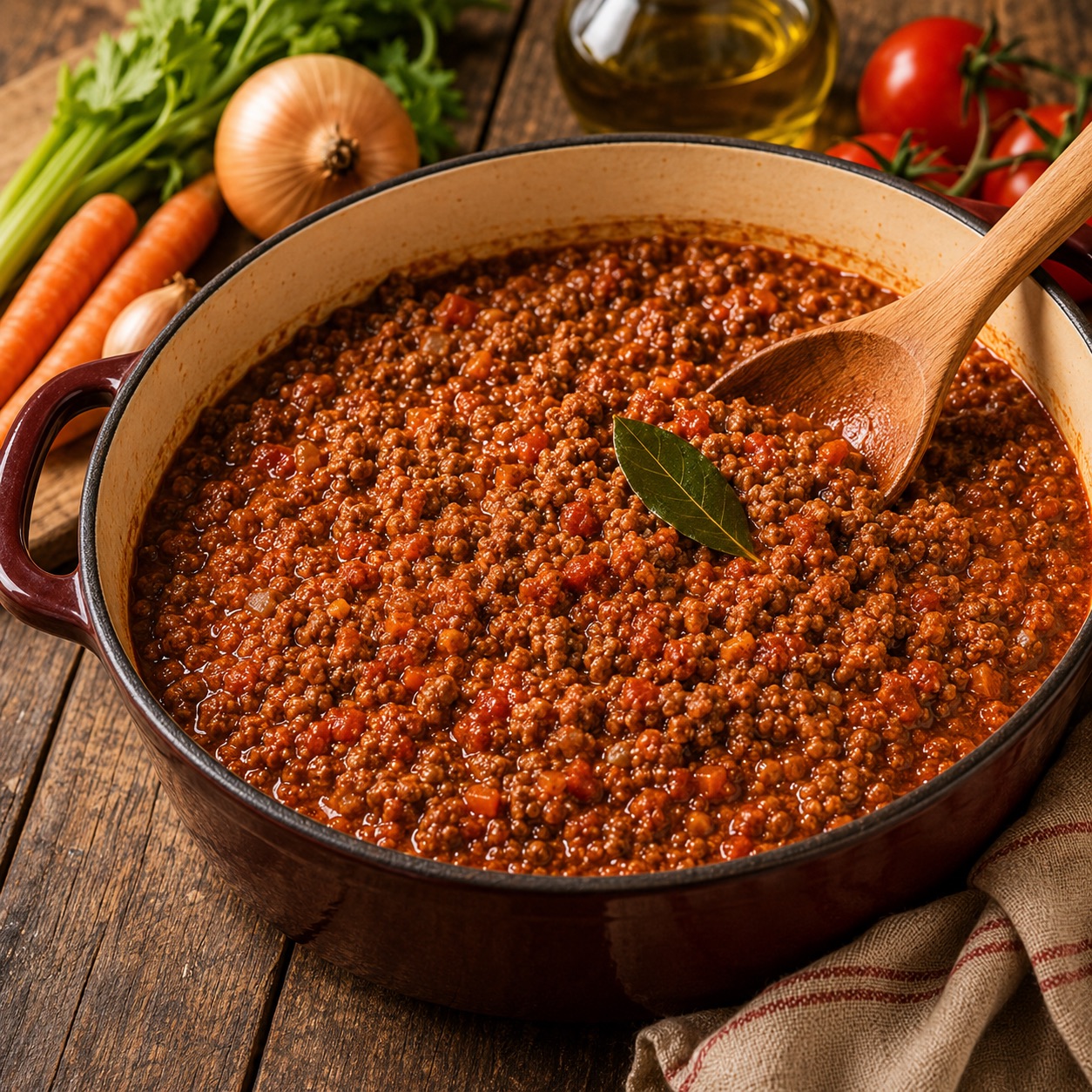
The ragù alla Bolognese is not from Campania — it belongs to Emilia-Romagna, to Bologna, to a culinary tradition centered on egg pasta and slow-cooked meat sauces that is one of the great contributions of the northern Italian table. It appears in this collection because it is one of the Italian classics that every household knows and makes in some version, because it is the sauce for which the fresh egg pasta tradition exists in its most celebrated form, and because the version made without pancetta — which is how this household makes it, since pancetta is not always present — is genuinely worth documenting as a legitimate and excellent preparation in its own right.
The official recipe — La Ricetta Ufficiale del Ragù alla Bolognese, deposited at the Accademia Italiana della Cucina and registered at the Bologna Chamber of Commerce in 1982 — specifies: beef (cartella, the plate cut), pancetta tesa, onion, carrot, celery, tomato passata or concentrate, dry white wine, whole milk, and tagliatelle. No garlic, no herbs beyond the vegetables, no cream. The pancetta provides fat, body, and a cured pork undertone that gives the official version its particular richness. Omitting it produces a leaner sauce where the two meats — beef and pork — carry the flavor without the additional cured pork fat. The result is lighter, cleaner, and still completely satisfying after the required hours of slow cooking. It is not the official version. It is an excellent version.
The two-meat combination — beef and pork — is important. The beef provides the primary flavor and the iron-rich depth of red meat; the pork adds fat and tenderness and a softer texture in the finished sauce. The ratio is roughly 2:1 beef to pork. The cuts matter: well-marbled beef (chuck, brisket, or beef belly) rather than lean mince; pork shoulder or neck rather than loin. Both should be ground coarsely if possible — the texture of the finished sauce depends on the mince not being too fine, which produces a paste rather than the loose, distinct-grain texture that is characteristic of a proper Bolognese.
The milk is the detail that surprises people who encounter it for the first time. A proper Bolognese contains whole milk — added in the last 15–20 minutes of cooking, stirred in gradually, allowed to absorb and reduce into the sauce. The milk mellows the acidity of the tomato and the wine, rounds the flavor, and makes the meat incredibly tender by further breaking down the collagen in the long-cooked mince. The finished sauce should be rich and smooth and slightly creamy — not from cream, but from the milk that has been absorbed into the meat and the sauce over the last stage of the slow cook. Skip the milk and the sauce is still good. Add it and the sauce becomes something slightly different and better.
The pasta rule — not negotiable
Fresh egg tagliatelle or pappardelle. Not spaghetti, not rigatoni, not penne. The Accademia Italiana della Cucina has a gold model of the correct tagliatelle width — 8mm cooked, exactly 1/12,270th the height of the Torre degli Asinelli in Bologna — on permanent display. The reason is not arbitrary: the rough, egg-enriched surface of fresh tagliatelle grips the ragù and carries it through the dish in a way that smooth dried pasta cannot replicate. A Bolognese on spaghetti is a different dish — it is what most of the world calls Bolognese, but it is not what the dish is. Fresh tagliatelle or pappardelle: the pasta and the sauce are designed for each other and the combination is the point.
Maillard reactions, collagen, and the chemistry of hours-long meat sauce
The Bolognese ragù is one of the most chemically complex preparations in the Italian kitchen, not because of exotic ingredients but because of the duration of the cooking and the number of distinct chemical transformations that occur over three hours. The soffritto — onion, carrot, celery cooked in butter and olive oil for 10–15 minutes — undergoes Maillard reactions and caramelization that produce pyrazines, furans, and melanoidins at concentrations that define the flavor base of the sauce. The browning of the meat produces additional Maillard compounds (particularly thiazoles and pyrroles from the interaction of amino acids with reducing sugars in the meat), and the command not to rush the browning step is a flavor-chemistry directive: under-browned meat is grey and muted; properly browned meat has developed hundreds of distinct volatile compounds that cannot be produced at lower temperatures. The wine deglazing step dissolves the browned fond from the pan (concentrated Maillard products) and the alcohol volatilizes during evaporation, leaving the grape-derived phenolics and organic acids behind as flavor compounds. The long simmer at minimum heat extracts collagen from the connective tissue in the well-marbled cuts and converts it to gelatin — the same mechanism as in the tagliolini brodo post — producing the silky, body-rich texture of a properly made Bolognese. The milk added at the end contains casein proteins and lactose: the lactose undergoes partial Maillard reaction with amino acids from the meat at the simmering temperature, contributing additional caramelized notes; the casein acts as an emulsifier, binding the fat phase more stably into the aqueous phase and producing the creamy cohesion of the finished sauce. The lactic acid in whole milk (pH ~6.5) also partially denatures the surface proteins of the meat particles, contributing to tenderness — this is the tenderizing mechanism also observed with buttermilk marinades in other culinary traditions. Nutritionally, the Bolognese provides complete protein from two meat sources, iron (heme iron from beef at high bioavailability), zinc, B12, collagen-derived gelatin peptides, and fat-soluble vitamins from both the meat fat and the butter. Served with fresh egg tagliatelle, it is a complete meal with balanced macronutrients and a micronutrient profile that reflects the richness of its ingredients.
The recipe
Ingredients · serves 6–8
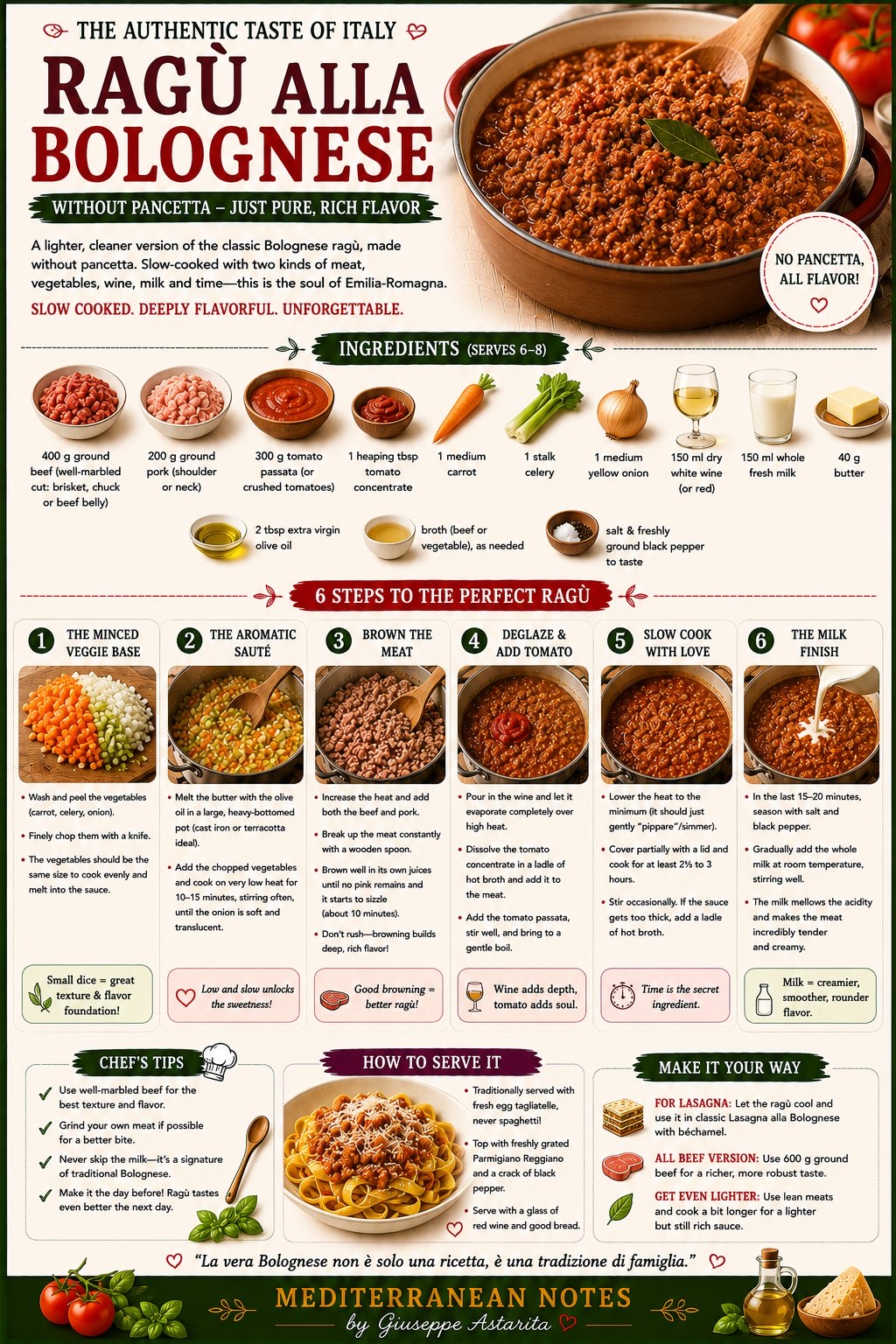
Method — 6 steps over 3 hours
Prepare the soffritto. Finely dice the carrot, celery, and onion to an even, small dice — they should be roughly the same size so they cook evenly and melt into the sauce. In a large, heavy-bottomed pot (cast iron or terracotta ideal), melt the butter with the olive oil over low heat. Add the vegetables and cook very gently for 10–15 minutes, stirring often, until the onion is completely soft, sweet, and translucent. Do not brown. This step builds the sweet foundation of the sauce.
Brown the meat. Increase the heat to medium-high. Add both the beef and pork. Break up the meat constantly with a wooden spoon. Brown well — no pink should remain — until the meat sizzles and begins to stick slightly to the bottom, about 10 minutes. Do not rush this step: the browning is where most of the flavor of the finished sauce originates. Well-browned meat produces a completely different result from pale, steamed-grey meat.
The meat will release liquid first and appear to be boiling rather than browning. Keep the heat high and keep breaking and stirring until the liquid has evaporated and the meat begins to sizzle and color. That is the moment that matters.
Deglaze with wine. Pour in the wine over high heat. Let it evaporate completely — you should no longer smell alcohol, only the grape. This takes about 3–5 minutes. The wine dissolves the browned fond from the bottom of the pot; scrape and stir to incorporate everything.
Add the tomato. Dissolve the tomato concentrate in a ladle of warm broth and add to the meat. Stir well. Add the tomato passata. Bring to a gentle boil, stirring to combine all elements. The tomato should be present but not dominant — the Bolognese is a meat sauce, not a tomato sauce. Reduce the heat immediately to the lowest possible setting.
Slow cook. Cover partially with a lid and simmer at the absolute minimum heat — the surface should just barely tremble, never boil rapidly — for at least 2½ to 3 hours. Stir occasionally. If the sauce becomes too thick, add a ladle of warm broth. The sauce is ready when the meat is tender, the fat has separated slightly and glistens on the surface, and the color has deepened to a rich, dark reddish-brown.
Meglio il giorno dopo — better the next day. Make the ragù the evening before, refrigerate overnight, and reheat gently. The flavors consolidate overnight and the sauce becomes markedly richer and more complex. Make a large batch.
Add the milk — the final step. In the last 15–20 minutes of cooking, season with salt and black pepper. Gradually pour in the whole milk at room temperature, stirring continuously. Let it absorb and reduce into the sauce over the remaining cooking time. The sauce should become noticeably creamier, smoother, and more rounded in flavor. Serve with fresh egg tagliatelle and a generous amount of Parmigiano Reggiano.
How to use the ragù
With fresh tagliatelle or pappardelle
The canonical use. Toss freshly cooked egg tagliatelle with a generous amount of ragù and Parmigiano Reggiano. The rough surface of the fresh pasta grips the sauce at every turn. Serve immediately — ragù Bolognese waits for no one at the table.
For lasagna alla Bolognese
Let the ragù cool completely. Use it layered with béchamel and fresh pasta sheets for a classic lasagna alla Bolognese — one of the great uses of a slow-cooked ragù and a natural companion to the fresh egg pasta in this collection. The ragù should be cool and firm when assembling so the layers set properly during baking.
With rigatoni — the Roman adaptation
In Rome, this sauce is served with rigatoni rather than tagliatelle — a substantial dried pasta that holds the ragù in its ridges and hollow interior. A different eating experience from the egg pasta version, and a legitimate one. Not Bolognese orthodoxy, but very good.
As filling for stuffed pasta
Cooled ragù mixed with Parmigiano and a little ricotta makes an excellent filling for tortellini, tortelloni, or cannelloni. The long-cooked, fine-textured meat is ideal for filling — it holds its shape inside the pasta without being dry or crumbly. Serve the stuffed pasta in brodo or with a simple butter and sage sauce.
"La vera Bolognese non è solo una ricetta, è una tradizione di famiglia."
Buon appetito — e buona domenica.