La Pasta Fatta in Casa
Homemade Fresh Egg Pasta
We still make it at home, with the girls — the rolling machine clamped to the table, the dough fed through by hand, the tagliolini or tagliatelle draped over the back of a chair to dry. Very easy, very fun, and you eat something you made entirely from scratch. You cannot go wrong with any sauce. The question is just which flour.
Italy has always had a tradition of fresh pasta shops — the pastificio, which makes and sells only fresh pasta, and where you went with a container and came home with tagliatelle or lasagne sheets or ravioli already made. In Caserta there were several in the neighborhood. Nowadays in Italy you barely need them — every supermarket and grocery store sells fresh pasta in the refrigerated section, and fewer and fewer people make it from scratch at home. The pastificio still exists but its clientele has changed.
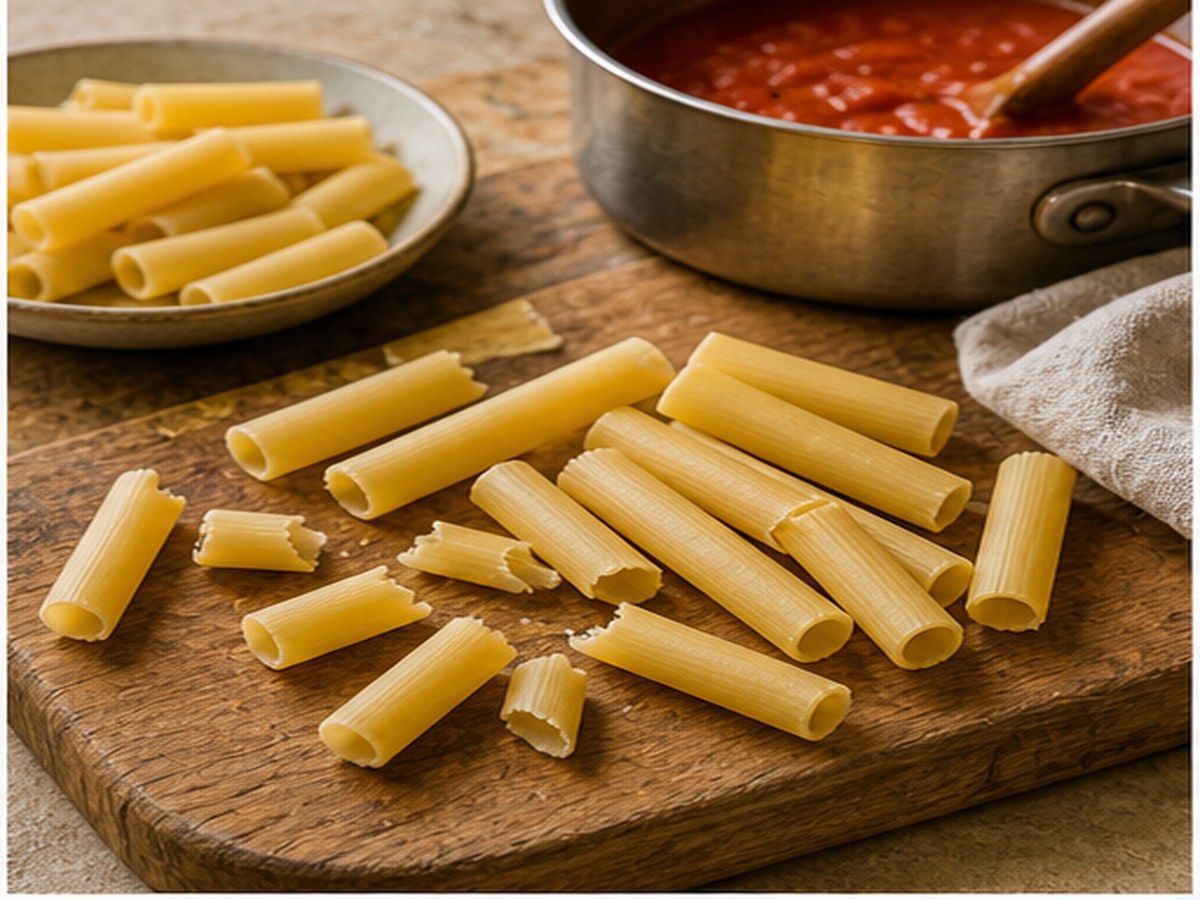
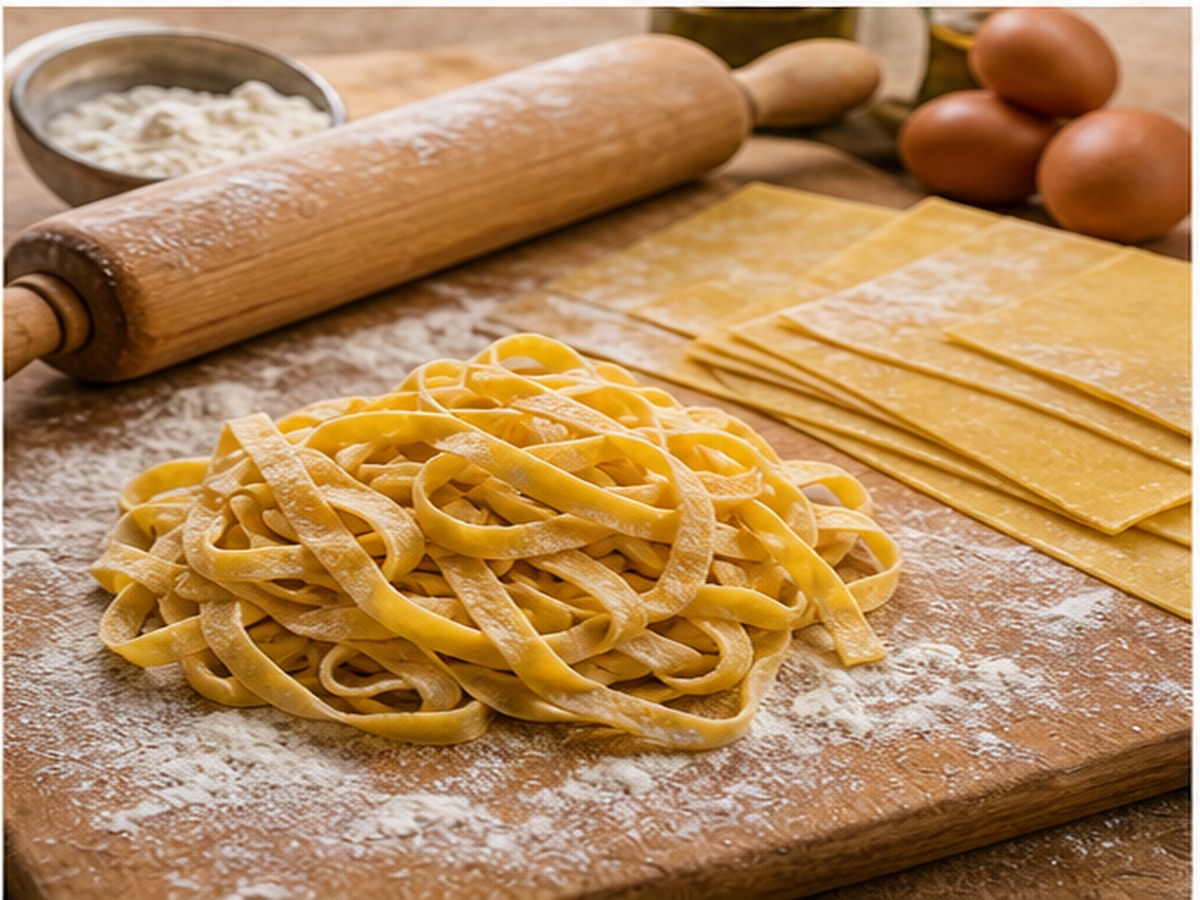
We still make it. It is one of the things I do with the girls in Massachusetts — the pasta machine clamped to the edge of the kitchen table, the dough worked and divided into portions, each one fed through the rollers starting at the thickest setting and passing through progressively thinner ones until you have a sheet you can almost see through. Anna is methodical about it; she likes feeding the dough and catching it on the other side. We make tagliolini or tagliatelle with the cutter attachment, or we cut pappardelle by hand with a knife, wide and irregular in the way that hand-cut pasta always is. We have also bought a pasta extruder in recent years, which makes short shapes — paccheri, penne, even bucatini — but the rolling machine is the better experience. The extruder is efficient. The rolling machine is fun.
The rolling machine on the table, the dough passing through by hand, the sheet coming out the other side longer each time — this is a Saturday morning activity that produces something edible for lunch. Not many cooking projects can claim both.
There is also a practical reason to make fresh pasta at home in the US that does not apply in Italy: tagliolini. The very thin egg pasta — thinner than tagliatelle, closer to a flat spaghetti — is essential for certain dishes, particularly tagliolini in brodo, the egg pasta in clear broth that is a completely different preparation from pastina in broth and requires the real thing. You cannot substitute dried spaghettini or capellini; they cook differently, they have a different texture in broth, and the result is a different dish. Tagliolini from scratch is the only solution in Massachusetts, because it is genuinely not available at any store I have found. Making it takes twenty minutes once the dough is rested.
The flour question — which one to use
This is the one question where the answer actually matters. The flour determines the texture of the pasta — how firm it is when cooked, how much it holds its shape, how it interacts with the sauce. The options:
All 00 flour
100% 00
Soft, silky, very tender when cooked. The standard fresh pasta of northern Italy — delicate, slightly yielding. Good for filled pasta (ravioli, tortellini) where tenderness is the point. Can be too soft for shapes that need to hold against a heavy sauce.
00 + semolina — the preferred mix
½ to ¾ 00 + ¼ to ½ semolina
The combination I prefer. The semolina adds structure and a slight roughness that holds sauce better, gives the pasta more bite when cooked, and makes it more forgiving of slight overcooking. 50/50 or 75/25 in favor of 00 both work well. Start here.
Egg-free with semolina
Semolina + water only
The format of most dried pasta sold in boxes. No eggs — just fine semolina (durum wheat flour, finely ground) and water. Produces a firmer, more resilient pasta. Without eggs you need the semolina for structure; soft 00 flour without eggs produces pasta that falls apart. Note: this is the direction of
pettole e fagioli, which is a different conversation.
What eggs and semolina actually do — the gluten and protein explanation
Flour mixed with water forms gluten — a protein network created when glutenin and gliadin proteins hydrate and link together during kneading. This network gives pasta its elasticity and its ability to hold a shape under cooking. Egg yolks add fat and emulsifiers (primarily lecithin from the yolk) that coat the gluten strands and produce a more tender, less chewy texture — which is why fresh egg pasta is softer than dried pasta. Egg whites add more protein and water, contributing to firmness.
Semolina is made from durum wheat, which has a higher protein content and a different gluten structure than soft wheat (00 flour). The durum gluten network is stiffer and more resistant to heat, which is why dried pasta — made almost exclusively from durum semolina — holds its shape through long cooking times without going mushy. Adding semolina to an egg pasta dough introduces this structural rigidity while keeping the tenderness from the eggs. The result is pasta that has more bite — the Italian al dente — and a slightly rough surface texture that adheres to sauce more effectively than a purely smooth 00 pasta. The golden rule of 1 egg per 100 g of flour holds regardless of which flour combination you choose: the ratio maintains the right hydration for a workable dough.
The recipe — serves 4
The golden rule: 1 medium egg per 100 g of flour. Scale up or down from there.
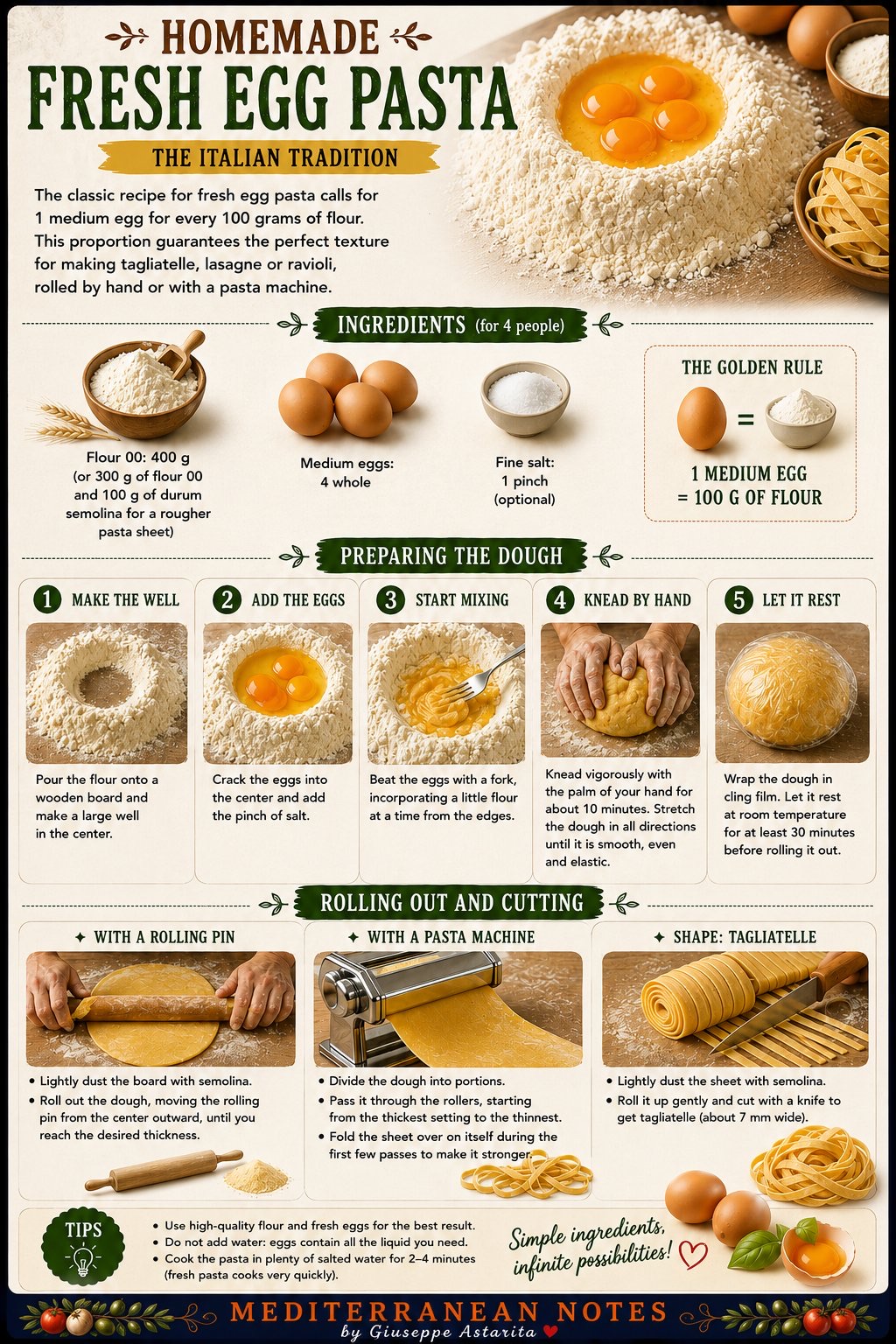
La pasta fatta in casa — the golden rule: 1 egg per 100 g of flour. Click to enlarge.
300 g 00 + 100 g fine semolina
Flour — the preferred mix; or 400 g all 00
4 medium
Eggs, at room temperature
1 pinch
Fine salt (optional)
1
Pour the flour onto a wooden board or into a large bowl and make a well in the center. Crack the eggs into the well and add the pinch of salt. Beat the eggs with a fork, incorporating flour gradually from the inner edges of the well until the mixture is too thick to work with a fork.
Do not add water. The eggs contain all the liquid you need. If the dough feels too dry after 5 minutes of kneading, wet your hands slightly rather than adding water directly.
2
Knead vigorously by hand for about 10 minutes — pushing the dough away with the heel of your palm, folding it back, rotating a quarter turn, repeating. The dough should become smooth, even, and elastic. When you press a finger in it should spring back slowly. If it tears when stretched, it needs more kneading.
3
Wrap tightly in cling film and rest at room temperature for at least 30 minutes. This is not optional — the resting allows the gluten network to relax, making the dough much easier to roll without springing back. After 30 minutes it will feel noticeably more pliable.
4
Divide the dough into 3–4 portions. Keep the portions you are not rolling covered. Feed each portion through the pasta machine starting at the widest setting (1), folding it in half and passing it through again two or three times to make it smooth and even. Then pass it through each progressively thinner setting without folding — 2, 3, 4, 5 — until you have a thin, even sheet. For tagliolini go to setting 6 or 7. For tagliatelle, 5 or 6. For pappardelle cut by hand, 4 or 5.
Dust the sheet lightly with semolina as you work to prevent sticking. Semolina rather than 00 — it coats without clumping.
5
Cut using the machine's cutter attachment for tagliolini or tagliatelle, or roll the sheet loosely and cut across with a sharp knife for pappardelle. Unroll immediately and dust with semolina. Drape over the back of a chair, a drying rack, or lay flat on a floured surface. Cook within an hour or dry completely and store.
Fresh pasta cooks very fast — 2 to 4 minutes in plenty of well-salted boiling water depending on thickness. Taste constantly. It goes from al dente to overcooked in under a minute.
Why you need it in the US — the tagliolini problem
Tagliolini — the very thin egg pasta, flatter than spaghetti, thicker than a capellino — is not available in American supermarkets in fresh form and the dried version is rare. It is essential for tagliolini in brodo: egg pasta cooked directly in a clear meat broth, which is a completely different preparation from pastina in broth and cannot be replicated with dried spaghettini or capellini. The dried pasta cooks at a different rate, has a different texture, and sits differently in the broth. Making the tagliolini from scratch takes twenty minutes once the dough has rested and is the only correct solution when you are not in Italy. This alone justifies keeping the pasta machine accessible rather than stored.
Shapes, tools, and what to do with it
The rolling machine vs the extruder
The manual rolling machine (Atlas, Imperia, or equivalent) produces flat sheets that you cut into tagliolini, tagliatelle, pappardelle, or use for lasagne and filled pasta. The pasta extruder pushes dough through bronze dies to make short shapes — rigatoni, penne, paccheri, even bucatini. Both have their place. The machine is more fun, especially with children; the extruder is more versatile for shapes but less engaging as an experience.
Which sauce — you cannot go wrong
Fresh egg pasta works with almost any sauce: a simple butter and Parmigiano, a cream of mushroom, a ragù, a simple tomato. The pasta itself is flavorful enough that even a very light dressing — just olive oil and grated cheese — is satisfying. The semolina-blend version holds up better against heavier sauces. The all-00 version is better with delicate preparations. Both are correct.
Gnocchi — rarely
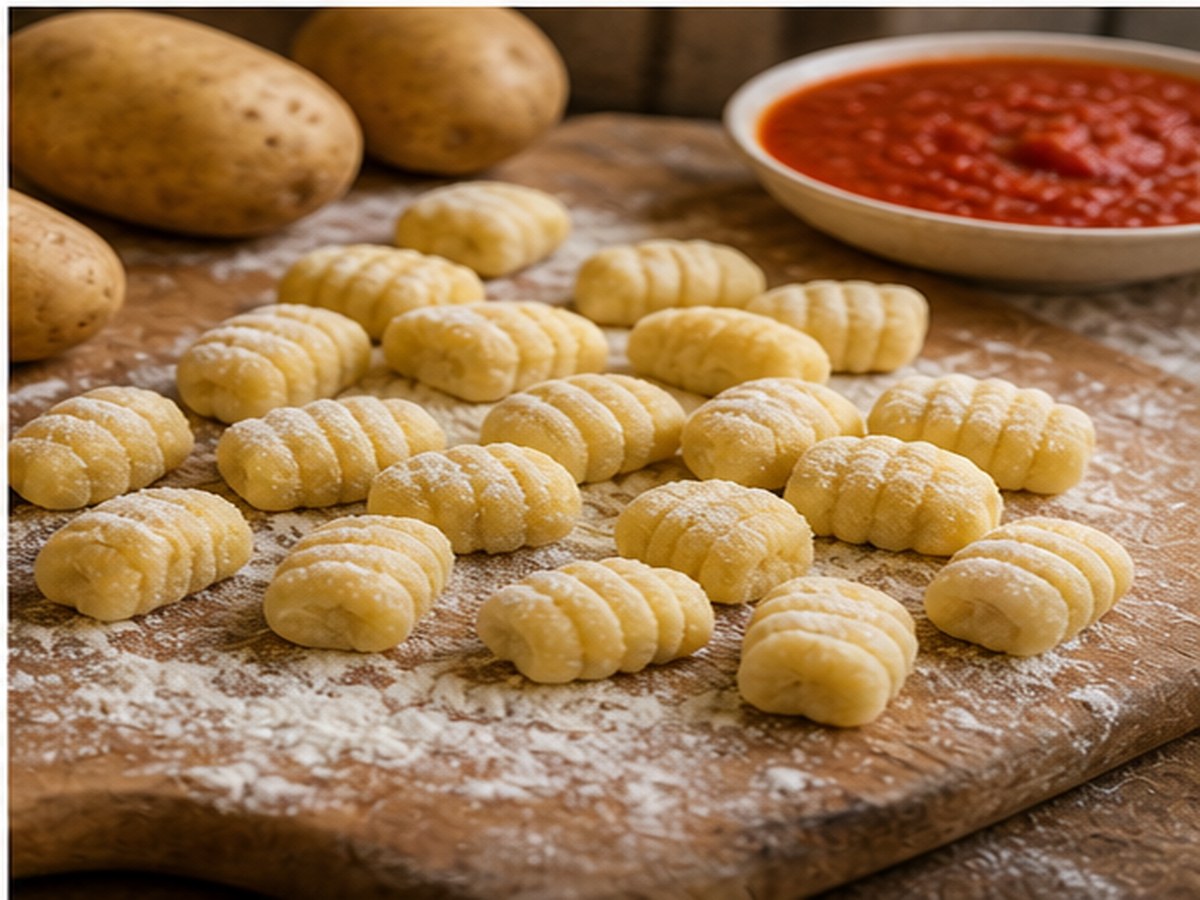
We make gnocchi occasionally — potato gnocchi, the basic version with flour and a little egg — but it is a separate project from pasta and requires different attention. The gnocchi dough is wetter and more forgiving in some ways, more demanding in others: too much flour and they are heavy, too little and they fall apart. A different post for a different day.
The pastificio — what is being lost
The neighborhood pasta shop that made only fresh pasta was a fixture of Italian daily life for generations. You went with a container, you bought what you needed that day, it was made that morning. Most supermarkets now sell perfectly acceptable fresh pasta, and fewer people bother making it. This is not a tragedy — the supermarket pasta is genuinely good — but something about the Saturday morning activity of making it with the girls, the flour everywhere, the sheets draped over the chair, is not replaceable by a refrigerated package, however convenient.
The skill of making fresh pasta is not difficult and it is not precious. The golden rule — one egg per 100 g of flour — is the whole technique. Everything else is practice: learning how the dough feels when it is right, knowing when the sheet is thin enough, timing the cooking correctly. Children learn it quickly because it is physical and produces immediate results. The pasta machine is one of those tools that earns its counter space.
Buona pasta — fatta con le vostre mani.