Gnocchi di patate: a treat, underrated, full of family memory
Two main ingredients: potatoes and flour. Easy to prepare, deeply comforting, full of love and family memories — and underappreciated in the United States in a way that is genuinely puzzling. A plate of soft, pillowy homemade gnocchi in a good sauce is one of the most satisfying things you can make, and the technique is simpler than it looks.
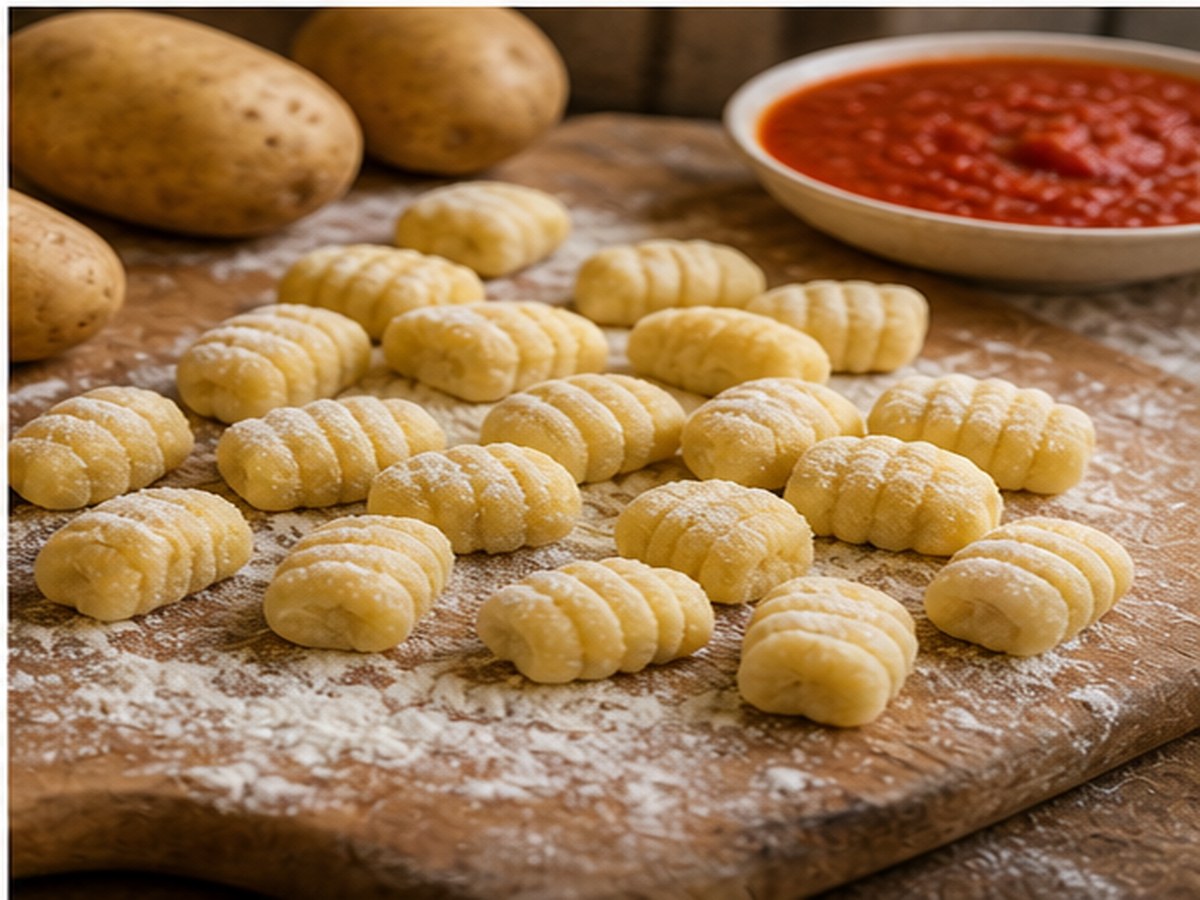
The gnocco is not pasta. It is something older and more elemental: a small dumpling of cooked potato and flour, shaped by hand, boiled briefly until it floats, transferred directly to a sauce. The tradition of making them from potatoes is relatively modern in Italian terms — potatoes arrived from the Americas in the sixteenth century and took centuries to become a staple — but the category of small hand-shaped dumpling cooked in water has roots in every region of Italy and in much of European cooking. The Neapolitan and Campanian household makes them with the same casual confidence applied to the crocchè di patate and the gattò di patate already in this collection: the potato is the base, the transformation is simple, and the result is completely satisfying.
The American unfamiliarity with gnocchi as a home-cooked dish is one of the more interesting cultural gaps. In Italy, making gnocchi on a Thursday (gnocchi di giovedì) is a Roman tradition with the force of a weekly ritual, and throughout the country homemade gnocchi appear at family tables with the same regularity as pasta. In the United States, gnocchi are typically encountered as a restaurant item — slightly dense, slightly chewy, served in a cream sauce — rather than as the light, pillowy, almost weightless thing that homemade gnocchi can be. The difference is almost entirely about the potato: the right potato, cooked correctly, riced while still hot, worked as little as possible with the flour, produces a gnoccho that is nothing like the commercial version. It melts in the mouth. It disappears.
The secret is in two places: the potato variety and the handling. Old, starchy potatoes — Russet, Kennebec, Maris Piper — have low water content and high starch content, which means the dough needs less flour to come together. Less flour means lighter gnocchi. Waxy or new potatoes have high water content and need more flour to produce a workable dough, which makes the gnocchi denser and heavier. The potato is not interchangeable in this recipe. The second secret is handling: work the dough only as much as necessary to bring it together — from the outside toward the center, quickly and gently. Every additional second of kneading develops more gluten and makes the gnocchi tougher. The Italians say mani leggere: light hands. The gnocchi reward exactly that.
Starch ratio, gluten, and water — the three forces that determine gnocchi texture
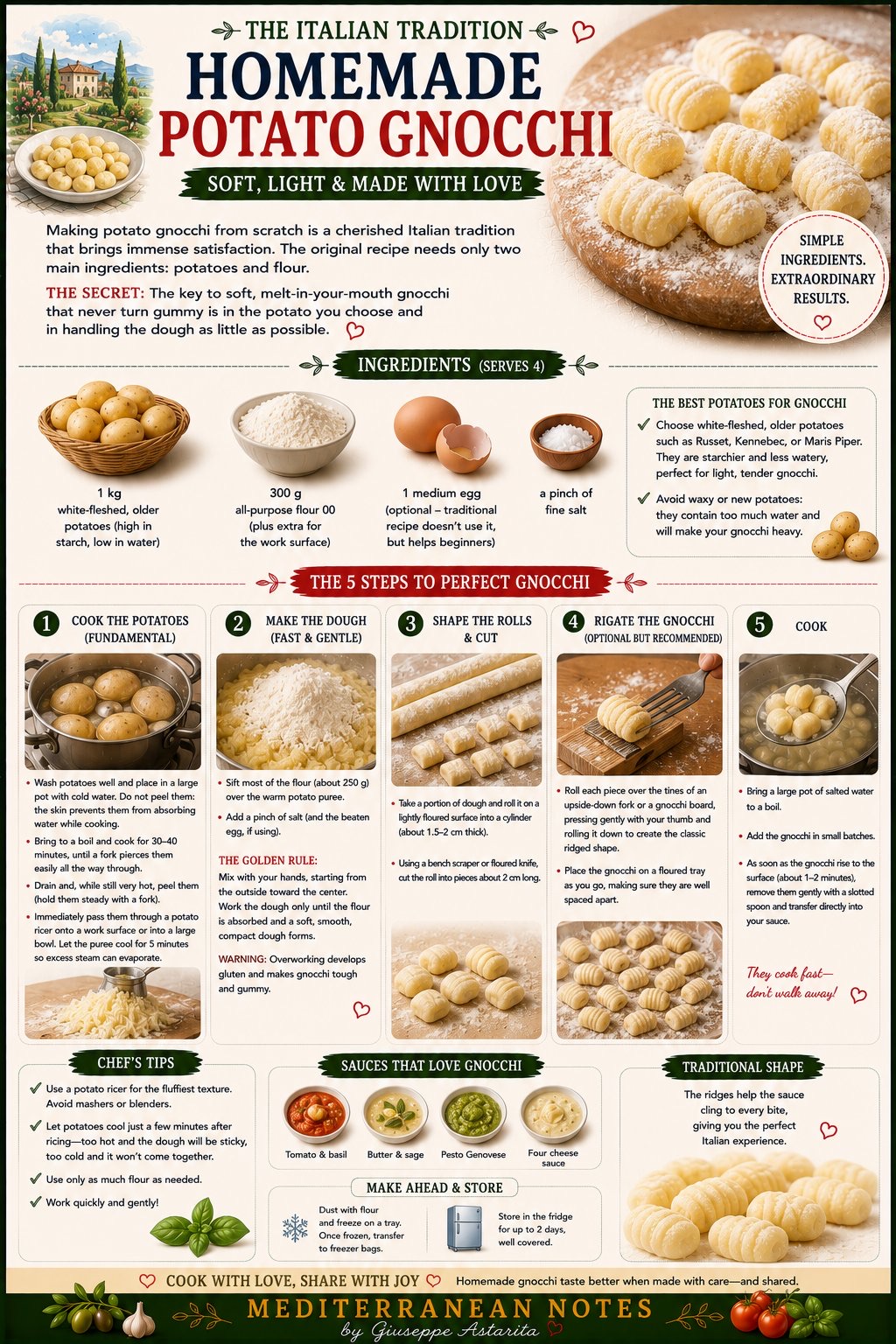
The texture of potato gnocchi is determined by the ratio and interaction of three structural elements: potato starch, gluten from the flour, and water. Starchy potato varieties (Russet, Kennebec) have a high amylose-to-amylopectin ratio, which produces a drier, more friable flesh when cooked — less water needs to be displaced during mixing, less flour is required to produce a workable dough, and the resulting gnocchi have a lighter, more delicate texture. Waxy potatoes have the inverse ratio and produce a wetter, denser result. Cooking the potatoes in their skin prevents water absorption during boiling — this is why the infographic's instruction to cook unpeeled is technically important rather than merely traditional. The ricing step breaks the potato cells into fine particles without overworking the starch chains; using a blender or food processor instead would rupture the cells more violently and release more free starch, which when combined with flour produces a gluey, dense dough. The rest after ricing allows residual steam to escape, further reducing the moisture content and improving dough texture. The gluten warning in the recipe — "work only until the flour is absorbed, never longer" — reflects genuine food science: wheat gluten develops through mechanical agitation of glutenin and gliadin proteins in the presence of water. Every additional second of kneading cross-links more gluten, producing a tougher, chewier gnoccho rather than the soft, yielding texture that is the whole point. Cooking the gnocchi in boiling water gelatinizes the surface starch into a coating that keeps the pieces from sticking and gives them their characteristic smooth exterior. Rising to the surface signals that the density has decreased below that of water as the internal starch has fully gelatinized and the gnocchi have expanded slightly — the culinary float test is physically correct. Nutritionally, potato gnocchi provide complex carbohydrate (potato starch and wheat starch), potassium from the potato, B vitamins including B6 and folate, and some protein from the flour and the optional egg. They are a complete carbohydrate-based first course in the Italian tradition, appropriately followed by a protein-rich second course in a traditional meal structure.
The recipe
Ingredients · serves 4
Method
Cook the potatoes — in their skin. Wash the potatoes and place in a large pot of cold water without peeling. Bring to a boil and cook for 30–40 minutes until a fork pierces them easily all the way through. Drain. While still very hot, peel them (hold with a fork) and pass immediately through a potato ricer onto a clean surface or into a large bowl. Let the riced potato cool for 5 minutes so excess steam can escape — this is not optional.
Never use a blender, food processor, or masher. They rupture the potato cells and release too much free starch, producing a gluey dough. The ricer is the correct tool.
Make the dough — quickly and gently. Sift most of the flour (start with 200 g) over the warm riced potato. Add a pinch of salt and the egg if using. Mix from the outside toward the center with your hands, incorporating the flour gradually, until a soft, smooth, compact dough forms — use only as much flour as needed to stop the dough from sticking. Work only until the flour is absorbed. Stop immediately. Do not knead further.
Mani leggere — light hands. The moment the dough comes together, you are done. Every additional second of working develops gluten and makes the gnocchi tougher. Speed and restraint together.
Shape the gnocchi. Take a portion of the dough and roll it on a lightly floured surface into a cylinder about 1.5–2 cm thick. Cut into pieces about 2 cm long with a bench scraper or knife. Roll each piece over the tines of an upside-down fork or a gnocchi board, pressing gently with your thumb, to create the classic ridged shape. Place on a floured tray, well spaced.
Cook and serve. Bring a large pot of generously salted water to a rolling boil. Drop the gnocchi in small batches. As soon as they rise to the surface — 1–2 minutes — remove with a slotted spoon and transfer directly into your waiting sauce. Never leave them sitting in the water after they float. Toss gently to coat and serve immediately.
Have the sauce hot and ready before the gnocchi go into the water. The gnocchi wait for no one — they must go directly from pot to sauce.
The sauces — four that love gnocchi
Pomodoro e basilico
Simple tomato sauce with fresh basil — the most classic pairing, the one that shows the gnocco itself most clearly. The tomato should be good and the basil abundant. Parmigiano on top. This is the version most likely to convert someone who thinks they don't like gnocchi.
Burro e salvia
Brown butter with sage leaves fried until crisp — the northern Italian classic. Melt butter in a pan until it turns a deep golden brown and smells nutty, add a handful of sage leaves and let them crisp for 30 seconds, then immediately add the gnocchi. Parmigiano. Simple, rich, perfect. The sauce that most reveals the quality of the potato dough.
Quattro formaggi
Melt together Gorgonzola, Taleggio, Fontina, and Parmigiano with a splash of cream. Rich, indulgent, the version for very cold evenings when maximum comfort is the objective. The gnocchi hold up in a four-cheese sauce better than pasta does — their density absorbs without becoming overwhelmed.
Gnocchi dressed with the Sunday ragù napoletano from this collection — a combination that appears in Campanian cooking and that is genuinely excellent. The softness of the gnocchi against the richness of the slow-cooked ragù, with abundant Parmigiano. A different and slightly more elaborate Sunday primo.
Homemade gnocchi freeze beautifully — dust with flour, freeze on a tray, transfer to freezer bags. Cook from frozen in boiling water, adding 1–2 minutes. Making a double batch when you make them once is always the right decision. The work is in the shaping; the cooking takes two minutes and the satisfaction is immediate and complete.
They are underrated outside Italy. They are a treat. Every batch carries in its making the memory of hands that made them before — the grandmother's kitchen, the floured surface, the light pressure of the thumb on the fork. The infographic says it correctly: homemade gnocchi taste better when made with care — and shared.
Buon appetito — e mani leggere.