Meat · Secondo · Northern-Style Variation
Uccelletti alla Genovese
The creamy version. Same thin meat rolls, same sage, but the filling is prosciutto cotto and the pan sauce — made from the flour coating on the meat and the white wine — turns velvety and glossy entirely on its own.
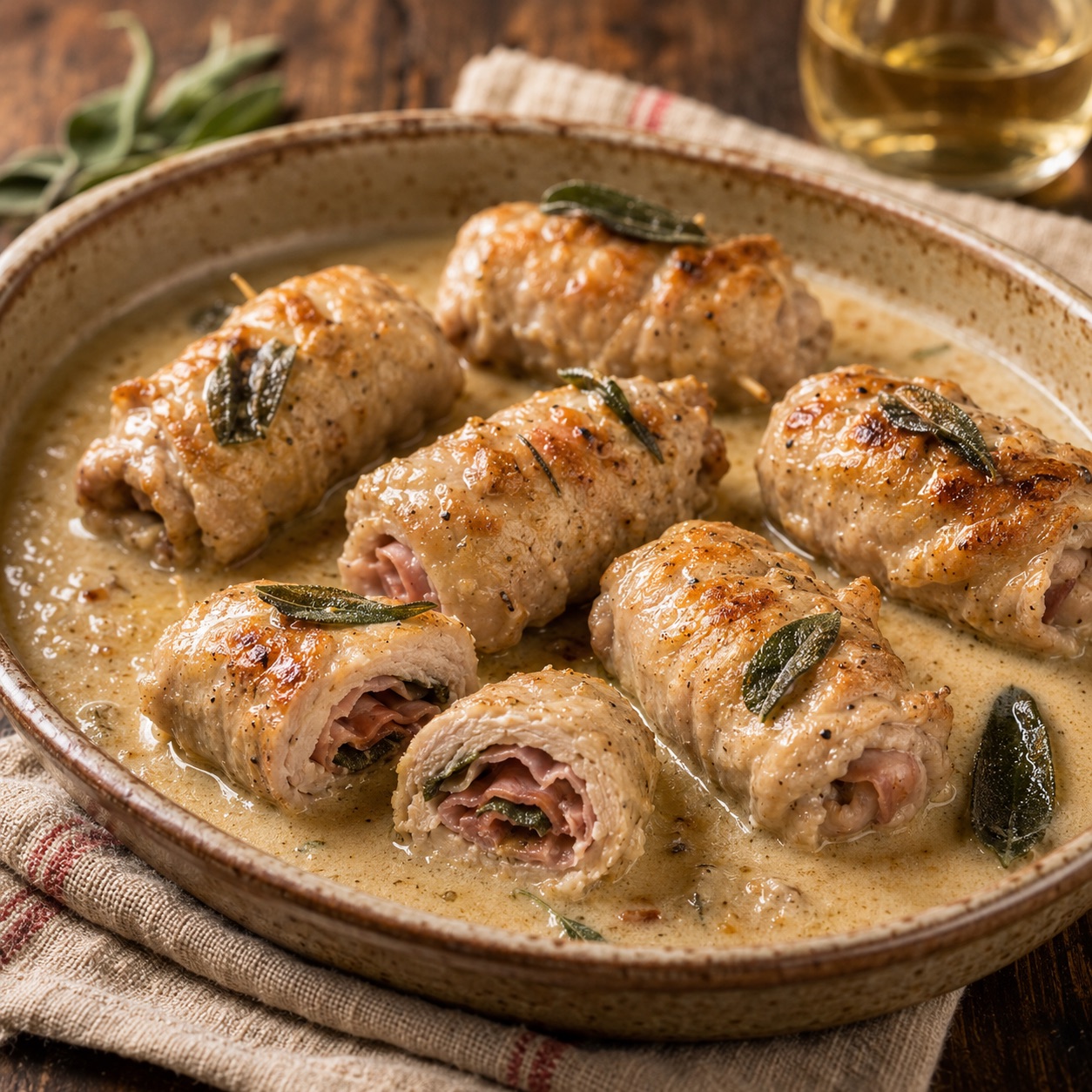
The alla genovese designation in Italian cooking is one of those labels that does not mean what you would expect. It does not necessarily indicate Genoese origin. It signals, in various regional traditions, a preparation with a specific richer, creamier character — often involving onions cooked long and slow in the Neapolitan ragù alla genovese, or in this case a velvety pan sauce that forms naturally from the flour coating of the meat rolls and the cooking liquids. The uccelletti alla genovese are the dressed-up cousin of the uccelletti scappati: same concept, same technique of rolling and searing, but the filling is prosciutto cotto rather than pancetta, and what happens in the pan after deglazing is the point of the dish.
The sauce forms without intervention. When you flour the meat rolls before searing — shaking off the excess so only a thin coating remains — the flour that stays on the meat surface is enough to thicken the cooking liquid into a smooth, glossy sauce during the covered braise. The white wine goes in, the alcohol evaporates, the heat drops, the lid goes on, and for the next fifteen minutes the flour on the meat slowly dissolves into the cooking liquid and the liquid becomes something richer and more coating than a simple wine braise. You have made a sauce without making a sauce. The pan did it.
The filling is prosciutto cotto — cooked ham, not cured — with the fresh sage leaf. Mortadella is a good alternative: slightly fattier, more aromatic from the spices and pistachios, it contributes more to the flavor of the sauce than the ham does. Neither is raw meat; both are already cooked, which means the roll is flavored from the inside by something that does not need to cook further, only to warm and release its flavors into the surrounding pork or veal. This is a more restrained filling than the pancetta of the scappati, and the result is lighter and more suited to the creamy sauce surrounding it.
The infographic notes a chef's tip: if you remember the sauce being distinctly milky or extra thick from a version you ate somewhere, stir in 2–3 tablespoons of heavy cream or a splash of whole milk in the last two minutes of cooking. This is not traditional but it is not wrong. It moves the sauce from a glossy wine reduction to something more explicitly creamy. Both are correct depending on what you are after.
The self-forming pan sauce — gelatinization and emulsification in the braise
The white sauce that forms around the uccelletti alla genovese during braising is the result of starch gelatinization. The thin flour coating on the meat surface contains raw starch granules. When these granules contact the hot cooking liquid — the combination of white wine, butter, and the water released by the meat — they absorb the liquid and swell, then burst, releasing starch polymers (amylose and amylopectin) that increase the viscosity of the surrounding liquid. This is precisely the same mechanism as a classic white sauce or béchamel, except that the starch is on the meat rather than cooked separately in a roux.
The butter plays a separate role: its fat droplets are held in suspension by the milk proteins it contains (casein), creating a loose emulsion with the wine and meat juices. The starch thickens this emulsion and stabilizes it, preventing the fat from separating out as the sauce cools. The result is a sauce that coats a spoon and the meat evenly — glossy, not greasy, pale from the wine and butter rather than brown from browning.
This mechanism is sensitive to heat: if the braising temperature is too high, the starch can form lumps rather than a smooth suspension, and the sauce will be grainy. Medium-low heat, covered, with the cooking liquid kept just below a simmer, produces the characteristic velvety result.
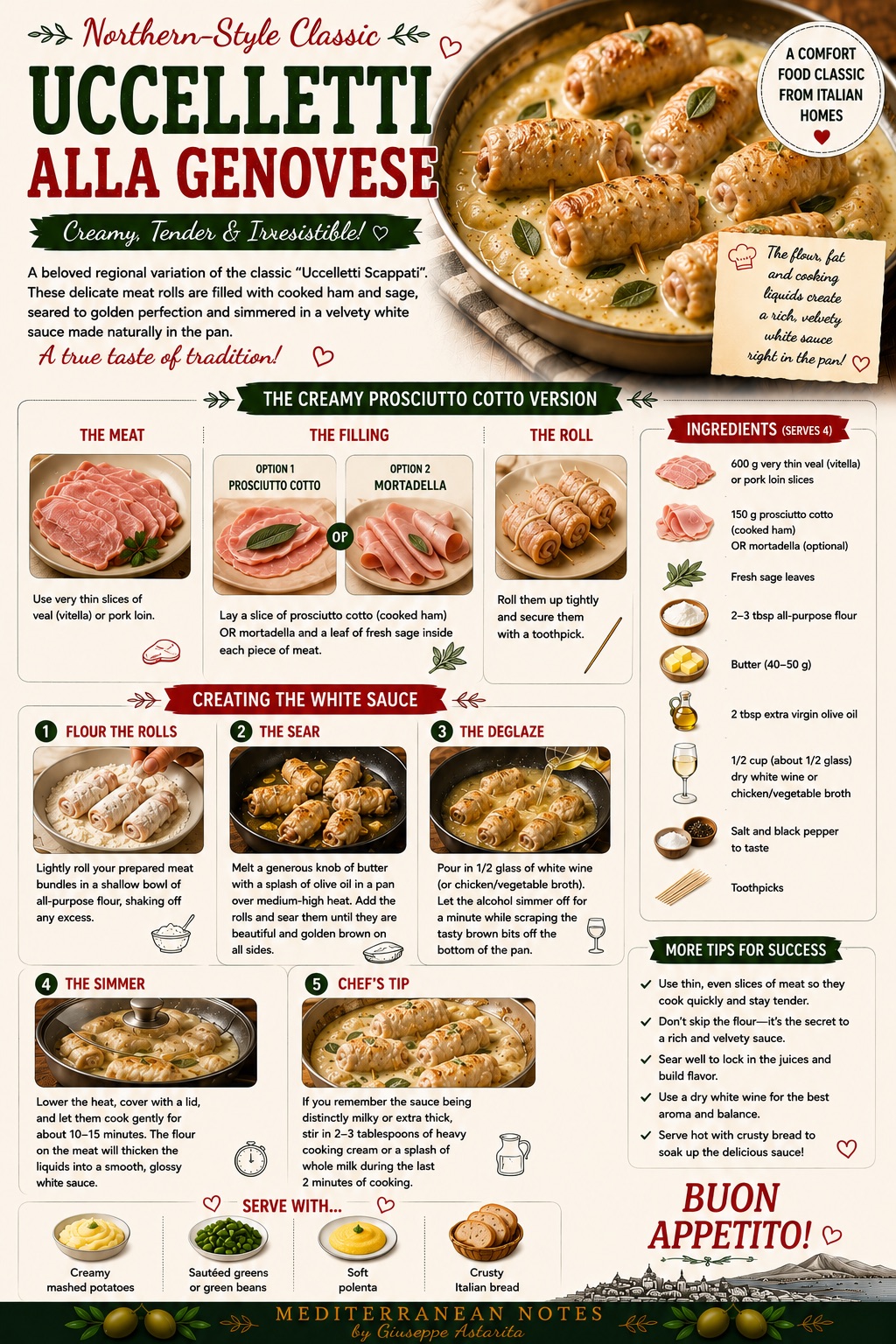
Tap to enlarge — Uccelletti alla genovese: la salsa bianca nel tegame
Recipe — Uccelletti alla Genovese
Serves 4 · Active time 25 min · Total about 40 min
- 600 g veal (vitella) or pork loin very thin slices — 3 mm after pounding
- 150 g prosciutto cotto cooked ham, sliced; OR mortadella
- Fresh sage leaves one per roll minimum
- 2–3 tbsp all-purpose flour for dredging the rolls lightly
- 40–50 g butter
- 2 tbsp extra virgin olive oil
- ½ cup dry white wine or chicken/vegetable broth
- Salt and black pepper
- Toothpicks to secure each roll
- 2–3 tbsp heavy cream optional — for a richer, milkier sauce
The uccelletti alla genovese are a dish that rewards close attention during cooking and then very little attention at the table. The sauce does not need finishing, adjusting, or enrichment beyond what the pan has already done. Serve them hot, immediately, with something that can carry the sauce. The pan sauce is the dish as much as the rolls are.