Spezzatino di Vitello con Patate
The Winter Weekday Stew
I remember this dish from winter weekday evenings — the potatoes almost melted into the sauce, the meat so soft it came apart at the touch of a fork. My mother made it during the week, not on Sundays. I never made it myself. For most of my adulthood I was vegetarian. The recipe is here now.
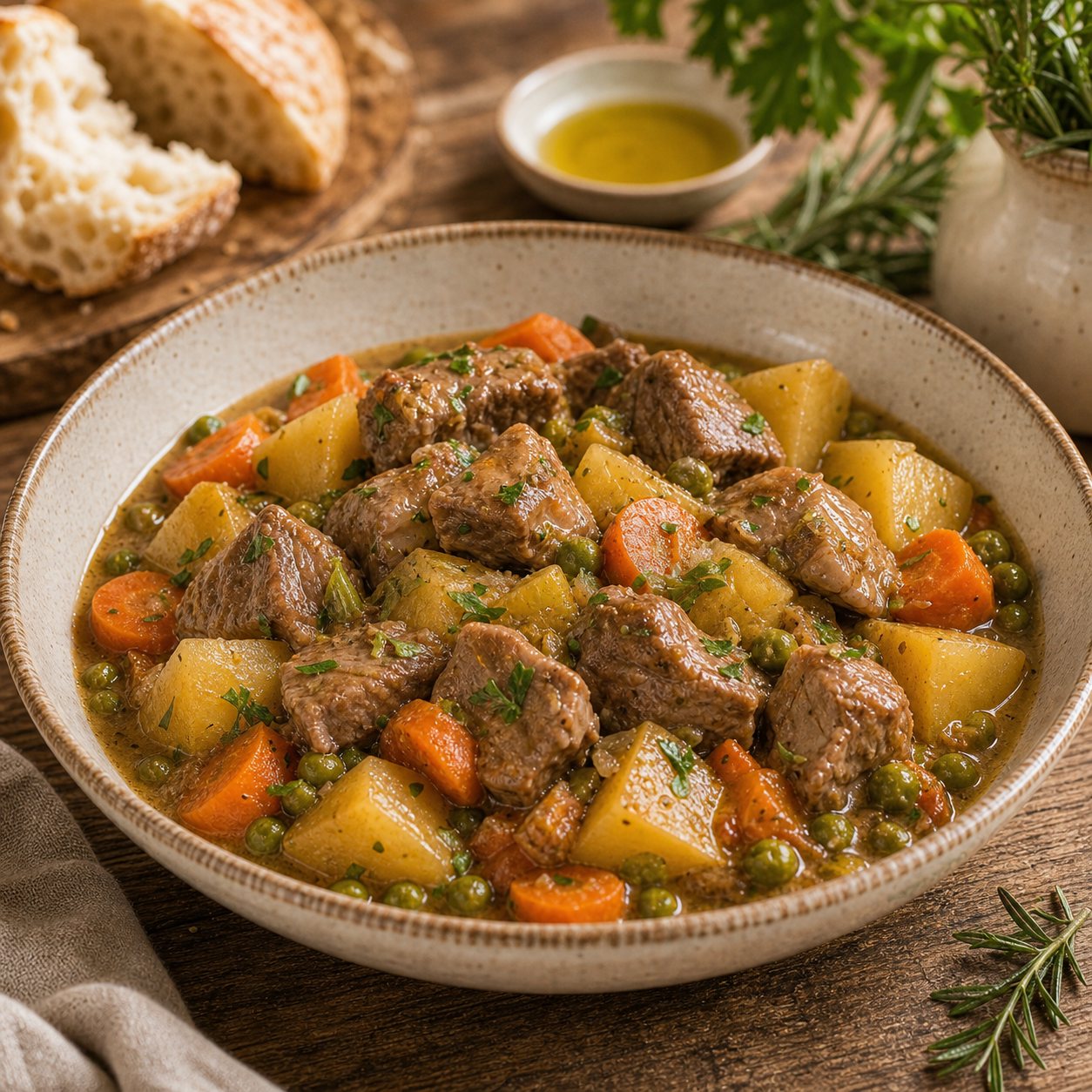
The spezzatino — from spezzare, to break or cut into pieces — is the Italian stew built from small cubes of braised meat. Veal is the classic choice for the Neapolitan winter version: its connective tissue breaks down into gelatin during the long slow cook, giving the braising liquid a body and glossiness that chicken or pork does not produce in the same way. The potatoes go in later — large chunks, peeled and cut to roughly the same size as the meat cubes — and they absorb the surrounding broth and become something between firm and falling-apart, their starch thickening the sauce further as they cook. By the end the distinction between sauce and potato is not entirely clear, which is the correct result.
This is a weekday dish, not a Sunday one. It shares logic with the pollo alla cacciatora — same braising approach, same one-pot structure, same principle of potatoes in the pot absorbing the cooking liquid — but it is lighter and less assertive than the cacciatora and was used differently in the rotation. Sunday was the ragù and the second course that went with it. The stew was Tuesday or Wednesday, a proper cooked dinner that required an hour and a half but produced something genuinely satisfying from a modest cut of meat.
I was vegetarian for most of my adulthood — from my early twenties through a significant portion of my years in the United States — which means I ate none of these meat dishes during those decades and made none of them. My relationship to the meat preparations in this collection is therefore somewhat different from my relationship to the vegetable dishes and the pasta dishes: I remember eating them as a child and I have not cooked them since. This one specifically I have never made. Writing it down required reconstructing it from memory and from the logic of the technique, cross-checked against the infographic. The memory of eating it is clear — the specific texture of the potato, the way the sauce clung to the bread, the warmth of it in a cold week — even if the cooking of it is something I am only now approaching for the first time.
Veal shoulder and chuck contain a high proportion of collagen — the fibrous connective tissue protein that runs through working muscles. At low cooking temperatures (85–95°C) over a long period, collagen undergoes hydrolysis and converts into gelatin, which dissolves into the surrounding liquid and gives the braising broth its characteristic body and lip-coating richness. This is the process that makes a properly braised stew sauce glossy and substantial while the liquid in a quickly cooked preparation remains thin and watery. The conversion requires time — at least 90 minutes at a gentle simmer — which is why rushing the stew produces tough, dry meat and thin sauce regardless of the quality of the starting ingredients.
The potatoes added in the final 30–40 minutes contribute starch to the braising liquid as they cook. Potato starch gelatinizes at around 60–80°C, which is well within the temperature of the simmering stew, and the gelatinized starch dissolves into the surrounding liquid and thickens it further — working in the same direction as the gelatin from the collagen. By the time the dish is done, the sauce has been thickened by two independent mechanisms: protein gelatin from the meat's connective tissue and carbohydrate starch from the potato. This is why the final sauce of a well-made spezzatino con patate has a density and cohesion that a stew made without potatoes lacks, and why you need bread to deal with it properly.
The recipe — serves 4
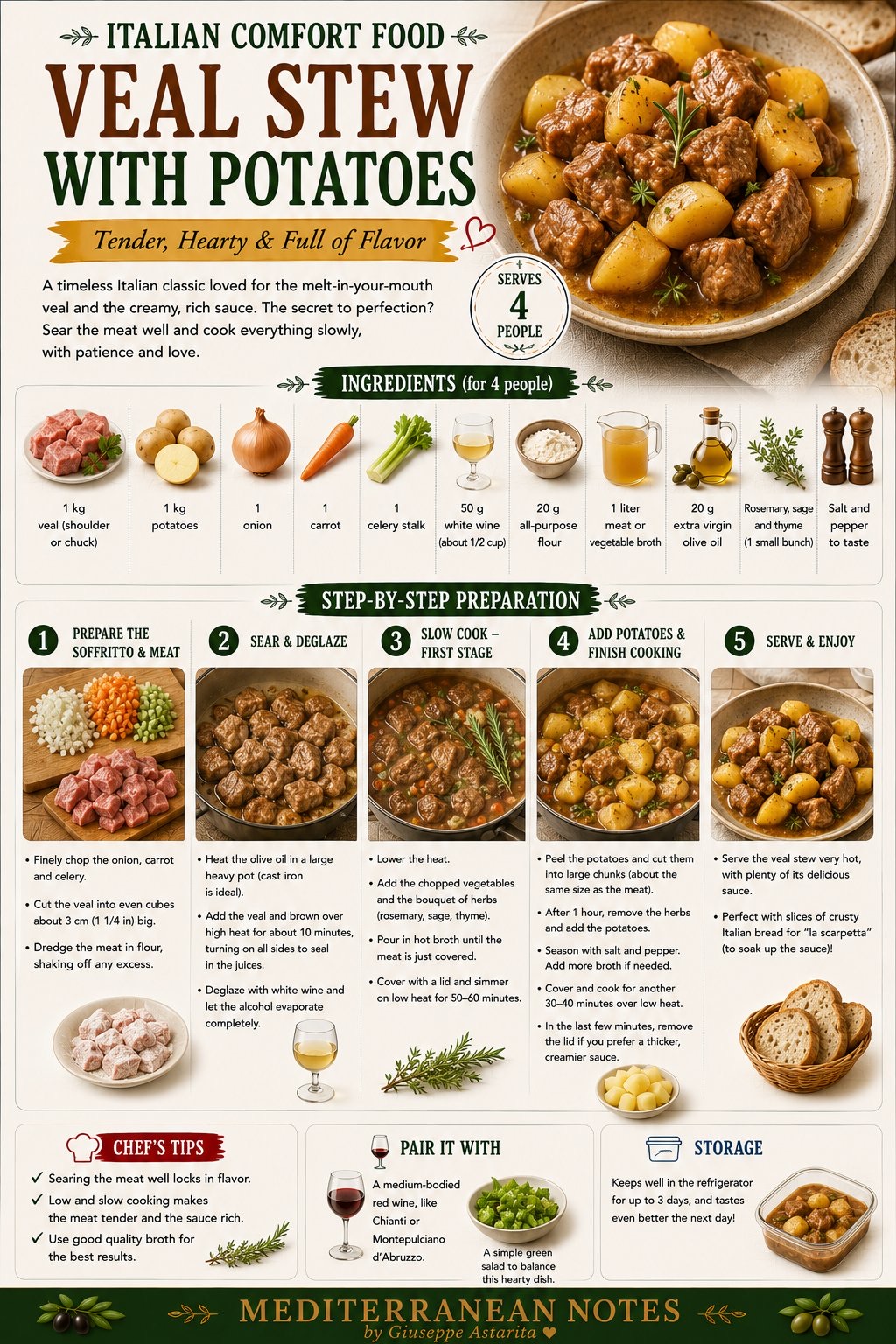
I will make this. Writing it down has made it more specific and more real than it was as a memory, and the memory was already specific: the bowl on the kitchen table on a cold evening, the potatoes yielding at the edge of the fork, the sauce dark and thick around them. My mother made this with the attention it requires and served it as if it were simply dinner. It was more than that, in the way most of the things in this collection are more than they appeared to be at the time. The recipe is here now.
Buon appetito — e grazie, mamma.