Chicken · Secondo · Neapolitan Family Cooking
Pollo con Peperoni
Chicken with sweet peppers. Browned, then braised slowly until the peppers are silky and the chicken falls from the bone. The kind of dish that smells like Sunday before it is ready.
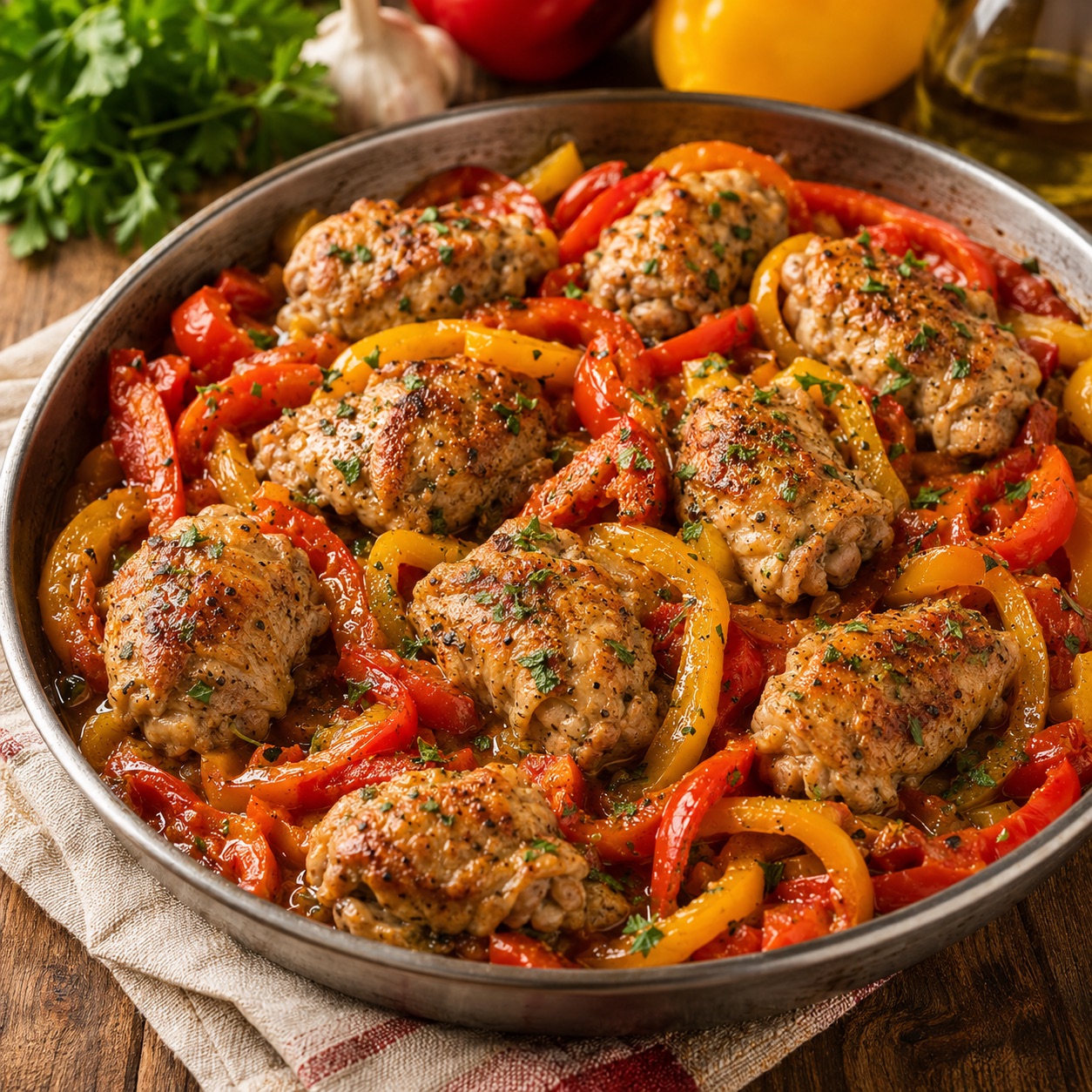
The combination of chicken and sweet peppers in Neapolitan cooking works on such an obvious level — the richness of the braised chicken fat against the sweetness of slow-cooked bell peppers — that it is easy to underestimate how much technique is embedded in the apparent simplicity. The dish fails when either element is cooked incorrectly: underdone peppers are sharp and slightly raw-tasting; overcooked chicken on the bone becomes dry and stringy. The success of pollo con peperoni depends on a specific sequence, a specific heat level, and a specific willingness to cover the pan and leave it alone for the last thirty minutes.
Red and yellow peppers together are not a visual choice — they are a flavor choice. Red peppers are sweetest, having ripened longest on the plant. Yellow peppers are slightly more acidic and floral. Together they produce a more complex base than either alone. Green peppers, which are harvested before ripeness, retain a bitterness that persists through braising and competes with the chicken rather than complementing it. The infographic is direct about this: mix red and yellow. The color is also the flavor.
The chicken goes in first, skin-on and bone-in — thighs and legs are the right cut, not breast, which dries out over the 25–30 minute braise that makes the peppers silky. The skin is what creates the cooking fat in the pan. Once the chicken is browned and set aside, the rendered fat is what softens the onion and garlic before the peppers go in. The fat connects the chicken flavor to the vegetable base before they are ever reunited in the same pan.
Legs and thighs, bone-in and skin-on. The bone conducts heat to the interior and the skin renders during browning, creating the cooking fat and the flavor base for the entire dish. Breast meat will be overcooked and dry by the time the peppers are ready. Mixed pieces — some breast and some thigh — produce inconsistent results because the two cuts are done at different times. If you only have breast, reduce the braising time by 10 minutes and check early.
Why the peppers become silky — and why the chicken stays moist
Bell peppers contain roughly 92% water by weight, held in the cell structure of the flesh. During slow cooking over medium heat, the cell walls break down as the pectin matrix that holds them together is hydrolyzed by heat. The cellular water is released gradually, and the pepper flesh softens from rigid strips into the characteristic silky, almost melting texture of a properly braised sweet pepper. The sugars (primarily fructose) concentrate as some water evaporates, intensifying the sweetness. This process takes a minimum of 25–30 minutes at moderate heat — shortcuts produce firmer, less sweet peppers.
The chicken stays moist through two mechanisms: the collagen in the thigh and leg meat (richer in connective tissue than breast) converts to gelatin during the moist braise, lubricating the muscle fibers from within; and the closed pan environment maintains humidity around the chicken, preventing surface drying. Thigh and leg meat can tolerate temperatures well above 75°C — the point at which breast meat becomes dry — because the gelatin produced from their collagen compensates for moisture lost from the muscle fibers.
The white wine added at the deglazing stage evaporates its alcohol quickly but leaves organic acids and aromatic compounds that brighten the pepper sweetness and prevent the dish from reading as heavy or one-dimensional despite the long cooking time.
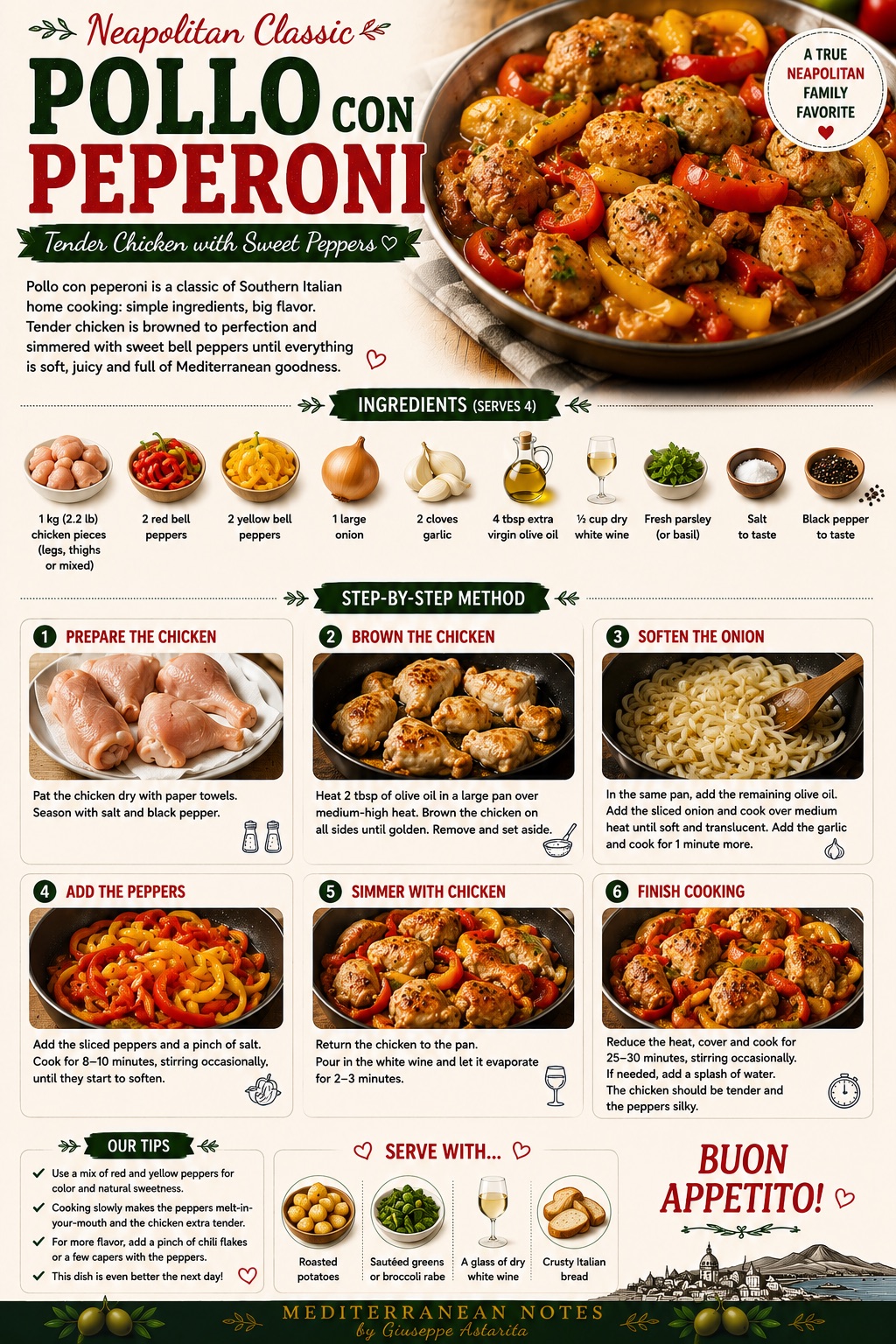
Tap to enlarge — Pollo con peperoni: ingredienti, metodo, consigli
Recipe — Pollo con Peperoni
Serves 4 · Active time 25 min · Total about 1 hour
- 1 kg chicken legs and thighs, bone-in, skin-on
- 2 red bell peppers sliced into 1 cm strips
- 2 yellow bell peppers sliced into 1 cm strips
- 1 large onion thinly sliced
- 2 garlic cloves lightly crushed
- 4 tbsp extra virgin olive oil
- ½ cup dry white wine
- Fresh parsley or basil a handful, added at the end
- Salt and black pepper
- Pinch of chili flakes optional — a few capers work too
Pollo con peperoni is one of the dishes that is genuinely, measurably better the next day — not as a consolation but as a fact. The chicken continues to absorb the pepper cooking liquid overnight, the flavors integrate further, and reheating gently produces a dish that is more unified and more flavorful than what came off the stove the previous evening. Make it ahead if you can. If you cannot, eat it immediately. Both are correct, but the next-day version is the argument for making twice as much.