Pizzette o frittelle con i fiorilli
'E sciurilli — i fiori di zucca fritti alla napoletana
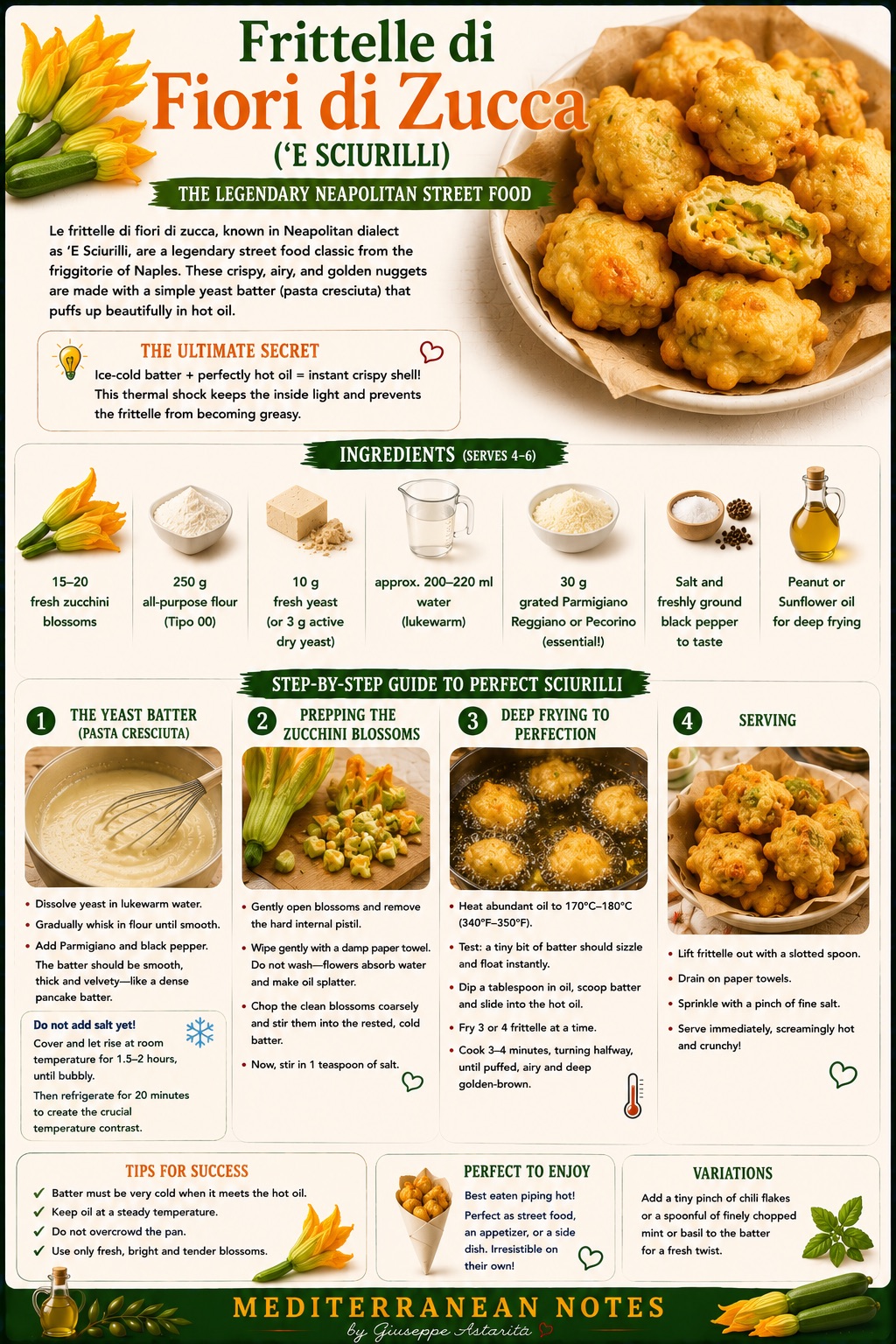
A yeast batter — pasta cresciuta, the same living dough that makes the Neapolitan pizza fritta and the zeppole — made cold and dropped by the spoonful into very hot oil. The thermal shock seals the exterior in an instant, trapping steam inside that puffs the fritter into a light, airy shell around the tender blossom. Piping hot, sprinkled with fine salt, eaten in a paper cone standing up. There is no more direct version of summer in Naples than this.
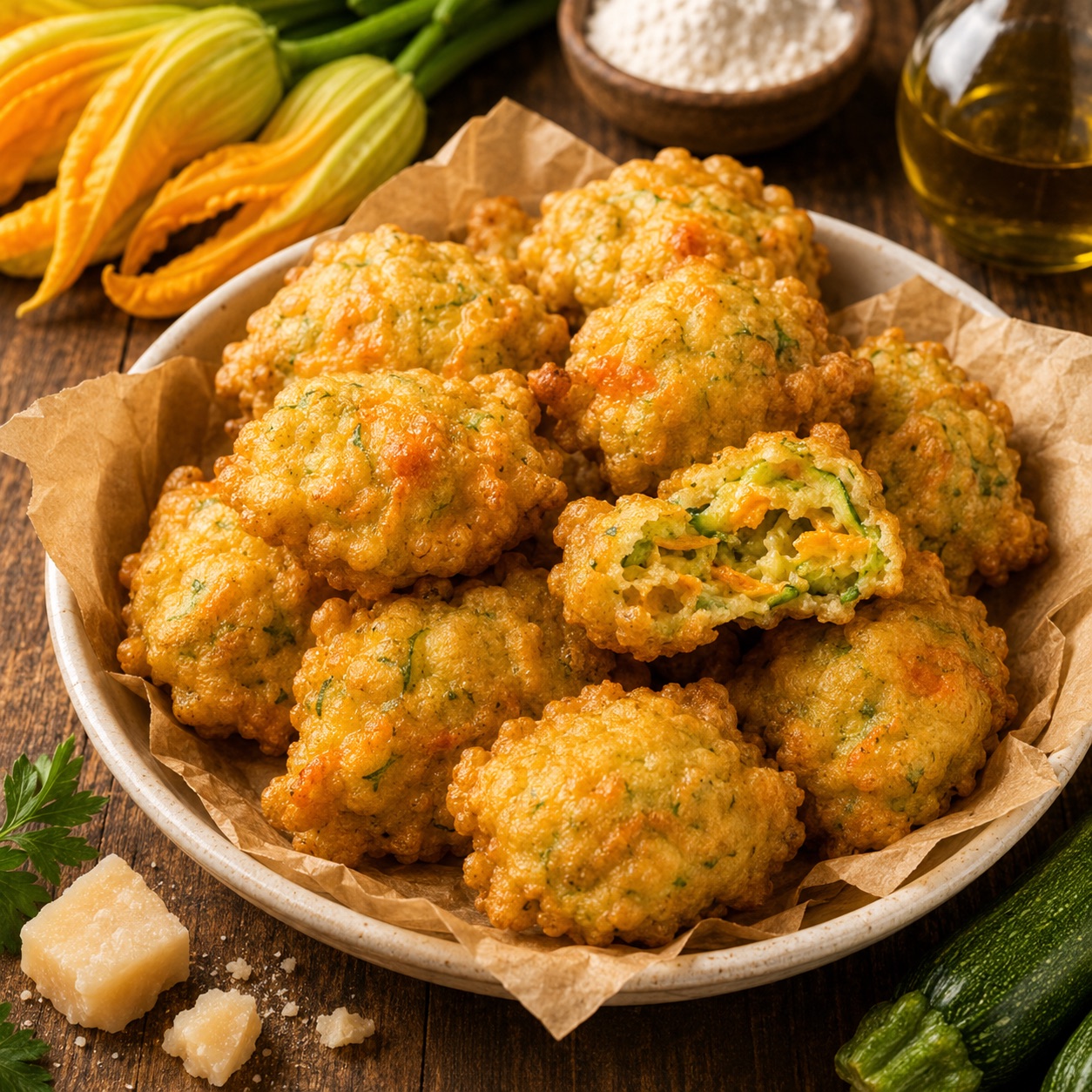
The Neapolitan friggitoria is a specific institution — a small shop, sometimes no more than a counter open to the street, where things are fried continuously and sold hot in paper cones or on small paper plates to people who eat them while walking or standing at the counter. The repertoire of the friggitoria is broader than most people outside Naples realize: cuoppo di frittura mista with seafood or vegetables (see frittura di paranza), panzarotti, crocchè di patate, pizza fritta in its various forms, zeppole both savory and sweet depending on the season. And in summer, when the zucchini plants are flowering, the 'E Sciurilli — the dialect word for fiori di zucchina, from the Neapolitan sciurillo, little flower — piled golden and fragrant in the display case, impossible to resist. For everything else the Italian kitchen does with the blossom beyond frying — stuffed, in risotto, in a frittata — see the full guide to fiori di zucca.
The batter is a pasta cresciuta — a risen dough, leavened with fresh yeast, flour, water, and Parmigiano or Pecorino. It is made in advance, left to rise at room temperature until bubbly and doubled, then refrigerated for twenty minutes before frying. This is the critical step that most people skip and that makes the difference between a good fritter and the Neapolitan one: the batter must be cold when it meets the hot oil. The temperature contrast — ice-cold batter, oil at 175°C — creates an immediate seal on the exterior that traps the steam produced by the water in the batter, inflating the fritter into the characteristic light, puffed shape. Warm batter in hot oil produces a denser result that absorbs more oil before the crust sets. Cold batter in hot oil produces the fritter that the friggitoria sells.
Thermal shock frying — how cold batter in hot oil creates the hollow without leavening
The thermal shock mechanism in Neapolitan frying — cold batter into very hot oil — exploits a straightforward thermodynamic principle. When the cold batter contacts oil at 170–180°C, the water in the outer layer of the batter vaporizes almost instantaneously, creating a steam barrier between the batter and the oil. This steam pressure simultaneously inflates the fritter from inside (the puffing effect) and prevents oil from penetrating the batter surface until the crust has set. The result is a shell with substantially lower fat content than a fritter made from warm batter, because the oil absorption window — the period before the crust is rigid enough to exclude oil — is dramatically shorter. Yeast leavening adds a further structural advantage: the carbon dioxide produced by the yeast during the rise creates bubbles throughout the batter that expand under the heat of frying, producing the characteristically open, airy crumb. The Maillard reaction between the flour proteins and the reducing sugars in the batter produces the golden-brown color and the complex toasted flavor of the crust. Fresh yeast (10 g) produces a more nuanced, slightly tangy flavor than the equivalent amount of active dry yeast because fresh yeast contains a broader range of enzymatic activity that continues during the rise, producing additional flavor precursors. Maintaining oil temperature is the critical variable during frying: below 165°C the batter absorbs oil before the crust sets, producing a greasy result; above 185°C the exterior browns before the interior has cooked through. A kitchen thermometer is the most reliable way to manage this. Testing with a small drop of batter — it should sizzle immediately and float — is the traditional method and is sufficiently accurate when done with attention.
The recipe — 'E Sciurilli alla napoletana
Ingredients · serves 4–6 as appetizer
Method
Make the yeast batter — pasta cresciuta. Dissolve the fresh yeast in the lukewarm water in a large bowl. Gradually whisk in the flour until completely smooth with no lumps — the batter should be thick and velvety, like a dense pancake batter. Add the grated Parmigiano and a generous amount of black pepper. Do not add salt yet — salt inhibits yeast activity and added too early it will prevent the batter from rising properly. Cover the bowl with a clean towel and leave at room temperature for 1.5 to 2 hours until the batter is visibly bubbly and has increased in volume. Then stir in 1 teaspoon of salt and refrigerate for 20 minutes. The batter must be cold when it enters the oil.
The refrigeration step is not optional. It is the mechanism that produces the characteristic light, puffed texture. Do not skip it even when in a hurry.
Prepare the blossoms. Use the male flowers (fiori maschi) for this — the ones on a long bare stem with no baby zucchini attached, sold loose by the bunch at the market; the female flowers with the fruit still on are better saved for risotto or pasta. Gently open each blossom and remove the stamen from the inside — it is bitter and should always be removed. Do not wash the flowers under running water; they absorb water immediately. Wipe gently with a damp cloth if needed. Chop the cleaned blossoms coarsely — into pieces of roughly 2–3 cm — and stir them directly into the cold risen batter. See the full guide to fiori di zucca for more on telling the two apart.
Fry to golden perfection. Heat abundant oil in a deep heavy pan to 170–180°C. Test with a tiny drop of batter: it should sizzle instantly, float immediately, and begin coloring within 30 seconds. Fry 3 or 4 frittelle at a time — do not overcrowd the pan, which drops the oil temperature and produces a greasy result. Scoop the batter with a large tablespoon, dip the spoon briefly in the hot oil to prevent sticking, then slide the batter in. Cook for 3–4 minutes, turning once, until puffed, airy, and deeply golden-brown on all sides. Lift out with a slotted spoon and drain on paper towels.
Between batches, let the oil return to temperature before frying the next round. Consistent oil temperature is the single most important variable in Neapolitan frying.
Serve immediately. Sprinkle with a pinch of fine salt while still hot. Serve at once — in a paper cone for the street version, on a paper-lined plate at the table. They must be eaten hot. A fritter that has cooled loses its crunch within minutes and becomes a different, lesser preparation. If making for a group, fry in small batches and bring them to the table continuously rather than all at once.
The 'E Sciurilli are also the gateway to understanding Neapolitan frying as a technique — the same pasta cresciuta batter, the same cold-into-hot principle, the same oil management applies to zeppole, to panzarotti, to any of the savory fried preparations of the Campanian kitchen. Master the batter and the temperature and the rest follows. The flower is the occasion. The technique is the education.
Buon appetito — e mangiateli caldi.