Zeppole di San Giuseppe: my name day, fifty zeppole, and why March 19th was the best day of the year
Every March 19th in Italy is Father's Day and the feast of San Giuseppe. Being named Giuseppe meant that everyone knew the date and expected something. My mother made fifty zeppole — choux pastry rings filled with custard cream, topped with a sour cherry — and brought them to school for teachers and classmates. The memories of eating them that day are among the best I have.
In Italy, the onomastico — the name day — is in some ways more significant than the birthday. Every name in the Catholic calendar has its feast day, and the person who carries that name celebrates it: receives wishes, is expected to offer something to friends and family, and in a household where the tradition is taken seriously, can expect the kitchen to produce something specific for the occasion. March 19th is the feast of San Giuseppe, patron saint of fathers, workers, and — less officially — of everyone named Giuseppe. It is also Italian Father's Day. The coincidence of name day and national holiday on the same date makes March 19th a particularly complete celebration.
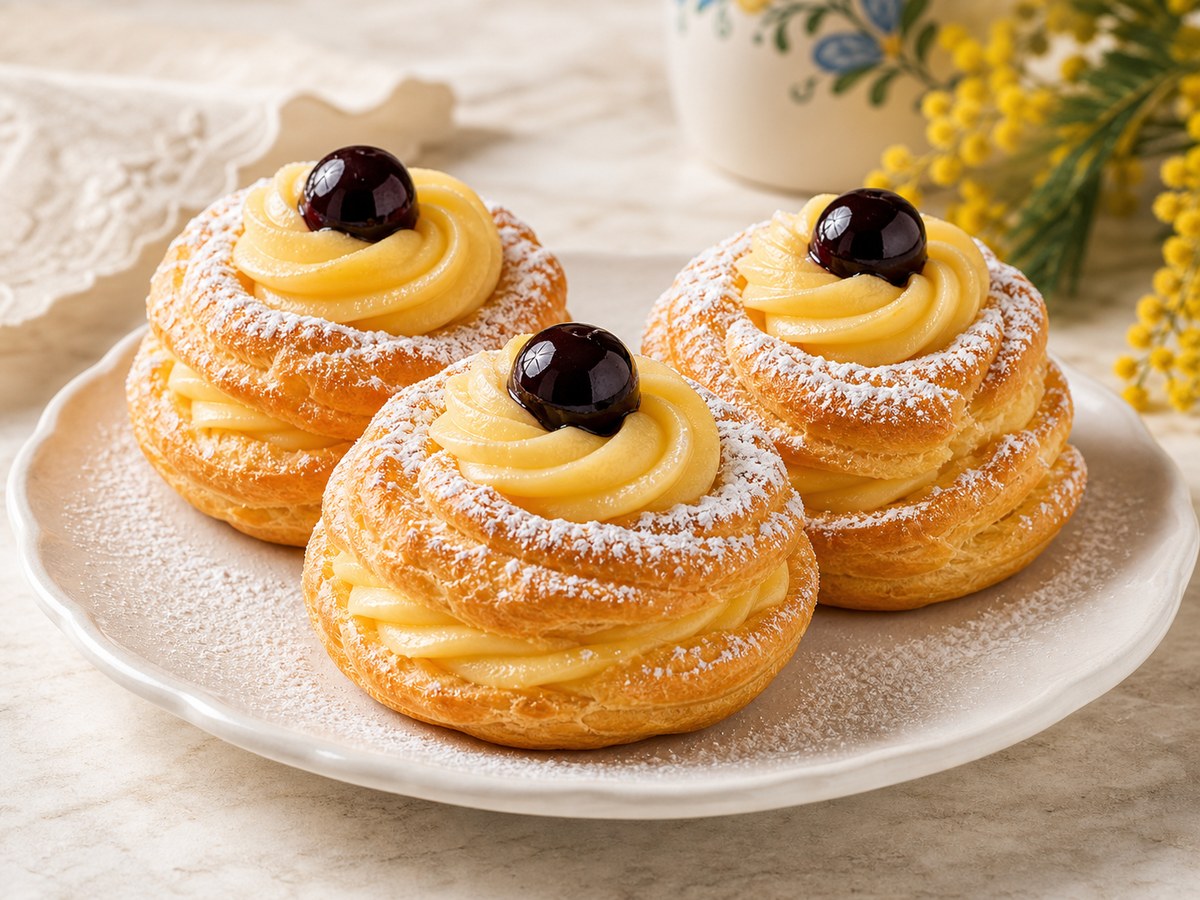
The zeppola is its pastry. In Naples and throughout Campania, the pastry shops begin producing them in February and they are at their peak on and around March 19th — the windows full of them, trays of rings dusted with powdered sugar and each topped with its single dark cherry, sold individually or by the box. The zeppola di San Giuseppe is a ring of pasta choux — the same light, hollow pastry as a cream puff or an éclair — fried in oil or baked in the oven, filled with a silky lemon-scented custard cream, and finished with an amarena cherry in syrup on top. The combination of the crispy or puffy pastry shell, the cold custard, and the tart-sweet cherry is one of those flavor combinations that is immediately and completely right.
The logistics of fifty zeppole deserve acknowledgment. Making a batch of choux pastry is straightforward but attentive work. Making eight of them is an afternoon. Making fifty is a commitment — multiple rounds of frying or baking, the custard prepared the day before to firm up overnight, the assembly and the powdered sugar and the cherries and the carrying of them to school in containers without the cream collapsing or the pastry going soft. My mother did this every year. The scale of it was not commented on at the time. It is clear now that it was an act of considerable love, expressed in the form of fifty zeppole on March 19th.
The fried version is the traditional Neapolitan one — the oil produces a specific puffiness and a slightly crispy shell that the baked version does not perfectly replicate. But the baked version is lighter, significantly less work, and genuinely excellent — particularly when the choux is piped well and the oven is at the right temperature. The air-fryer version, more recent, produces something close to the baked result with even less effort. All three are valid. My preference is still for the fried one eaten within an hour of coming out of the oil, which is the version that existed at school on March 19th.
Choux pastry and the steam that creates the hollow — no leavening agent needed
The pasta choux — the choux pastry — is one of the most technically interesting preparations in classical pastry, because it achieves a hollow interior without any leavening agent. The process works through steam: when the water-butter-flour paste (the panade) is cooked on the stove and then enriched with eggs, the high moisture content of the dough becomes steam in the oven or in the hot oil, expanding the pastry from the inside and creating the hollow shell. The eggs provide structure (the proteins coagulate around the steam cavity) and richness, and the precise ratio of eggs determines whether the choux is stiff enough to pipe into rings and hold their shape during cooking. Too few eggs and the rings are dense and don't puff; too many and the dough is too liquid to pipe. The white film that forms on the pan bottom during the stovetop cooking phase — mentioned in the method — is the indicator that sufficient moisture has evaporated and the panade is ready for the eggs. The custard cream (crema pasticcera) is a cooked egg-yolk-based emulsion stabilized by cornstarch or flour: the starch granules gelatinize when heated with the milk, forming a network that prevents the egg protein from curdling and produces a smooth, pipeable cream that sets firmly when refrigerated. The lemon zest contributes volatile terpenes (limonene and linalool primarily) that remain partially trapped in the cream after cooling and produce the characteristic fresh aroma. Egg yolks provide lecithin, choline, lutein, and fat-soluble vitamins. The amarena cherry — the dark, tart Emilia-Romagna cherry variety preserved in syrup — provides anthocyanins (the pigments responsible for its deep dark color, with documented antioxidant activity) and a tartness from malic acid and citric acid that provides the sharp counterpoint to the sweet cream. The zeppola is, nutritionally, a celebration food — calorie-dense, rich in fat from both the choux and the custard, appropriate to a feast day and the affection that produces fifty of them at once.
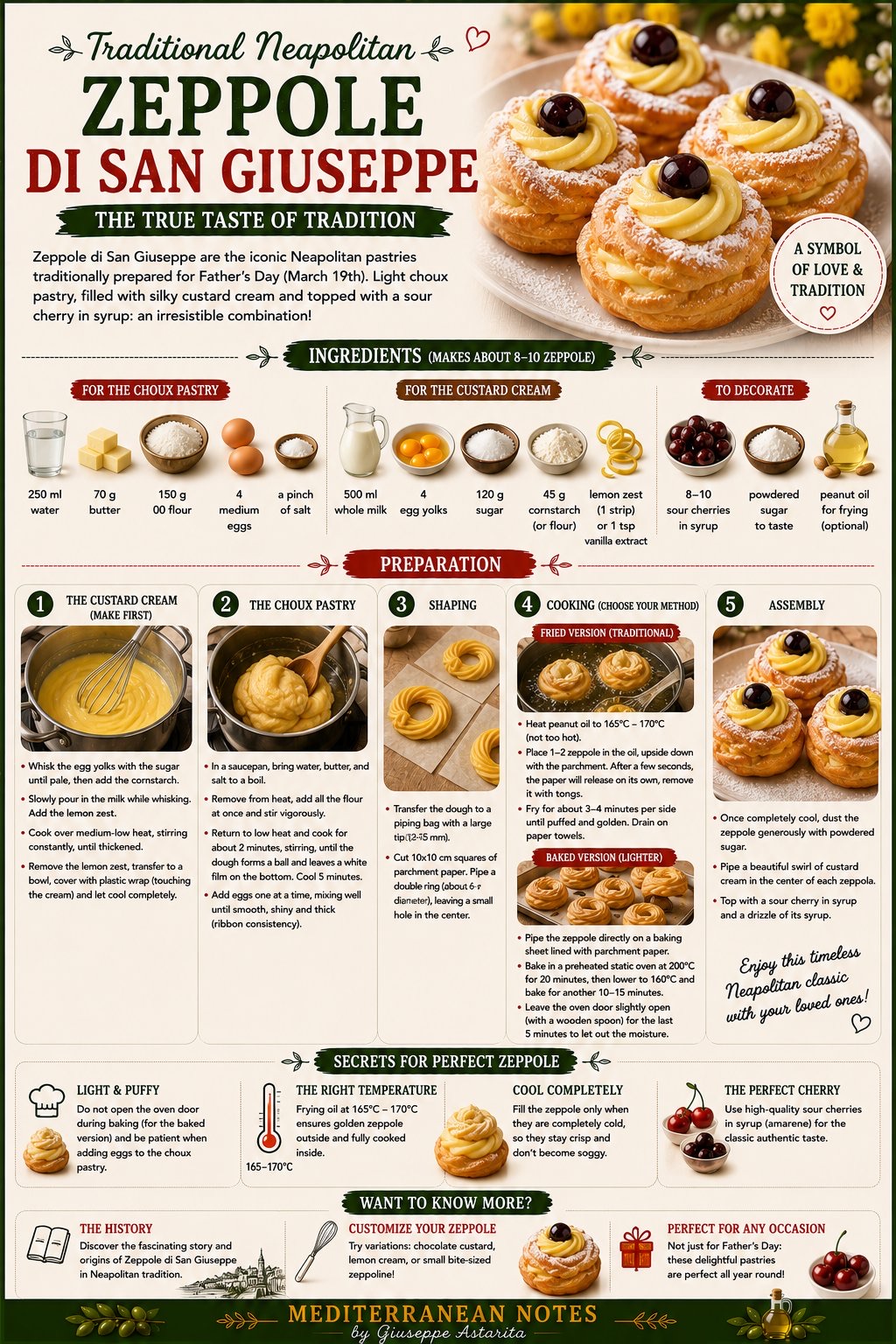
The recipe — makes 8–10 zeppole
For the custard cream — make the day before
For the choux pastry
To finish
Method
Make the custard cream — the day before. Whisk the egg yolks with the sugar until pale and creamy, then whisk in the cornstarch. Heat the milk with the lemon zest strip until just below boiling, then pour slowly over the egg mixture, whisking constantly. Return to the saucepan over medium-low heat, stirring continuously, until the cream thickens — about 5–7 minutes. Remove the lemon zest. Transfer to a bowl and press plastic wrap directly onto the surface (touching the cream, preventing a skin). Refrigerate overnight. The cream must be completely cold and firm before piping.
The overnight rest is not optional — it firms the cream so it holds the swirl when piped and doesn't collapse into the pastry. Made same-day cream is too soft.
Make the choux pastry. Bring the water, butter, and salt to a boil in a saucepan. Remove from heat and add all the flour at once — stir vigorously with a wooden spoon until completely combined. Return to medium-low heat and cook, stirring constantly, for about 2 minutes until a white film forms on the bottom of the pan and the dough comes away cleanly from the sides. Remove from heat and cool for 5 minutes. Add the eggs one at a time, incorporating each completely before adding the next — the dough should end up smooth, shiny, and thick, falling from the spoon in a ribbon.
The white film on the pan bottom signals that sufficient moisture has evaporated — this step determines whether the zeppole puff properly. Don't skip it. The final dough should hold its shape when piped but flow slowly from the spoon.
Pipe the rings. Transfer the choux to a piping bag fitted with a large star tip (12–15 mm). Pipe double rings about 6–7 cm in diameter onto 10×10 cm squares of parchment paper — pipe a circle, then pipe a second circle on top of the first to build height. Leave a hole in the centre.
Cook — choose your method. See the three options below. Either way, cool the zeppole completely before filling — warm pastry melts the custard cream and collapses the swirl.
The traditional
Fried in oil
Heat oil to 165–170°C. Lower 1–2 zeppole into the oil with their parchment; the paper releases after a few seconds — remove with tongs. Fry 3–4 minutes per side until golden and puffed. Drain on paper towels. Crispy, rich, the classic.
The lighter
Baked in the oven
Pipe directly onto lined baking trays. Bake at 200°C for 20 minutes, reduce to 160°C and bake another 10–15 minutes. Leave the oven door slightly open (wooden spoon) for the last 5 minutes to release steam. Do not open the door during the first 20 minutes.
The modern
Air fryer
Pipe onto parchment cut to fit the air fryer basket. Air fry at 190°C for 15–18 minutes until golden and puffed. Do not open during cooking. Produces a result close to the baked version with minimal effort. The lightest of the three.
Assemble. Once the zeppole are completely cool, dust generously with powdered sugar. Transfer the cold custard cream to a piping bag and pipe a generous swirl into the centre of each ring. Top with one amarena cherry and a drizzle of its syrup. Serve within 2–3 hours — the custard softens the pastry over time and the zeppole lose their crispness. This is why they are made the day of and eaten the day of.
The Neapolitan pastry shops make them from February onward and sell out reliably on March 19th. They are also available — in good Italian bakeries — as an occasional item throughout the year, because the combination of crispy choux, cold custard, and sour cherry is too good to confine to one date. But the date is when they mean the most. My mother made fifty. I ate several of them at school while my classmates and teachers wished me buon onomastico, which is perhaps the ideal setting for a pastry: shared, in quantity, on a specific day that you will remember for the rest of your life.
Buon onomastico a tutti i Giuseppe — e a tutti i papà.