Struffoli Napoletani
The sweet that meant Christmas had arrived
It was not Christmas without struffoli where I grew up. Not as decoration, not as an afterthought — as the thing itself. You ate them for breakfast on Christmas morning. You ate them after the meal. You ate them passing through the kitchen because the plate was there and you could not stop, which is the point of them entirely.
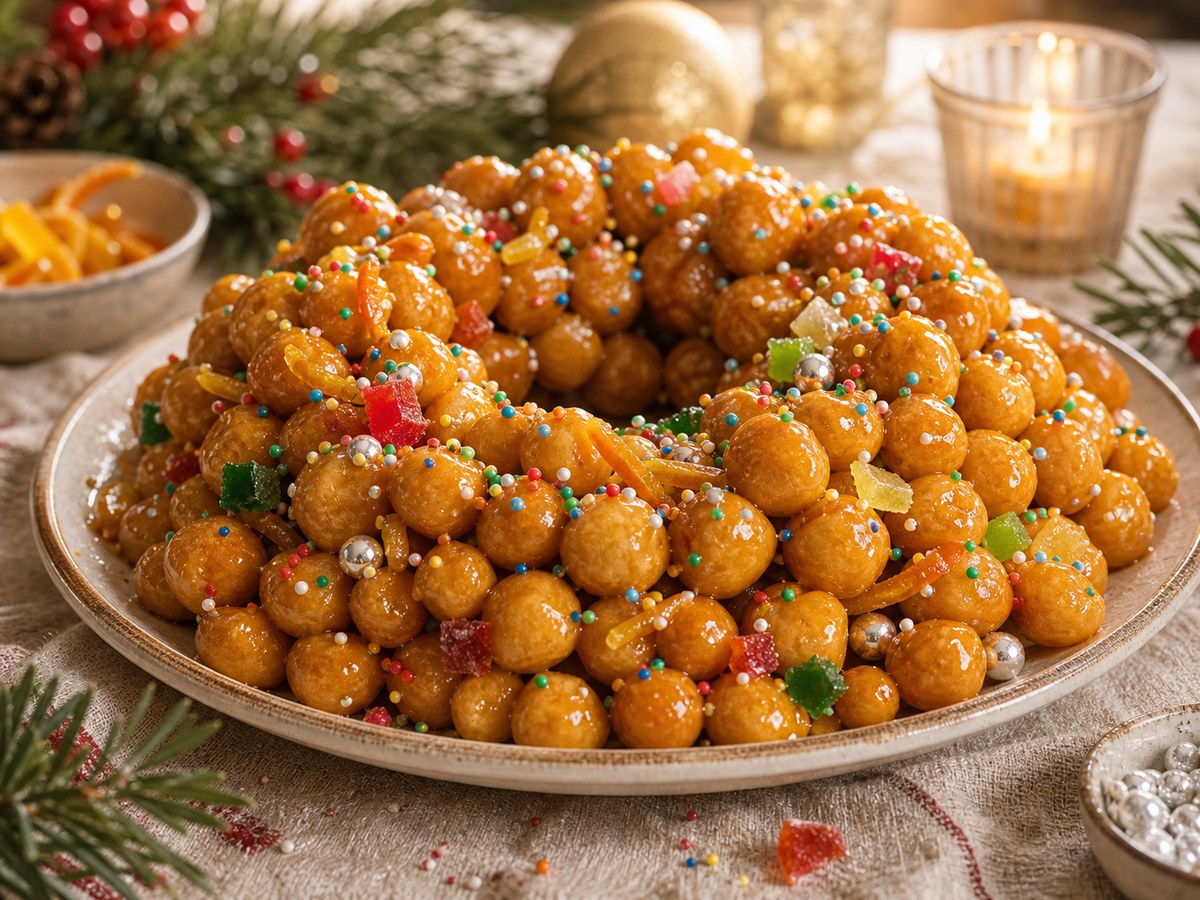
Struffoli are tiny fried dough balls — about the size of a chickpea, sometimes smaller — coated in warm honey and piled into a wreath on a plate, then scattered with diavulilli, the small colored sugar sprinkles that are as Neapolitan as anything in the Christmas pantry, and with candied orange, candied citron, and the small cinnamon candies called cannellini. The honey sets as it cools and the whole thing becomes sticky and fragrant and nearly impossible to eat with any restraint. This is by design. Struffoli are not a dish that rewards moderation. They are a dish that rewards the decision to have another handful.
They are also, technically, very simple. The dough is flour, eggs, butter, sugar, citrus zest, and a splash of liquor — grappa, rum, or anise — worked until smooth, rested, then rolled into thin ropes and cut into tiny pieces. The size is not negotiable. Pieces that are too large fry unevenly, stay soft in the center, and capture less honey relative to their volume. The correct struffola is small enough that the exterior crisps fully and the interior stays just tender, and when it meets the honey it is coated on every side rather than sitting in a pool of it. My mother made them on the small side, which is the right side.
December in Caserta, in the weeks before Christmas, meant the smell of frying oil from multiple apartments in the building. Everyone made struffoli. The preparation was spread over a day or two — the dough one afternoon, the frying the next morning, the honey-coating and decorating before guests arrived. Children helped with the rolling and cutting, which was the part that did not require skill, and stood close to the stove during the frying, which was the part that did. The plate came out of the kitchen with the honey still warm and slightly liquid, the sprinkles bright against the gold of the dough, and it sat at the center of the table for the rest of the day. The next morning it was still there for breakfast, the honey firmed overnight into something between a glaze and a candy coating. This was, if anything, the better version.
The word struffoli comes, most likely, from the Greek strongoulos — round, spherical — which points to the deep roots of Neapolitan cuisine in the pre-Roman Greek colonies that founded the city. The dish has been made in Naples at Christmas for centuries in forms recognizably similar to what appears on tables today. The honey coating, the citrus, the fried dough: all of it was already there. The diavulilli are a more recent addition, probably no older than the twentieth century, but they have become so characteristic that a plate of struffoli without them looks underdressed.
The size of struffoli is a genuine technical matter, not just tradition. A small sphere has a higher surface-area-to-volume ratio than a large one. In frying, this means the heat reaches the center faster and more evenly, producing a fully cooked interior without the risk of a dark exterior and raw core. It also means that when the struffoli are tossed in warm honey, each piece is almost entirely coated — very little of its surface is in contact with another piece rather than with the honey. The result is a more uniform, more flavorful coating that penetrates slightly into the fried crust rather than sitting on top of it.
The alcohol in the dough — grappa, rum, or anise liqueur — serves the same function it does in chiacchiere: it inhibits gluten development slightly, keeping the dough tender and the fried result light rather than chewy. The citrus zest contributes limonene and other aromatic volatile compounds that survive the frying process partly because the dough insulates them from direct contact with the oil. The result is a fried dough that smells faintly of lemon and orange even after frying.
When warm honey is poured over the struffoli and the mixture cools, the honey undergoes partial crystallization: the fructose and glucose in wildflower honey begin to form crystal nuclei as the temperature drops, which is why the coating firms from a liquid glaze to a set, slightly opaque surface. This is not a flaw — it is what makes the next-morning struffoli, eaten at room temperature after a night of cooling, texturally different from and arguably better than the warm version. The honey has had time to adhere fully to the surface and set into something that cracks slightly when you bite through it.
The recipe
Serves 8 to 10. The dough is easy; the rolling takes patience; the frying goes quickly once you find the right oil temperature. Make the dough a day ahead if you like — it keeps well wrapped in the refrigerator overnight and is easier to work with cold. The decorating is best done while the honey is still warm and liquid, so have the sprinkles and candied fruit ready before you start the honey step.
For the dough
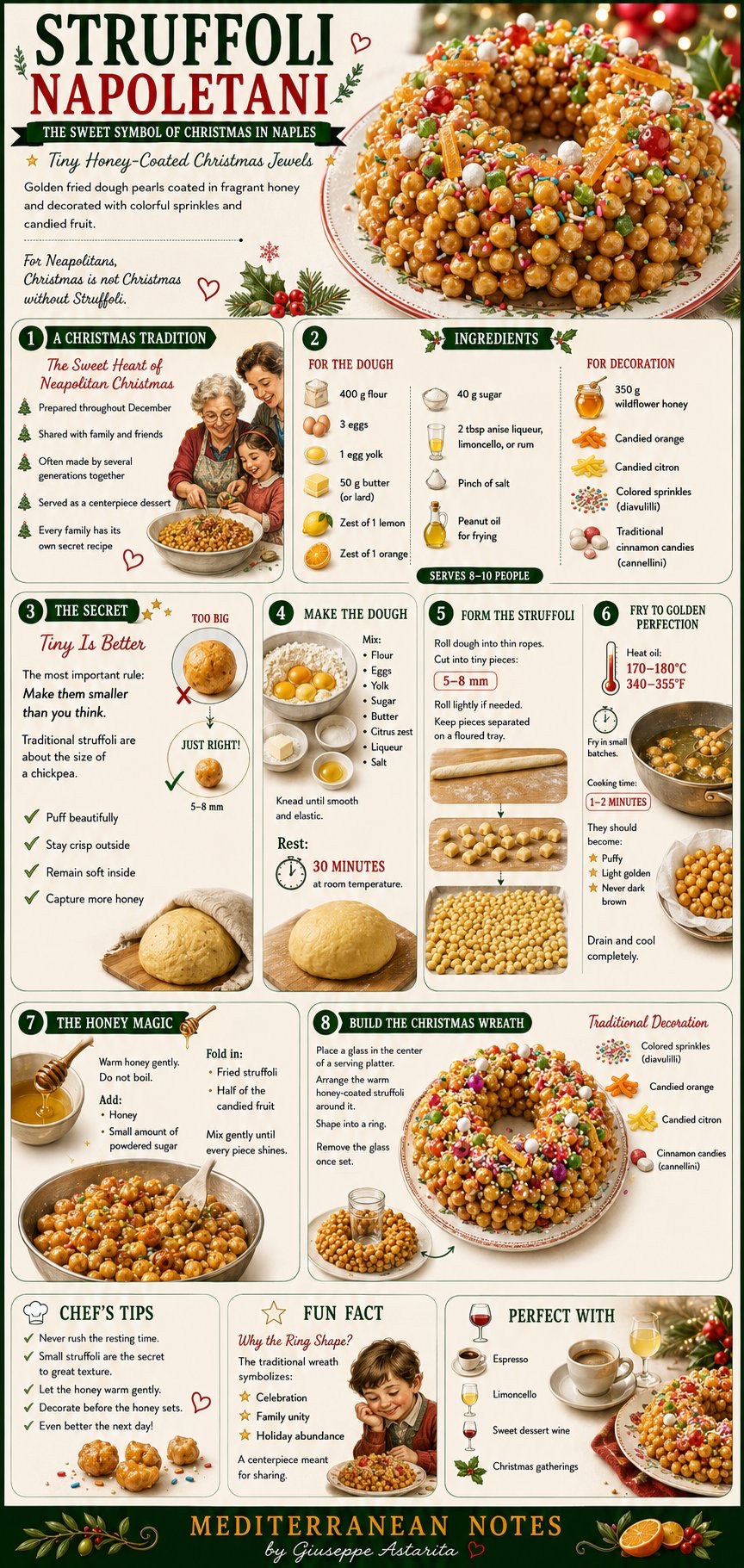
For coating and decoration
A note on the diavulilli
The diavulilli — literally "little devils" — are the tiny colored nonpareils found on every plate of Neapolitan struffoli and on certain other traditional sweets of the Christmas season. They come in the standard colors: red, green, white, yellow, silver. They contribute almost nothing to the flavor of the struffoli — they are pure color and pure texture, a small crunch against the soft honey-coated dough. Their importance is entirely visual and entirely traditional. A plate of struffoli without them is technically the same dish and noticeably less itself.
In Naples they are sold in small packets at pasticcerie and alimentari throughout December. In the United States they are available at Italian specialty shops and online. They are called nonpareils in most American baking contexts, which is the correct thing to search for if you cannot find the Italian version. The two are essentially the same product. Buy more than you think you need — they go on generously, not sparingly, and you will want to have enough.
Variations
Every family in Naples has its own version of this recipe, or believes it does. The differences are small — more or less citrus, one liquor over another, lard versus butter, the exact size of the pieces. These variations matter to the people who hold them and are not worth arguing about. What is not variable is the honey, the size, and the diavulilli. Everything else is family preference, which is another way of saying it is correct.
Buon Natale — e buoni struffoli.