Profiteroles alla Napoletana
The Chocolate Crown of Neapolitan Pastry
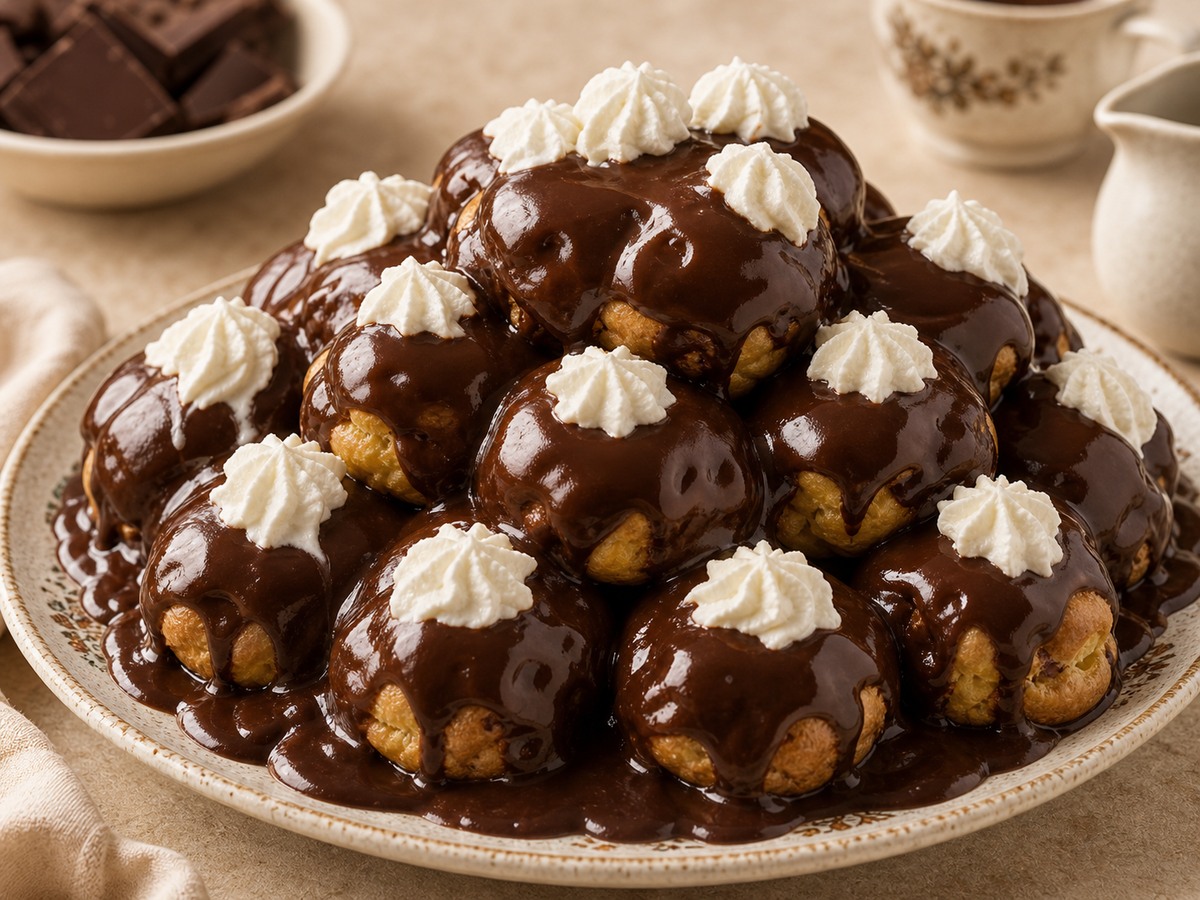
Some Sundays my mother prepared desserts from scratch. One of our favorites was profiteroles — so decadent, with that chocolate cream all over the top that messed up our mouths and plates. Light, airy choux pastry shells, sweet whipped cream inside, and a rich, silky chocolate glaze over everything. A show-stopping finale.
The Sunday desserts from scratch were a different category from the pastries bought at the pasticceria — those arrived in a box, chosen and purchased, beautiful but external. The homemade ones were the kitchen itself becoming something celebratory. The profiteroles required real work and real time: the choux dough made on the stove, the piping, the baking (never open the oven door — this was the rule, stated with emphasis, because opening the door during baking collapses the shells), the chocolate glaze cooked separately, the cream whipped, the filling of each individual shell, the dipping in the chocolate, the building of the pyramid. Several hours from start to finish, and the result arrived at the Sunday table with the specific weight of something that had been made for us, specifically, that day.
The chocolate glaze was the part we remembered most — thick and glossy and dark, the Neapolitan version made with cocoa, dark chocolate, and a little rum for the classic touch. It set slightly as it cooled over the cream-filled shells and then, when you took a bite, it cracked and ran and covered everything. Mouths, fingers, plates, sometimes the tablecloth. Profiteroles are not a tidy dessert. That is part of what makes them right for a Sunday table where the meal has already been long and substantial and the mood is generous and the children are not required to be careful.
The profiterole is technically a French preparation — pâte à choux (choux pastry) piped and baked into small rounds, filled with cream, and covered in chocolate — that arrived in Naples through the Bourbon court and was so completely absorbed into the Neapolitan pastry tradition that it is now found in every pasticceria in the city and in many home kitchens on special Sundays. The Neapolitan version is distinguished by the chocolate glaze, which is richer and darker than the French version, made with cocoa powder and good dark chocolate and often finished with a measure of rum. The filling in the classic pasticceria version is pastry cream; the home version more commonly uses sweetened whipped cream, which is easier to prepare and which produces a lighter result against the heavy chocolate exterior.
In our house they were a Sunday production, sometimes arriving after a full multi-course lunch, when reasonable people would have surrendered. And here the family record needs a correction I only made decades later, by text message to my mother: besides this chocolate version she also made profiteroles alla crema di limone — dipped in a semi-firm lemon cream, finished with grated zest — and those, not these, were my father’s true favorite. The chocolate pyramid got the fame; the lemon one got him.
Never open the oven door during baking. This is the single most important rule of choux pastry, and the one most commonly broken by people who want to check on progress. The shells rise because steam trapped inside the dough pushes the structure outward and upward. Opening the oven releases the steam, the temperature drops suddenly, and the shells collapse before the protein structure has set enough to hold their shape. Fifteen to twenty minutes without touching the oven door. Then, and only then, check.
1
Choux Pastry
Light and airy shells made from water, butter, flour, and eggs. The steam inside the dough is what makes them hollow and crisp. The technique requires attention at the stove and patience at the oven.
2
Sweet Whipped Cream
The classic Neapolitan filling — heavy cream whipped to firm peaks with powdered sugar. Light against the heavy chocolate exterior. Piped into each shell through a small hole in the base.
3
Chocolate Glaze
Rich, silky, deeply chocolatey — cocoa powder, dark chocolate, sugar, starch, milk, and a measure of rum for the Neapolitan touch. Cooked until thickened, poured warm over the cream-filled shells. It sets, cracks when you bite, runs everywhere. Perfect.
The recipe — makes approximately 35 profiteroles
For the choux pastry shells
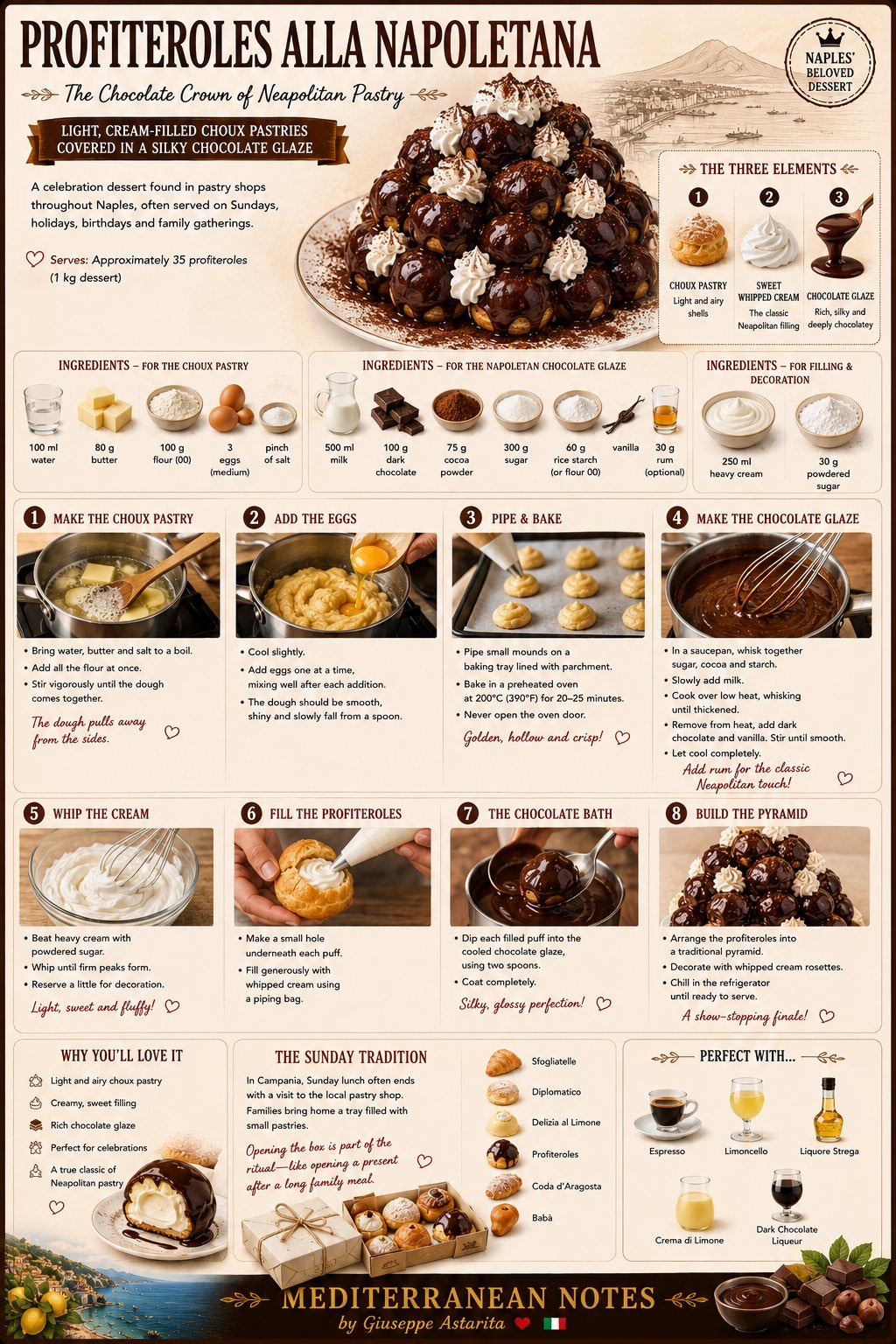
Profiteroles alla napoletana — la corona di cioccolato della pasticceria napoletana. Click to enlarge.
100 mlWater
80 gButter, cut into pieces
100 gAll-purpose flour (00), added all at once
3 mediumEggs, added one at a time after cooling
pinchSalt
For the Neapolitan chocolate glaze
500 mlWhole milk
100 gDark chocolate (70%), chopped
75 gUnsweetened cocoa powder
300 gSugar
60 gRice starch (or flour 00)
1 tspVanilla extract
30 g, optionalRum — for the classic Neapolitan touch
For the filling and decoration
250 ml, very coldHeavy cream
30 gPowdered sugar
1
Make the choux pastry: bring water, butter, and salt to a boil in a saucepan. Add all the flour at once and stir vigorously over the heat until the dough pulls away from the sides of the pan and forms a ball — about 2 minutes. Remove from heat and let cool slightly. Add eggs one at a time, beating well after each addition. The dough is ready when it is smooth, shiny, and falls slowly from the spoon in a ribbon.
The eggs must go in one at a time after the dough has cooled slightly — adding them to a too-hot dough cooks them into scrambled egg rather than incorporating them into the structure. Test the dough by lifting the spoon: it should form a slow, thick V-shape as it falls.
2
Pipe small mounds (about 3 cm diameter) onto a parchment-lined baking tray using a piping bag or two spoons. Space them well apart — they expand significantly. Bake at 200°C static oven for 20–25 minutes until golden, hollow, and crisp. Never open the oven door during baking. Remove and let cool completely on a rack before filling.
3
Make the chocolate glaze: whisk together sugar, cocoa powder, and starch in a saucepan. Slowly add the milk, whisking to prevent lumps. Cook over low heat, stirring constantly, until the mixture thickens to a smooth, flowing consistency — about 8–10 minutes. Remove from heat. Add the chopped dark chocolate and vanilla; stir until completely melted and smooth. Add rum if using. Let cool until warm but still fluid.
4
Whip the cold cream with the powdered sugar to firm peaks. Make a small hole in the base of each cooled choux shell with the tip of a piping bag. Fill generously with whipped cream. Reserve a little cream for decoration rosettes on top.
5
Dip each filled profiterole into the warm chocolate glaze using two spoons, coating completely. Place in a serving dish and build into a pyramid. Decorate with whipped cream rosettes and a dusting of cocoa powder. Refrigerate until the glaze has set slightly and the cream has firmed — at least 1 hour before serving. Serve cold.
The chocolate glaze should be warm but not hot when you dip — too hot and it runs off immediately; too cool and it sets before the shell is fully coated. The correct consistency is thick enough to coat a spoon but fluid enough to flow slowly.
Why choux pastry is hollow — and why the oven door stays closed
Choux pastry (pâte à choux) is unique among pastry doughs in that its leavening comes entirely from steam rather than from chemical leaveners (baking powder) or biological ones (yeast). When the dough is first cooked on the stove, the flour's starch gelatinizes and forms a rigid network that traps moisture. When this dough goes into a hot oven, the water inside (from both the cooking water and the eggs) converts to steam and expands dramatically — water increases in volume by approximately 1,700 times when it becomes steam — pushing the gelatinized starch network outward. The shell expands into a hollow sphere as the steam pushes from the interior. Meanwhile, the heat sets the egg proteins and the starch structure into a rigid form that holds the expanded shape.
This is why opening the oven door is fatal to choux pastry. The blast of cool air that enters when the door opens does two things simultaneously: it drops the oven temperature (slowing the steam production needed to maintain the expanded structure) and it causes the steam inside the partially set shell to condense back to liquid. The shell, whose protein structure has not yet fully set, collapses inward under the pressure of the condensing steam and the loss of internal support. Once collapsed, it cannot be recovered — the structural proteins have begun setting in the collapsed position and the shell will remain flat, dense, and wet. Twenty minutes is usually sufficient for the proteins to fully set; after that point the door can be opened safely. Before that point — not for any reason.
The Sunday homemade dessert was different from the pastries in the box from the pasticceria — both were celebrations, but in different ways. The bought box said: we went out and chose something special for today. The homemade profiteroles said: someone spent several hours in the kitchen making this specifically for this table, this Sunday, these people. Both are expressions of care. The homemade version is the more intimate one. The chocolate glaze running down fingers and onto plates was not a problem. It was the point.
Buona domenica — e il cioccolato dappertutto.
Good Sunday — and chocolate everywhere.