Filoscio Napoletano
A soft folded egg with mozzarella melted inside. Not a French omelette. Not scrambled eggs. Something in between that only Naples has a name for.
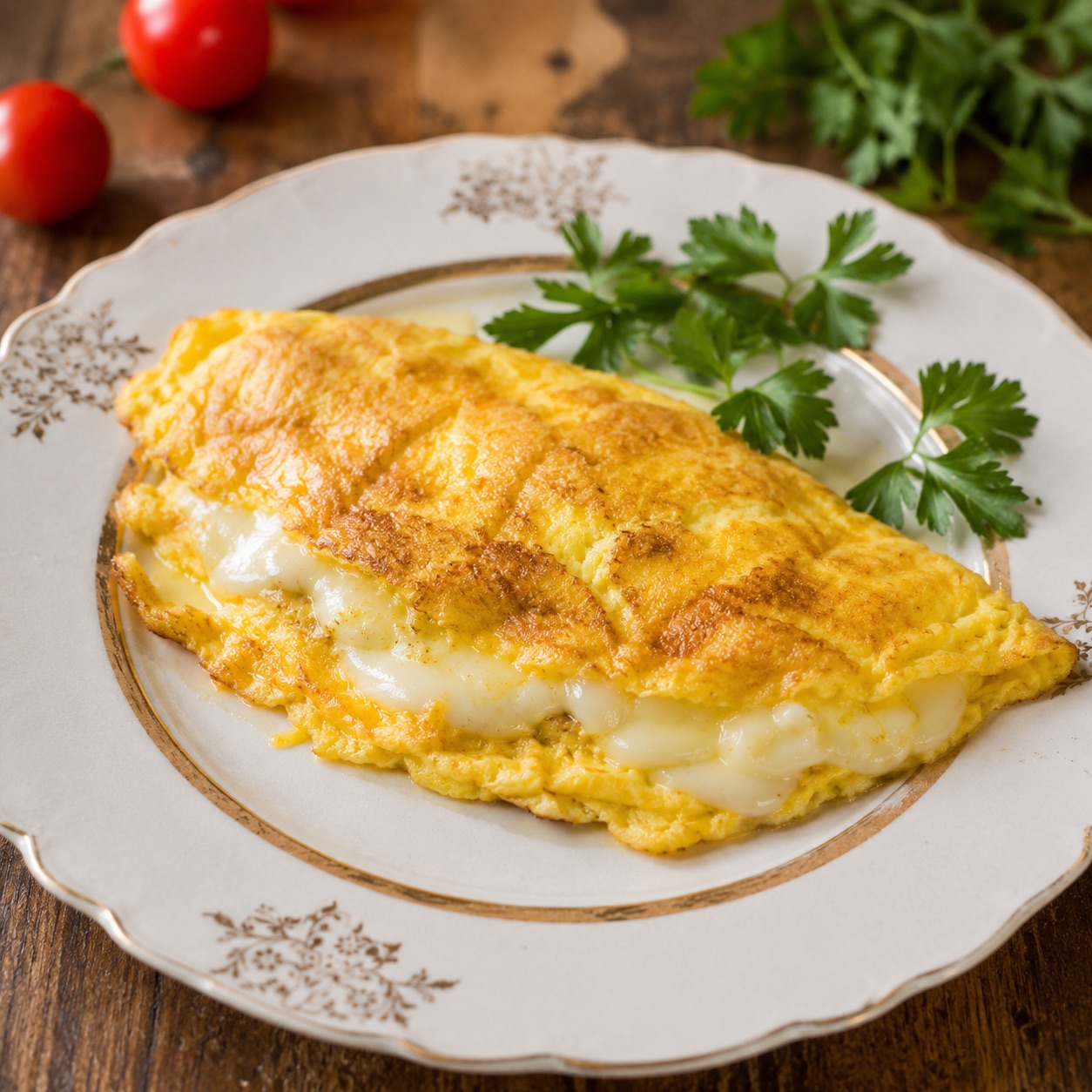
Filoscio is a Neapolitan dialect word. It means something soft, floppy, lacking firmness — used for objects, for fabric that won't hold its shape, and for people who can't be relied upon in a crisis. Applied to this dish, it is a precise description: you are aiming for eggs that give way, that fold without resistance, that hold the mozzarella inside without squeezing it out. If the result slides onto the plate and settles with a slight collapse at the seam, you have done it correctly.
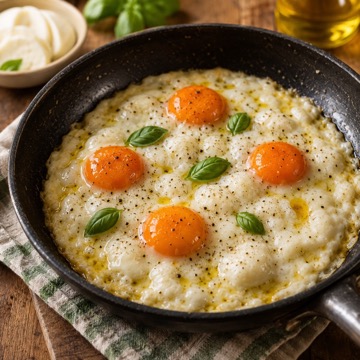
The filoscio comes from the same family as the uova al tegamino con mozzarella — same two ingredients, same pan, same leftover-cheese logic. But the technique and the result are different enough to be treated as separate dishes. In the tegamino, the eggs are cracked whole into the pan, the mozzarella is arranged around the intact yolks, and the whole thing cooks open and uncovered. In the filoscio, the eggs are beaten first, poured in as a single layer, and the mozzarella is added on top as the eggs begin to set — then the whole thing is folded, so the cheese melts inside a soft egg envelope.
The result looks more composed than the tegamino: a golden folded surface, the cheese visible at the seam where it has overflowed slightly, served on a plate rather than in a pan. This is probably why the filoscio felt more like a proper dish when I made it myself, living alone or with roommates, than the tegamino did. The tegamino was what my parents made. The filoscio was what I made when I wanted to feel like I had put a little effort into the evening without actually putting in much effort.
Some families add a couple of tablespoons of grated Parmigiano to the beaten eggs before pouring them in, which gives a slightly denser, more flavored base. Others use butter instead of olive oil, which produces a softer, richer exterior. My mother's version was straightforward: olive oil, eggs, mozzarella, fold, done. I have tried both variations and I keep returning to the plain version — partly because it is simpler, and partly because the mozzarella is doing enough work on its own without additional cheese or fat complicating the result.
Why beaten eggs behave differently from whole eggs
When egg whites and yolks are beaten together, the protein networks begin to mix and align. Ovalbumin (the main white protein) and the yolk lipoproteins are distributed evenly through the liquid. This means the beaten egg sets more uniformly when heated — forming a continuous, cohesive layer rather than the distinct white-and-yolk regions of a fried egg.
The lower surface area of a beaten egg layer also means the base is less likely to overset before the top reaches temperature. Combined with the lid-and-steam method, this allows the entire egg layer to reach the target temperature (around 65–70°C) more evenly than cracked whole eggs cooked the same way.
Mozzarella melting on top of partially set beaten eggs creates a feedback effect: as the cheese releases water, the steam helps finish setting the upper surface of the eggs without direct heat. The result — if you work at medium-low and cover — is an egg surface that is just barely set, still yielding, with no dry or rubbery patches. This is the texture that gives the filoscio its name.
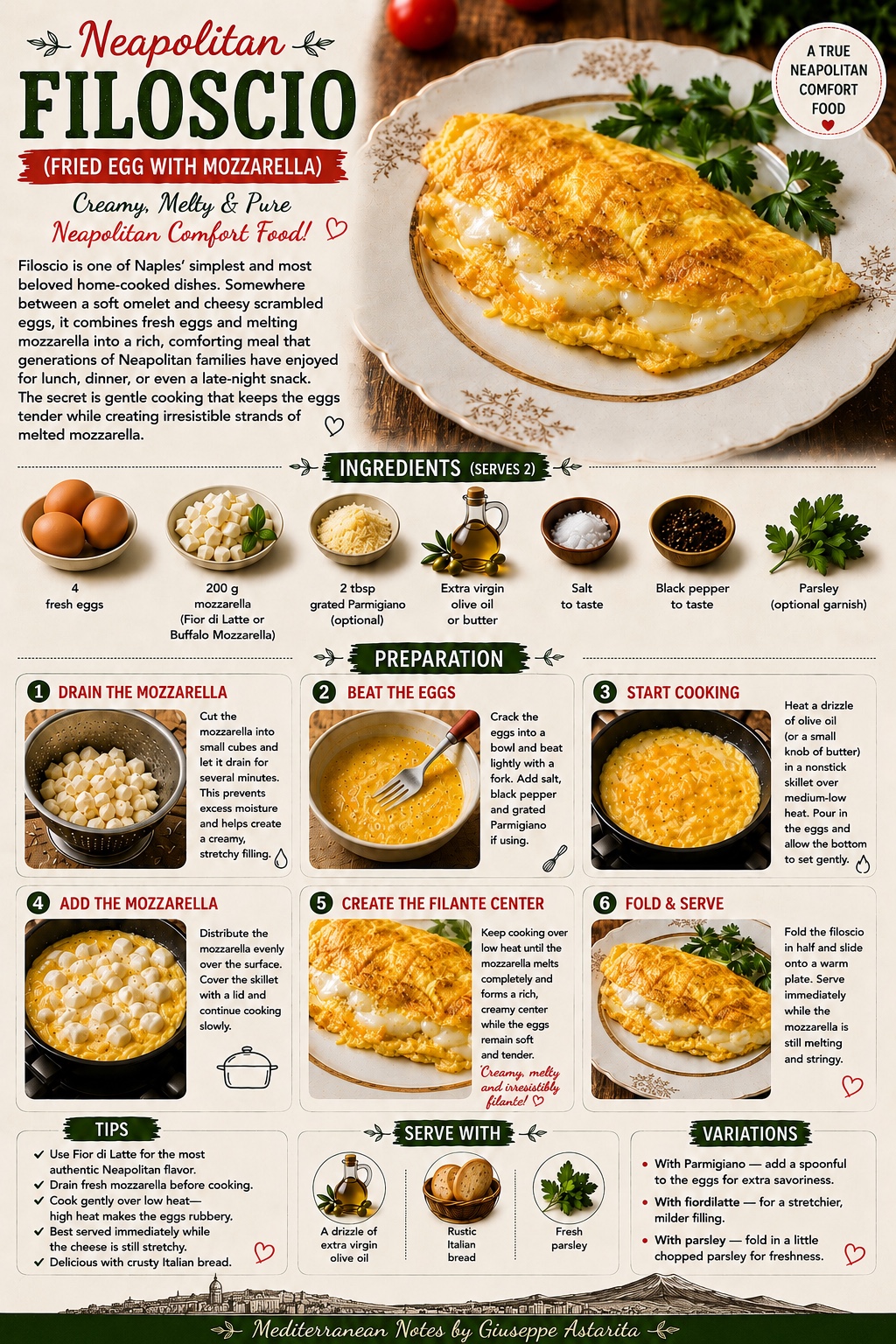
Tap to enlarge — Il filoscio: metodo passo dopo passo
Recipe — Filoscio Napoletano
Serves 2 · Ready in 10 minutes
- 4 eggs beaten lightly with a fork
- 200 g fior di latte day-old, well-drained, cut into small cubes
- 2 tbsp extra virgin olive oil or a small knob of butter
- Salt and black pepper to taste
- 2 tbsp grated Parmigiano optional — add to the beaten eggs
- Fresh parsley optional garnish
The filoscio and the tegamino are related and distinct, and in our family both were made from the same starting point: a piece of mozzarella that had been in the house since yesterday, that was still good but had become something other than what it was when fresh. Neither dish requires fresh mozzarella, and neither dish benefits from it. They are what leftover cheese becomes when you have eggs and a pan and nothing else to prove.
I make the filoscio more often now than the tegamino, probably because it looks more deliberate on a plate — the fold, the cheese at the seam, the golden surface. But the tegamino is what I remember more clearly from the kitchen in Caserta, and memory has its own hierarchy. Both are correct. Both are quick. Both are exactly what they are supposed to be and nothing more than that.