The Horse Meat Butcher
La macelleria equina of viale Beneduce, where nonna Toto lived (closed now, like most of Italy's horse butchers). My mother bought the fettina there whenever I had a blood draw: “horse meat is full of blood.” Forty years since I last ate it.
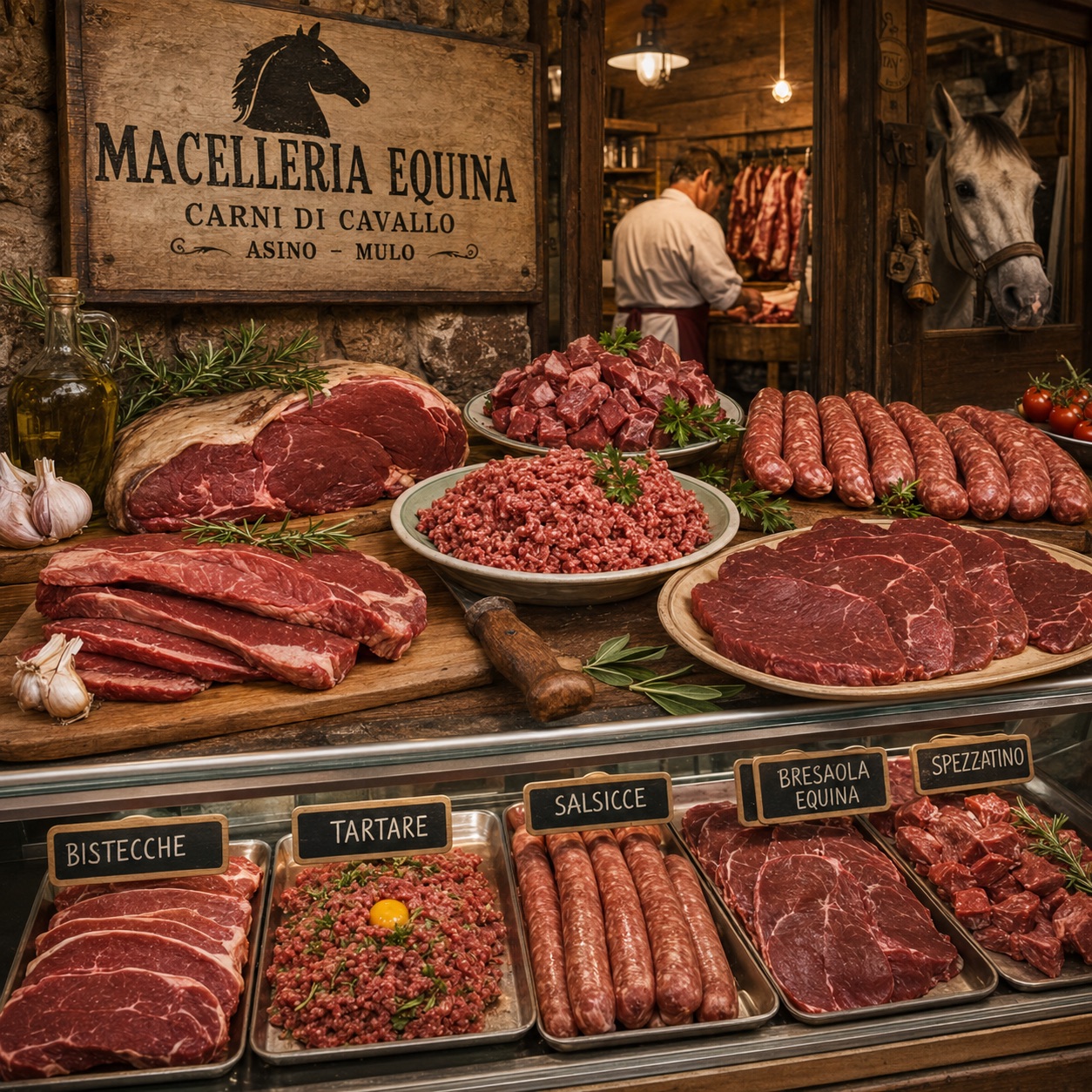
There used to be a horse butcher — a macelleria equina — in viale Beneduce in Caserta, on the street where my grandmother, nonna Totò, lived, and where my mother grew up with her five siblings. It is closed now, like most of them. This post is partly a recipe and mostly a record, because I have come to believe the blog should also keep the memory of the food that was simply around us growing up in southern Italy — the shops, the smells, the certainties — even the ones we no longer eat. Especially those.
I have not eaten horse meat in forty years. But as a boy I did, and the occasion was always the same: a prelievo di sangue, a blood draw. My mother would buy a fettina from the macelleria in viale Beneduce and cook it in padella, veloce — fast, the same one-turn-one-flip grammar as any fettina — and the reasoning came with the plate, as it always did in our house: horse meat is full of blood, and when you lose blood, it is good for you. I suppose the kernel of truth is that it is all muscle — extremely lean, and famously rich in iron. Her transfusion theory was folk medicine; her nutrition was, as usual, roughly right.
The macelleria equina was its own institution, distinct from the regular butcher: a shop specializing in horse — sometimes donkey or mule — with its own counter liturgy: fresh steaks and thin cutlets, hand-made sausages, horse bresaola, the sfilacci (shredded cured meat for pasta and salads), and tartare for those who took it raw. For generations these shops ran through Lombardy, Veneto, Emilia-Romagna, Puglia, Sicily — and Campania. The surviving ones have evolved into grill stations and lunch counters; most have simply closed, taking with them one of the country's most distinctive food cultures.
Her reasoning, audited
Horse meat carries more heme iron than beef — the most bioavailable dietary form — with very little fat and a complete amino acid profile, which is why it was historically prescribed to the anemic, the convalescent, and children fresh from the blood-draw chair. Iron does not replace lost blood on the spot, but it is precisely what the body needs to rebuild hemoglobin. My mother's mechanism was wrong; her prescription was right. This, I have learned writing this blog, was her speciality.
The recipe she made
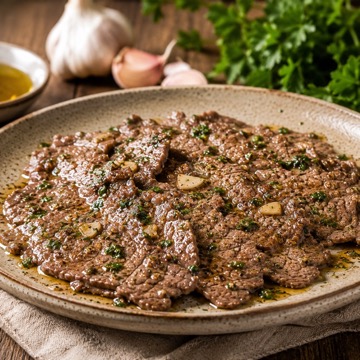
She cooked it the way it is always cooked: cut thin, seared fast, garlic in the oil, a splash of wine, parsley at the end — never more than a minute or two a side, because meat this lean turns to leather if you forget it. The full recipe, with quantities and the science of why horse meat was the blood-builder, is its own page now: Fettina di Cavallo →
The method is the same as my father's fetta di carne in padella — the family grammar applied to a different animal from a different counter. The counter is gone; viale Beneduce has one less smell than it did when my mother was a girl there. The blog remembers it now, which is the point of the blog.