Peperoni alla napoletana: the cold green pepper plate that smelled like summer — 'e friggitelli
Blistered green peppers, cherry tomatoes releasing their juice, whole garlic, and a fistful of fresh basil. Left to cool on the counter. That particular smell — olive oil, basil, hot summer kitchen — is one of the most direct routes back to growing up in Campania.
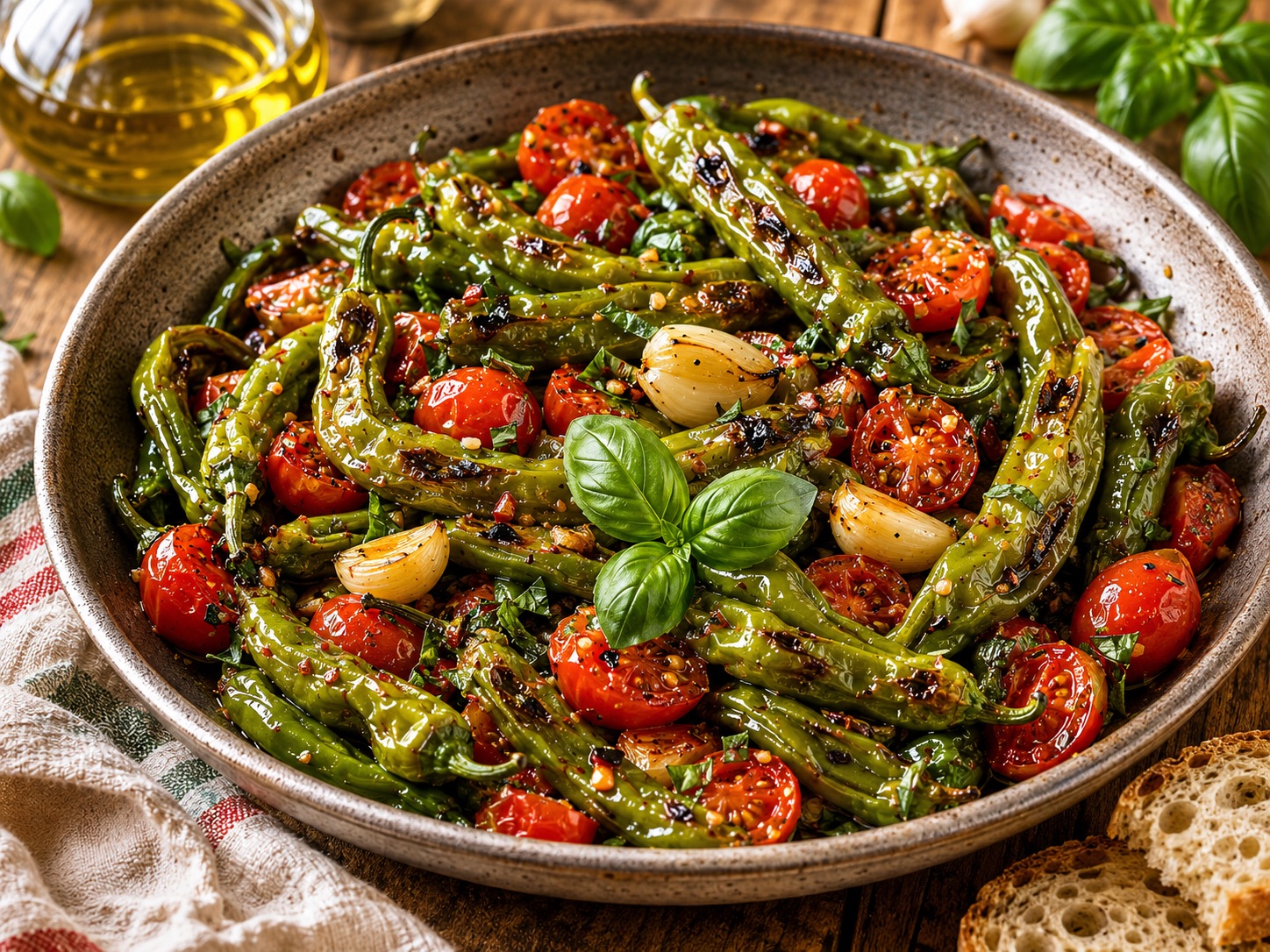
There is a plate that appeared in the summer kitchen without announcement — a wide, low plate or a large bowl, set on the counter to cool while other things were still being prepared. Green peppers, blistered and slightly collapsed, swimming in the olive oil and tomato juices that had cooked together in the pan. A handful of basil torn over the top. Whole garlic cloves, golden and mellowed. The smell reached you from the other room.
This is the peperoni alla napoletana — sautéed friggitelli peppers with cherry tomatoes, garlic, and basil, cooked in extra-virgin olive oil until everything is soft and fragrant and slightly sweet. Friggitelli are the slender, mild green peppers that appear in Campanian markets all summer, sometimes called friarielli in their pepper form (not to be confused with the leafy brassica of the same name), or substituted elsewhere with shishito peppers, which are the closest equivalent available outside Italy. The peppers are cooked whole or halved, without preparation beyond washing — the skin blisters, the interior softens, the stem stays on and you eat around it or pull it off as you go.
The dish was always cold or room temperature by the time it reached the table — partly because it was made in advance and partly because cold peppers in olive oil are, genuinely, better than warm ones. The oil settles into the peppers and tomatoes as they cool, the garlic mellows further, the basil wilts into the juices. What was a hot pan dish becomes something else entirely at room temperature: more cohesive, more flavored, more suitable for eating on bread or directly from the plate with your fingers while someone else finishes cooking.
The panino con i peperoni is the logical extension of this dish — cold peppers from the previous day, a few slices of good bread, the olive oil and tomato juices soaked in. It is not a formal recipe. It is what happens when the plate from yesterday is still in the refrigerator and lunch needs to happen quickly. In a Campanian summer kitchen, this was understood without discussion.
Bell peppers, vitamin C, and the summer vegetable case for seasonal cooking
Peppers — green, red, yellow — are among the richest dietary sources of vitamin C available in the summer kitchen: a single 100 g serving of green pepper provides approximately 80 mg of vitamin C, well above the adult daily requirement. Vitamin C is heat-labile and is partially reduced during cooking, but the short cooking time of this dish (the peppers are blistered, not stewed) preserves a significant portion of the vitamin. Friggitelli and similar mild peppers also contain capsaicin at very low concentrations — enough to contribute a faint warmth without the inflammatory potential of hot chili — and luteolin, a flavone with documented anti-inflammatory and antioxidant properties studied in relation to cardiovascular and neurological health. Cherry tomatoes contribute lycopene, whose bioavailability increases substantially when cooked in the presence of olive oil fat — so the tomatoes cooked directly in the olive oil in this dish are delivering lycopene more efficiently than they would raw. Garlic cooked whole and gently sautéed, as here, undergoes partial conversion of allicin to diallyl disulfide and other organosulfur compounds that retain cardiovascular and antimicrobial activity while losing much of the pungency of raw garlic. Fresh basil added at the end contributes linalool, eugenol, and rosmarinic acid — the volatile aromatics that are responsible for the characteristic smell of the dish and that diminish rapidly with sustained heat. The extra-virgin olive oil, used generously throughout, provides oleic acid, hydroxytyrosol, and oleuropein — phenolic antioxidants that also serve as the medium in which the fat-soluble carotenoids from the tomatoes and the fat-soluble vitamins from the peppers are absorbed. This is a very simple dish with a surprisingly complete nutritional profile, assembled from ingredients that each bring something specific.
The recipe
Ingredients · serves 4
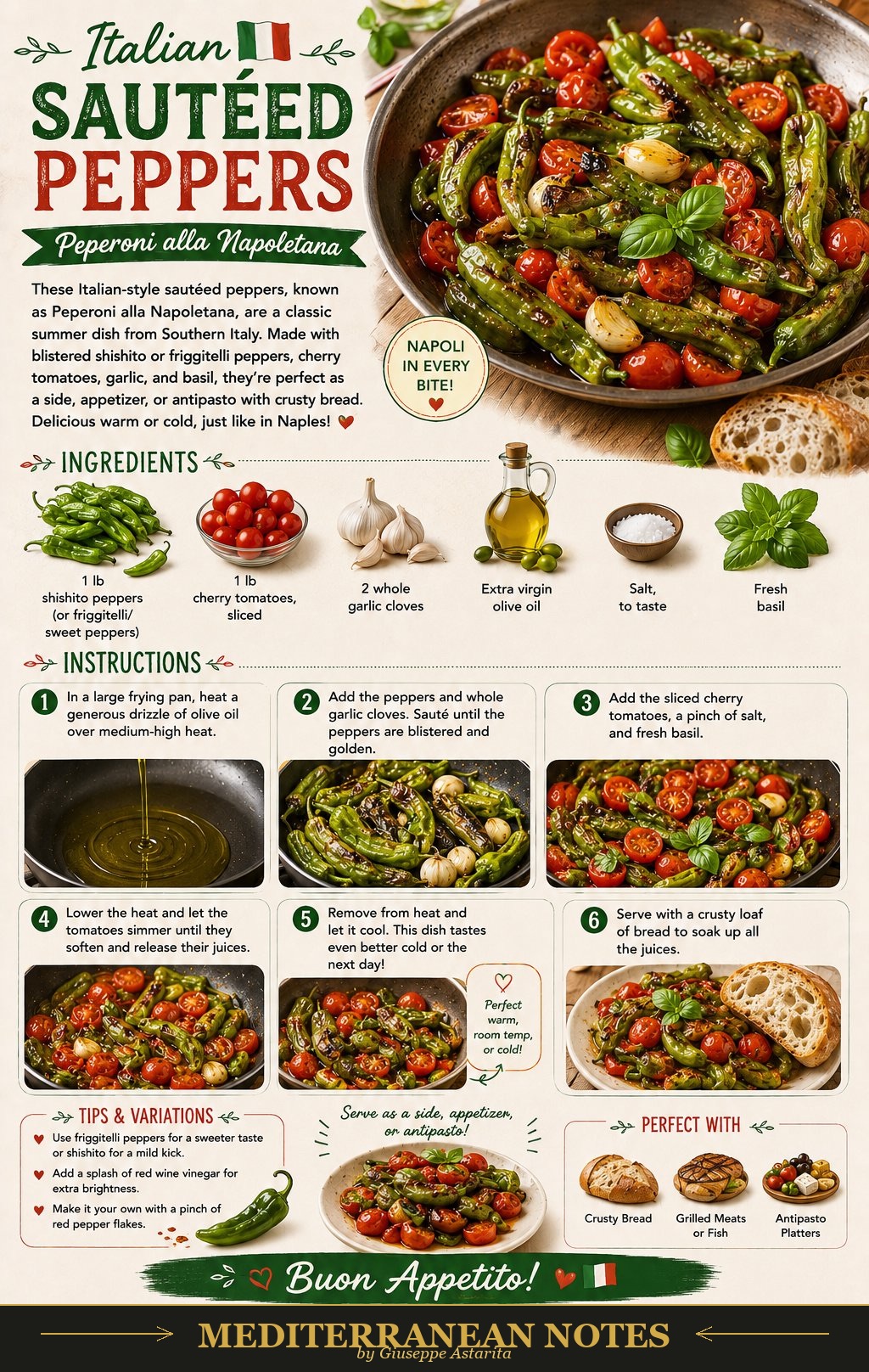
Method
Heat a generous pour of extra-virgin olive oil in a large, wide skillet over medium-high heat. Add the whole peppers and the garlic cloves. Sauté without stirring too frequently — let the peppers blister and take color on each side. Turn occasionally until blistered and golden all over, about 8–10 minutes total. The skins should be slightly charred in spots; this is flavor.
Friggitelli go in whole, stem and all. Shishito peppers the same. The skin blistering is the point — do not be tempted to stir constantly. Let them sit against the hot pan.
Add the halved cherry tomatoes, a pinch of salt, and a few torn basil leaves. Lower the heat to medium. Cook, stirring occasionally, until the tomatoes soften and release their juices — about 5–7 minutes. The liquid from the tomatoes combines with the olive oil into a loose, fragrant sauce that pools at the bottom of the pan.
Remove from the heat. Scatter the remaining basil generously over the top, torn by hand. Taste for salt. Transfer to a wide serving plate or bowl — including all the oil and tomato juices from the pan. These are the best part.
A splash of red wine vinegar added with the tomatoes gives the dish extra brightness — a classic Campanian variation. A pinch of red pepper flakes in the oil at the start adds gentle heat.
Let the dish cool to room temperature before serving — at least 20–30 minutes. Or refrigerate and serve the next day, brought back to room temperature. Both are correct; the cooled version is the better one.
The juices at the bottom of the plate are for bread. Make sure there is bread.
The panino — the next day
This is not a recipe so much as a fact: cold peppers from the refrigerator, a few slices of bread, the olive oil and tomato juices from the bottom of the dish. Assemble. This is one of the best summer lunches available without any cooking at all, and it is also the reason to make more than the meal requires. The panino con i peperoni alla napoletana is better than it sounds, which is already good.
The dish works as part of an antipasto table alongside the zucchine alla scapece and the melanzane a funghetto — three summer Neapolitan vegetable plates that follow the same logic: cooked in olive oil, left to rest, served at room temperature, better the next day, always with bread. They were on the same tables growing up, in the same summer, and they belong together.
Buon appetito — e buona estate.