Melanzane a funghetto: the Neapolitan eggplant dish that needs nothing else
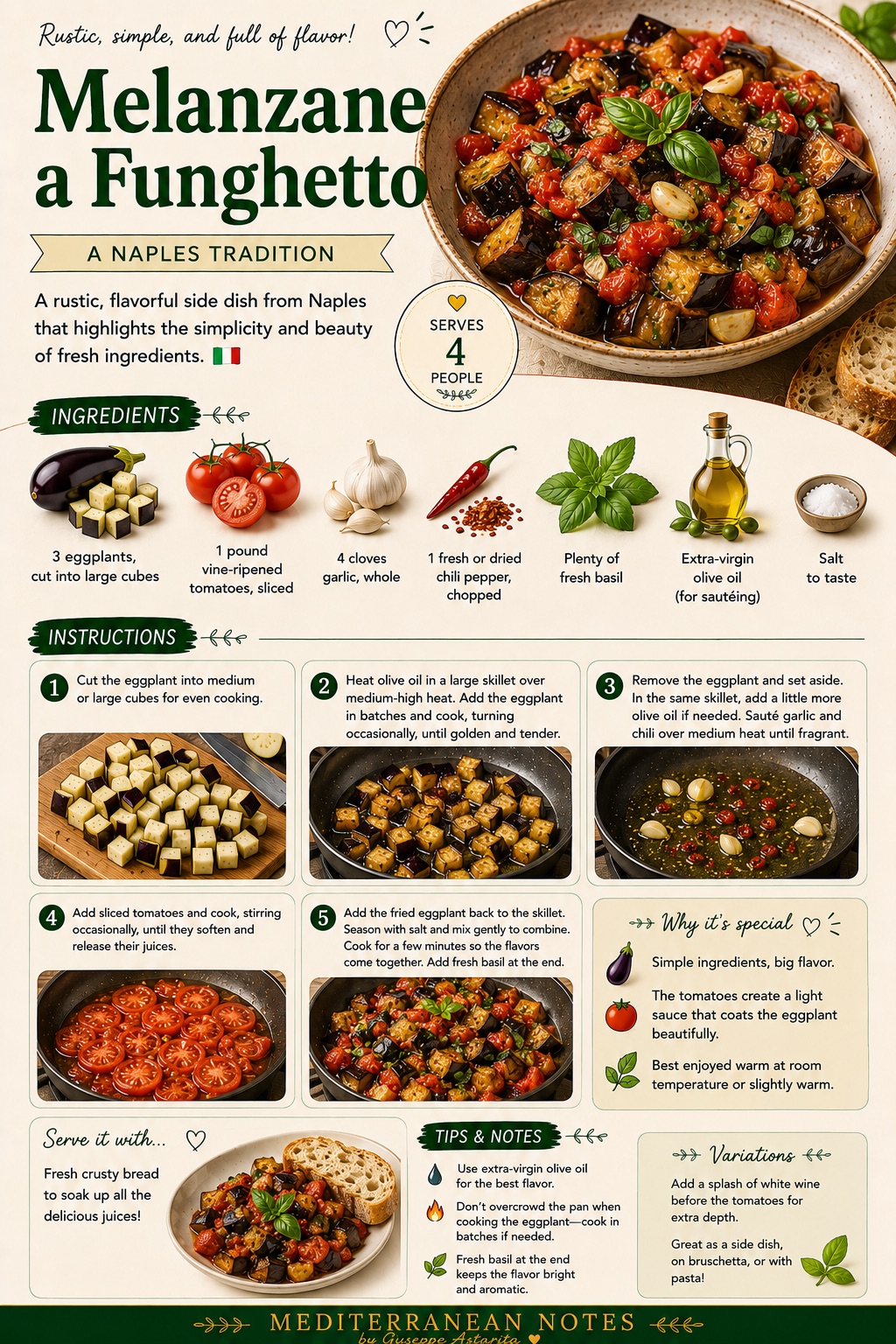
Fried eggplant cubes, vine-ripened tomatoes, whole garlic, chili, and fresh basil torn at the end. The smell of basil and ripe tomatoes in the same pan is one of the most specific memories of a summer kitchen in Campania. Side dish, panino filling, pasta sauce. It does everything.
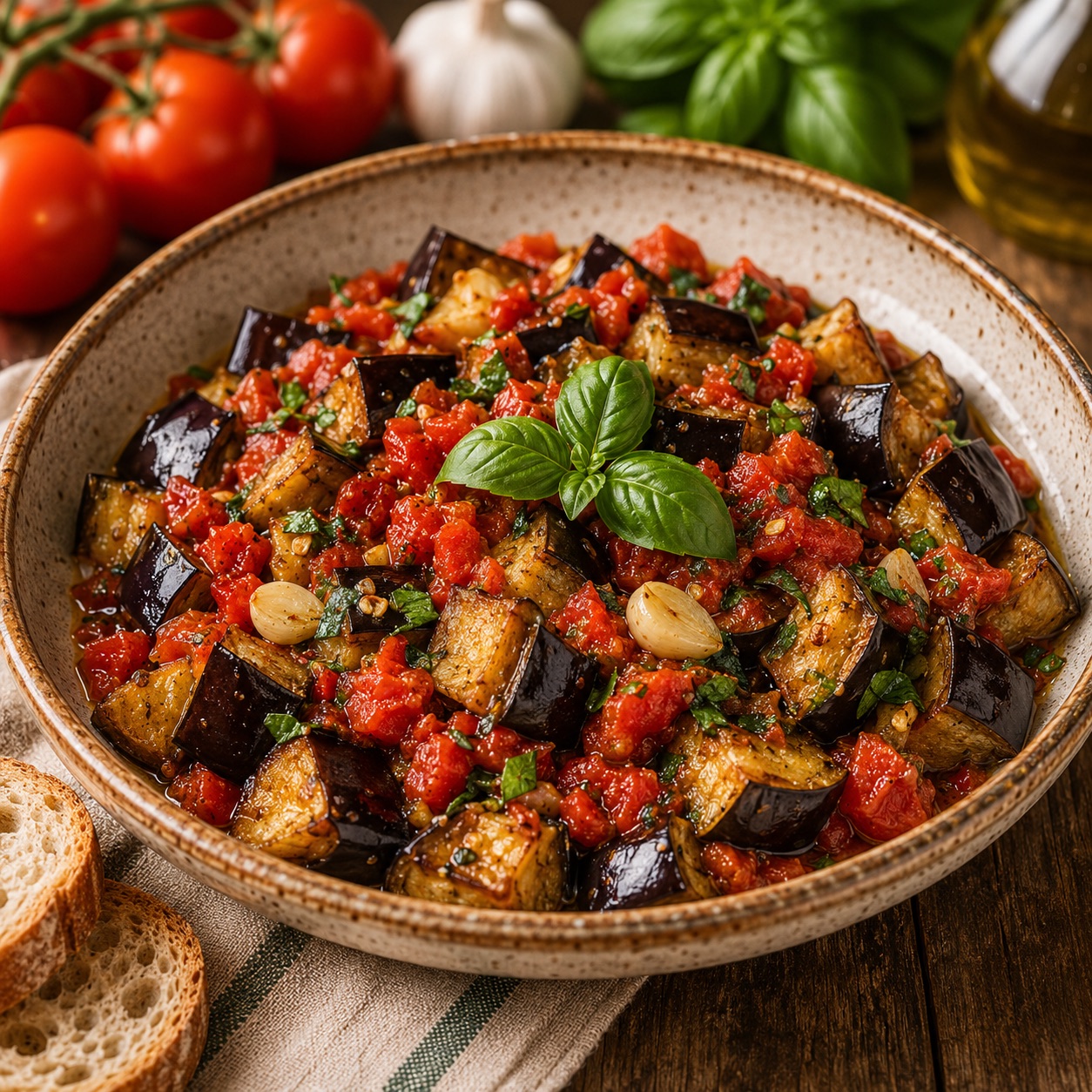
There are dishes that smell like a season before you taste them, and this is the summer one. The combination of hot olive oil, eggplant beginning to brown, tomatoes starting to release their juice, and basil added at the end — that smell is a Campanian kitchen in August, and it is precise and immediate in a way that is difficult to account for until you find yourself making it in another country twenty years later and the smell arrives first.
The name is literal and slightly mysterious: a funghetto means "in the style of mushrooms" — a reference to the way the eggplant is cut into large cubes, not slices, so that when fried it develops a dense, meaty interior beneath a golden crust that resembles, in texture and presence, a sautéed mushroom. It is a Neapolitan technique applied to a Neapolitan obsession. Eggplant in Campania is not a vegetable you add to a dish. It is the dish.
It was always on the table in summer — alongside the polpette at Sunday lunch, or served warm as a side at dinner, or cold the next morning in a panino. The panino con le melanzane a funghetto is one of those combinations that exists without ever being officially named: bread, cold eggplant and tomato, a little of the olive oil that has settled at the bottom of the bowl. A very good lunch that requires no cooking at all on the day you eat it.
No deep frying required. A generous pour of olive oil in a wide skillet, heated properly, is enough — the eggplant cubes brown in batches, developing a golden crust on all sides without being submerged. The same olive oil does the work throughout: frying the eggplant, then building the tomato base separately. Two pans, one oil, one dish.
Nasunin, chlorogenic acid, and the antioxidant case for eggplant skin
Eggplant is notable among vegetables for its content of nasunin — a potent anthocyanin antioxidant concentrated in the purple skin that gives the vegetable its color. Nasunin has been studied for its ability to chelate iron and inhibit lipid peroxidation in cell membranes, a property relevant to both cardiovascular health and neurological function. Frying eggplant in hot oil triggers the Maillard reaction at the surface while the interior softens and sweetens — a transformation driven by the breakdown of chlorogenic acid, another polyphenol present at high concentrations in eggplant. Vine-ripened tomatoes contribute lycopene, the carotenoid antioxidant whose bioavailability increases significantly with heat and in the presence of oil — so the tomato sauce built with olive oil is delivering lycopene far more efficiently than a raw tomato would. Garlic sautéed whole (rather than minced and added raw) mellows considerably: the allicin compounds partially convert to diallyl disulfide and other organosulfur molecules that retain cardiovascular and antimicrobial activity with a softer, more rounded flavor. Fresh basil added off heat preserves its volatile aromatic compounds — linalool, eugenol, and β-ocimene — which cook off rapidly and are largely lost when basil is exposed to sustained heat.
Ingredients · serves 4
Method
Cut the eggplant into large, even cubes — about 3 cm per side. Uniform size matters for uniform frying; pieces that vary in size will cook unevenly, with smaller ones burning before larger ones are cooked through.
Choose eggplants that are ripe but still firm when pressed. Very soft eggplants will fall apart during frying. The skin stays on — it holds the cube together and carries most of the antioxidant pigment.
Pour enough olive oil into a wide skillet to generously coat the bottom — about 4–5 mm deep. Heat over medium-high until shimmering. Test with one cube: it should sizzle immediately. Fry the eggplant in batches, without crowding, until deeply golden on all sides — about 4–5 minutes per batch, turning as needed. Remove with a slotted spoon and drain on paper towels. Salt lightly while still hot.
Do not crowd the pan — the cubes need space to brown, not steam. And make sure the oil is properly hot before each batch; eggplant dropped into lukewarm oil will soak it up rather than sear.
In a separate wide pan, heat the olive oil over medium heat. Add the whole garlic cloves and the chopped chili. Sauté gently until the garlic is golden and fragrant — about 3–4 minutes. Do not let the garlic brown past golden; it turns bitter.
Add the sliced tomatoes to the pan. Increase the heat slightly and cook, stirring occasionally, until the tomatoes collapse and release their juice — about 8–10 minutes. The sauce should be loose and bright, not dried out. Season with salt.
If the tomatoes are very acidic, a tiny pinch of sugar corrects this without sweetening the sauce noticeably.
Add the fried eggplant cubes to the tomato sauce. Toss gently — the goal is to coat the eggplant and let it absorb the tomato without breaking the cubes or softening the crust more than necessary. Two or three minutes over medium heat is enough.
Remove from the heat. Tear the fresh basil leaves by hand and scatter over the top. Toss once more, gently. Serve warm — in a bowl, with a plate of crusty bread alongside.
Tear the basil rather than chop it. Cutting releases the volatile aromatics faster; tearing by hand slows that loss and keeps more fragrance in the dish.
Melanzane a Funghetto is a side dish in name only. In practice it is the thing people reach for first, the thing the bread disappears into, the thing that gets eaten cold the next morning in a panino — eggplant and tomato between two slices of bread, a little of the settled oil soaked in. It holds well overnight and actually improves — the eggplant continues to absorb the tomato sauce, the flavors deepen.
The leftovers also make an excellent pasta sauce. Warm the remaining melanzane a funghetto gently in a pan, toss with just-drained pasta and a splash of the pasta cooking water, and finish with a little extra basil. The eggplant breaks down slightly and coats the pasta in a way that is completely different from the dish it started as — and just as good. Make more than you think you need, specifically because of this.
It works as an antipasto, as a side for the Sunday polpette, in a panino the next day, or spooned over pasta the evening after. In Naples, no further justification is required.
Buon appetito.