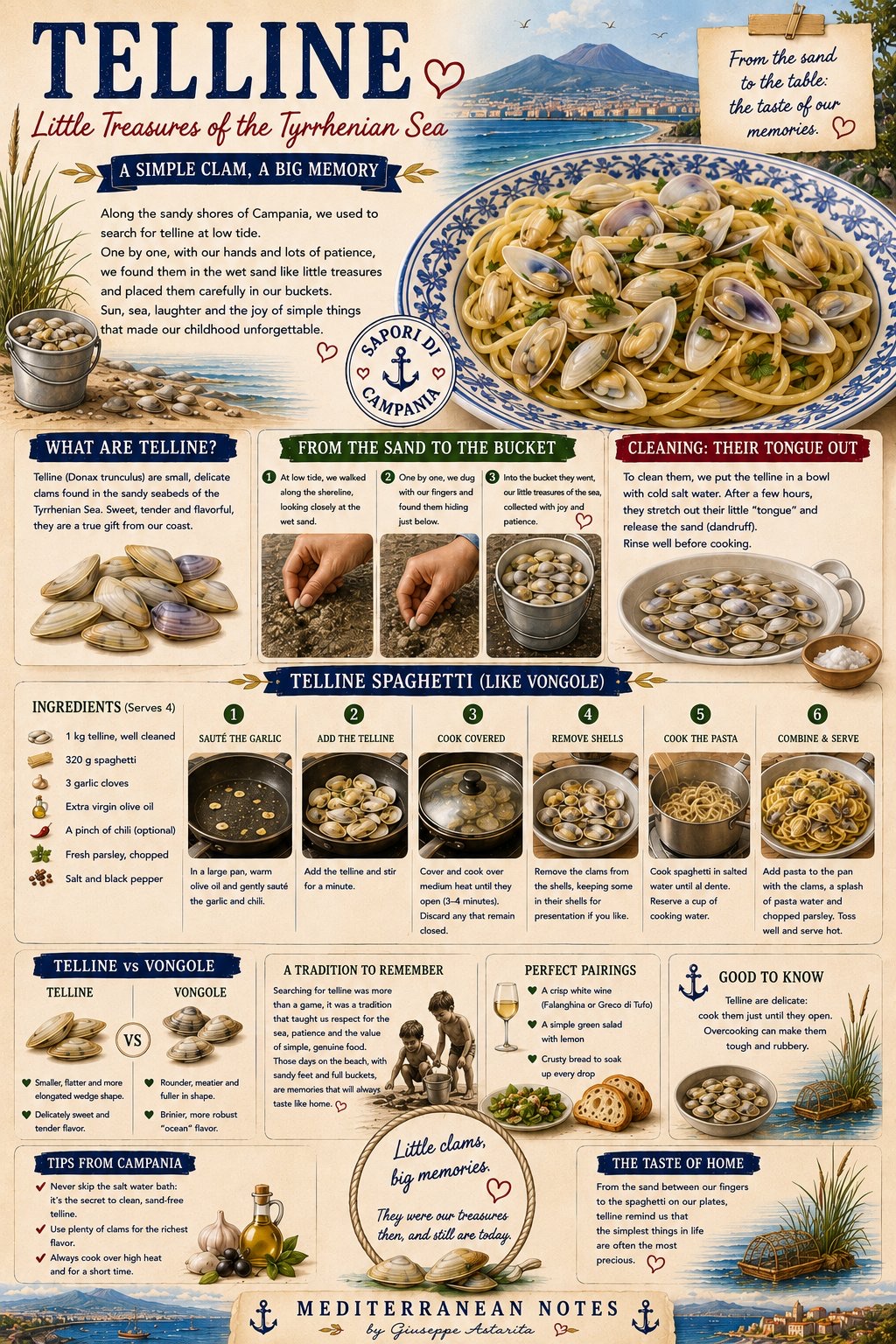
Telline
Little treasures of the Tyrrhenian Sea — found by hand, one by one, in the sand
Along the sandy shores of Campania, we used to search for telline at low tide. One by one, with our hands and a lot of patience, we found them hiding just below the wet sand like little treasures and put them carefully in our buckets. Sun, sea, laughter, and the joy of simple things. Then we brought them home, put them in cold salt water until they stretched out their tongue and released the sand, and cooked them like vongole — with spaghetti, garlic, olive oil, and parsley. They were better than vongole.
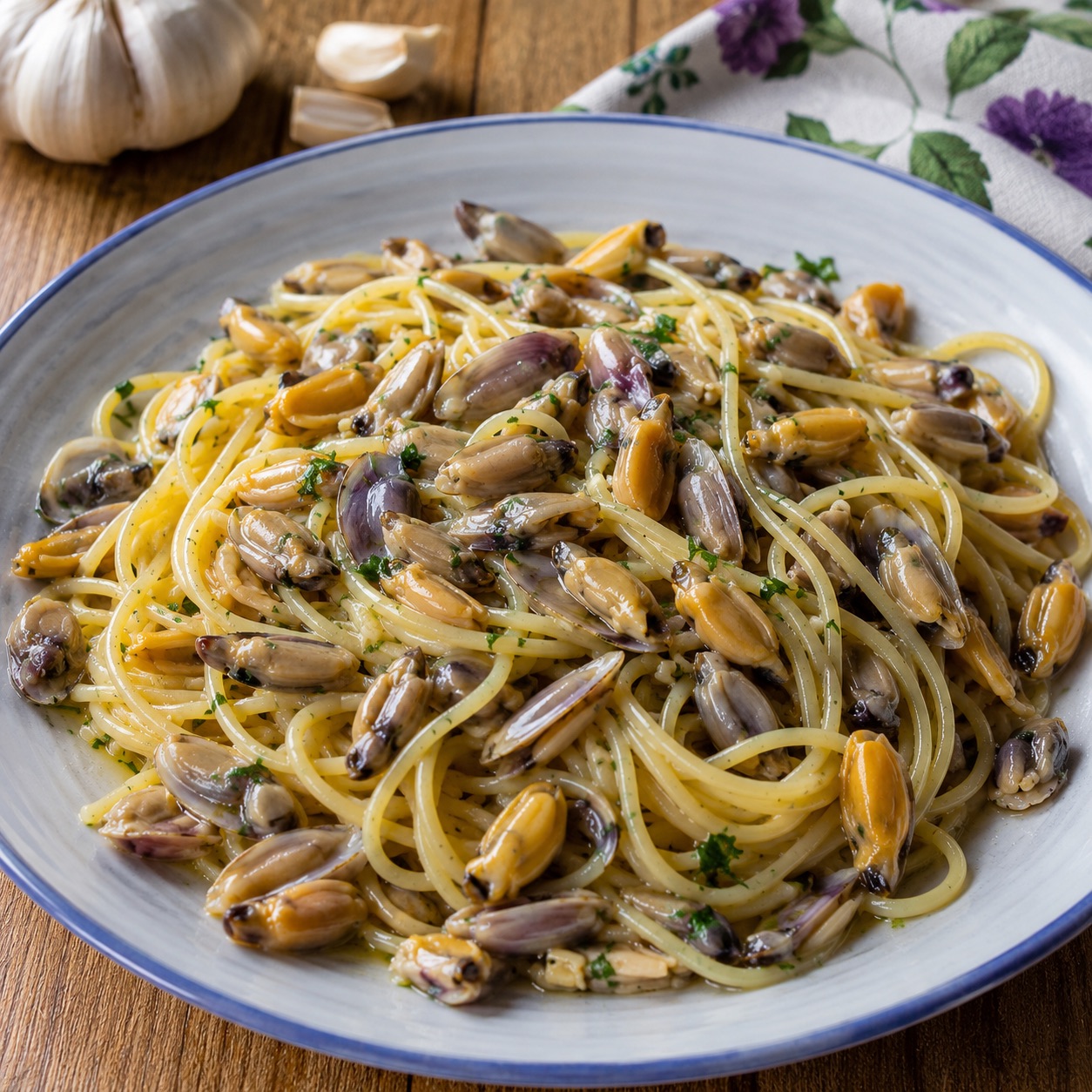
The telline — Donax trunculus, known as wedge clams in English, as arselle in other parts of the Mediterranean, as coquinas in the United States — are among the smallest edible bivalves found along the Italian coastline. They measure two to three centimeters at most, flat and elongated in their characteristic wedge shape, with smooth glossy shells that range in color from pale cream to violet to deep purple, patterned in stripes and rays. They live just below the surface of clean, fine sandy beaches, in the shallow water at the shoreline, burrowing rapidly into the wet sand and surfacing with the movement of the waves. This is why finding them was a game: you had to watch the water recede and move quickly, fingers working through the top layer of sand before they buried themselves again. The bucket filled slowly, one clam at a time, and filling it was the point.
This was a summer activity of childhood on the Campanian coast — the kind of thing that required patience rather than skill, attention rather than equipment, and that produced a tangible result in the form of a full bucket that would become dinner. The searching was its own pleasure independent of the eating, though the eating was also good. The telline are among the most delicate and sweet of all Mediterranean clams, their flavor more refined and less aggressively briny than the vongole that have become the standard of Italian clam pasta. When you have gathered them yourself from the beach where you are spending the afternoon, and cleaned them yourself at home, and cooked them an hour later, the connection between the sea and the plate is as direct and as clear as it ever gets.
The cleaning requires patience of a different kind. The telline must be placed in cold water with a generous amount of salt — seawater concentration, about 35 grams per liter — and left for several hours. In this salt bath they extend their siphon — the small tube the infographic calls their "tongue" — and pump water through their bodies, expelling the sand they ingested while burrowing. This self-purging is why the salt concentration matters: fresh water at lower salinity does not trigger the same behavior and the clams remain closed and gritty. After two to four hours the water at the bottom of the bowl will be visibly sandy, and the telline will be clean. Rinse well before cooking.
Telline vs vongole — not the same
The practical consequence of these differences for the spaghetti: with telline the sauce is lighter, sweeter, and more delicate than with vongole. The telline release less liquid when they open, so the pasta cooking water plays a more important role in building the sauce. The garlic must be cooked gently, not at all golden — too much garlic heat competes with the delicate clam flavor in a way that vongole, with their stronger brininess, can withstand. The wine, if used, should be minimal and should have evaporated completely before the telline go in. The parsley at the end is essential — its freshness is the only thing the telline sauce needs beyond the clam liquid and the olive oil.
Telline, like all bivalves, regulate their internal salt concentration through osmosis. When placed in water with a salinity similar to seawater (approximately 3–3.5% NaCl), they resume normal filter-feeding behavior: they extend their siphon, draw water through their gills to extract dissolved oxygen and organic particles, and expel water through the exhalant siphon. The sand that accumulated in their mantle cavity during burrowing is expelled along with the water. In fresh water or low-salinity water, the osmotic gradient across the gill membranes produces cellular stress that causes the clam to close and remain inactive rather than filter-feeding, which is why the salt bath must be at the correct concentration to work. Two to four hours is sufficient for small telline; larger vongole may require up to six hours. Placing a sheet of metal mesh or a colander inside the soaking container allows the expelled sand to fall below the clams rather than being re-ingested.
The telline's rapid toughening when overcooked is due to their small size and correspondingly thin muscle tissue, which reaches full protein denaturation temperature within 2–3 minutes of heat exposure. The adductor muscle — the same muscle that holds the shell closed — contracts fully and the meat becomes rubbery within seconds of overcooking. The correct technique is high heat, a covered pan, and removing the telline from heat the moment the last shell opens.
Spaghetti alle telline
Serves 4. If you cannot find telline, use the smallest vongole available — the method is the same, the result slightly more robust in flavor. Either way, do not overcook the clams and do not skip the salt water bath.
Also good: the telline sautéed simply with olive oil, garlic, salt, and pepper — no pasta — and eaten directly from the shell with bread to soak up the liquid. This is how they were sometimes eaten on the beach, the simplest possible preparation, the flavor of the sea at its most direct.
Buon appetito —
dal sabbia al piatto, il sapore del Tirreno.