From Columbus to Bananas
How Southern Italian food changed across five centuries — told through my father’s postwar bananas, my mother’s one piece of meat among seven, and a tomato that took two hundred years to be trusted.
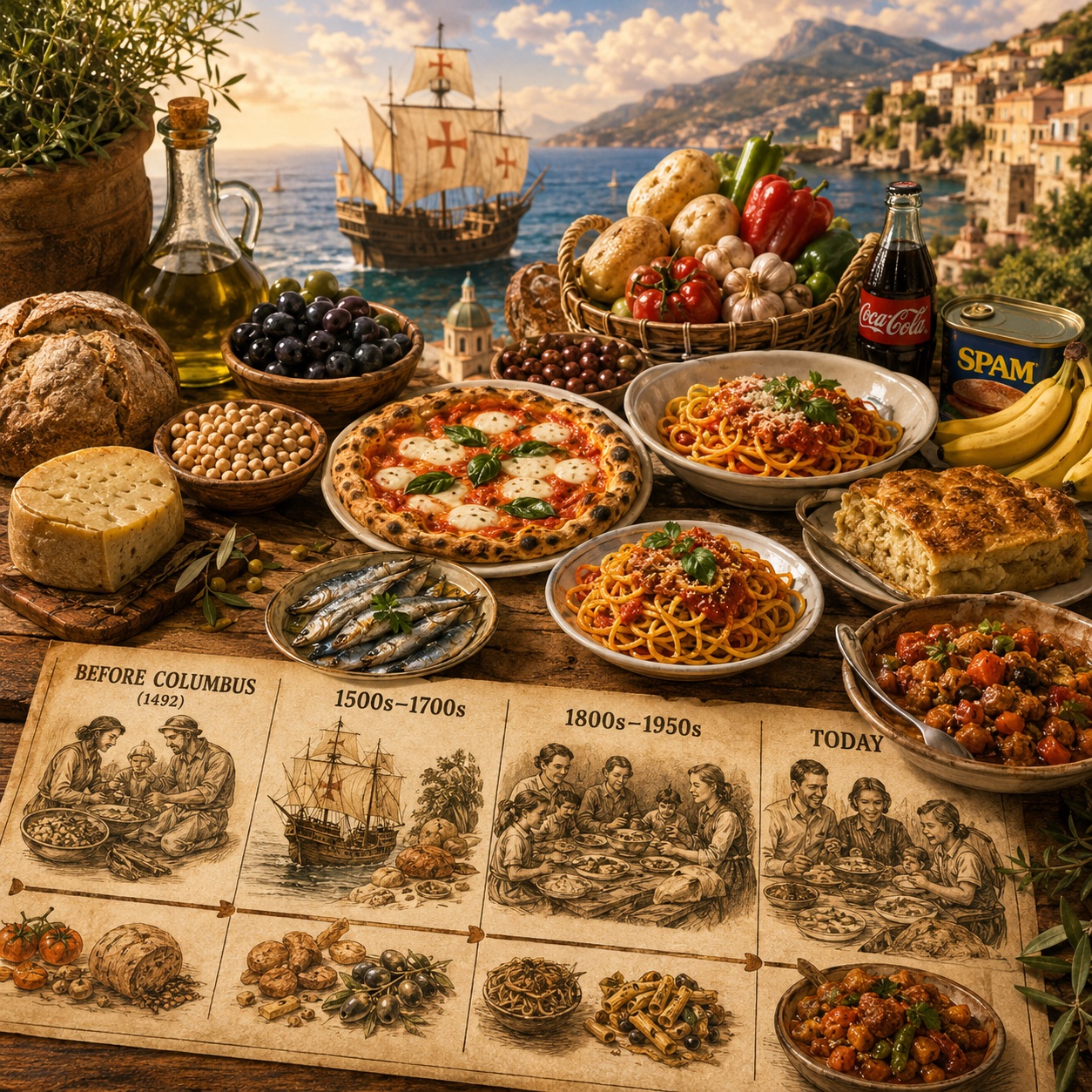
My father used to tell me there were no bananas before the American occupation. He said it flatly, as a fact about the world — bananas arrived in his life with the Allied troops after the war, the way chocolate and canned goods did, handed down or traded or glimpsed. My mother's version of the same years was a single piece of meat shared among her family of seven: one piece, in the pot, flavoring everything, belonging to no one. I grew up on these stories the way other children grow up on fairy tales, and it took me years to understand that they were not just family lore — they were the last chapter of a five-hundred-year story about how Southern Italian food became what it is.
Because the deeper you go, the stranger it gets. The tomato — the soul of Neapolitan cooking, the sauce on everything — did not exist in Italy before Columbus. For nearly two centuries after it arrived from the Americas it was treated as decorative, suspicious, possibly poisonous; it grew in gardens, not kitchens, and tomato pasta became common only in the 1800s. Early Neapolitan pizza was garlic, oil, cheese, anchovies and herbs — the Margherita combination was canonized only in 1889. No potatoes either: without them there is no gattò, no crocchè, no gnocchi as we know them. Half of what feels eternally Neapolitan is younger than the violin.
And the other half was shaped by poverty. Meat was a luxury: my mother's one-piece-for-seven was the standard arithmetic of the South, where a small cut flavored a whole pot and the cucina povera turned the constraint into a cuisine. It is also why the quinto quarto existed — the tripe, the liver, the brains, the soffritto, the horse meat, 'o pere e 'o musso — nothing wasted, everything eaten, and the necessity dressed up as tradition until it genuinely became one. The Mediterranean diet the journals praise was not designed by anyone. Beans, greens, bread, pasta, olive oil, occasional meat: it is the menu of people who were poor, kept honest by a climate that grew vegetables all year.
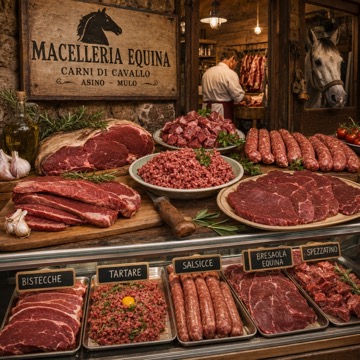
Then the war ended and the last great rearrangement began. The Allied troops brought bananas, peanut products, American chocolate, canned goods, soft drinks — my father's banana stories sit precisely here. Even the carbonara, for all its Roman swagger, is most plausibly a postwar dish: eggs and bacon meeting pasta somewhere in the orbit of Allied supplies. Arrabbiata, too, is a twentieth-century invention. Meanwhile the dishes of scarcity began their slow retreat: the blood-based sweets, the brains, the horse butcher on viale Beneduce — surviving today mainly in traditional homes, specialty shops, and blogs like this one.
The irony at the center of this story is now textbook nutrition: the diet of Southern Italian poverty — legume protein, whole-grain bread, vegetables in olive oil, fish on Fridays, meat as a seasoning — is approximately what modern dietary science recommends, and what the Seven Countries Study found in the Cilento in the 1950s just as the people living it were abandoning it for the foods of prosperity. Nobody chose the Mediterranean diet. It was the constraint set by income and climate, and it outperformed most things chosen on purpose. My grandmother shared one piece of meat among seven and accidentally ate better, by the ledger of cardiovascular epidemiology, than most of her descendants.
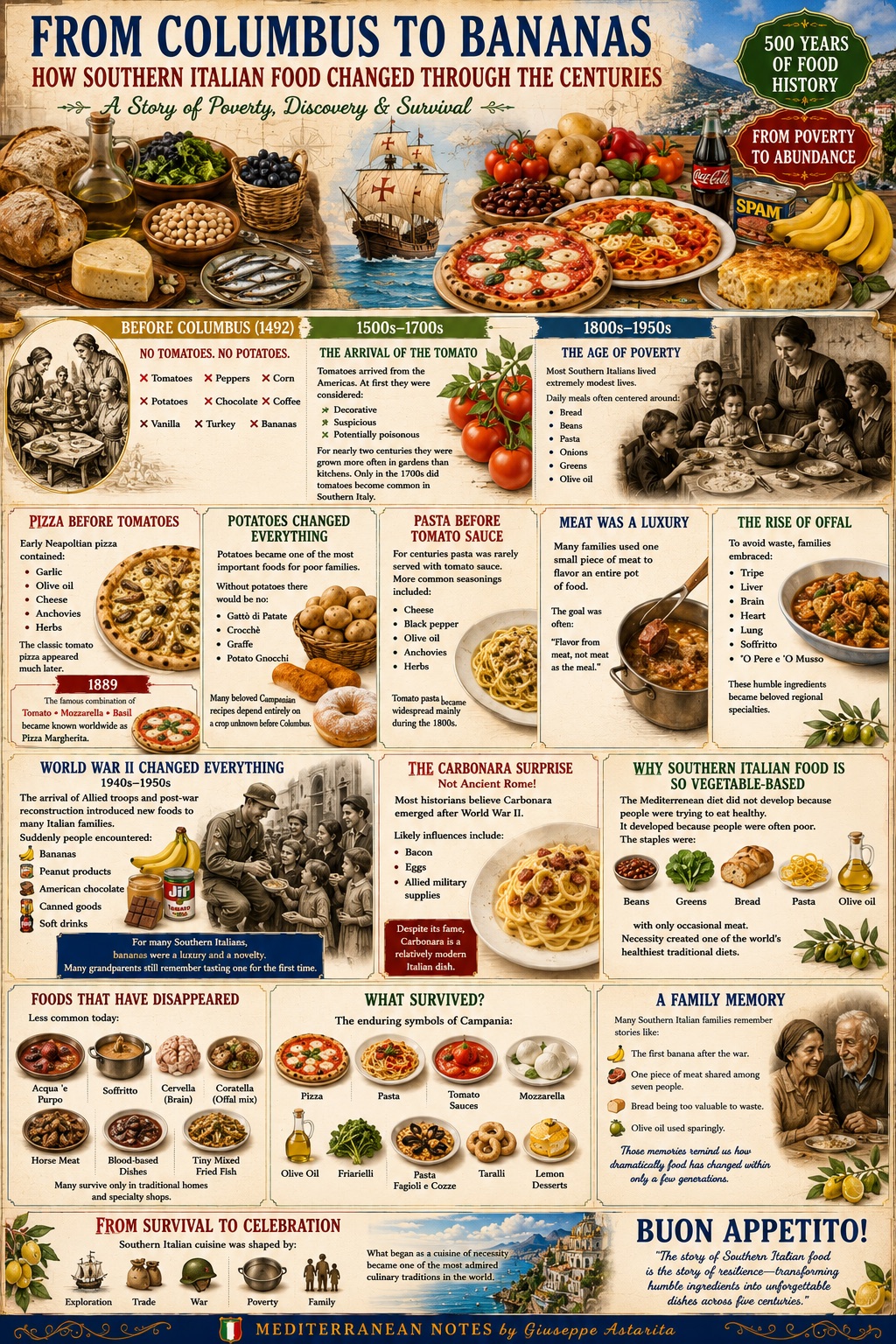
From Columbus to Bananas — 500 years of Southern Italian food history, era by era.
A Pantry Through the Centuries
Five hundred years in one pantry — what arrived, and when.
The lesson sits in plain sight once you know to look for it. Take any dish that feels eternally Neapolitan and ask when its ingredients actually reached Italy: the answers are usually centuries apart, and usually after 1492. The other half of the story is poverty — one piece of meat in the ragù pot, offal turned into delicacy, bread never wasted, pasta as the daily certainty — and the strangest twist is the modern one: the scarcity diet my parents left behind is the very one the journals now recommend. Recording who made these things, who ate them, and what was believed about them is the point of half the posts on this site. Food is memory; the recipes keep the food, and the stories keep everything else.