La Vita Mediterranea
The Mediterranean Life — and how Cilento gave it its name
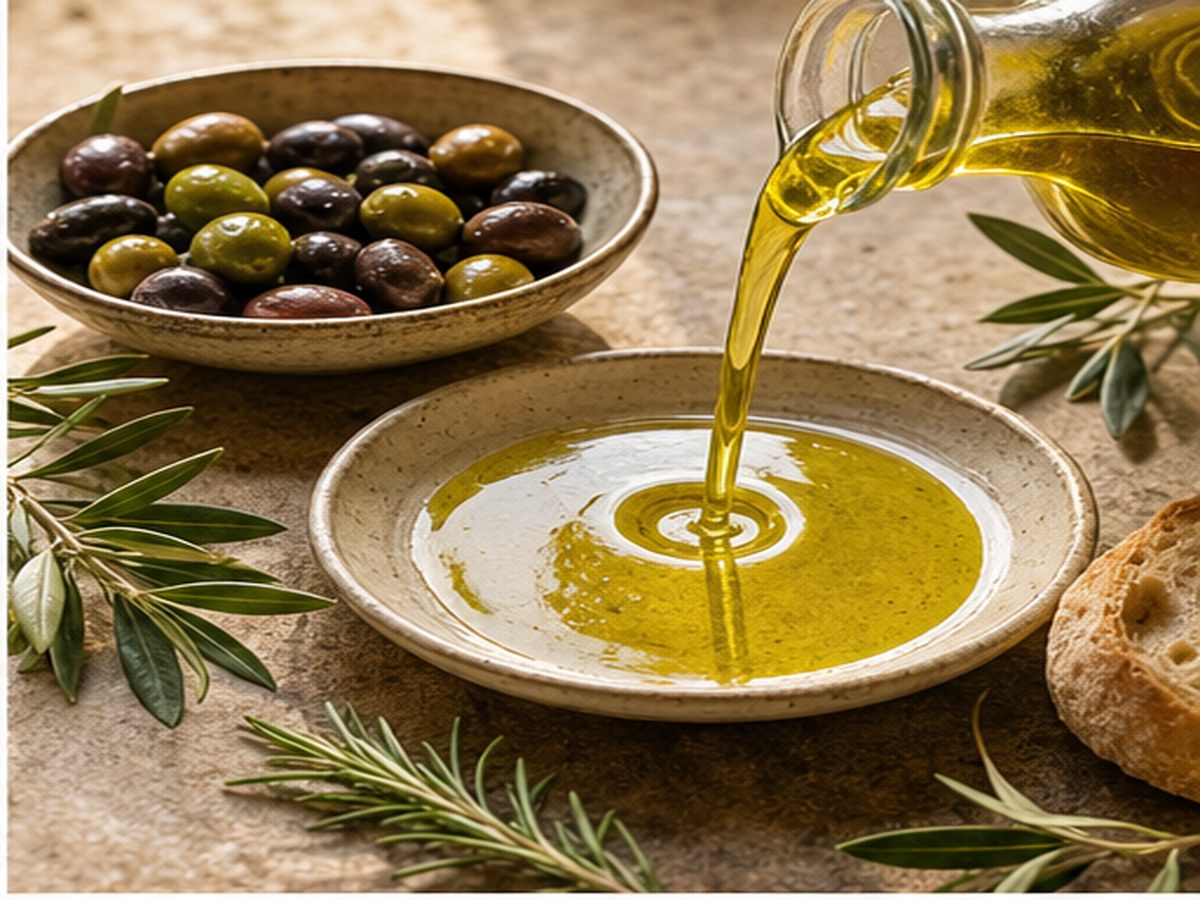
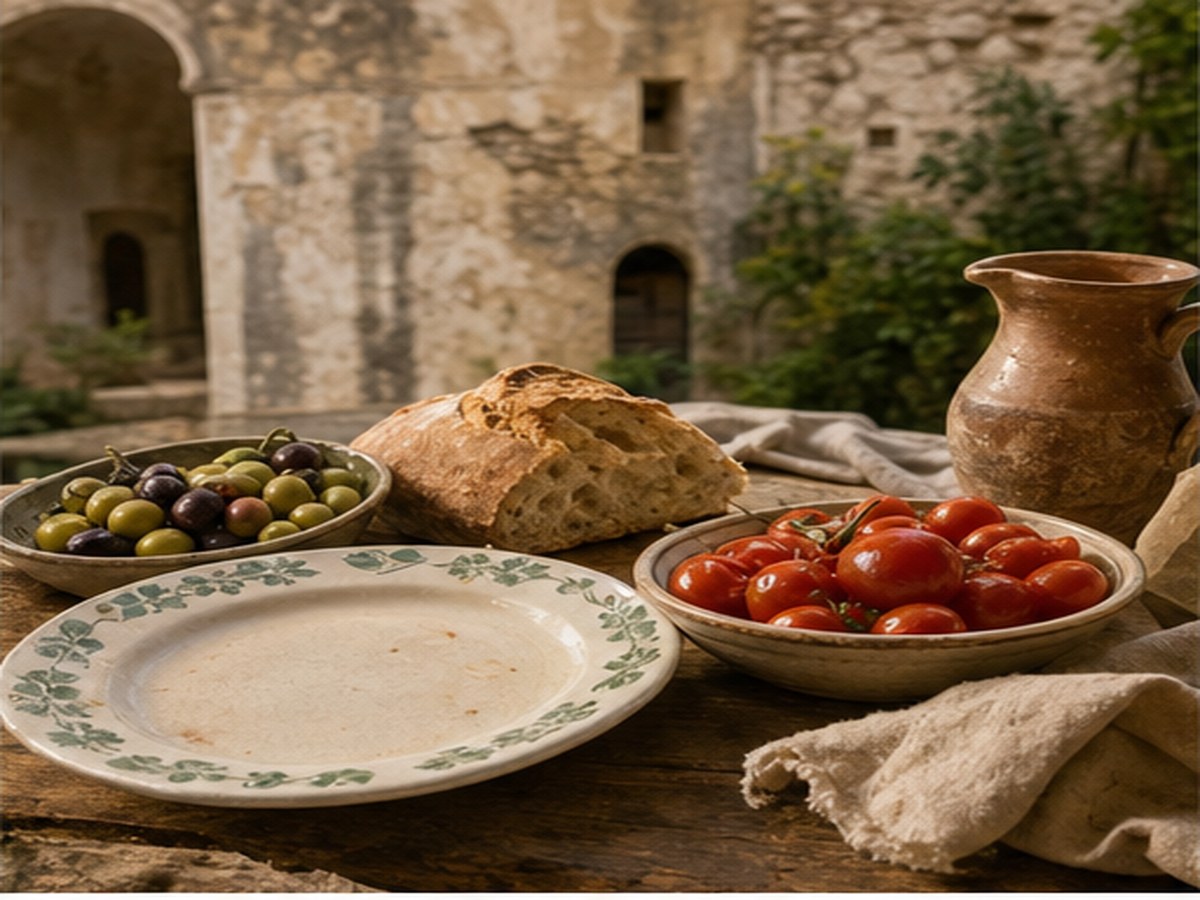
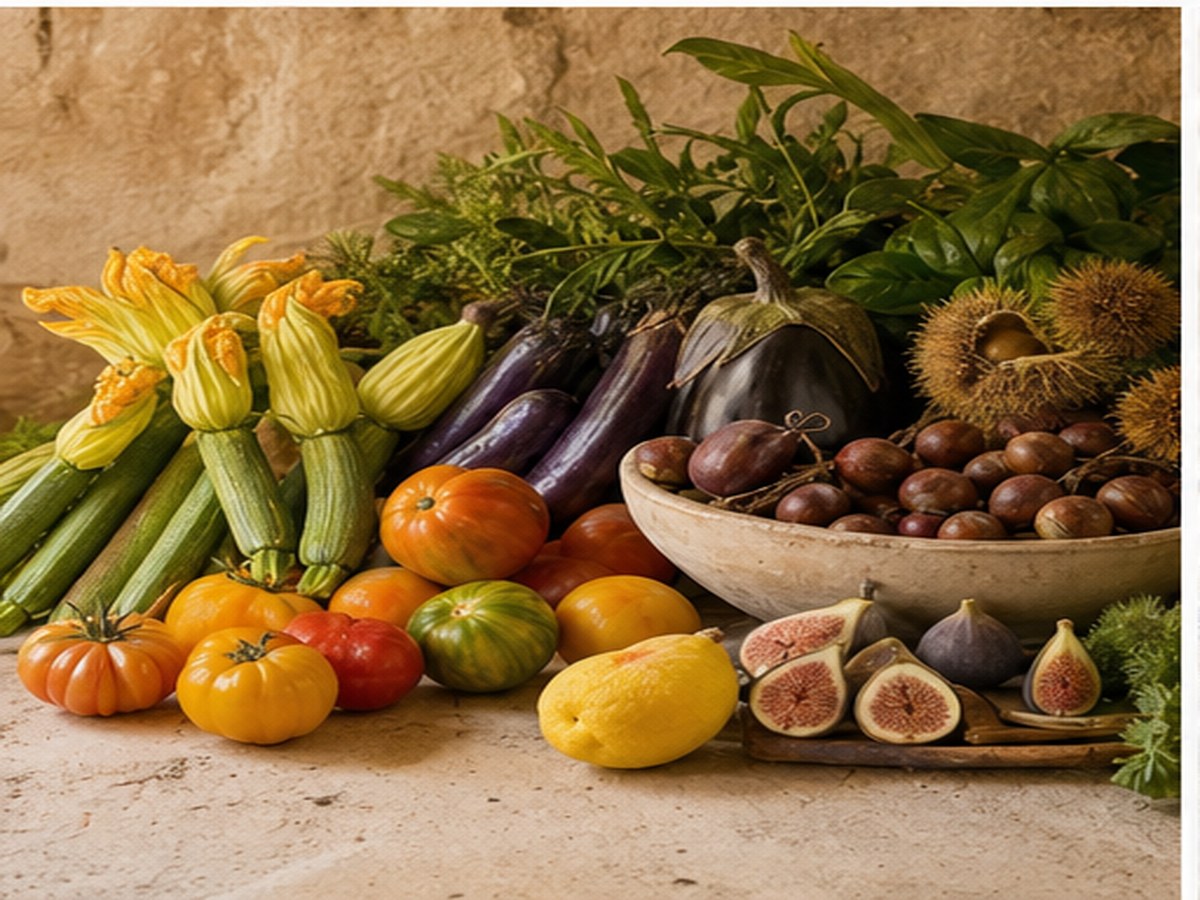
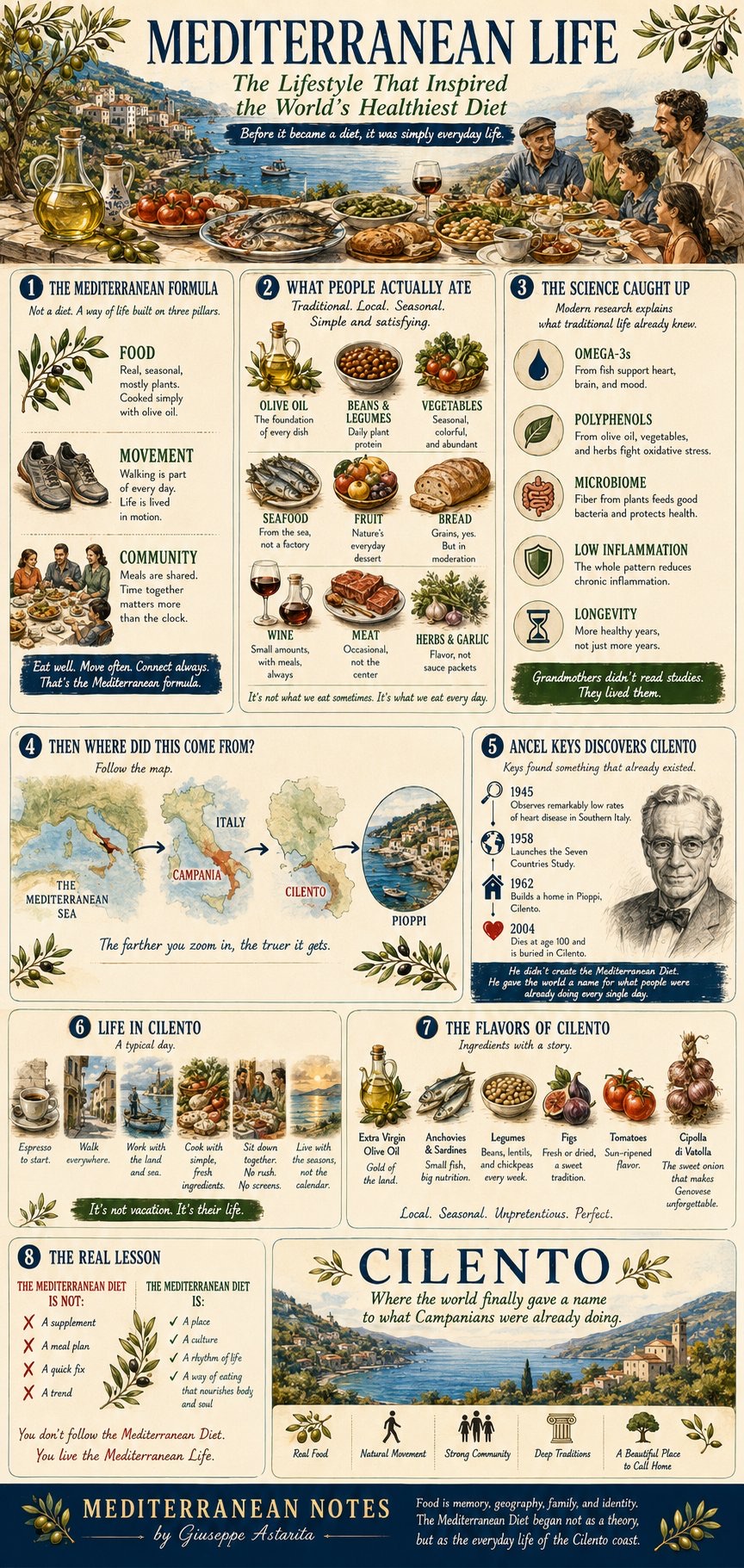
Food: Real, seasonal, mostly plants. Cooked simply with olive oil. Not a meal plan — a daily habit built from what the land and sea give.
Movement: Walking is part of every day. Not as exercise scheduled into a calendar — as transportation, as the natural consequence of living in hilly terrain with no reason to drive short distances. Life is lived in motion.
Community: Meals are shared. Time together matters more than the clock. The long slow lunch at the table with people you know is not a luxury — it is the structure of the day. You don't follow the Mediterranean Diet. You live the Mediterranean Life.
The Mediterranean diet is not a diet. It is a life — a way of eating that emerges from a way of living, inseparable from the landscape, the pace, and the people around the table. Before researchers named it, before UNESCO recognized it, before the world was told to follow it, the people of the Cilento coast were simply living it. An hour south of Caserta, in a fishing village called Pioppi, an American scientist came to study what they were already doing. The farther you zoom in, the truer it gets.
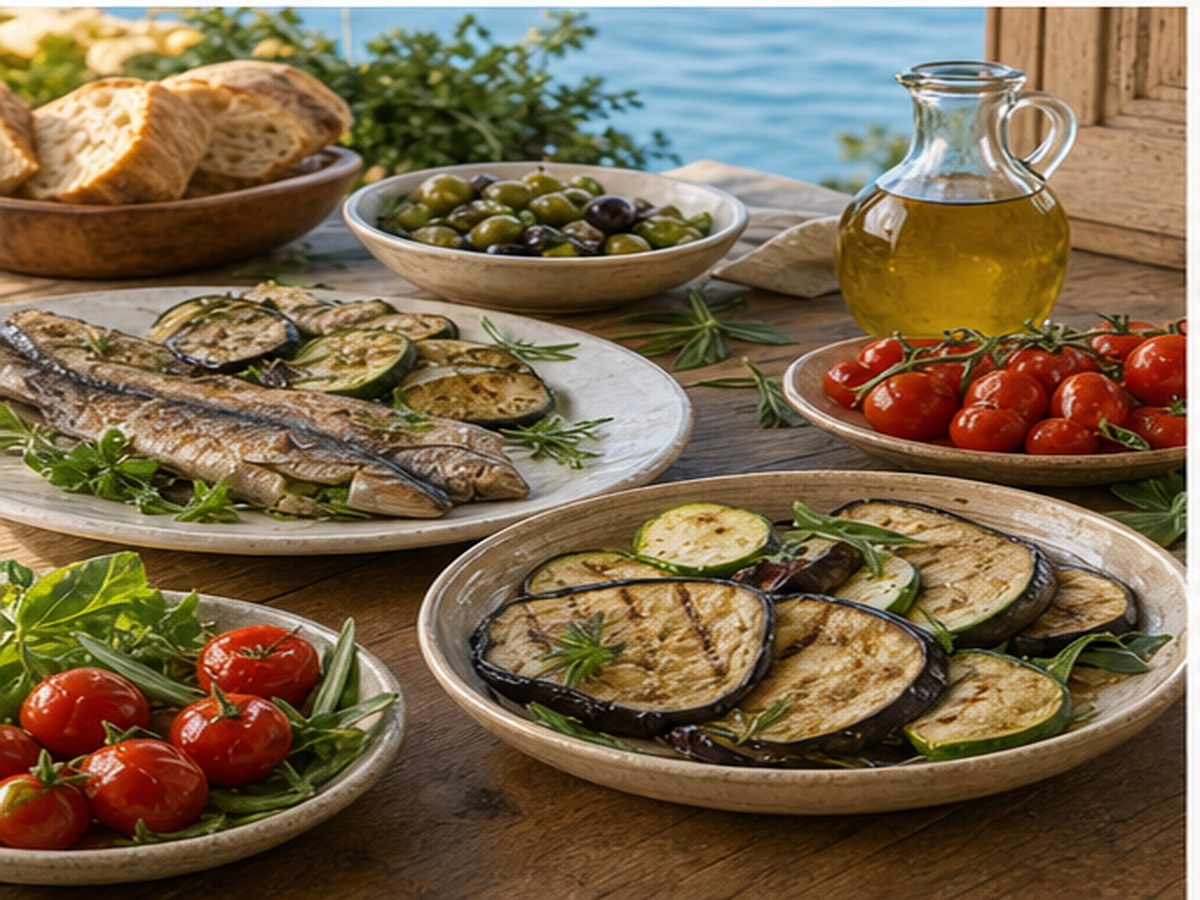
The Mediterranean Life rests on three things operating together — none of them sufficient alone. Food that is real, seasonal, mostly plants, cooked simply with olive oil. Movement woven into the day as transportation and work rather than scheduled as exercise. Community — the shared meal, the unhurried table, the understanding that time with people matters more than the clock. You do not follow the Mediterranean Diet. You live the Mediterranean Life. The diet is what that life produces at the table.
This is not a recent discovery. It is an ancient inheritance — the specific combination of geography, agriculture, and social structure that produced, over centuries, a way of eating that the rest of the world would eventually be told to replicate. What makes it difficult to replicate is that it was never just the food. It was the whole life around it.
It has no single image that travels the way the Amalfi cliffs or the Positano pastels do. What it has is the thing itself: a coast still largely intact, a landscape still largely what it was, a way of living still largely continuous with the one Ancel Keys found worth studying for four decades. The whole territory is the Parco Nazionale del Cilento, Vallo di Diano e Alburni — Italy's second-largest national park, a UNESCO World Heritage Site. The protection has done what it was supposed to: kept the hills in Mediterranean macchia, kept the villages small, kept the coast from being built over.
The visual character of the place is specific. The macchia — the dense scrub of holm oak, myrtle, rosemary, wild olive, and arbutus — gives the hills a dark saturated green that runs almost to the water. Against it, the Tyrrhenian Sea here has a color that shifts between blue and green depending on the angle of the light: not the turquoise of a postcard, but something more mineral and transparent, with a clarity that lets you see the bottom at considerable depth. The contrast between the dark vegetation on the hills and that particular color of the sea is one of those views that requires no commentary. You round a bend in the coast road and it is simply there.
The villages along the Cilento coast — Pioppi, Acciaroli, Pollica, Marina di Camerota — remain small and unhurried. A piazza, fishing boats on the beach, a bar where the same people sit at the same table every morning. The food follows from the place: anchovies from the Tyrrhenian, vegetables from the hillside gardens, legumes cooked slowly in local olive oil, wild greens gathered from the hillsides and dressed simply with oil and lemon. These are not dishes designed to express a dietary philosophy. They are what is available, in this season, from this land and this sea. They happen to be among the most health-protective foods a human being can eat — which is precisely what Keys came here to understand.
Ancel Keys and the observation that changed nutrition
Keys arrived in post-war Naples in 1945 as part of a U.S. Army nutrition team. He expected to find malnutrition — and he did. What he did not expect was the cardiovascular pattern: the Neapolitan upper classes, who could afford meat and dairy, had significantly higher rates of heart disease than the poor, who subsisted on pasta, beans, vegetables, and olive oil. This observation — that poverty, in dietary terms, appeared to protect — set him on a thirty-year research program.
The instrument of that program was the Seven Countries Study, launched in 1958: one of the first large-scale prospective epidemiological studies in nutritional science, following 12,763 men aged 40–59 across the United States, Finland, the Netherlands, Italy, Yugoslavia, Greece, and Japan. The men of southern Italian villages — eating the food generations of Campanian peasants had eaten — showed rates of coronary heart disease that were a fraction of those in Finland and the United States. Keys concluded that the dietary pattern, not genetics, explained the difference. His core insight — that a pattern of eating rather than any single nutrient determines health outcomes — was correct, and has been validated ever since.
Mediterranean populations — Crete, southern Italy, parts of Yugoslavia — had the lowest rates of coronary heart disease in the Seven Countries Study despite similar caloric intake to higher-risk populations. The most powerful subsequent validation was the PREDIMED trial (2013, New England Journal of Medicine): 7,447 participants at high cardiovascular risk, randomized to the Mediterranean diet with olive oil or nuts, showed a 30% reduction in major cardiovascular events — one of the largest effect sizes in nutrition intervention history. In 2010, the Mediterranean diet was added to UNESCO's Intangible Cultural Heritage list, the first dietary pattern to receive that recognition. Pioppi, a village of 200 people on the Cilento coast, is where it got its name. In 2025, a systematic review of 18 studies confirmed that the Mediterranean dietary pattern is also associated with slower cognitive aging — by up to 3.5 years — the most consistent finding of any dietary pattern on brain health to date.
In 1962 Keys built a house in Pioppi and spent the next four decades moving between his Minnesota laboratory and that village by the sea — eating the local food, studying the local population. He died in 2004, aged one hundred, and is buried in Pioppi. The village renamed its piazza after him and opened a small museum — the Museo del Mare e della Dieta Mediterranea — in a 16th-century watchtower overlooking the sea. Keys and his wife Margaret — a biochemist and frequent co-author — were not simply observers of the diet. They lived it. Margaret Keys wrote How to Eat Well and Stay Well the Mediterranean Way (1959) and The Benevolent Bean (1972), bringing Mediterranean cooking to American kitchens decades before it became fashionable.
What they actually ate — the original Mediterranean diet
What Keys described — and ate — was not exotic. It was the food of Campanian peasants: practical, seasonal, local. It was not a diet of deprivation. Keys described it as a diet of abundance — of plant foods, of good fat, of food preserved and prepared slowly. Every preparation in this collection draws from the same tradition.
In molecular terms this was a daily delivery system for oleic acid and its derivatives, long-chain omega-3 fatty acids, dietary polyphenols, resistant starch, and fermented bioactives — all operating simultaneously, through a varied diet, over decades. What Keys could not see in the 1950s and 60s was the molecular machinery that explained why it worked. He did not know about oleoylethanolamide from olive oil and its role in satiety and metabolic signaling, or about the resolvins and protectins produced from EPA and DHA that actively resolve inflammation, or about the conversion of resistant starch from legumes into butyrate by the gut microbiome, or about the urolithins produced from polyphenols that protect mitochondrial function. That molecular biology — the science I spent my career developing the tools to study — is what the last thirty years have made visible. Keys identified the pattern. The molecular mechanisms explain why it works. The Campanian grandmothers who cooked this food were practicing precision nutrition fifty years before the term existed.
The Cilento today — landscape, lifestyle, and what survives
The olive groves Keys walked past still produce oil. The fishing boats still bring the same anchovies to the same markets. The legumes still grow in the same volcanic and clay-rich soil of the Cilento interior. The diet and the lifestyle that generated it remain more intact here than in most of coastal Italy — precisely because the Cilento was never overrun, never became a destination in the way Amalfi or Positano did. The protection that kept it quiet also kept it real.
La Cipolla di Vatolla — the onion that explains a sauce
The Cilento interior has its own specific ingredients that do not travel — flavors tied to particular soils, altitudes, and microclimates that cannot be reproduced elsewhere. The most distinctive of these is the cipolla di Vatolla: a flat, pale, ancient onion variety grown on the hillside terraces of the hamlet of Vatolla, in the hills above the Cilento coast. It is not sold in supermarkets. You find it at the annual summer festival, or you know someone who grows it. It arrives in braided strings — plaited together at harvest and hung in the kitchen to be used through the autumn and winter, the way preserving and storing were done before refrigeration made the practice seem archaic.
The hamlet of Vatolla is also where Giambattista Vico — the Neapolitan philosopher, author of the Scienza Nuova — spent much of his early life in the late 1600s, tutoring the children of a local family in the hills above what is now a national park. The cipolla di Vatolla and Vico's philosophy coexist in that hamlet with a certain rightness: ancient ingredients and ancient ideas, both growing slowly on the same hillside, both more significant than their obscurity suggests.
Standing at the festival with a braided string of these onions in hand, the thought that comes is the one a Campanian always has when confronted with a genuinely good ingredient: what could I make with this. The answer is immediate. The genovese napoletana — and its meatless version, the genovese fujuta — our great sauce of nothing but onion, cooked for hours until it collapses into something sweet and brown and deep — lives or dies by the quality of its onion. A sauce that is only onion needs an onion like Vatolla's: sweet enough to cook for five hours without turning bitter, substantial enough to become silk rather than mush. The cipolla di Vatolla is the onion the genovese was made for, and has probably been using for centuries in the Cilento version of the dish, without anyone writing it down. I need to go back with a bag of them and a free afternoon. The genovese is waiting.
What Keys understood, living in Pioppi, was that the diet and the lifestyle were not separable. The food was the product of the place and the pace: the hilly terrain that made walking the ordinary mode of movement, the sea that provided the fish, the hillsides that produced the oil and the wild greens, the rhythm of the day that made the slow meal at the table a structure rather than a luxury. You cannot extract the dietary pattern from the life that generated it and expect the same result. The Mediterranean lifestyle is the context in which the Mediterranean diet makes sense — and the Cilento is one of the few places where that context remains largely intact, visible in the landscape, in the pace of the villages, in the food still cooked from what the land and the sea give.
The science explains the mechanisms. Keys observed the pattern. The people of the Cilento lived the life. All three are the same thing at different levels of resolution. Drive south from Caserta, past Salerno, past the Greek temples of Paestum. Find the green coast and the clear water and the small village by the sea. Eat what the land and the sea give you. You will be doing what the entire nutritional establishment now recommends — except here, no one is following any recommendation. They are just having lunch.
Il segreto meglio custodito della Campania —
and it was never a secret. It was always just lunch.