Cosa Mangiava Mio Padre da Piccolo
What my father ate as a child
I asked my father, Nando, what he remembered eating when he was small. What came back was not a list of dishes so much as a whole vanished economy — bulk goods weighed out by hand, a shop that sold nothing but bananas, a fear of mussels that has lasted sixty years, and a city that didn't eat fish on Sundays until Naples arrived and taught it to. This is Part Two of a pair — Part One, what my mother ate as a kid, covers her side of the same city.
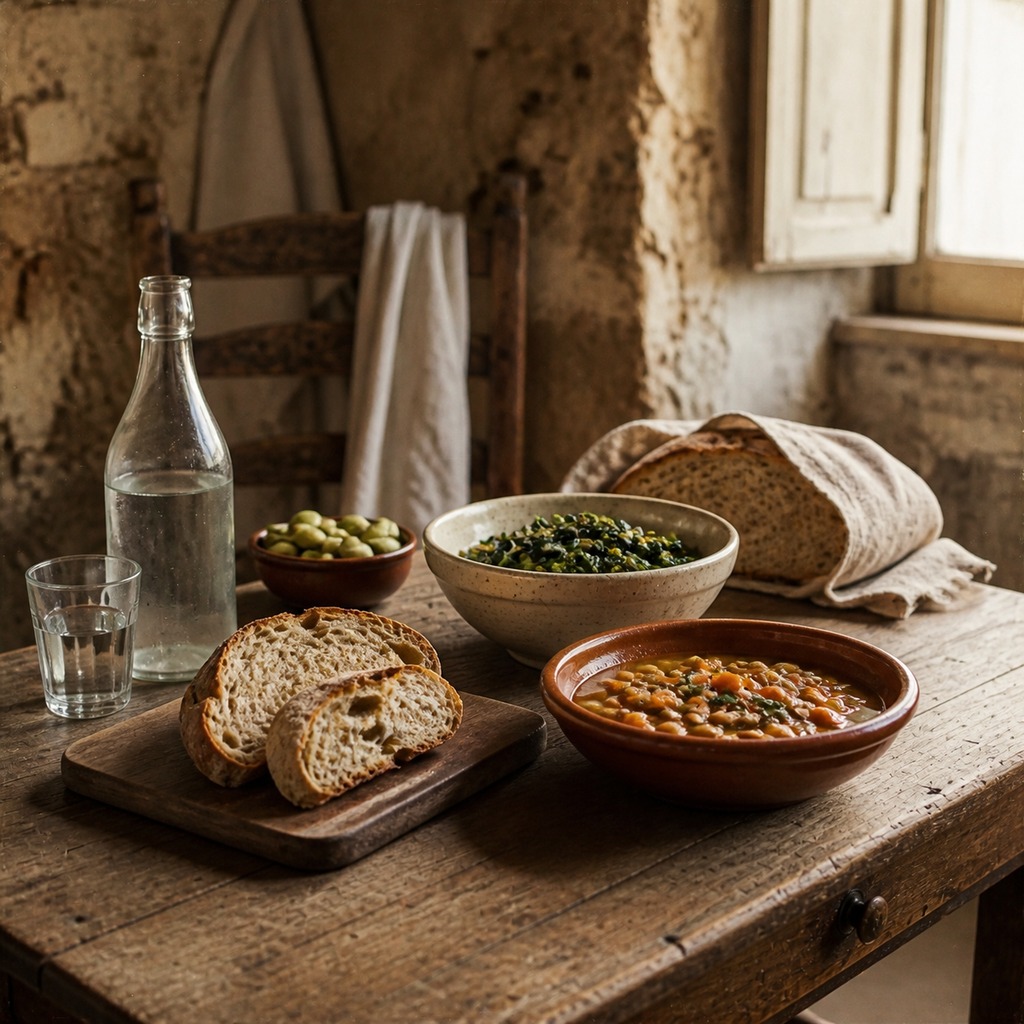
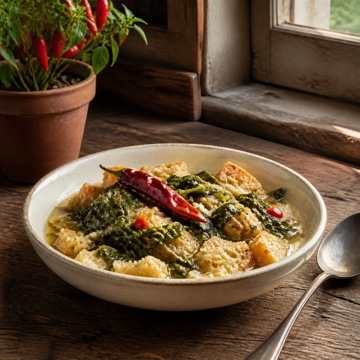
Ask my father what he ate as a child and the first thing he says, without hesitating, is pane cotto — stale bread dunked briefly in water simmered with garlic, chili, and bay leaf. He still makes it for himself now, decades after it stopped being the only option in the house. Everything else he remembers sits somewhere between that dish and pure novelty — vegetables constantly, meat rarely, and a handful of things so unfamiliar the first encounter with them stayed with him for life.
Vegetables, always — meat, almost never
His mother's cooking, he says plainly, was una cucina molto povera — a very poor kitchen. Peppers, eggplant, potatoes, vegetables constantly. Eggs sometimes, and rarely, drunk raw straight from fresh farm eggs — two small holes poked in the shell, one at each end so air could pass through, and sucked out directly. He's careful to say it wasn't sucked straight from an open shell — that would be disgusting, he insists — the two-hole method was the only acceptable way, and he knows exactly how unwise it would be to do today.
And whatever vegetable was around went into bread — that was just how it was eaten. Melanzane, peperoni, whatever came out of the pan that day, tucked straight into a piece of bread and eaten that way rather than plated as a side. It wasn't a specific dish so much as a habit that applied to almost anything: bread wasn't just what came with the meal, it was often the container the meal was eaten out of.
When there was meat at all, it stretched as far as it possibly could. His mother made what he calls "agnello con le patate senza agnello" — lamb and potatoes, without the lamb: potatoes cut into large chunks, lard, a great deal of onion, a thread of olive oil, all baked together in a pan. No lamb anywhere in it. "Il sapore era squisito," he says — the flavor was exquisite anyway. When there was fish, it was almost always alici — anchovies, the cheapest fish available — baked in a dish with oregano, alici in tortiera, prepared the Neapolitan way because his own father's family was originally from Naples.
His own frequent dinner, the one he made for himself often as a young man, was even simpler: spaghetti with a fried egg cracked directly on top and stirred through everything, the runny yolk becoming the sauce. Carbohydrates and protein, he points out, in one pan, in minutes.
Why Caserta didn't eat fish on Sundays — until it did
One detail is worth recording precisely, because it's real local history and not just family taste: in Caserta, up through his own adulthood, no fish shop opened on Sundays. Sunday in Caserta meant ragù, not fish — the opposite of Naples, where Sunday fish is its own tradition. It was only in the 1970s, as Neapolitan families began migrating to Caserta and settling there, that they started asking for fish on Sundays too, and the local pescherie gradually began opening that day to meet a demand that simply hadn't existed in Caserta before. A habit that reads today as unremarkably regional was, within living memory, something one city imported from another.
The Sunday structure itself was fixed: ragù at lunch, pasta first, then the meat from the sauce — never the reverse. In the evening, to balance the day, a piece of sausage and a piece of pork rib, always alla pizzaiola, drowned generously in tomato, eaten mostly with bread rather than as a plated second course — a huge plate of sauce with a little meat somewhere inside it.
A world sold loose, by weight
Almost everything, as a child, was bought unpackaged. He'd go down and buy half a kilo of pasta out of enormous sacks. A shop sold "crema Alba" — a pale yellow hazelnut cream, loose, weighed out — made in the city of Alba, which eventually became the branded, jarred Nutella everyone knows today. Fizzy water wasn't bought — it was made at home on Sundays with Idrolitina, a small box of blue and red sachets that turned still water effervescent, sealed afterward in glass bottles with the old rubber-gasket metal stoppers. Polenta, on the other hand, simply didn't exist in this world at all — not a regional dislike, a genuine absence: "non si sa nemmeno cosa sia," he says. We don't even know what it is.
Street food came from men pushing carts, not shops. One sold boiled potatoes and chestnuts out of a cauldron of hot water, ten or twenty lire for a paper cone — "coppetta" — of lesse. Chestnuts, he notes, are what carried Europe through famine before potatoes did, more nutritious than potatoes and far more available than the sweet potatoes that didn't exist here at all. And then there was the shop that sold only bananas — a sign outside reading simply BANANE, four or five bananas on an otherwise empty shelf, a scale beside them, nothing else in the store. His mother bought him one. It was the first banana he'd ever eaten.
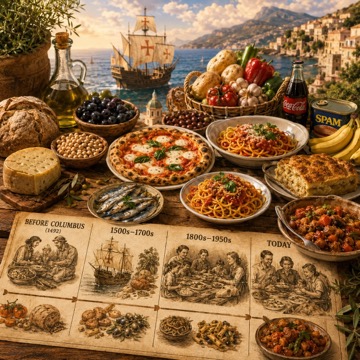
The full five-hundred-year story of how bananas, tomatoes, and everything else arrived in Southern Italy — including my own father's postwar version of this same memory — is told at length in from Columbus to bananas.
Pizza at sixteen, and a fear that never left
He didn't eat pizza until he was sixteen. Going out with friends by then, he'd buy it from Carmine, under the bridge on via Verdi, and eat it hot straight out of the paper in a field with the other kids, sitting on benches — a pizza for close to nothing, a lira or two, less than 200 lire. Later, with a friend named Renato Pepe, he'd ride a moped up to Caserta Vecchia for two pizzas and two beers between them, total cost 500 lire, in a restaurant by the castle where the two of them were often the only customers in the place.
And then there is the mussel story, which he tells with real weight even now. Around eight or nine years old — the same age as my own daughter Anna today — a young couple next door, unable to have children of their own, doted on him and invited him to Sunday lunch. They served mussels. When he got home and told his mother what he'd eaten, she was genuinely alarmed — no shellfish, no seafood at all, had ever entered their house. He never ate a mussel again. He still doesn't know, in his own words, what it means to hold a mollusk in your mouth, and he's never gone near impepata di cozze since, though this blog's own generation makes it often. Liver and onions, too, he genuinely disliked — undercooked it tasted of blood, cooked any further it turned tough; see fegato in padella for the version this family makes today, which he still doesn't order.
His mother's kitchen and my mother's kitchen were two different worlds in the same small city — see what we ate in Caserta, a few generations back for hers.