Spaghetti con Uovo Fritto
Garlic oil spaghetti, crispy fried egg, runny yolk -- brilliant from almost nothing
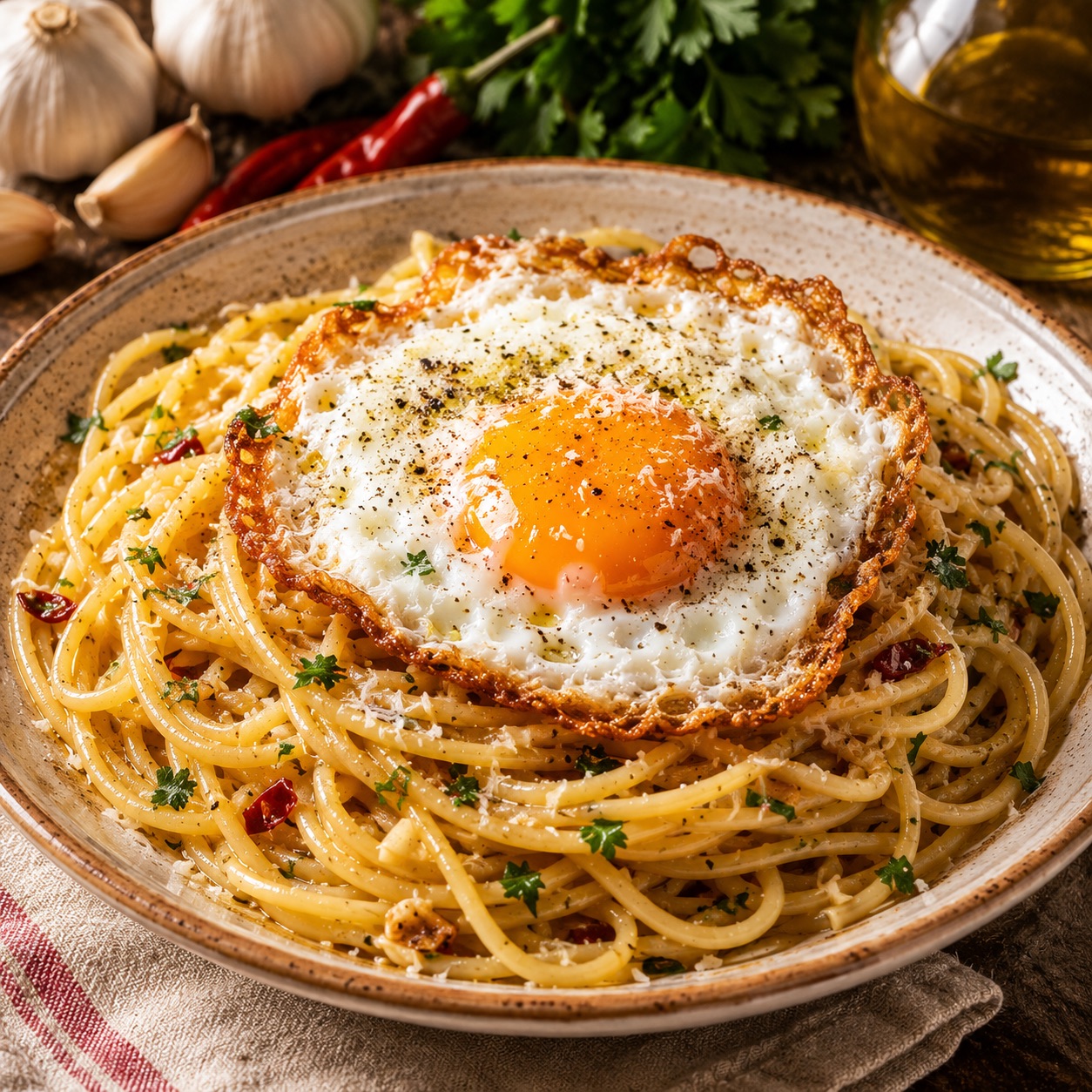
The spaghetti con l'uovo fritto is one of those dishes that does not require a recipe so much as a philosophy. The philosophy is this: good pasta dressed with olive oil, garlic, and a touch of chili, topped with a fried egg whose yolk breaks over everything when you eat it and becomes the sauce. The egg is not an afterthought or a novelty -- it is the point. The runny yolk combines with the olive oil and pasta starch to create something richer and more cohesive than any of the individual elements, and the crispy white edges of a well-fried egg add a texture contrast that makes the dish more interesting than the sum of its parts. It is a poor man's pasta in the most honorable sense: brilliant from almost nothing.
The dish is Neapolitan at its roots and belongs to the same cucina povera tradition as the spaghetti ru puveriello -- the category of pasta that exists because there was always pasta, always olive oil, always garlic, and the egg made it a complete meal without requiring anything from the market. It was dinner on days when money was short or time was shorter, and it was good enough to remain dinner voluntarily on days when neither was true. I still make it on evenings when the kitchen has not been planned for, when the alternative is cereal or a sandwich, and it is reliably one of the most satisfying things I eat. Two eggs, a handful of spaghetti, olive oil, garlic, chili, Parmigiano. Twenty minutes. Done.
Egg yolk contains approximately 30% fat (primarily phospholipids and triglycerides), 17% protein, and 50% water. When a runny yolk breaks and mixes with hot pasta dressed in olive oil, the lecithin in the yolk acts as an emulsifier -- exactly as it does in hollandaise and mayonnaise -- binding the water-based elements with the fat, producing a smooth, creamy emulsion that coats each strand of pasta evenly. The residual heat of the pasta is enough to partially warm the yolk without cooking it further, producing a consistency similar to a warm sauce rather than a raw egg. The pasta starch dissolved in the olive oil from the toss further stabilizes this emulsion.
The crispy white edge of a correctly fried egg is the result of rapid protein coagulation and Maillard browning at the contact surface between the egg white and the hot oil. At frying temperatures above 180C, the proteins in the outermost layer of egg white set almost instantly and the thin, lacy edge that spreads into the oil becomes golden and crisp through the same mechanism that crisps the skin of fried chicken or the crust of toasted bread. The center of the white sets more slowly as heat conducts inward, while the yolk -- insulated by the surrounding white -- remains liquid if the cooking is brief enough. Medium heat rather than high heat gives the yolk time to be protected while the white still crisps at the edges.
The recipe
Serves 2. The timing matters: fry the egg just before serving while the pasta finishes its last minute in the pan. Both must arrive at the plate simultaneously, hot.
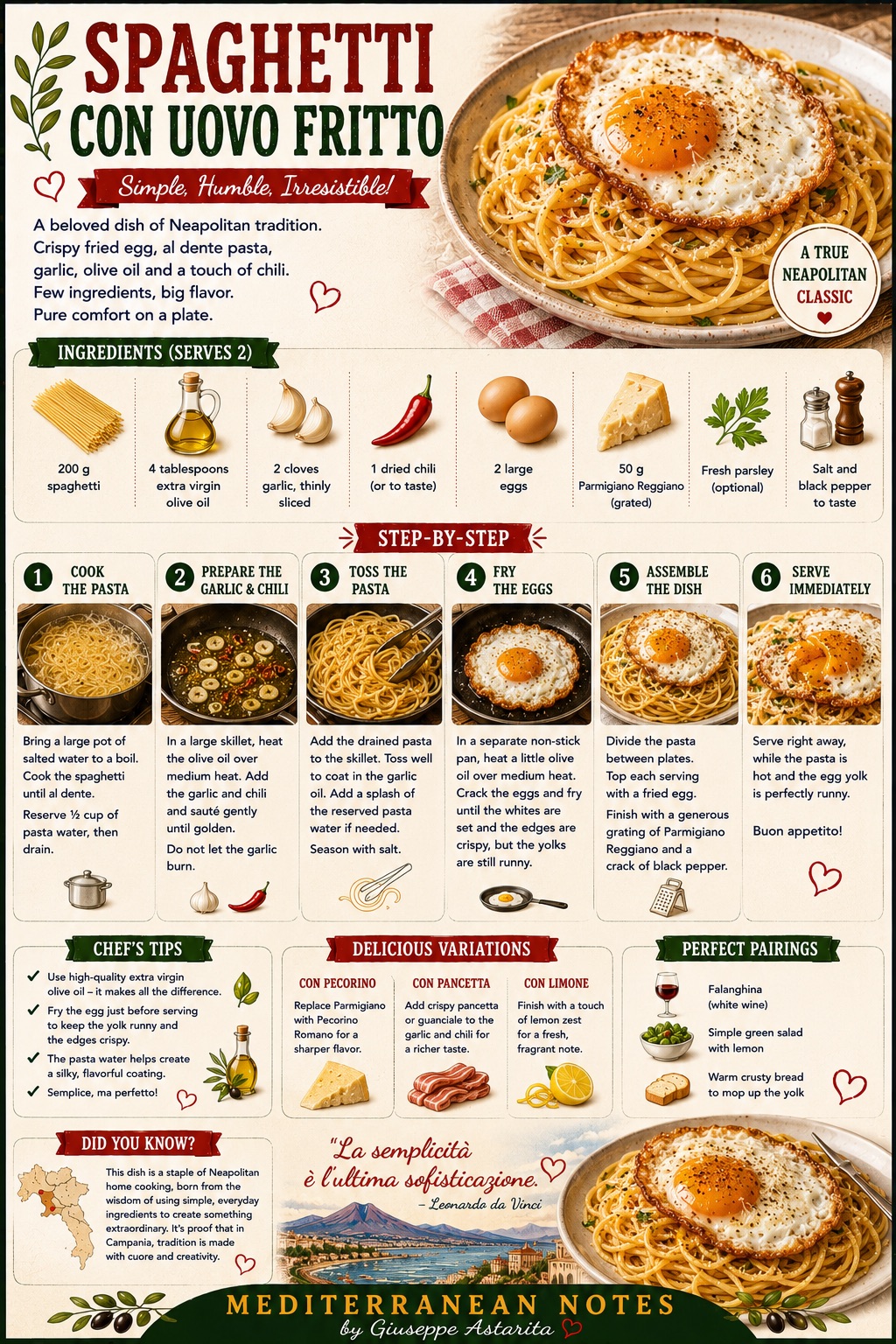
Variations worth knowing: Replace Parmigiano with the sharper Pecorino Romano. Add crispy pancetta or guanciale to the garlic oil for a richer version. Finish with a little lemon zest for freshness. None of these are necessary -- the plain version is the best version most of the time.
Buon appetito -- la semplicita e' l'ultima sofisticazione.