Patate in Teglia
Potatoes in the Baking Dish — A Classic Neapolitan Countryside Side Dish
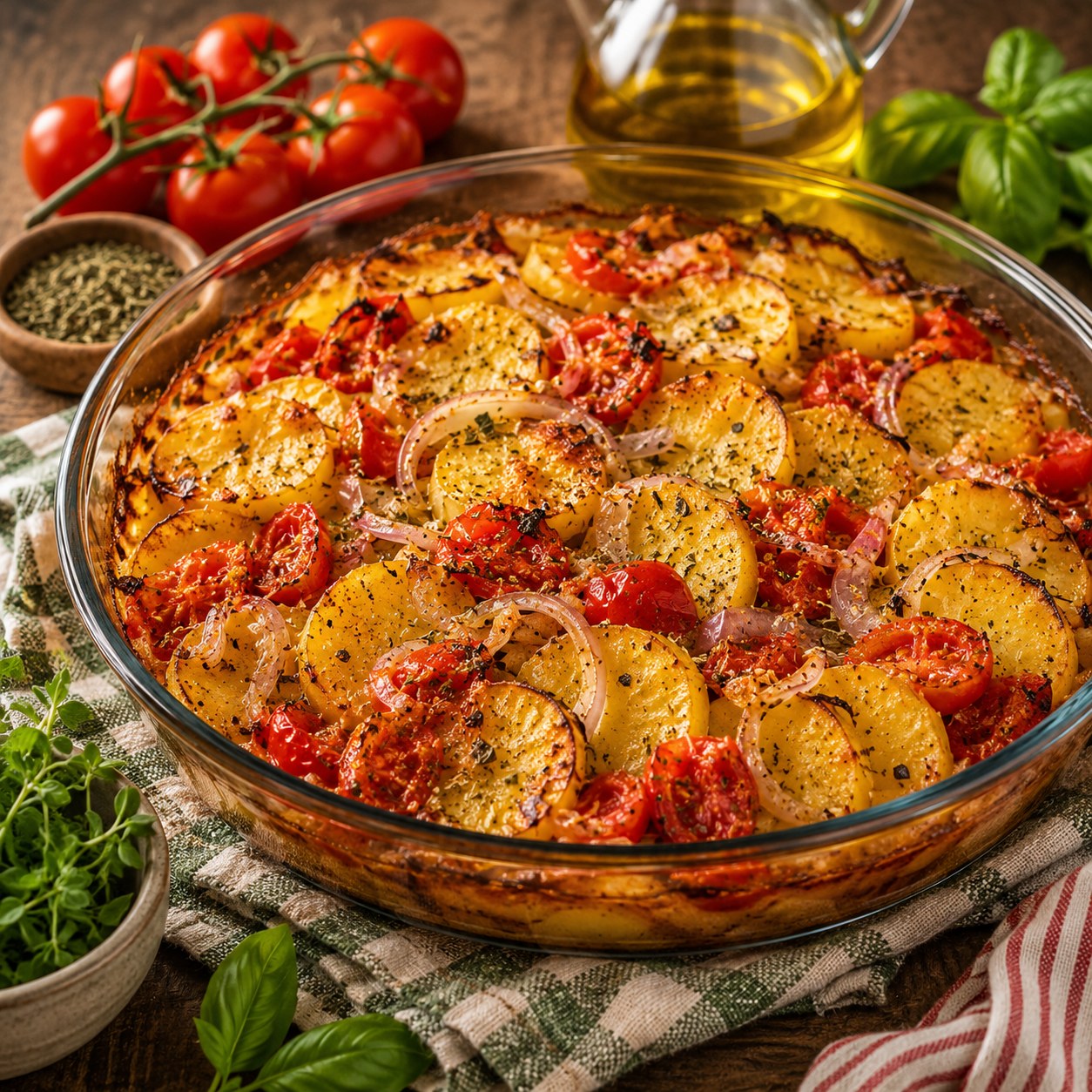
My father's favorite. I remember my mother making them for him at lunchtime — when he used to come back home from work during the long Italian midday break, before going back for the afternoon. Layers of potatoes, onions, and tomatoes, seasoned generously with oregano, baked until golden. Simple, flavorful, made with humble ingredients. It took me a while to appreciate how good they are. The onion and the oregano are strong. That is exactly the point.
In Naples and across Campania, this dish is historically called patate in tortiera or patane 'o furno — the tortiera (or teglia) is the baking dish itself, and the name simply says "potatoes in the dish, in the oven." Both terms are used interchangeably by most cooks, and most families consider them the same dish.
There is, however, a real technical distinction that some cooks observe: the version called specifically in teglia or in tortiera — the one on this page — is made with potatoes sliced thin into rounds and arranged in strati sovrapposti, overlapping layers, like a gratin or a pasticcio. Potato, onion, tomato, seasoning — then again, and again, each layer pressed down gently before the next. The result is compact, almost tart-like, and the slices meld together during baking.
The version called patate al forno alla napoletana (the rustic version) uses large cubes or wedges of potato, mixed freely with onion and tomato directly in the pan — no layering, no order. The cubes stay independent, their edges go crispy and abbrustoliti, and the dish is rougher, more robust. Same base ingredients, genuinely different result.
In practice, restaurants and home cooks often use the names as if they were interchangeable — and the peasant tradition never cared much for the distinction. But if you want the layered version with its soft, fused texture and the classic teglia presentation, this is the recipe. The rustic cubed version has its own page here.
This is a dish from the Neapolitan peasant kitchen — a cucina povera preparation in the truest sense, made from the cheapest and most available ingredients: potatoes, onions, fresh tomatoes, dried oregano, olive oil. The fresh tomatoes — not canned, not passata — are crushed or sliced directly onto each layer, releasing their juice as they bake into the potato, which absorbs it along with the olive oil. This makes the dish seasonal in character: it is best when summer tomatoes are ripe and full of liquid, the kind that spread easily by hand and smell of the sun. No meat, no cheese, no elaborate technique. The layers build slowly in the baking dish, each one seasoned, each one drizzled with oil, and the oven does the rest for forty-five to fifty minutes. What emerges is something greater than the sum of its parts: the potato absorbs the tomato liquid and the olive oil during baking, the onion sweetens and caramelizes at the edges where it catches the heat, the oregano disperses through the whole dish. Tender inside, lightly golden on top. The kind of food that improves as it sits — equally good warm and at room temperature, which made it ideal for the midday table when timing was not always exact.
The recipe — serves 6
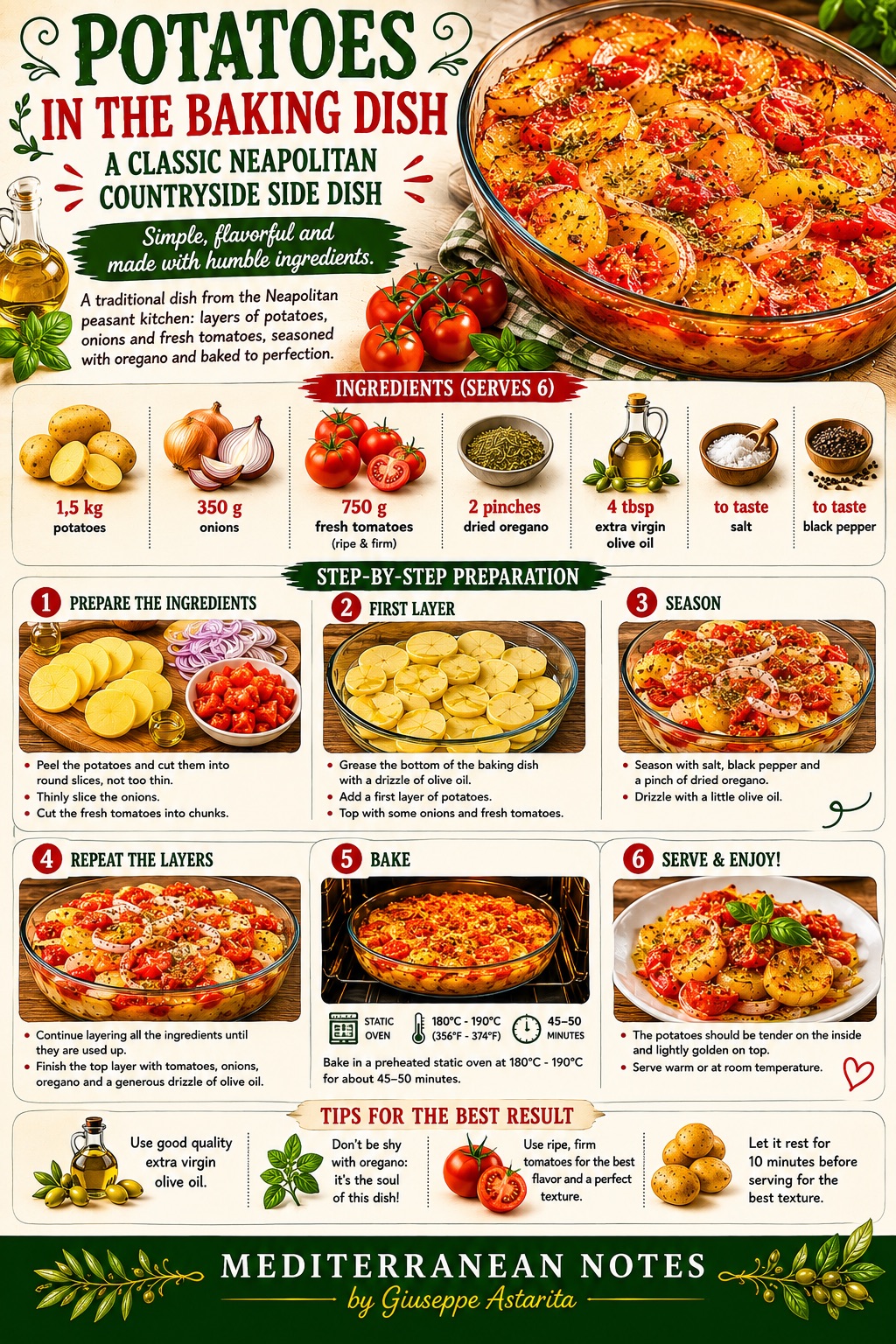
During baking, three concurrent processes transform the individual ingredients into a unified dish. First, the potato starch gelatinizes as it absorbs the tomato liquid and olive oil — the same process that makes pasta e patate creamy, here producing the characteristic soft, yielding texture of a baked potato slice that has fully absorbed its cooking liquid. The potato's own starch thickens the tomato juices at the bottom of the dish as they heat, creating the dense, rich sauce that forms under the layers and is the best part to mop with bread.
Second, the onion undergoes Maillard browning and caramelization at its exposed edges — the thin rings lose water rapidly and concentrate their natural sugars (fructose and glucose), producing the sweet, slightly jammy character of a well-baked onion that is entirely different from the raw, pungent alliin-driven flavor of uncooked onion. The allicin and other sulfur compounds that make raw onion assertive are volatile and mostly disperse during the long baking time, leaving behind the sweetness. This is why the child finds the raw onion too much and the adult finds the baked version exactly right — they are genuinely different compounds producing genuinely different sensations.
Third, the dried oregano releases its essential oils — primarily carvacrol and thymol — into the surrounding olive oil and tomato liquid during baking. These compounds are fat-soluble, which is why the olive oil is essential to their distribution: without fat, the oregano aromatics remain concentrated in the herb rather than dispersing through the dish. Carvacrol specifically has documented antimicrobial and anti-inflammatory properties, though at the concentrations present in a serving of this dish the sensory contribution vastly outweighs any measurable biological effect. The oregano is there because it is the soul of the dish, as the infographic correctly states. The science confirms the flavor logic.
My father came home for lunch, and my mother made this. The midday break was long enough — an hour and a half, sometimes two hours — to eat a proper meal and return. That rhythm of the day no longer exists for most people, not in Italy and certainly not in America. The patate in teglia went into the oven in the morning, filled the house with oregano and onion while it baked, and was ready when the key turned in the lock. A simple thing, organized around a particular shape of the day that has since disappeared. The dish survives the rhythm that generated it.
Per mio padre — e per il pranzo delle tredici.
For my father — and for the one o'clock lunch.