Patate al Forno alla Napoletana
Rustic Neapolitan Oven-Roasted Potatoes — Cubes, Not Layers
The rough, rustic version of the Neapolitan baked potato — large cubes mixed freely with red onion, crushed tomato, and a genuinely generous amount of oregano. No layering, no order. Everything goes into the pan by hand, coated in olive oil, and the oven does the rest for fifty minutes. The edges go dark. The bottom forms a thick sugo. You mop it with bread.
The two Neapolitan baked potato dishes — what makes this one different
In Campania both this and patate in teglia live under names like patate al forno, patate in tortiera, or patane 'o furno, and most families use the names interchangeably. But the two dishes are genuinely different in technique and result.
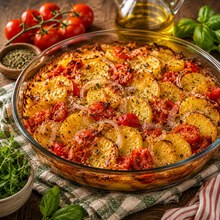
Patate in teglia: potatoes sliced thin into rounds, arranged in overlapping strati — layer by layer, like a gratin. Compact, fused, almost tart-like in texture. The dish holds its shape when you serve it.
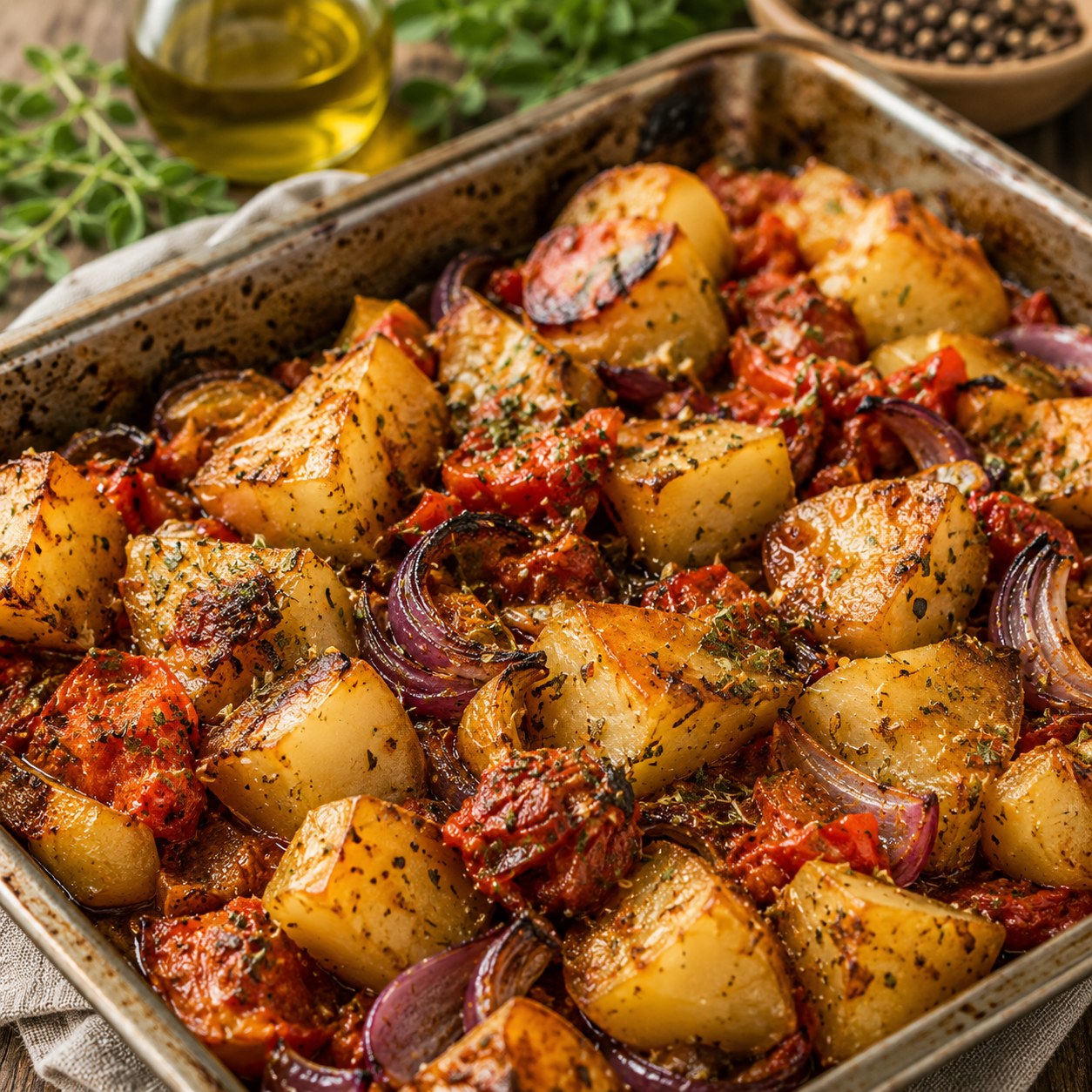
Patate al forno alla napoletana (this recipe): potatoes cut into large cubes or spicchi, mixed freely with everything else directly in the pan. The pieces stay independent. Their edges abbrustolano — catch color and caramelize where they sit against the hot metal. The result is rougher, more robust, with a contrast between the soft interior of each cube and the darker, slightly crispy edges. The thick sugo that collects at the bottom of the pan is the whole point.
This belongs to the same cucina povera tradition as the layered version — the same ingredients, the same logic of stretching cheap vegetables into a full dish. What changes is the cut and the technique, and those two things change the character of the result completely. The cubed version is more common for a quick weekday lunch — less precision required, everything in the pan in five minutes, and an hour later you have a dish that tastes like Sunday cooking without the Sunday effort.
The half glass of water added along the edge before baking is not optional. It creates steam in the early minutes that cooks the interior of each cube before the surface has time to dry out and toughen. When the water evaporates in the final twenty-five to thirty minutes — after you remove the foil — the heat concentrates and the potato edges finally start to color. The sugo at the bottom thickens as the tomato liquid and olive oil reduce together. This is the moment to watch for: the dish is ready when the pan bottom has a dense, ristretto sauce and the potato edges are visibly scure and golden-dark.
Two tablespoons of oregano means two full tablespoons — not a pinch, not a suggestion. This is not background seasoning. It is the flavor of the dish. Use good dried oregano, ideally Sicilian or Calabrian, dried on the branch. The powdered supermarket version has lost most of its volatile oils and will disappoint you.
The recipe — serves 4
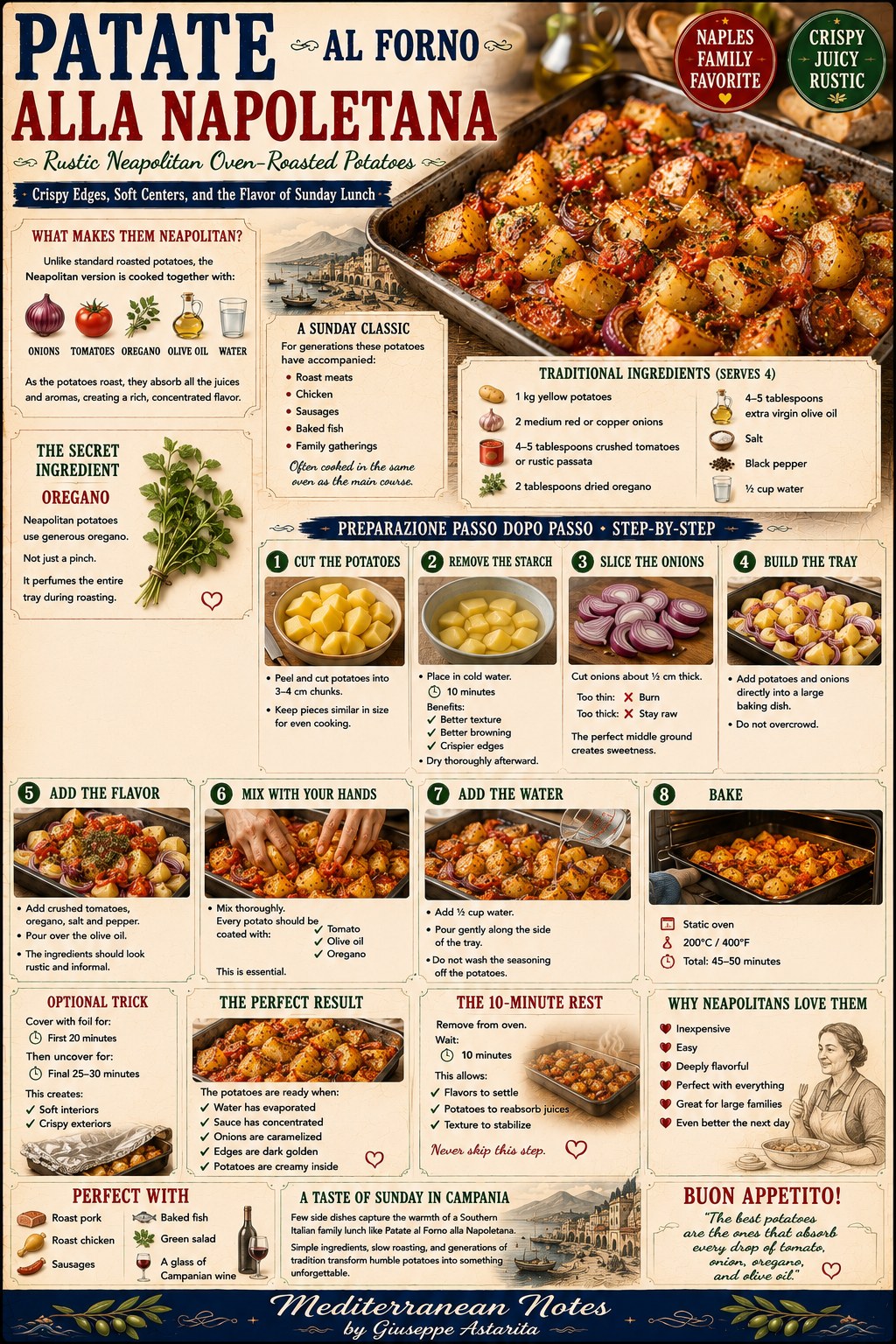
Patate al forno alla napoletana — versione rustica. Click to enlarge.
1 kgYellow potatoes — peeled, cut into large cubes or wedges, about 3–4 cm. All roughly the same size.
2 mediumRed or copper onions — sliced into rings, not too thin. About half a centimetre. Thin slices burn before the potatoes are done.
4–5 heaped tbspCrushed tomatoes or rustic passata — not puree, not canned whole tomatoes. Passata rustica or crushed pelati with texture.
2 generous tbspDried oregano — the soul of the dish. Two full tablespoons, genuinely generous.
4–5 tbspExtra-virgin olive oil
½ glassWater — added along the edge of the pan before baking. Not optional.
to tasteSalt and black pepper
1
Peel the potatoes and cut into large cubes or rough wedges — about 3 to 4 cm. Keep them all roughly the same size so they cook evenly. Put them in a bowl of cold water for 10 minutes to draw out some of the surface starch. Drain and dry them very well with a clean cloth — wet potatoes steam instead of roasting.
2
Slice the onions into rings about half a centimetre thick. If you slice them thinner they risk burning during the long bake before the potatoes are done.
3
Put the potatoes and onions directly into a large baking dish — they should fit in a roughly single layer, not stacked. If they are too deep they will steam rather than roast and you will not get the abbrustolatura on the edges. Add the crushed tomatoes, oregano, salt, pepper, and olive oil.
The pan size matters. The potatoes should not be crowded — a single generous layer with some gaps is correct. In a pan that is too small, the steam cannot escape and the potatoes will be soft all over rather than crispy at the edges.
4
Mix everything by hand — clean hands, directly in the pan. Work thoroughly: every piece of potato should be coated in tomato, olive oil, and oregano. This is the step that determines whether the seasoning is evenly distributed or concentrated in patches.
5
Level the mixture without pressing it down. Pour the half glass of water gently along one of the inside edges of the pan — let it run underneath rather than washing the seasoning off the tops of the potatoes.
6
Bake in a preheated static oven at 200°C. Cover the pan with aluminium foil for the first 20 minutes — this traps the steam and cooks the inside of each cube before the surface seals. After 20 minutes, remove the foil and continue for another 25 to 30 minutes uncovered.
Static oven, not fan. Fan mode dries the surface too quickly and you lose the sugo at the bottom before it has time to develop.
7
The dish is ready when: the water at the bottom has completely evaporated and what remains is a dense, concentrated sugo; the edges of the potatoes are visibly darker and abbrustolati; and the cubes yield easily when pierced with a knife but hold their shape.
8
Remove from the oven and rest for 10 minutes before serving. The rest is not optional — it allows the potatoes to reabsorb the cooking juices and the flavors to stabilize. Serve directly from the pan with bread for the scarpetta through the sugo at the bottom.
The dish holds well and is equally good warm or at room temperature. The day after, with all the flavors absorbed and settled, it is often even better.
Questo piatto è vegano. Potatoes, onion, tomato, oregano, olive oil — nothing else is needed. Entirely plant-based as written.
The same base dish appears under different names across different Campanian families — some call it patate al forno, some call it patate in tortiera, some call it patane arreganate. The name shifts by neighborhood, by generation, by how your grandmother called it. The constants are always the same: yellow potatoes, red onion, tomato, oregano, olive oil. Simple things, treated with patience and heat.
Buon appetito.