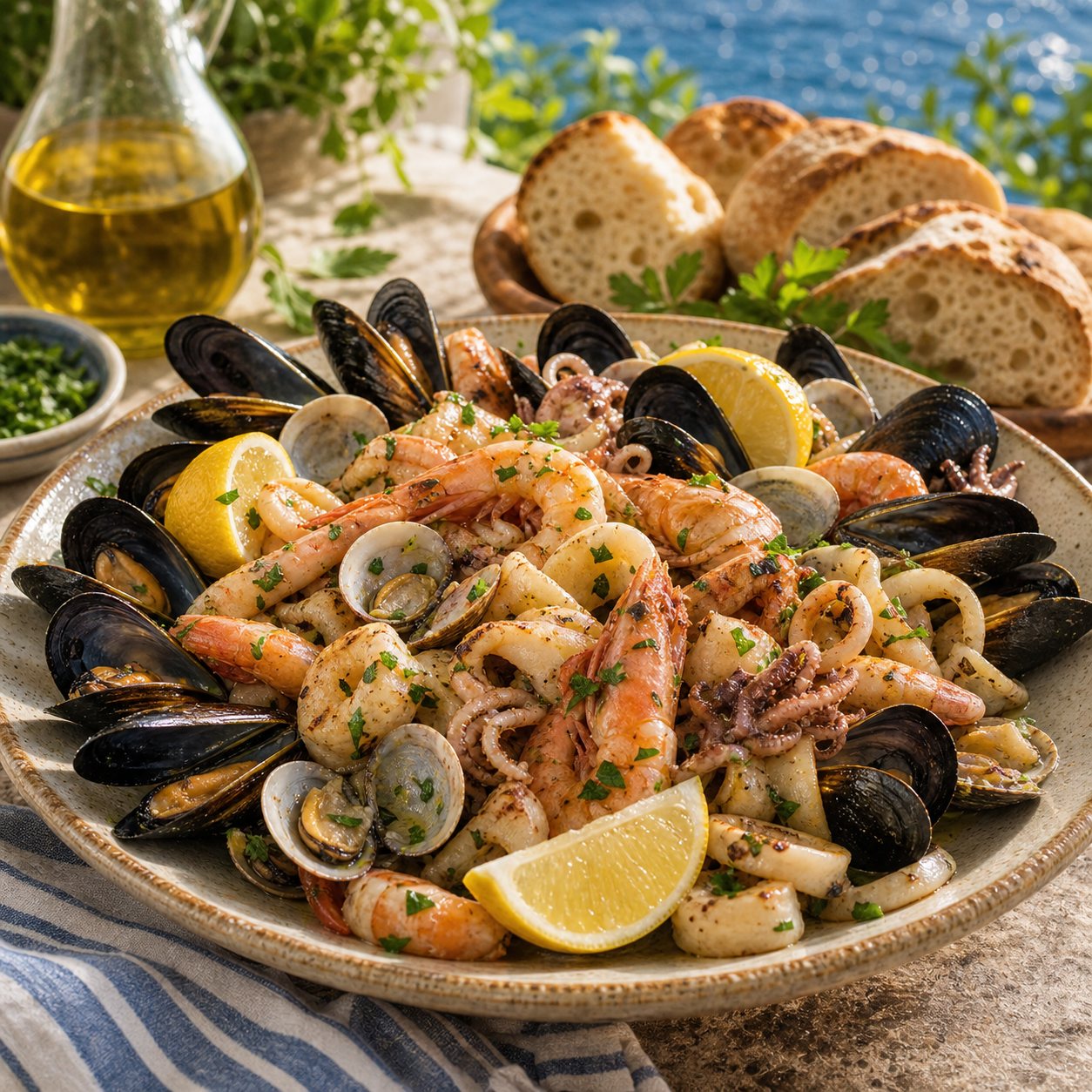
The Friday fish: Neapolitan seafood and the sea that was always close
Caserta is fifteen miles from the sea. Not much — but enough that the sea was always present in the food without being visible from the window. Seafood was every Friday, and every Christmas Eve, and every New Year's Eve. My father didn't eat it. The rest of us did, and the pescivendolo came to the neighborhood with the morning's catch and the kitchen organized itself around whatever had arrived.
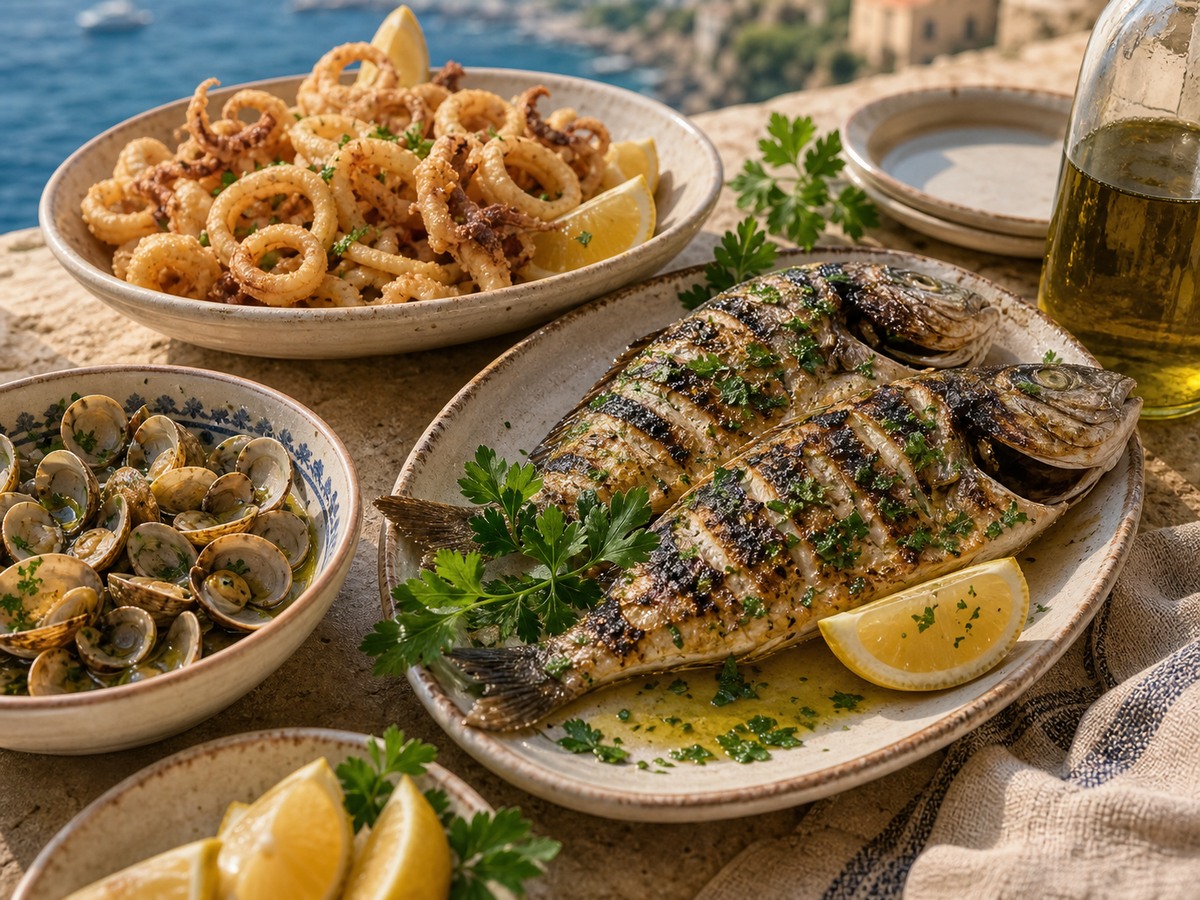
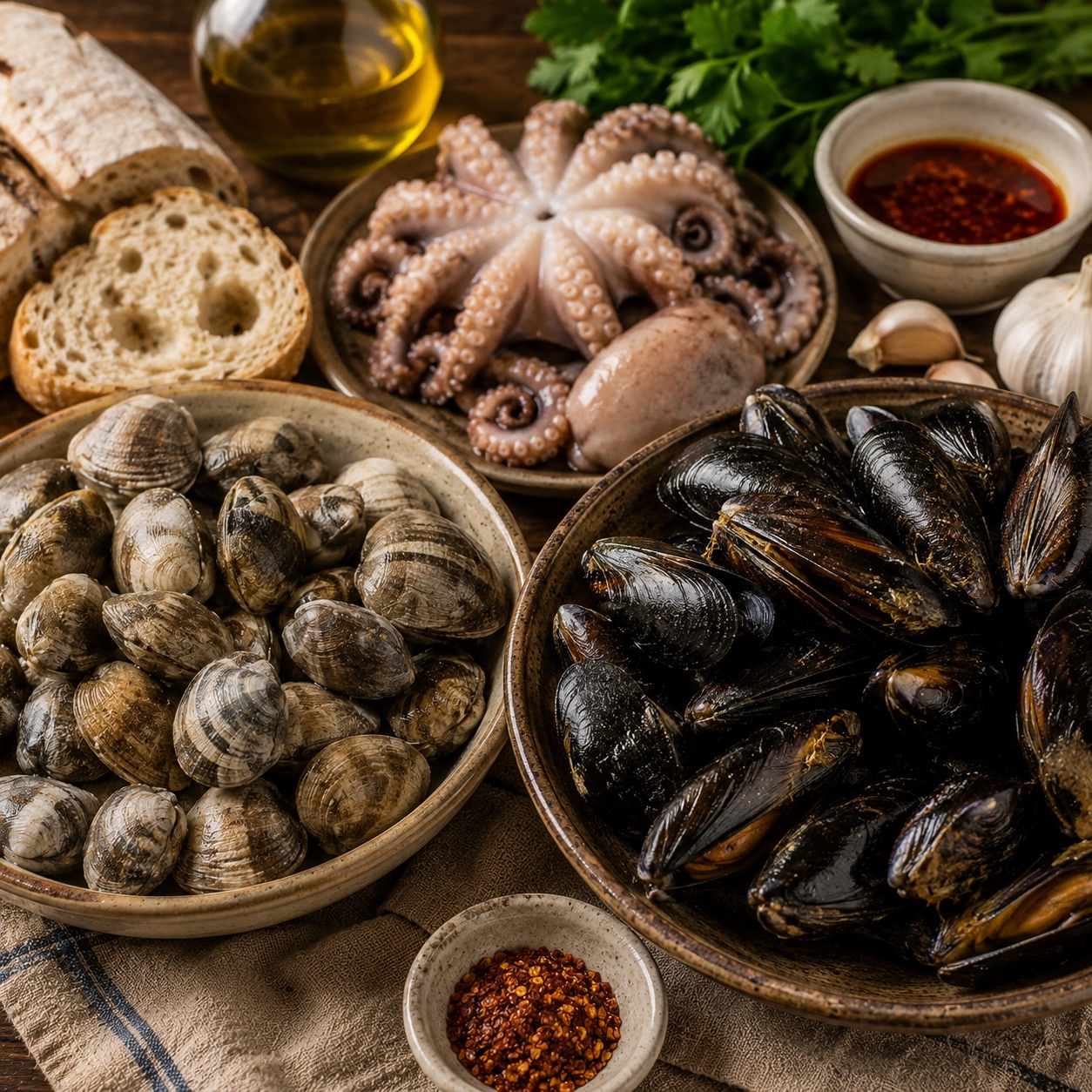
The Tyrrhenian coast runs along the western edge of Campania — from the Phlegraean Fields north of Naples down through Pozzuoli, Baia, the islands of Ischia and Procida, then south past Naples along the Amalfi coast to Salerno and beyond. This is one of the richest and most varied stretches of Mediterranean coastline in Italy, and its fish and seafood have defined the Neapolitan table for as long as there has been a Neapolitan table. The branzino and the orata from the open sea, the vongole and the cozze from the sandy and rocky shallows, the calamari and the moscardini from the deeper water, the alici — anchovies — from the seasonal schools that pass through every spring and summer. Each has its season, its preparation, its specific relationship with the table.
In our household the rhythm was simple and fixed. Every Friday, seafood — driven by the Catholic tradition of meatless Fridays that shaped the Italian table for centuries and that still shapes it in many households even where the religious observance has faded. The Christmas Eve Vigilia required fish and seafood by tradition: seven courses in the most observant households, or a version of that — clams, mussels, baccalà, something fried, something in tomato. New Year's Eve had a similar structure. My father ate puttanesca on those nights, as described in the puttanesca post. The rest of the table ate the sea.
The Neapolitan approach to seafood is built on restraint and quality. The fish and shellfish of the Tyrrhenian coast are good enough that they require very little. The primary preparation methods are few and consistent: raw or briefly cured (crudo, carpaccio of tuna), quickly grilled or pan-seared (alla griglia, alla piastra), baked whole in the oven with tomatoes and olives (all'acqua pazza), baked in a salt crust (al sale), simmered briefly in tomato and olive oil, or stewed slowly with vegetables. The garlic is always present, always sautéed gently — golden, never brown. The olive oil is always extra-virgin, always good. The lemon brightens at the end. The parsley is always fresh and always generous. These four elements — garlic, olive oil, lemon, parsley — are the kitchen vocabulary of Campanian seafood, and they appear in almost every preparation in some form.
The one rule that overrides all others: save the cooking liquid. When clams or mussels open in the pan, the liquid they release is concentrated marine flavor — filtered of its sand and used as the cooking medium for the pasta, as the base of a soup, as the finishing element of a risotto. This is the liquid gold that makes spaghetti alle vongole taste of the sea rather than of a sauce made in a kitchen. No cream, no stock, no flavoring agents — just the clam liquid, the pasta starch, the olive oil, and the risottatura that emulsifies them together. The sea provides what the recipe needs, if you let it.
Tyrrhenian seafood, EPA and DHA, and the omega-3 profile of coastal cooking
The regular consumption of Tyrrhenian seafood — bivalves, small cephalopods like moscardini, white-fleshed fish, anchovies — provides a nutritional profile that is difficult to replicate from any other food group. The long-chain omega-3 fatty acids EPA (eicosapentaenoic acid) and DHA (docosahexaenoic acid) are found almost exclusively in marine sources, and at concentrations that vary significantly by species: fatty fish like anchovies (alici) and sardines are among the richest dietary sources, providing 1–2 g of EPA+DHA per 100 g; white-fleshed fish like branzino and orata provide 0.3–0.5 g; shellfish like clams and mussels provide 0.2–0.4 g. These fatty acids are incorporated into cell membrane phospholipids throughout the body, where they influence membrane fluidity, receptor function, and the production of anti-inflammatory lipid mediators (resolvins, protectins) at concentrations that measurably affect cardiovascular, neurological, and immune function. The anchovies (alici) — the smallest and most overlooked fish in this collection — deserve specific mention: they provide EPA+DHA at very high concentration, complete protein, vitamin D, vitamin B12, calcium (when eaten whole), selenium, and iodine. Their small size means they accumulate less methylmercury than large predatory fish, making them the safest and most nutritionally optimal choice in the collection from a risk-benefit standpoint. The gentle cooking methods favored in Neapolitan seafood preparation — brief sautéing, steaming, poaching — preserve the structural integrity of these fatty acids better than high-temperature frying or prolonged cooking. The combination of seafood with extra-virgin olive oil, which is standard in every Neapolitan preparation, enhances the absorption of fat-soluble vitamins from the fish and provides additional oleic acid and phenolic antioxidants. Friday fish, in other words, is genuinely good for you — and has been so for the entire duration of the Mediterranean dietary tradition that preceded the science that would eventually confirm it.
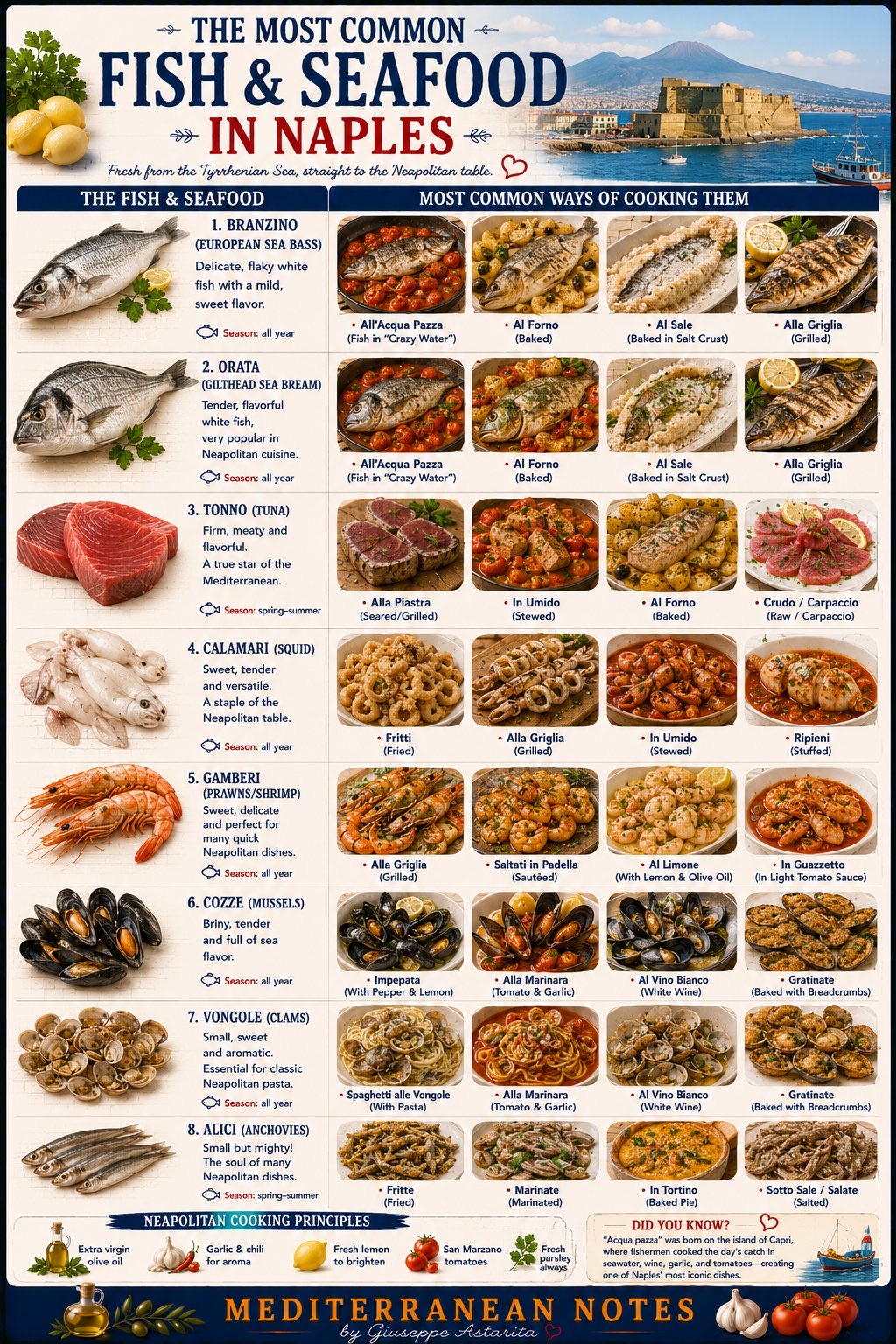
The eight fish and seafood of the Neapolitan table
Branzino — European sea bass
All year · best in autumn and winter
Delicate, flaky white flesh with a mild sweetness. The fish that rewards the simplest preparations most clearly — anything too elaborate obscures the reason you are eating it. The quality of the fish is the whole dish.
All'acqua pazza · al forno · al sale · alla griglia
Orata — gilthead sea bream
All year · very popular in Campania
Slightly richer than branzino, with a more assertive flavor and firmer flesh. The most frequently farmed and therefore most reliably available white fish in the Neapolitan market. Wild orata is considerably better than farmed.
All'acqua pazza · al forno · al sale · alla griglia
Tonno — bluefin and yellowfin tuna
Spring–summer · the Mediterranean season
Meaty, firm, deeply flavored — the steak of the sea. Seared briefly on both sides and left pink inside, or braised slowly in tomato for a completely different character. Also eaten raw as carpaccio. The canned version is a different ingredient and belongs to its own category.
Alla piastra · in umido · al forno · crudo/carpaccio
Calamari — squid
All year · sweet and versatile
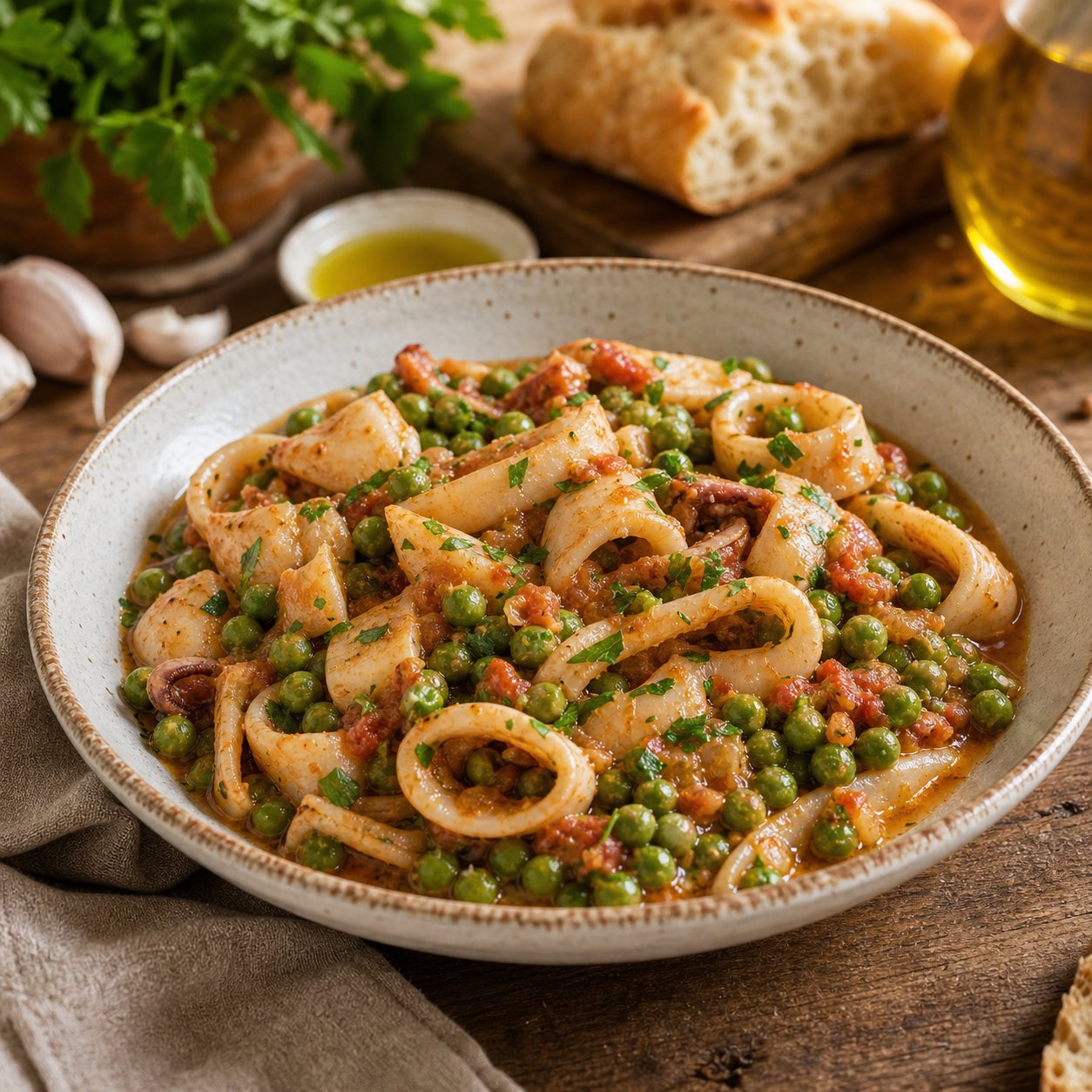
The most versatile seafood on the Neapolitan table. Fried in rings for street food, grilled whole, stewed slowly with tomato and peas, stuffed with breadcrumbs and herbs and baked. The rule: cook very briefly at high heat, or very slowly at low heat. Anything in between produces rubber.
Fritti · alla griglia · in umido · ripieni
Gamberi — prawns and shrimp
All year · best in spring
Sweet, delicate, quick. Grilled with a little olive oil and lemon. Sautéed in a pan with garlic and white wine for thirty seconds. In a light tomato guazzetto for pasta. The key is speed — prawns overcook in the time it takes to discuss whether they are cooked.
Alla griglia · saltati in padella · al limone · in guazzetto
Cozze — mussels
All year · best autumn through spring
Briny, tender, intensely flavored. The impepata di cozze — mussels steamed open with black pepper and lemon, no other intervention — is one of the purest expressions of Neapolitan seafood cooking. The cooking liquid is liquid gold for pasta and soup. Save it.
Impepata · alla marinara · al vino bianco · gratinate
Vongole — clams
All year · essential for the Vigilia table
The undisputed symbol of Neapolitan seafood cooking. Vongole veraci for the finest preparations, lupini for everyday use, telline gathered by hand from the beach for the taste of the exact place they came from. The spaghetti alle vongole post covers this in full.
Spaghetti alle vongole · alla marinara · al vino bianco · gratinate
Alici — anchovies
Spring–summer · the Campanian season
Small but the most nutritionally powerful fish in this collection. Fried in a light batter for street food, marinated raw in lemon juice and olive oil (alici marinate), baked in layers with breadcrumbs and capers, or cured in salt — the salted anchovy that appears in the friarielli, the puttanesca, and dozens of other preparations. The soul of Campanian cooking even when invisible in the dish.
Fritte · marinate · in tortino · sotto sale
The three ways Neapolitan seafood meets the table
Almost every seafood preparation in the Campanian kitchen arrives at the table in one of three forms. Understanding the logic of each clarifies why specific fish or shellfish belong to specific preparations — and why the combinations that appear strange from the outside make complete sense once you understand the flavor structure.
The first is il brodetto — the soup. Shellfish opened in olive oil and garlic, their liquid filtered and combined with tomato or left white, served in deep bowls with garlic-rubbed crostini. The bread absorbs the broth; the shellfish are the substance. The impepata di cozze is the simplest and most perfect version: mussels, black pepper, lemon, bread. Nothing else. The zuppa di vongole, the zuppa di cozze, the zuppa di pesce — all follow the same logic, with the fish providing the liquid and the bread providing the body.
The second is pasta. The risottatura technique — finishing the pasta directly in the seafood cooking liquid — transfers the flavor of the sea into the pasta itself, producing a dish that is inseparable from its ingredient in a way that sauce-dressed pasta is not. Spaghetti alle vongole is the canonical example, but the same principle applies to pasta con le cozze, pasta con gamberi, pasta con i moscardini. The pasta cooks in the sea.
The third is the whole fish, simply prepared — grilled, baked, or poached in acqua pazza. A branzino or orata cooked this way requires almost nothing: heat, olive oil, garlic, a few cherry tomatoes, salt. The fish provides everything else. This is the preparation that most requires quality, because there is nothing to hide behind. A good fish cooked simply is better than an elaborate preparation of a mediocre one. This has always been true, and the Neapolitan kitchen understood it before the concept of simplicity as sophistication was given a name.
The sea was always close to Caserta, even when it was not visible. It arrived every morning with the pescivendolo, and it was on the table every Friday, and it was what the kitchen smelled of on those nights. It is one of the things I miss most about living far from the Tyrrhenian coast — not the sea itself, which can be visited, but the specific casualness of it, the way it arrived in the neighborhood as a matter of course and the kitchen organized itself around what had come.
Buon appetito — e viva il mare nostro.