La Pastina in Brodo
Italy's timeless comfort — and the shapes you can't find in America
Homemade broth — whether vegetable or meat-based — contains a complex mixture of amino acids, peptides, minerals, and for meat broths, gelatin from collagen-rich bones. The gelatin is what gives a good meat broth its body at room temperature and its distinctive mouthfeel when hot. Bone broth cooked for several hours contains significant quantities of glycine and proline, the amino acids most abundant in collagen, which have been studied for their potential anti-inflammatory effects. The minerals — potassium, sodium, magnesium — make broth genuinely hydrating and restorative, which explains the cross-cultural tradition of giving soup to the unwell. A stock cube approximates the flavor but not the nutrient composition.
When a raw egg is broken into very hot broth and stirred quickly, the proteins in the egg white — primarily ovalbumin — denature rapidly in the hot liquid and form fine threads rather than setting into a solid mass, because they are dispersed throughout the liquid before they can coagulate into a compact structure. This is the same principle behind egg-drop soup in Chinese cuisine and stracciatella in Italian — the Roman version of egg in broth, which uses egg beaten with Parmigiano and a little semolina dropped into simmering broth. The result enriches the broth with protein and gives it a slightly silkier, more filling texture without making it heavy.
In Italian homes, la pastina is so much more than a simple soup. It is what you eat when you are not well, when you are very young, when it is cold, or simply when you need something that asks nothing of you except to eat it. Tiny pasta shapes cooked in homemade broth, finished with a generous hand of Parmigiano. And in the grandmother version: an egg broken directly into the hot broth and scrambled within it. La pastina della nonna.
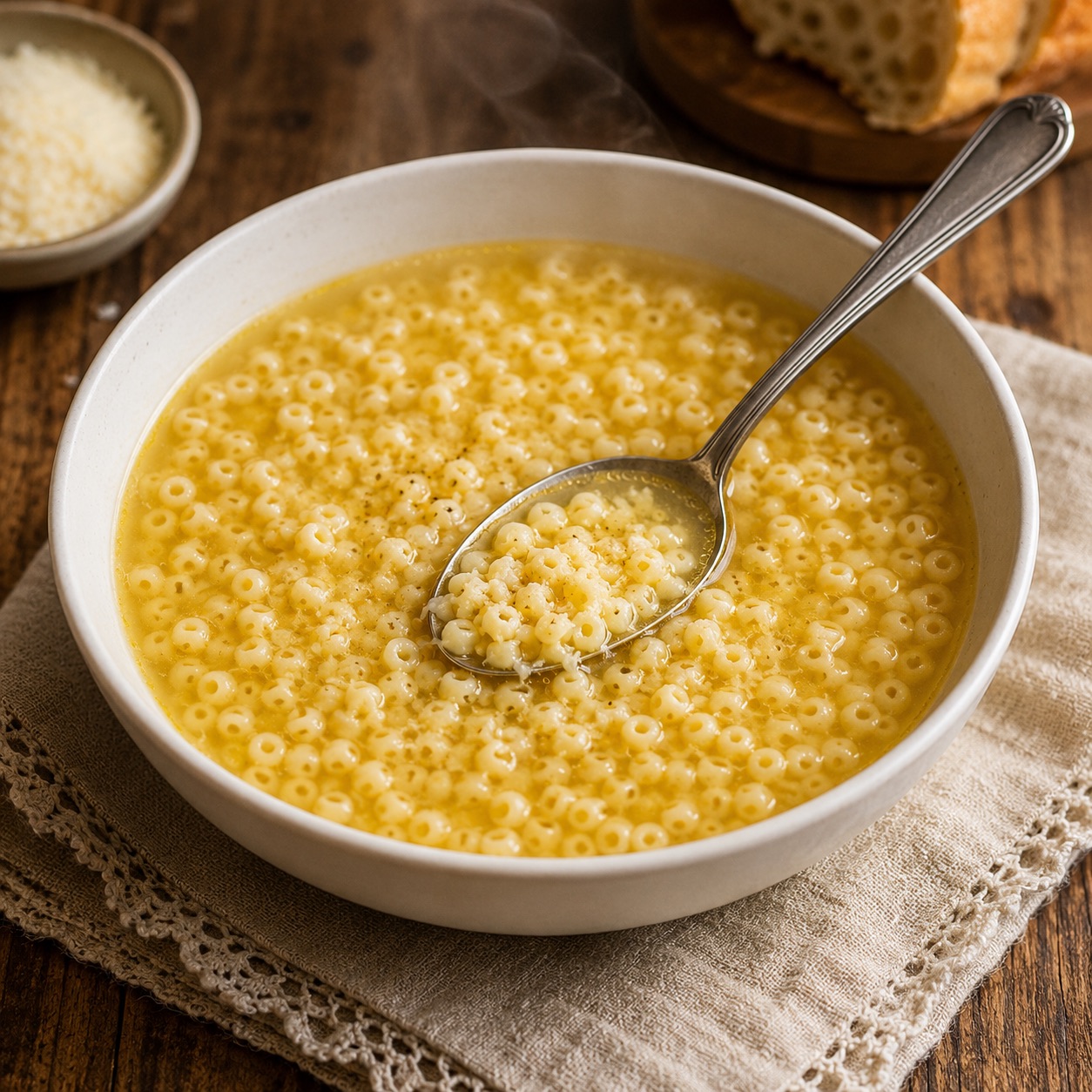
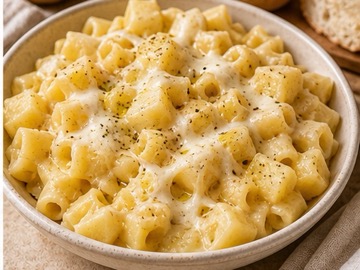
There is a whole section of Italian supermarkets dedicated to pastina — an aisle, sometimes two, of tiny pasta shapes in small packages that have no equivalent in the United States and never will, because the American pasta market has no tradition of cooking pasta directly in broth and allowing it to absorb the liquid as it cooks. What you find in Italy is extraordinary: stelline (little stars), anellini (little rings), conchigliette (tiny shells), quadrucci (small squares), farfalline (tiny butterflies), acini di pepe (peppercorns), ditali (little thimbles), and dozens more — most of them available in egg-based versions (all'uovo) as well as plain durum wheat. Each shape cooks slightly differently and produces a slightly different texture in the broth. Children have their preferences and defend them with conviction.
In the United States, you can find orzo, acini di pepe, and occasionally stelline at Italian specialty stores or online. Orzo is not quite right — it is too smooth and too neutral — but it works. Acini di pepe, the tiny round shape, is close to what you would use for a delicate broth. Broken spaghetti — pasta spezzata — is the traditional improvisation: spaghetti snapped into small pieces over a bowl, which produces an irregular, rustic result that is arguably better than the tidy shapes for a thick, fortifying broth. My grandmother broke spaghetti into the broth directly. It is a completely valid approach and requires no special ingredient.
The broth is where the dish lives or fails. A pastina made in good homemade vegetable or meat broth is a different dish entirely from one made in water with a stock cube. The vegetable broth — carrots, celery, onion, potato, and whatever else is in the kitchen, simmered for an hour — is lighter and more delicate, the right choice for a child or for someone who is not feeling well. The meat broth — beef, chicken, or a mix, cooked with vegetables and a bone for the collagen — is richer, more healing in the way that dense things are healing, with a body that the vegetable version does not have. In Northern Italy this would be the occasion for tortellini in brodo; in the south, pastina. Both are correct for their geography.
The Parmigiano goes in at the end, generously — not a light dusting but a real addition, enough to see it and taste it and feel it thicken the last spoonful slightly. This is not the time for restraint with the cheese. A pastina in brodo without enough Parmigiano is a bowl of hot water with small pasta in it. With the right amount of Parmigiano it is one of the most satisfying things you can eat.
The shapes — and where to find them
Most of these shapes come in two versions in Italy: plain durum wheat and egg-based (all'uovo). The egg versions cook faster, have a slightly richer flavor, and absorb the broth more readily. They are the traditional choice for pastina in brodo. In the United States the egg versions are almost impossible to find except at specialty Italian importers. If you are in Italy, buy several packages of the shapes you like in the egg version — they travel well and are worth the luggage space.
A note on long pasta in brodo: tagliolini — the very thin egg noodles — are a legitimate choice, particularly in Campania where they appear in certain traditional broth dishes. They are not the same as pastina but the principle is identical. Tortellini in brodo, the stuffed pasta in meat broth, is the Northern Italian version of this tradition — a different dish, more elaborate, belonging to Emilia-Romagna rather than the south. Both are correct for their places.
The recipe — two versions
The plain version and la versione della nonna with the egg.
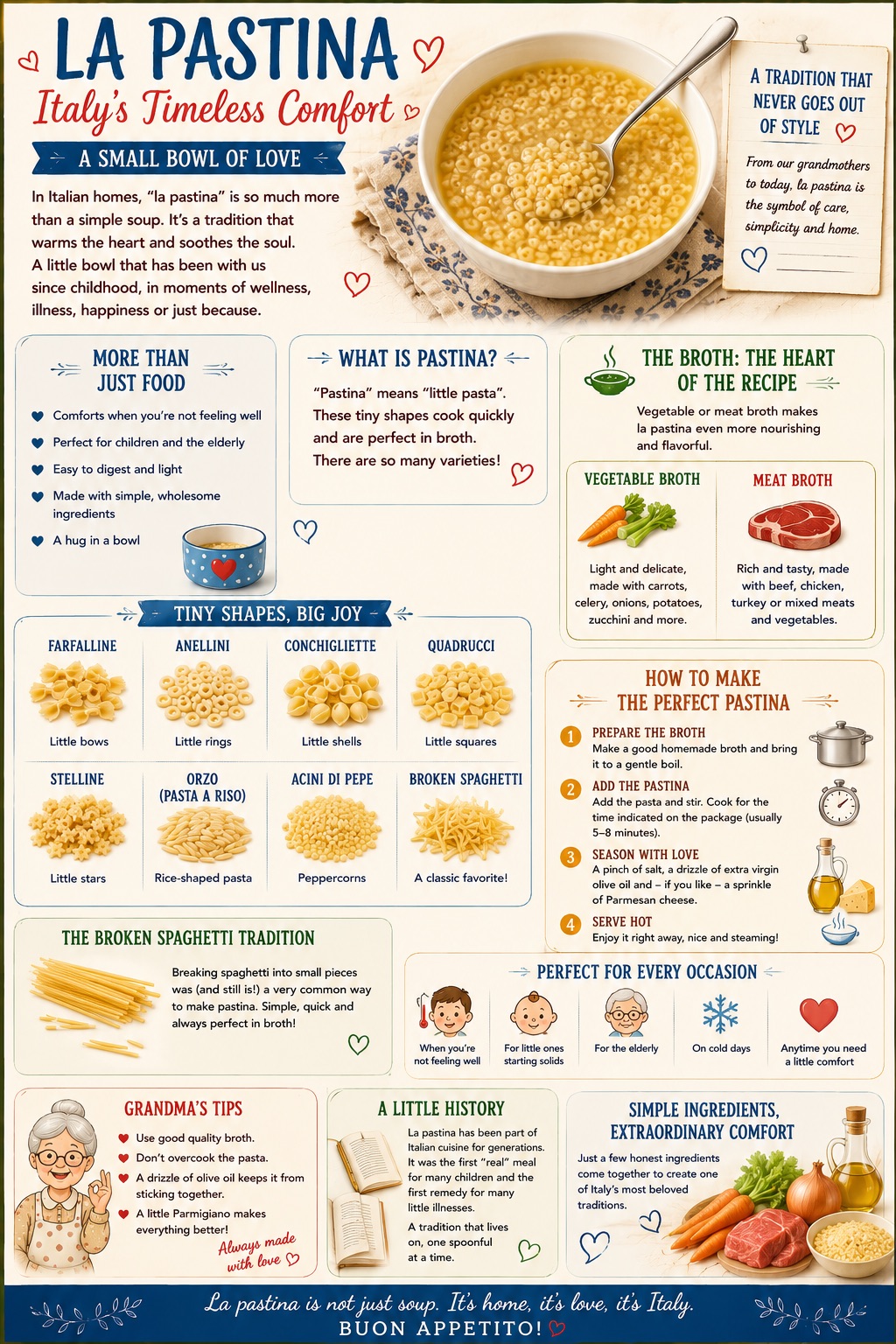
This is a dish for cold days, sick days, days when very little else is appealing. It is also a dish for children starting on solid food, for the elderly, for anyone who needs something light and nourishing and easy to eat. In Italy it crosses every class and every region, with variations in the shape and the broth but the same essential logic everywhere: small pasta, good broth, Parmigiano, warmth. It is, as the infographic correctly states, not just soup. It is home.
Buon appetito — un cucchiaio alla volta.