Il minestrone: the weekly pot of everything good
At least once a week in Italy we had it — whatever vegetables and potatoes were in the fridge, cooked together with rice until thick and nourishing and full of flavor. I still make it for my kids. It feels like it restores something.
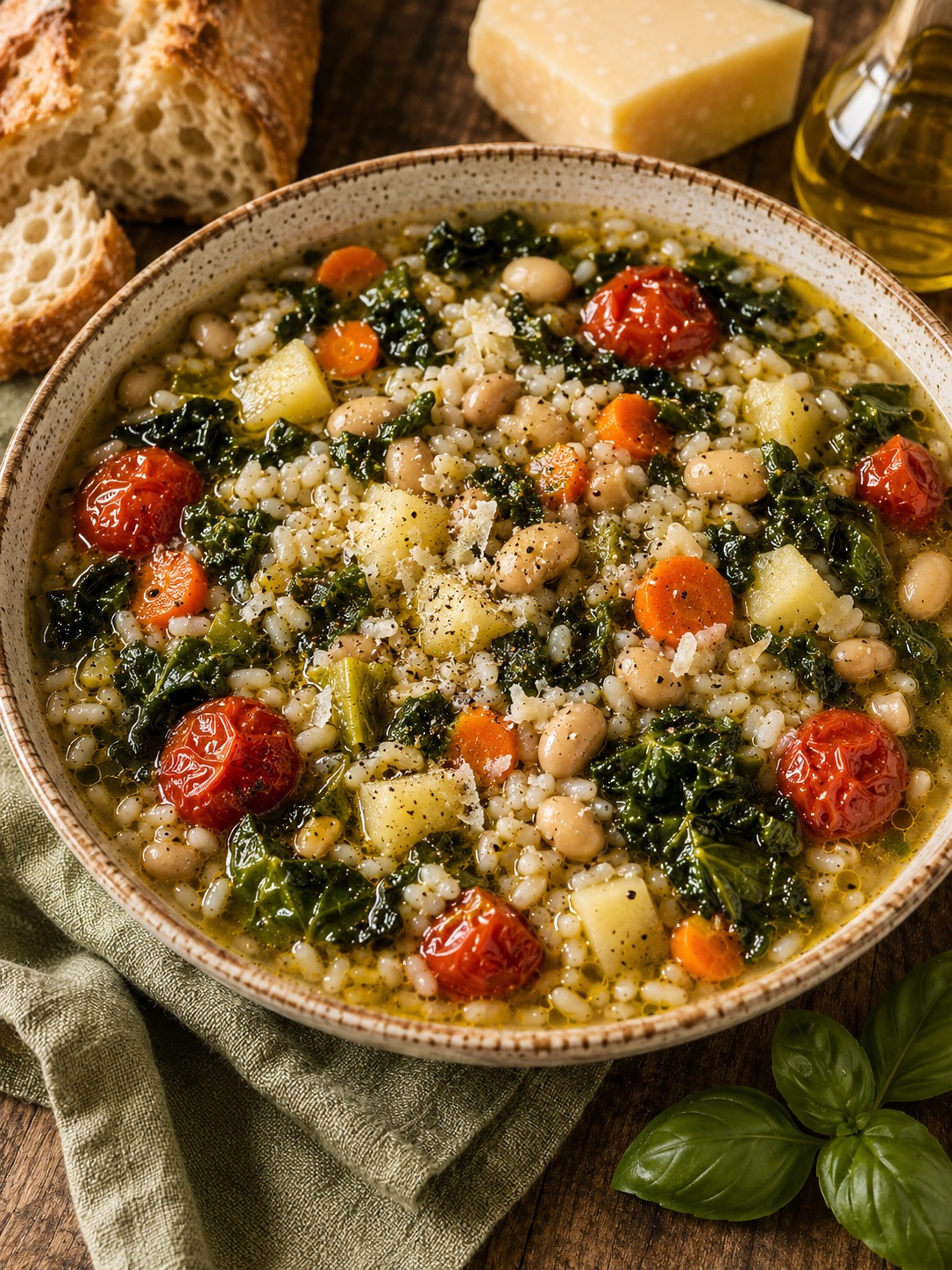
Rice appeared on the Italian family table at least once a week — sometimes as a simple risotto, sometimes with tomato sauce, sometimes in a soup. The minestrone with rice was the most nourishing version and the most flexible: a large pot of water with a soffritto of onion, celery, and whatever vegetables were available — potatoes almost always, zucchini in summer, cabbage or chard in the colder months, tomatoes throughout, beans when someone had remembered to soak them. The rice went in last, cooked directly in the soup, and thickened it with its starch in a way that is different from adding cooked rice separately — the soup becomes dense and almost creamy, a single unified thing rather than broth with ingredients floating in it.
We called it simply il minestrone. Not minestrone alla genovese or minestrone di verdure or minestrone napoletano — just minestrone, as if there were only one kind, which in that kitchen there was. It was the vegetables in the fridge at the end of the week, the slightly wrinkled tomatoes that needed to be used, the last potato from the bag. Cooked slowly with a Parmigiano rind dropped into the pot at the beginning — a detail that transforms the broth from water with vegetables into something with depth and a gentle savory undertone — and finished with raw extra-virgin olive oil poured over each bowl and a generous handful of grated Parmigiano.
The Parmigiano rind is the secret that appears in Italian household cooking and rarely makes it into recipes written for outsiders. The rind — the hard, pale outer layer of the cheese, which does not melt but softens and releases its flavor slowly into the liquid — is saved specifically for this purpose in Italian kitchens. When the Parmigiano block is finished, the rind goes into the freezer in a bag, and the bag comes out when there is a minestrone or a beans soup on the stove. It contributes glutamate, calcium, and the complex flavor compounds of aged cheese without turning the soup into a cheese dish. It is removed before serving or left in the pot for whoever wants it — softened and edible at this point, and excellent.
I make this for my daughters now. They eat it reliably, which is not universally true of the Campanian kitchen repertoire I have been cooking through this summer. Something about thick vegetable soup with rice is accepted by small children more readily than many more sophisticated preparations. It also freezes well, reheats easily, and is better the next day — the rice continues to absorb the broth overnight and the soup becomes even denser and more flavorful. Make more than you need.
Mixed vegetable broth, resistant starch, and complete protein from rice and beans
The minestrone with rice is one of the most nutritionally complete single-pot dishes in the Italian repertoire, and the specific combination of rice and beans (when present) is worth noting explicitly: together they provide all nine essential amino acids in adequate proportions, making the soup a complete protein source despite containing no meat. Arborio or Vialone Nano rice, cooked directly in the soup until very soft and thick, releases a higher proportion of its starch into the broth than separately cooked rice — the resulting resistant starch and slowly digestible starch fraction is lower than freshly cooked plain rice, but the soup's high fiber content from the mixed vegetables significantly slows gastric emptying and blunts the postprandial glycemic response regardless. The mixed vegetables contribute a broad spectrum of micronutrients: carotenoids and vitamin K from cabbage and chard, potassium and vitamin C from potatoes and tomatoes, folate and iron from beans. The Parmigiano rind releases glutamate (enhancing flavor without added salt), calcium, and fat-soluble vitamins into the broth over the long cooking time. The final drizzle of raw extra-virgin olive oil — added after the soup comes off the heat, directly into each bowl — is nutritionally important: it delivers oleic acid and phenolic antioxidants (hydroxytyrosol, oleuropein) that would be partially degraded if added at the start of cooking, and it provides the fat necessary for absorption of fat-soluble carotenoids from the vegetables. The Italian habit of finishing a minestrone with raw olive oil is, from a nutritional standpoint, the correct one. This is one of those cases where tradition and food science arrive at the same answer independently.
The recipe
There is no fixed version. This is the structure — follow it with whatever vegetables are available and good.
Ingredients · serves 4
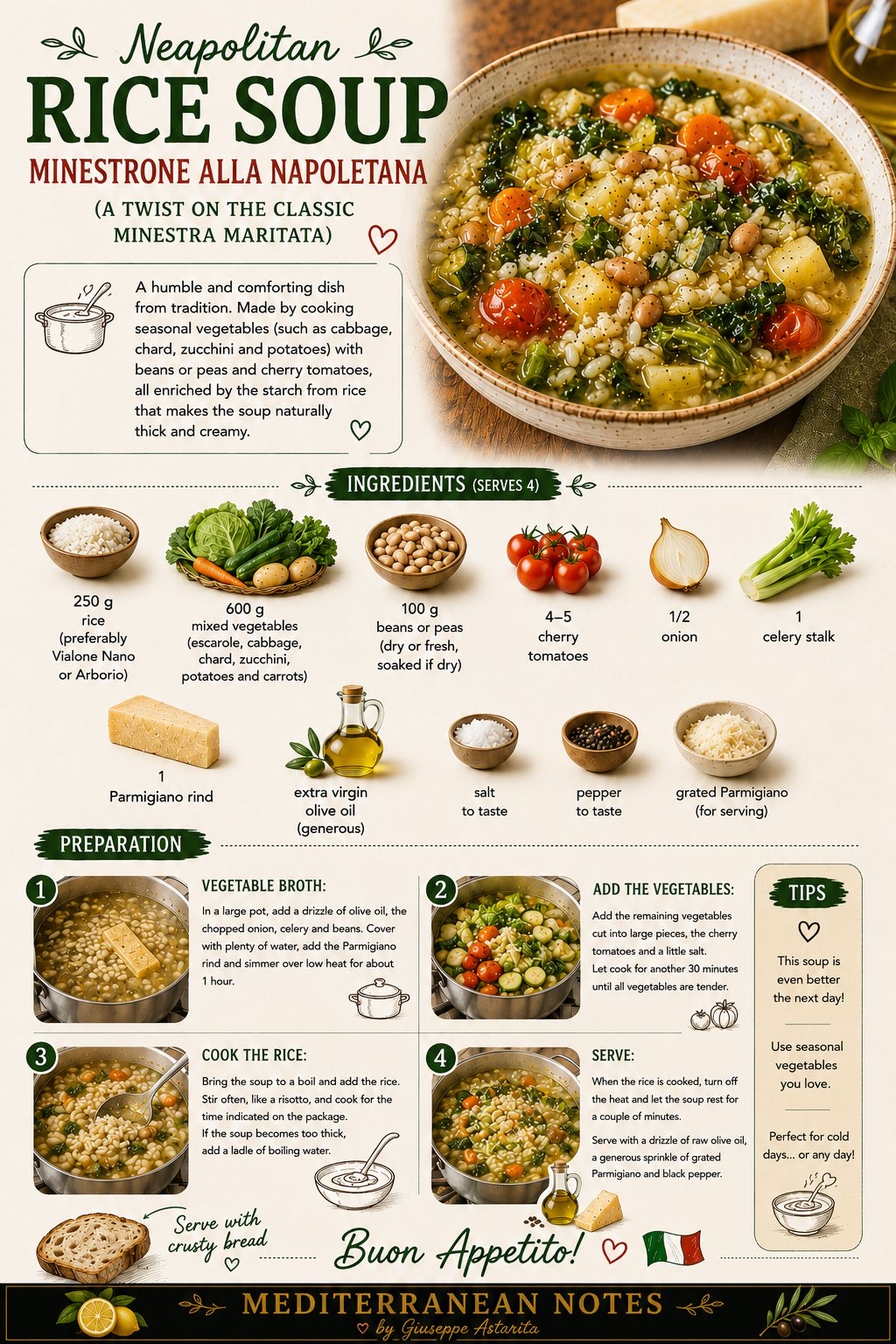
Vegetables that work well: potatoes (always), zucchini, cabbage, chard, escarole, carrots, celery root, fennel, green beans, peas, spinach. Use what is in the fridge. Avoid anything that becomes too bitter or disintegrates — broccoli works but breaks apart; add it later if using. The potatoes give body; do not omit them.
Method
Build the base. In a large pot, heat a generous drizzle of olive oil over medium heat. Sauté the onion and celery until soft and translucent — about 5 minutes. Add the beans (if using dried, pre-soaked; if canned, just drained). Add the Parmigiano rind and cover with plenty of water — about 1.5–2 litres. Bring to a simmer and cook gently for 30 minutes while you prepare the vegetables.
The Parmigiano rind goes in at the start and stays throughout cooking. It will soften but not dissolve. Remove before serving or leave in for whoever wants it — at this point it is soft and edible.
Add the vegetables. Cut all vegetables into large, irregular pieces — potatoes into chunks, zucchini into half-rounds, chard or cabbage roughly torn. Add to the pot along with the cherry tomatoes and a pinch of salt. Continue simmering over low heat for another 25–30 minutes, until all the vegetables are completely tender. The potatoes should be soft enough to partially break apart when pressed — this thickens the soup naturally.
Add the rice. Bring the soup to a gentle boil. Add the rice directly to the pot and stir frequently — like a risotto — for the time indicated on the package, usually 16–18 minutes for Arborio. The rice releases its starch into the broth and the soup thickens considerably. If it becomes too thick, add a ladle of boiling water. Taste for salt.
The soup should be dense — much thicker than a broth — but not so thick it sits solid. It will thicken further as it cools and continues to absorb liquid. If serving the next day, add water when reheating.
Rest and serve. Turn off the heat and let the soup rest for a few minutes. Ladle into bowls. Finish each bowl with a generous drizzle of raw extra-virgin olive oil, a good handful of grated Parmigiano, and black pepper. Serve with crusty bread alongside.
The raw olive oil at the end is essential — it is not just seasoning but the step that brings the bowl together and adds the beneficial compounds that would be lost if the oil were added at the start.
This soup is better the next day. The rice continues to absorb the broth overnight and the whole pot consolidates into something even denser and more unified than it was fresh. Reheat gently with a splash of water, check the salt, add fresh olive oil and Parmigiano again. It is a different soup on the second day, and a very good one.
The minestrone is the most honest dish in this collection — it does not require a specific ingredient, a precise technique, or a particular season. It requires a pot, water, whatever vegetables are good, and time. It is the soup that appears in every Italian family once a week because it is reliable and nourishing and because children eat it without difficulty and because it uses what needs to be used and wastes nothing. It is, in the most straightforward sense, food that is good for you — and it tastes like it.
Buon appetito.