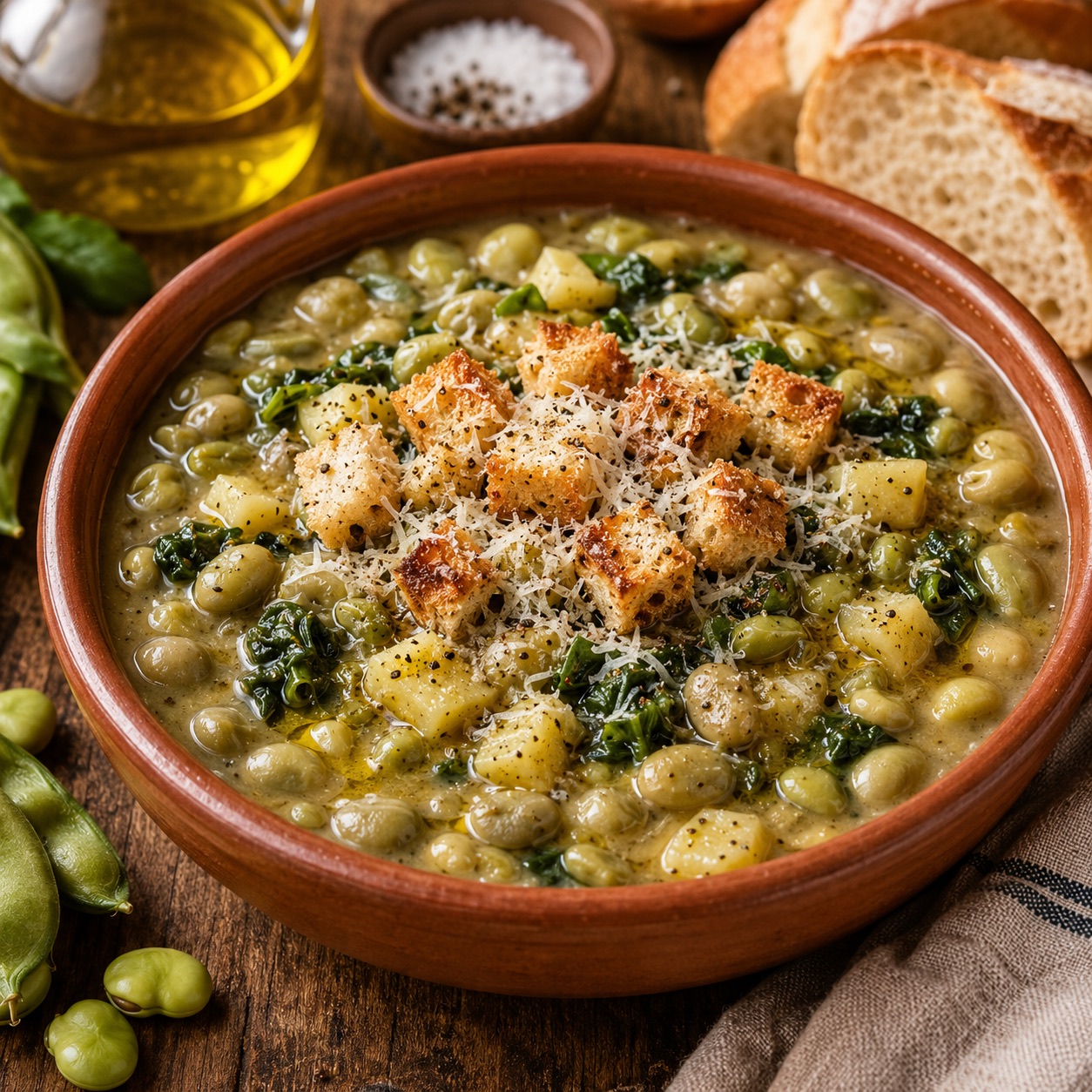
Zuppa di fave: my father's favorite, and the dishes that exist only at home
Fresh fava beans, pancetta, scallions, fresh mint. Nothing else. A simple spring soup from Campania that I took too long to fully appreciate — and that I cannot find anywhere once I started looking. Not in restaurants, not even in Italy in spring. Some dishes live only in homes, in the specific people who make them, and in the memory of eating them.
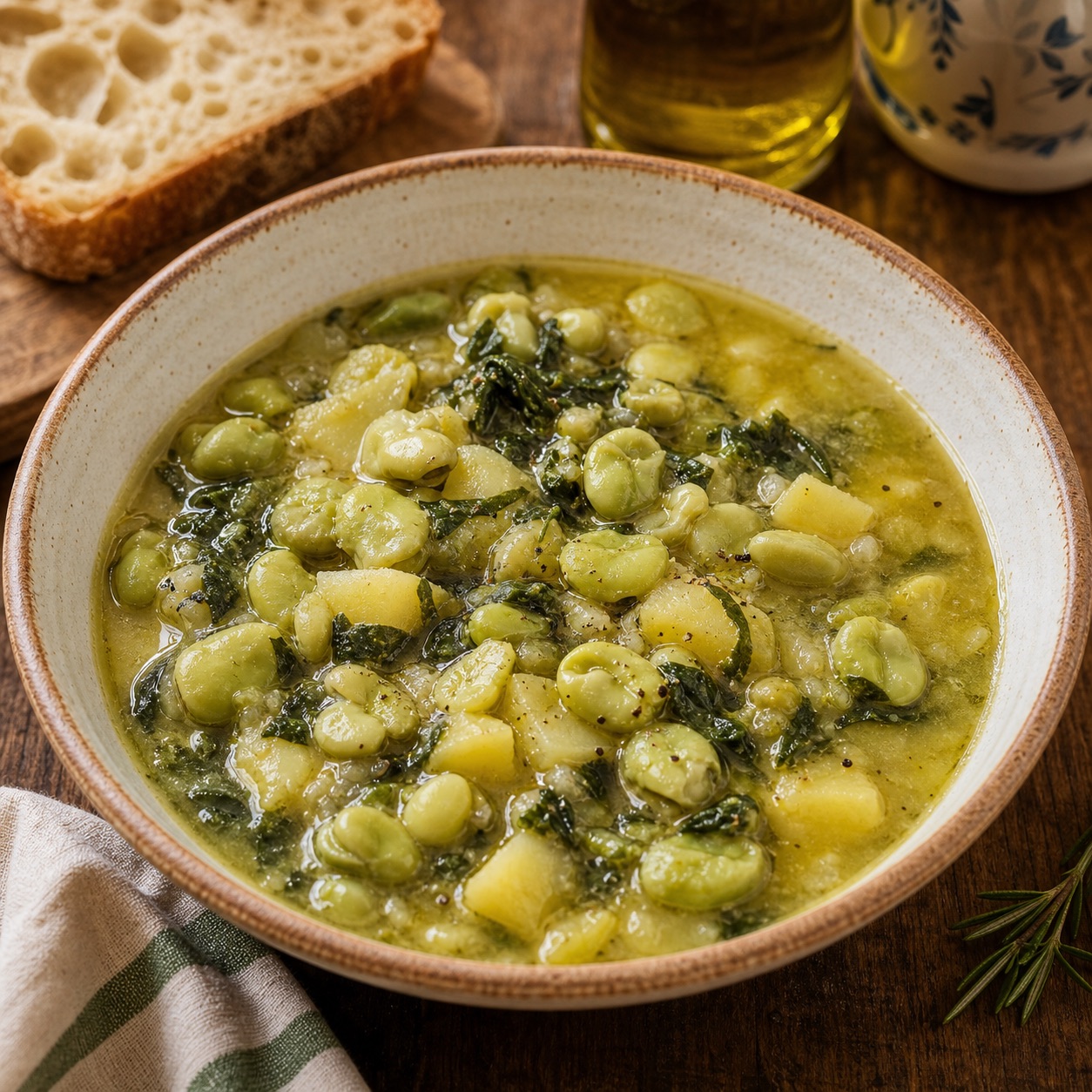
This soup has almost no recipe. Fresh fava beans, a small amount of pancetta rendered first so that its fat becomes the cooking medium, scallions softened in that same fat, and then the beans added and simmered briefly in just enough warm water or broth to cover them halfway. Fresh mint at the end. Reserved crispy pancetta scattered on top. Crusty bread alongside to soak up every drop. The whole thing takes thirty minutes once the beans are shelled, and the shelling is the only part that takes time — a pleasant task, as it turns out, that slows the cooking down to the right pace.
My father loved this soup. It took me a while to understand why — as a child I appreciated it without the vocabulary to describe what made it specific, and by the time I had that vocabulary I was no longer in Campania in May. The appreciation arrived retrospectively, which is how it often works with food that belongs to a place and a season. You eat it as a matter of course while it is available, and you understand what you were eating only when you try to find it somewhere else and cannot.
The simplicity of the recipe is the whole point. There are versions with potatoes for body, versions with chard or chicory for bitterness, versions with pasta stirred in at the end for substance. All of them are good. The version that my father liked — the one that lodged in memory — was the simplest: just the beans, just the pancetta, just the mint. Nothing that competes with the flavor of the fresh fava bean in the week or two when it is at its sweetest. The pancetta provides the savory counterpoint; the mint provides the lift; the beans provide everything else. The rendered pancetta fat, infusing the broth from the first step, is what gives the soup its particular richness without any additional ingredient. It is, as the infographic notes, flavor gold — not to be discarded.
The soup is also a reminder that fava beans are available for a very short time — April into May in Campania, a few weeks at most — and that the dishes depending on them are not available outside that window in any form that resembles the original. This collection now has five fava bean preparations: raw with Pecorino, the pasta with guanciale, the fava bean pasta, this soup, and the variations. All of them live in the same narrow calendar window. All of them are worth making during it, and impossible to replicate outside it with the same result.
Fava bean protein, L-DOPA, and folate — the most nutritious soup of the spring
The nutritional profile of this soup is discussed in detail in the fava beans and Pecorino post, which covers the fava bean's complete protein (high lysine content), L-DOPA, folate at approximately 35–45% of the adult daily requirement, iron, and prebiotic inulin. A few things specific to this preparation deserve mention. The pancetta fat used as the cooking medium is primarily oleic acid (monounsaturated) and palmitic acid (saturated), and cooking the fava beans in fat-enriched water rather than plain water significantly enhances the bioavailability of fat-soluble compounds in the beans — beta-carotene, lutein, and other carotenoids whose absorption requires dietary fat present in the same meal. This is a nutritional benefit that emerges from a culinary decision made entirely on flavor grounds: rendering the pancetta first and using its fat as the cooking base is a flavor technique that also happens to be nutritionally optimal for carotenoid absorption. The short cooking time — 12–15 minutes of simmering — is important for fava beans specifically: brief cooking preserves a higher proportion of folate and vitamin C than long simmering, and it keeps the beans bright green and tender rather than grey and mealy. The infographic's instruction not to overcook is both a culinary and nutritional directive. The fresh mint added at the end contributes menthol and related volatile monoterpenes — added off the heat to preserve the aromatic compounds that would otherwise volatilize during cooking. Menthol has mild anti-inflammatory and antispasmodic activity at culinary concentrations and contributes the characteristic freshness that cuts through the richness of the pancetta fat. This is a nutritionally complete light meal in a single bowl, available for approximately six weeks per year, and optimal in every measurable way during that window.
The recipe
Ingredients · serves 4
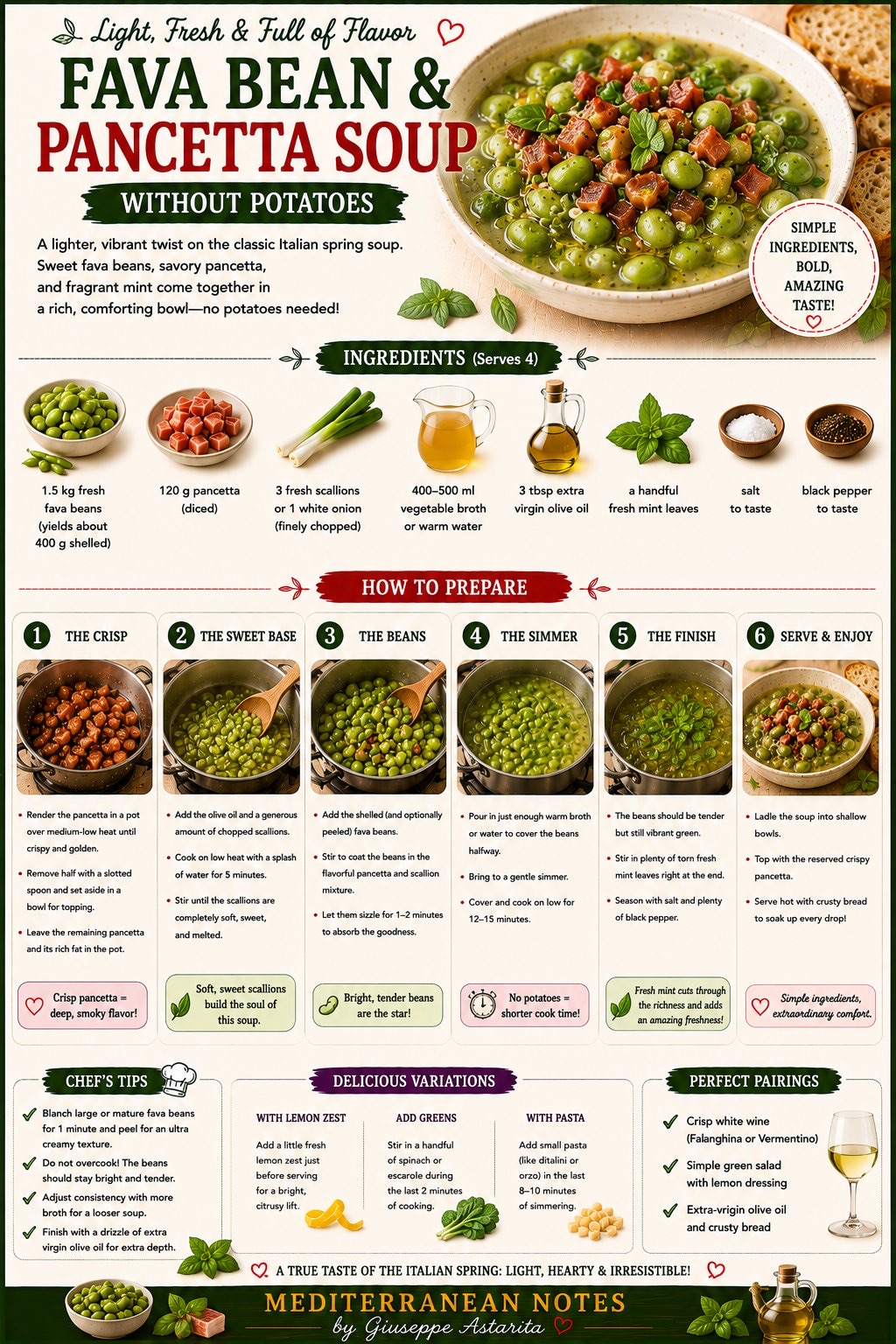
Method
Shell and peel the fava beans. Open the pods by pressing your thumb along the seam. For large or mature beans, blanch for 1 minute in boiling water, plunge into ice water, and pinch each bean from its inner skin — the bright green inner bean pops out cleanly. For very young, small beans the inner skin can be left on. The shelled beans should be vivid green.
Render the pancetta. Place the diced pancetta in a large pot over medium-low heat — no oil needed. Cook for 5–6 minutes until golden and crispy. Remove half with a slotted spoon and set aside in a small bowl — this reserved portion goes on top at serving. Leave the remaining pancetta and all the rendered fat in the pot. This fat is the flavor foundation of the soup.
Do not skip this step or discard the fat. The rendered fat infuses the entire soup with its flavor. Adding olive oil to a neutral pot would produce a completely different result.
Build the sweet base. Add the olive oil to the pot with the pancetta fat. Add the chopped scallions and a splash of water. Cook over low heat for 5 minutes, stirring, until the scallions are completely soft, sweet, and almost melted. They should not brown — the goal is gentle softness.
Add the beans. Add the shelled fava beans to the pot. Stir to coat in the pancetta-scallion mixture and let them sizzle for 1–2 minutes to absorb the flavors. Pour in just enough warm broth or water to cover the beans halfway — this is a thick soup, not a watery one. Bring to a gentle simmer, cover, and cook for 12–15 minutes over low heat until the beans are tender but still bright and vibrant green. Do not overcook.
Finish and serve. Turn off the heat. Stir in the torn fresh mint leaves generously. Season with salt (carefully) and plenty of black pepper. Ladle into shallow bowls. Top each with the reserved crispy pancetta, a few more mint leaves, a drizzle of raw olive oil, and a crack of black pepper. Serve with crusty bread on the side. Eat while hot.
The mint must go in off the heat — the volatile aromatics that give it its freshness evaporate quickly at cooking temperature. Add it at the last moment and serve immediately.
Variations
With lemon zest
Add a little fresh lemon zest just before serving for a bright citrusy lift alongside the mint. The acidity of the lemon cuts through the pancetta richness and sharpens the sweet fava bean flavor. A small addition with a significant effect.
With greens
Stir in a handful of spinach or escarole in the last 2 minutes of cooking for added bitterness and body. Escarole is the more Neapolitan choice — its slight bitterness against the sweet fava beans is a well-established pairing in Campanian spring cooking.
With pasta — pasta e fave
Add small pasta (ditalini or orzo) in the last 8–10 minutes of simmering. The pasta absorbs the broth and the soup thickens into something more substantial — closer to a meal than a soup. A third and equally valid version of this spring preparation.
With dried fava beans — year-round
Soak dried fava beans overnight and simmer until tender — about 45–60 minutes. Then follow the recipe as written. The dried version is available year-round and produces a good soup, earthier and denser than the fresh version. Both are good. Only one is the seasonal event.
This is one of the dishes in this collection that requires the least technique and carries the most memory. The fava beans are available for a few weeks in spring. The recipe is nearly without steps. The result is a soup that you will not find in any restaurant and that can only be made at home, in the right season, by someone who decides to make it.
When I was craving it and found nothing — not in Italian restaurants in the US, not in Italy itself when I went looking in the wrong season or the wrong kind of place — I understood something about what this category of food actually is. It is not restaurant food. It is not even particularly Italian in the sense of belonging to a cuisine. It belongs to specific kitchens and specific people and specific springs, and the only way back to it is through your own hands and the right month on the calendar.
Buon appetito — per te e per chi hai amato.