Pasta alla carbonara: eggs, pasta, cheese — and nothing it doesn't need
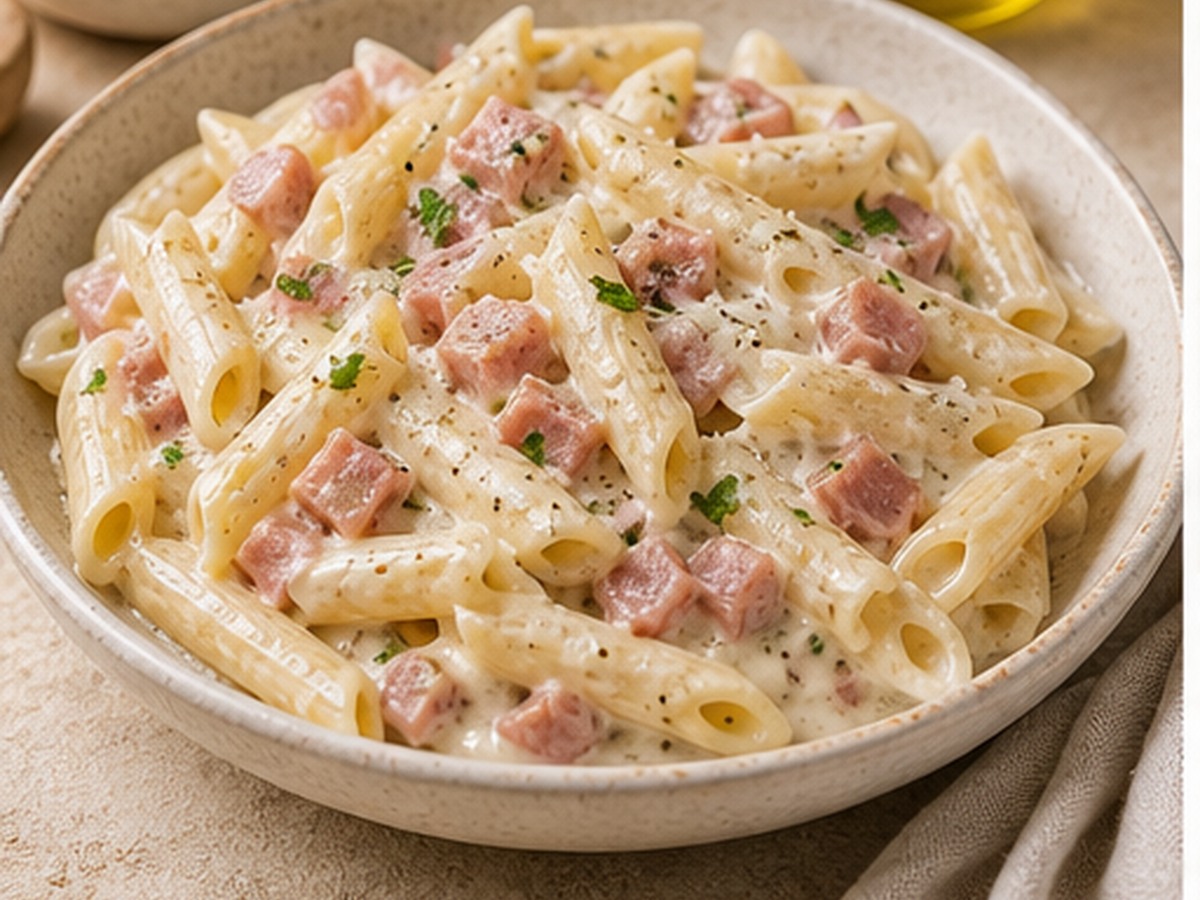
An Italian classic with so many variations, and one honest core. A friend made it simply — pasta, eggs, cheese. That was enough. Nutritious, satisfying, not fancy. Doesn't need to be super creamy. Doesn't even require the guanciale if you don't have it. Just good.
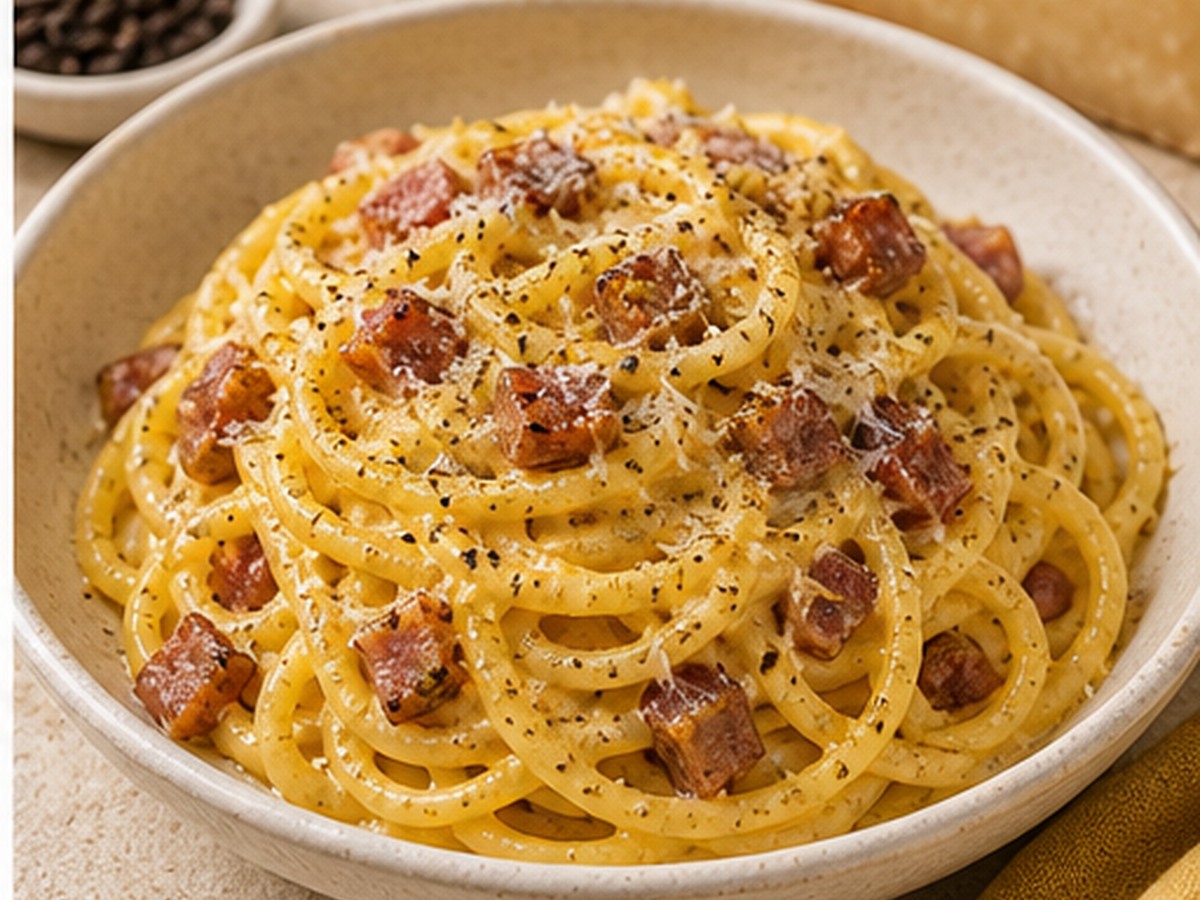
The carbonara is technically a Roman dish rather than a Neapolitan one — it originates from the Lazio region, and the authentic Roman version with its five strict ingredients (pasta, guanciale, Pecorino Romano, egg yolks, and black pepper — no cream, no garlic, no onion) is a product of the Roman culinary tradition and remains, in its proper form, one of the greatest pasta dishes in Italy. It does not belong to this blog by geography. It belongs here because every Italian knows how to make it, because it appears on Italian family tables everywhere, and because the version a friend made that lodged itself in memory was simpler than the Roman original and better than it had any right to be.
The friend's version had no guanciale. It had pasta, eggs, Pecorino or Parmigiano, black pepper, and a practiced confidence about the off-heat technique that produced something creamy without being rich, satisfying without being heavy, and done in fifteen minutes. It was not the authentic carbonara. It was a version of carbonara that a person makes when they understand the principle — egg and starch and mechanical emulsification — and applies it with what is available. The result was very good. This is the memory that attached itself to this dish.
The technique that makes carbonara work is the same one that runs through this blog in several other dishes — the pasta con zucchini e uova, the pasta con mozzarella, the cacio e pepe that is carbonara's close Roman relative. Egg yolks beaten with finely grated cheese and black pepper, combined with hot pasta that has been removed from the heat, with starchy pasta water added gradually while tossing vigorously. The starch from the pasta water creates a colloidal network that keeps the fat from the eggs and cheese dispersed evenly — the emulsion that produces the creamy coating. The technique fails if the pan is too hot (scrambled eggs) or too cold (clumped cheese). It succeeds with the right temperature management and sufficient agitation. The guanciale, in the proper version, contributes its rendered fat to the emulsion and a specific savory pork flavor that anchors the dish. Without it, the dish is leaner and lighter and still works on its own terms.
The carbonara debate in Italy is real and fierce and occasionally disproportionate to its subject. Cream is the most divisive addition — the Roman tradition considers it strictly forbidden, and this is not merely snobbery: cream does not add creaminess so much as it changes the emulsion from a starch-and-egg structure to a dairy-based one, which has a different texture and a different flavor and is genuinely a different dish. Garlic and onion are similarly excluded in the authentic version. These are not arbitrary rules — they reflect a dish that was designed with a specific balance of five ingredients where each one matters and addition dilutes. The simpler version without guanciale maintains the core principle. Cream does not.
Egg yolk emulsification and why carbonara is nutritionally complete from five ingredients
The carbonara is one of the most nutritionally complete pasta dishes available from just a few ingredients. Egg yolks — four for a four-portion recipe — provide approximately 20–22 g of fat (primarily oleic acid, palmitic acid, and linoleic acid), 12–14 g of complete protein, choline (approximately 400 mg total, close to the adult adequate intake), lutein and zeaxanthin (macular carotenoids that accumulate in the retinal pigment), and fat-soluble vitamins A, D, E, and K. The combination of pasta (carbohydrate and some protein) and egg (fat and protein) produces a complete macronutrient profile that explains the traditional association of the dish with restorative eating — which is also where the name is believed by some historians to have originated, from the carbon workers (carbonari) who needed a substantial and efficient meal. Pecorino Romano provides calcium at a high concentration, glutamate (which amplifies the savory perception of the egg and starch together), conjugated linoleic acid, and fat-soluble vitamins from sheep's milk. Black pepper — present in significant quantity in proper carbonara — provides piperine, a compound that enhances the bioavailability of several fat-soluble nutrients including beta-carotene and curcumin by inhibiting their intestinal metabolism; it also has mild anti-inflammatory activity. Guanciale, when present, provides saturated and monounsaturated pork fat including oleic acid and palmitoleic acid, plus the rendered fat that contributes to the emulsion mechanics and the flavor depth of the dish. The version without guanciale — pasta, eggs, Pecorino, pepper — is leaner and has a slightly higher protein-to-fat ratio, and is nutritionally complete in a different register. Both are good. The technique that produces the creamy sauce without cream — pasta starch forming the emulsifying matrix — means that the dish achieves its characteristic texture through a genuinely healthy mechanism: no added dairy fat, no thickeners, just the colloidal chemistry of cooked starch and egg protein in hot liquid.
The recipe — authentic and simplified
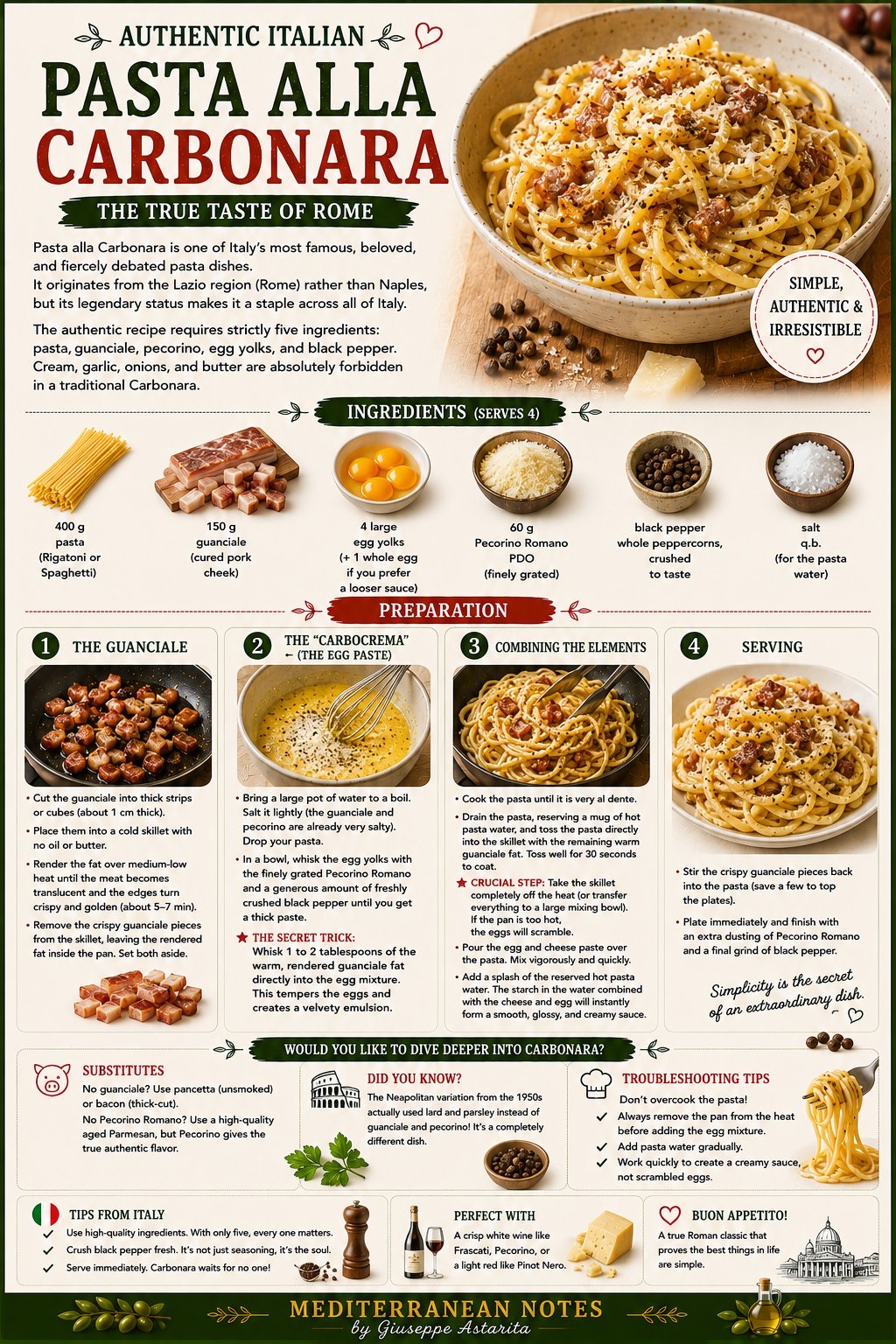
The authentic Roman version — 5 ingredients
The simpler version — when the pantry is bare
Method — the technique is the same for both
Render the guanciale (if using). Place the guanciale cubes in a cold, dry skillet — no oil or butter. Render over medium-low heat until the fat is translucent and the edges turn golden and crispy, about 5–7 minutes. Remove the crispy guanciale pieces and set aside, leaving the rendered fat in the pan. This fat is the foundation of the sauce emulsion.
Starting in a cold pan and rendering slowly produces a better result than high-heat sautéing — the fat renders evenly and the meat crisps without burning.
Make the egg paste — the carbocrema. In a bowl, whisk the egg yolks with the finely grated Pecorino, a generous amount of freshly crushed black pepper, and 1–2 tablespoons of the warm rendered guanciale fat (or a tablespoon of pasta water if not using guanciale). Whisk until thick and smooth. This tempering step prevents the eggs from scrambling when they contact the hot pasta.
Cook the pasta. In lightly salted boiling water (the guanciale and Pecorino contribute salt; do not over-salt the water). Cook until very al dente — the pasta will finish cooking in the pan. Reserve at least 1 full mug of pasta water before draining.
Combine — critical step. Drain the pasta and add it directly to the skillet with the guanciale fat over medium heat. Toss for 30 seconds. Then — take the pan completely off the heat, or transfer everything to a large bowl. This is the moment that determines success or failure. Pour the egg and cheese paste over the pasta. Mix vigorously and quickly. Add pasta water a splash at a time, tossing constantly, until the sauce is creamy and coats every strand. Return the crispy guanciale pieces. Serve immediately.
Off the heat means off. Not reduced heat, not low heat — off. If the pan is too hot when the egg goes in, it scrambles. The residual heat of the pasta is exactly enough. Trust the process.
Versions — the same technique, different configurations
The Roman original
Guanciale, Pecorino Romano PDO, egg yolks, black pepper, spaghetti or rigatoni. Nothing else. The definitive version and the one against which all others are measured. Requires guanciale specifically — pancetta is a common substitution but produces a milder, less complex result because guanciale has a higher fat-to-meat ratio and a different flavor profile.
With pancetta
The most common home version outside Rome. Pancetta (unsmoked) renders well and the fat contributes to the emulsion almost as effectively as guanciale. Good pancetta produces a very good carbonara. Smoked bacon changes the flavor significantly and pushes the dish toward something different — not wrong, but not carbonara.
Without meat — just eggs and cheese
Pasta, egg yolks, Pecorino or Parmigiano, black pepper, pasta water. The version a friend made simply, without guanciale, that is the memory attached to this dish. The emulsion still works — pasta starch and egg yolk and cheese, vigorously tossed off the heat. Lighter, leaner, and completely honest. The egg and cheese carry the dish on their own.
The things that don't belong
Cream: changes the emulsion type and the flavor, produces a different dish. Garlic: excluded in the authentic version; its flavor conflicts with the guanciale and Pecorino rather than complementing them. Onion: same reason. Peas: a northern Italian variation that Italians south of Rome regard with polite confusion. These are not forbidden out of snobbery — they each move the dish away from what makes carbonara specifically good.
The carbonara rewards understanding more than effort. The technique — the off-heat emulsification, the pasta water added gradually, the vigorous tossing — is the skill the dish requires, and once it is understood it works reliably whether the pantry offers guanciale and aged Pecorino or just eggs and whatever cheese is available. The simpler version is still good food. Sometimes the memory is of the simpler version, made by a friend without ceremony, and it is clear and complete and exactly enough.
Buon appetito.