Pasta con panna e prosciutto: the Italian 80s comfort classic
There was a time in Italy — the 1980s and '90s especially — when adding panna to pasta was the quick cheat that made everything taste richer, rounder, more immediately satisfying. Butter, cooking cream, good cooked ham, penne, Parmigiano, a pinch of nutmeg. Twenty minutes. Still very good. Not pretentious about it.
The panna era has a specific place in Italian culinary memory. In the 1970s and '80s, cream became widely available and affordable in Italian supermarkets, and home cooks discovered that adding it to pasta sauces produced an immediate result: richness, roundness, a silky coating on the pasta that required no technique and no particular skill. It became the shortcut solution for weeknight cooking — pasta panna e prosciutto, pasta panna e piselli, pasta panna e funghi, pasta panna e salmone. You could make any of them in the time it took to boil the pasta, and they all tasted good. Critics of Italian culinary tradition have looked back at this period with some condescension, but the condescension is misplaced. The dishes were popular because they were genuinely good, not because people did not know better.
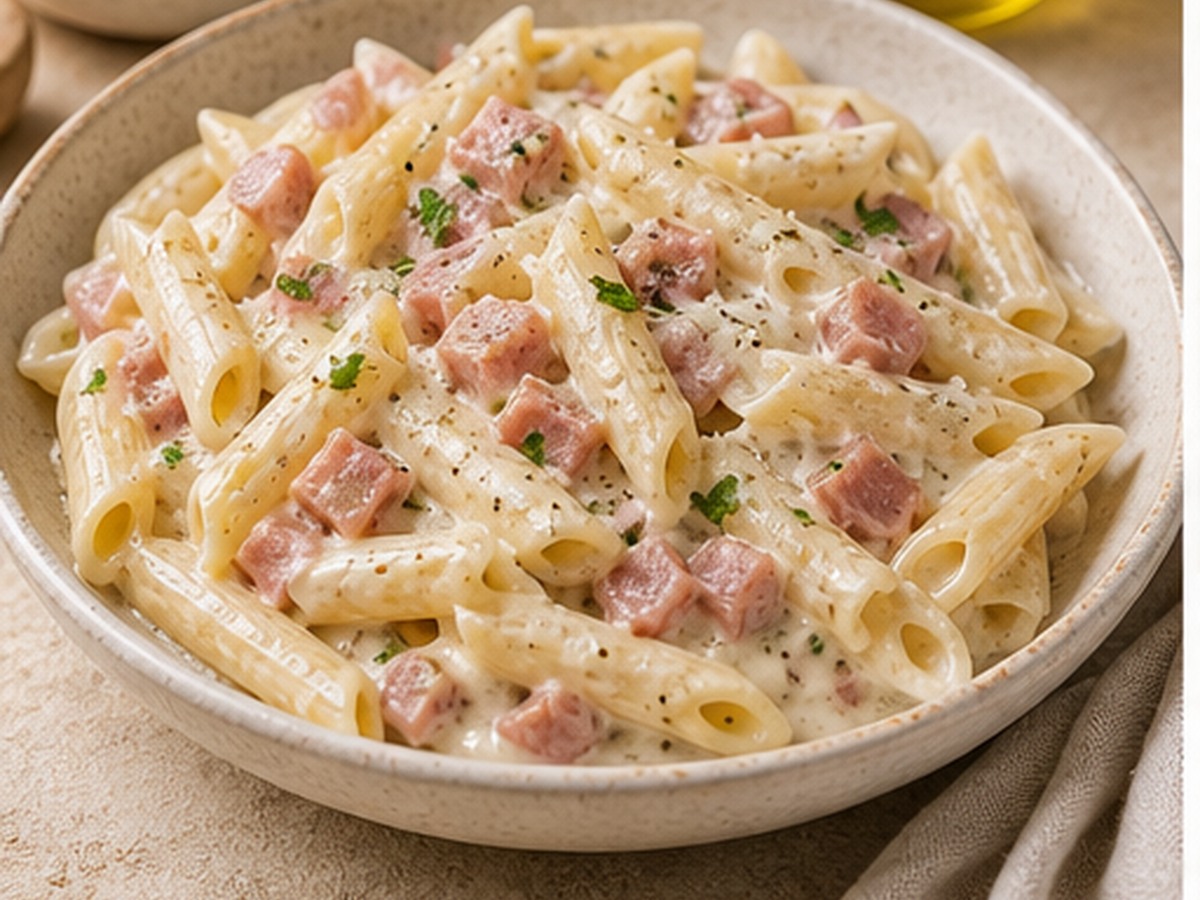
This specific version — ham and cream — was a staple of the Italian table during those years in a way that feels specific to a generation. I ate it often while growing up, always with short pasta and usually penne, which holds the cream sauce inside the tube and on its ridged surface simultaneously. The ham was cooked ham (prosciutto cotto — not cured, not raw, the mild, delicate pink slices that are Italy's equivalent of what English-speaking countries call just "ham"), cut into thin strips that warmed through in the butter before the cream arrived. Parmigiano at the end, a pinch of nutmeg, plenty of black pepper.
The observation that cream was the Italian home cook's workaround for richness is accurate and should not be embarrassing. The French culinary tradition had long understood the power of dairy fat as an emulsifier and flavor carrier in sauces — the Italian version of this was simply the panna in the home kitchen, producing similar results by similar means with less technique. Restaurants, particularly in northern Italy, used butter in quantities that would surprise a modern diner — the restaurant pasta of the 1980s in Italy was often significantly richer than what home cooks made, because professional kitchens had learned that butter mounts a sauce into a glossy, cohesive coating that is difficult to achieve any other way. The mascarpone version — stirring a spoonful of mascarpone into the warm sauce instead of or alongside the cream — produces an even richer result with a slightly tangier flavor profile. All of these are legitimate. None requires apology.
The one technical rule that matters: do not boil the cream. Cream added to a pasta sauce should be warmed gently — just enough to heat through, to thin slightly, to blend with the butter and the ham — and never reduced aggressively. Boiled cream separates and thickens into something less silky and more sauce-like, losing the light, flowing quality that makes it work. Warm, not boiled. Off the heat before the pasta goes in. The pasta's residual heat and the starchy pasta water finish the job.
The recipe
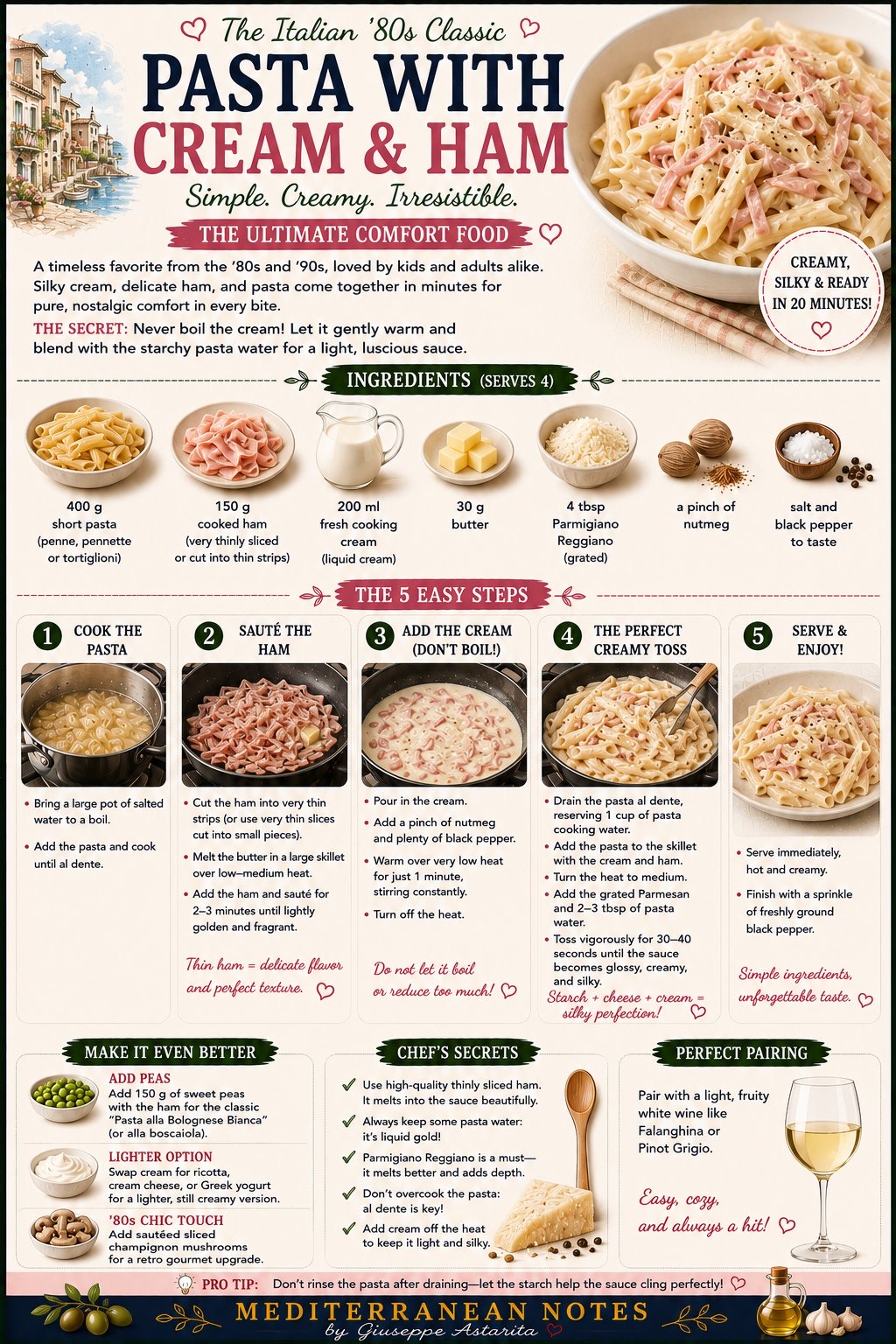
Ingredients · serves 4
Method — 20 minutes
Cook the pasta. Bring a large pot of salted water to a boil and cook the penne until al dente. Reserve 1 cup of pasta cooking water before draining.
Sauté the ham. In a large skillet over low-medium heat, melt the butter. Add the ham strips and sauté for 2–3 minutes until lightly golden at the edges and fragrant. The butter should be fully melted and foamy but not browned.
Add the cream — gently. Pour in the cream. Add the pinch of nutmeg and plenty of black pepper. Warm over the lowest possible heat for just 1 minute, stirring constantly. Do not let it boil or reduce. Turn off the heat.
This is the single rule: never boil the cream. Warm it through, no more. The pasta's residual heat does the rest.
Toss and finish. Drain the pasta and add directly to the skillet with the cream and ham. Turn the heat to medium. Add the Parmigiano and 2–3 tablespoons of pasta cooking water. Toss vigorously for 30–40 seconds until the sauce is glossy, creamy, and coats every piece of pasta. Serve immediately with a final crack of black pepper.
Variations — the whole panna era in four cards
Con mascarpone — richer
Replace the cooking cream with 150 g of mascarpone. Stir it into the warm butter and ham off the heat — it melts into a thicker, tangier, more intensely dairy-flavored sauce. The mascarpone version is the richest of the group and the one that most justifies the description "comfort food." A spoonful of mascarpone was also the restaurant's secret weapon in the 80s.
Con piselli — panna e piselli
Add 150 g of frozen peas to the ham during the sauté step. Cook for 2 minutes until bright green and warmed through before adding the cream. The peas add sweetness, color, and enough bulk to make the dish a more complete meal. Traditionally called pasta alla bolognese bianca in some households — the cream-based alternative to the tomato ragù.
Con funghi — panna e funghi
Sauté sliced champignons or mixed mushrooms in the butter before adding the ham. The mushrooms release their liquid, which reduces into the butter and creates a deeper, more savory base before the cream arrives. The 80s "gourmet" version of this dish — a step up in complexity without a step up in effort.
Solo burro — just butter
Pasta, butter, Parmigiano, pasta water, nutmeg, black pepper. No cream, no ham. The distillation of the same principle — dairy fat, starch, Parmigiano, pasta water emulsifying everything into a silky coating. The simplest possible version and the one most directly descended from the northern Italian butter tradition. Restaurant kitchens used a great deal of butter. More than you think.
This pasta does not need to be defended. It is not sophisticated. It is not the most important dish in Italian cooking. It is a twenty-minute weeknight pasta that tastes good, that a generation of Italian children grew up eating, and that still delivers exactly what it promises — immediate, uncomplicated comfort in a bowl. The nutmeg is not optional. The black pepper should be generous. The Parmigiano should be freshly grated. These three details lift the dish from simple to memorable.
Buon appetito — senza complicazioni.