Campanian kitchen · Pasta · Friday · Salmon · Special occasion · Shared
Farfalle al salmone
Smoked salmon, tomato paste, cooking cream, white wine, shallot, parsley — a pink sauce that coats every butterfly-shaped piece of pasta. A Friday dish, a celebration dish, a dish my mother made because she knew I loved it. One particular time she made it, I could not eat it. A doctor had told me I had to avoid food for a few days. I sat at the table. I am not sure when I ate it next, or whether I did.
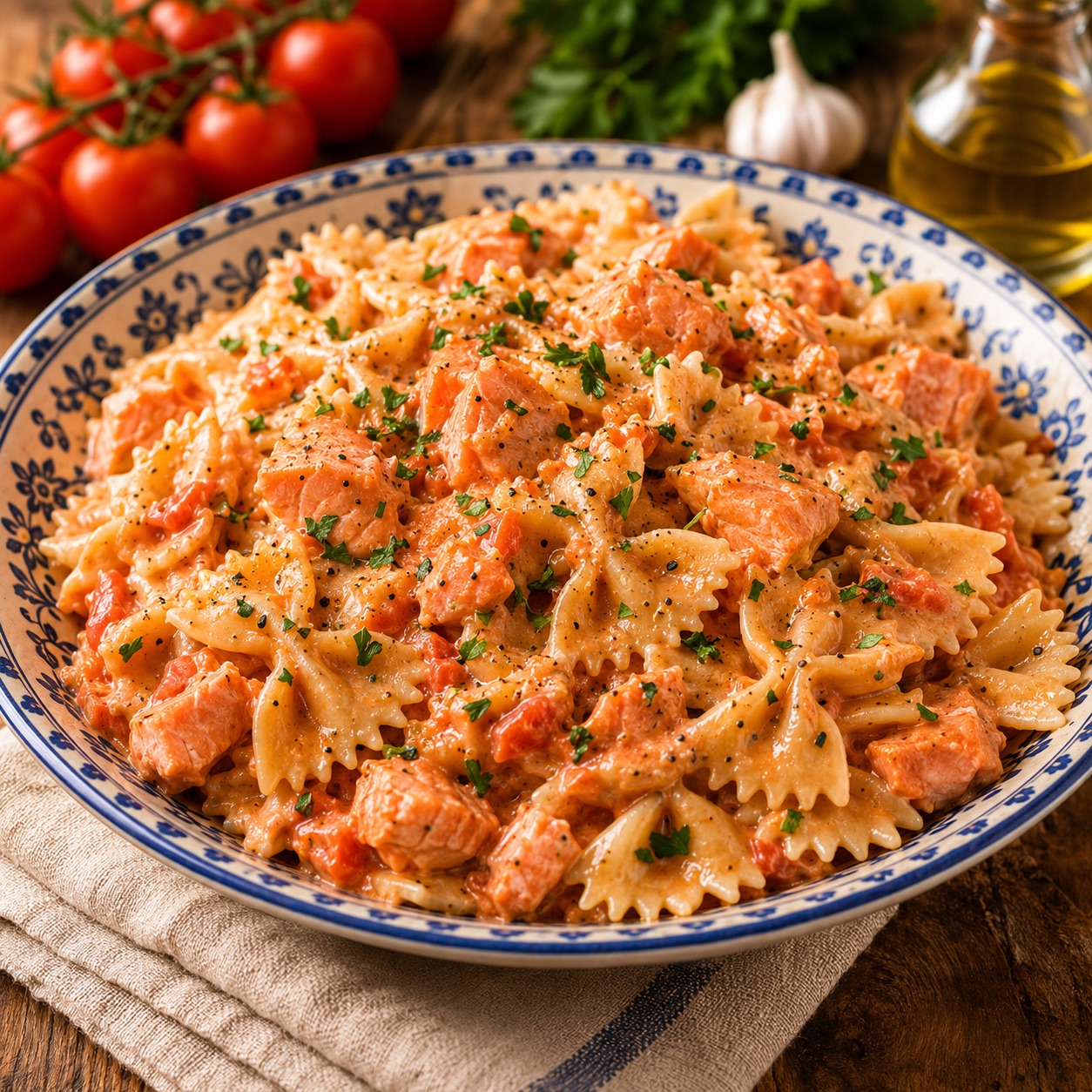
There are dishes that belong to a specific relationship at the table. Not just a family dish — the ragù belongs to the whole family, the parmigiana belongs to Sunday — but a dish that exists specifically between two people who both love it in a way the others at the table do not particularly share. The farfalle al salmone was that kind of dish for my mother and me. She loved salmon, she loved the creamy pink sauce, she loved the farfalle specifically because the butterfly shape holds a creamy sauce differently from a tube or a strand — the ridged edges collect it, the folded center retains it. And I loved it too, perhaps because she did, or perhaps because it is genuinely one of the best combinations of pasta, cream, and cured fish that the Italian kitchen produced in the 1980s and still holds up entirely.
She made it on Fridays, when seafood belonged at the lunch table. Not every Friday — it was a special preparation, the kind you made when the salmon was good and the occasion warranted it. When she made it, she made it for both of us in the way that seafood preparations in our house were always for the subset of the family who appreciated them: my father ate something else, patiently and without complaint, and the rest of us had the fish dish. The farfalle al salmone was even more specifically ours — the two of us sharing something we both looked forward to, which is a particular kind of pleasure at a family table that I did not have a name for then and still find difficult to describe precisely.
There was one particular occasion when she made it and I could not eat it. A doctor had told me to avoid eating — or to avoid certain foods, I no longer remember the exact instruction — for a few days, and that day was one of the few days. She made the dish anyway, perhaps because she had already planned it, perhaps because she made it for herself and the fact that I could not have it was simply how it was that day. I sat at the table. The smell of the salmon in the cream sauce was in the kitchen while she was making it. The plate was there. I did not eat it.
This is a small thing by any measure. It is not a serious loss. But certain food memories work this way — not through the experience of eating but through the experience of not eating, of being present when the dish was there and unable to participate. The absence leaves a sharper impression than the presence would have, because the anticipation has nowhere to go. I think of this every time I make the farfalle al salmone now. Whether the memory qualifies as a loss or just as a story I tell, I am not sure. It is the memory I have of the dish, and it is honest, and it belongs in this blog alongside the more comfortable ones.
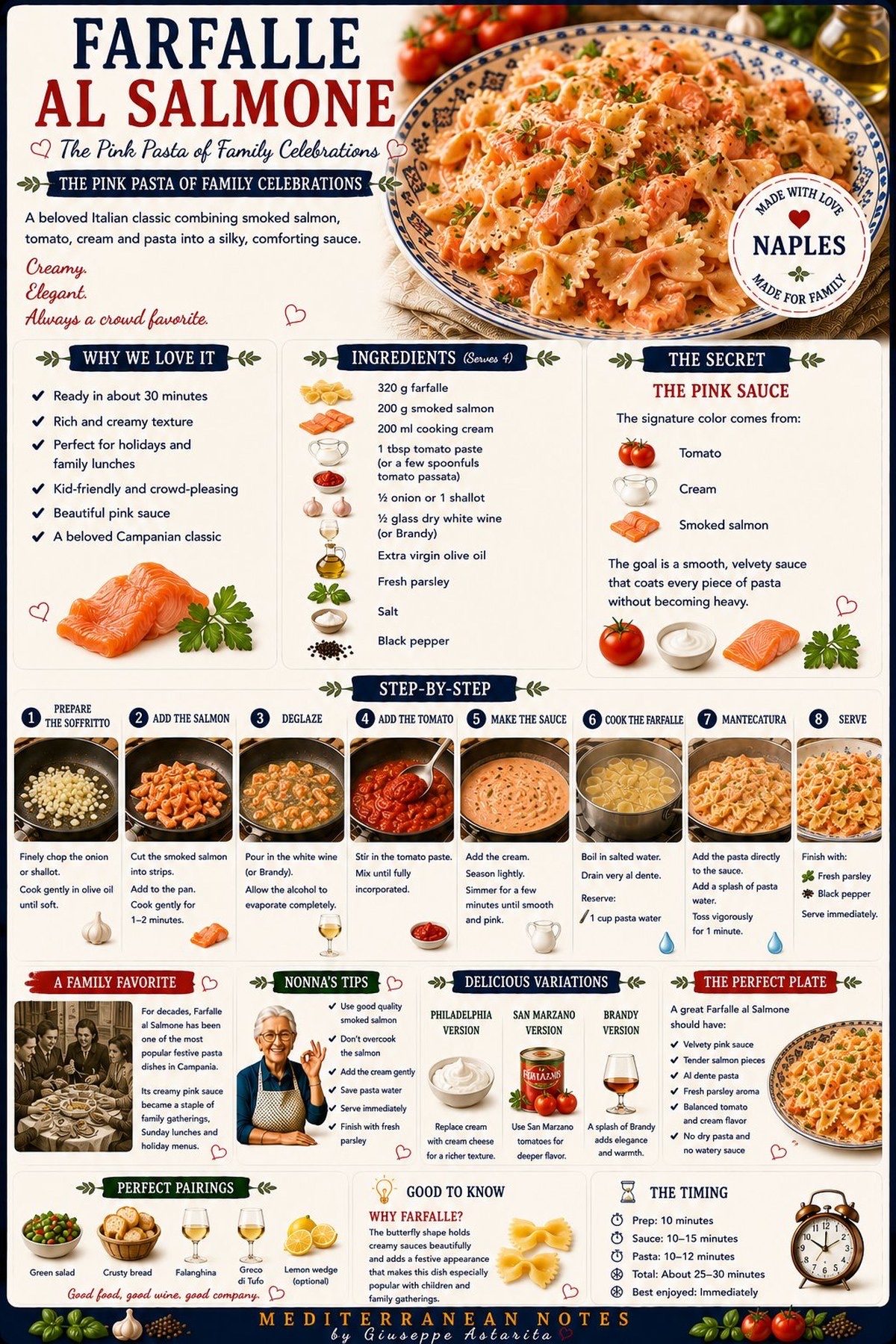
The dish itself is not complicated. The pink sauce is the combination of tomato — usually paste or a small amount of passata — and cooking cream, with the smoked salmon cut into pieces and cooked briefly in a base of shallot and white wine. The salmon is delicate enough that it does not need long cooking; it should remain in recognizable pieces rather than dissolving into the sauce, which is what happens if it is left over heat too long. The parsley at the end is not traditional in every version but my mother used it, and it cuts through the richness of the cream with a useful freshness. The farfalle are the right pasta — not because another shape would be wrong but because the shape was designed to hold this kind of thick, clinging sauce, and it does.
Why smoked salmon should not cook long — and what the pink sauce actually is
Smoked salmon is already cured and hot-smoked or cold-smoked before it reaches the kitchen — it does not require cooking for safety. In the farfalle al salmone, the brief heat exposure (1–2 minutes in the pan) serves to warm the salmon and allow it to release its fats into the sauce base, not to cook it through. Prolonged heat causes the salmon's myosin proteins to contract and expel moisture, producing a dry, crumbly texture and significantly reducing the omega-3 fatty acid bioavailability as the fat renders out into the sauce rather than remaining in the flesh. The pink sauce is an emulsion of dairy fat (from the cooking cream) and water, stabilized by the casein proteins in the cream, tinted pink by the tomato paste's carotenoids (primarily lycopene, which also contributes a subtle sweetness that balances the cream's fat). The white wine's ethanol evaporates during cooking, leaving tartaric acid and residual aromatic compounds from the wine that add acidity and complexity. The result is a sauce with the mouthfeel of a cream sauce, the color of a tomato sauce, and the flavor of neither — something between the two, with the salmon's smokiness running through it.
Recipe — serves 4
Ingredients
Method
Soften the shallot. Heat the olive oil in a wide pan over medium heat. Add the finely chopped shallot. Cook gently for 3–4 minutes until soft and translucent. Do not brown it.
Add the salmon briefly. Add the smoked salmon strips to the pan. Cook gently on medium heat for 1–2 minutes only — just long enough to warm through and release its oils into the pan. It should remain in pieces, not dissolve.
This is the step most people get wrong — they leave the salmon too long and it dries out and crumbles. One to two minutes and remove from heat if anything.
Deglaze with wine. Pour in the white wine (or Brandy). Let the alcohol evaporate completely — about 1 minute on medium-high heat. The pan will smell immediately better.
Build the pink sauce. Stir in the tomato paste until fully incorporated. Then add the cream. Stir together gently. Season lightly with salt (carefully — the salmon is already salted) and black pepper. Simmer for 3–4 minutes until the sauce is smooth, pink, and slightly reduced. It should coat a spoon without being heavy.
Cook the farfalle. Boil in abundant salted water until al dente. Reserve one cup of pasta water. Drain two minutes early.
Finish in the sauce. Add the drained farfalle directly to the pan with the salmon sauce. Toss vigorously over medium heat for 1 minute with a splash of pasta water. The sauce should cling to every fold of the butterfly pasta. Turn off the heat. Add the parsley. Serve immediately.
No Parmigiano on this one — cheese on fish pasta is a Neapolitan rule violation and also simply wrong with the cream-salmon combination. The dish is complete as it is.
The recipe is here now, written down. The next time I make it I will think of that afternoon in Caserta — the kitchen, the smell of the salmon in the cream, the plate I did not eat from. I do not think this is a sad story. It is a specific one, which is better. Most food memories are comfortable and pleasant and blur together over time. This one stayed sharp precisely because of the absence at its center. The dish I did not eat that day is the one I remember most clearly from all the times she made it. That seems like the right kind of memory to preserve.
Per la prossima volta — e per tutte le volte che non ricordo.