Campanian kitchen · Sunday · Pasta · Family · Tradition · For Anna and Carolina
Paccheri al sugo
Anna, Carolina — this is the Sunday pasta. Garlic, peeled tomatoes, one large carrot left whole, basil when we have it, Parmigiano at the end. The recipe has no surprises. The tradition has no end date. Una pasta importante.
There is a cabinet in our kitchen in Massachusetts that has, at any given moment, four or five packs of paccheri in it. I bring them back from Italy every time I go — and I have gone back, with varying frequency, for more than twenty years. The paccheri always come in the luggage. Sometimes pasta is the first thing I pack. Not because paccheri are impossible to find here, but because what you find here costs five times more and tastes half as much, and there are things for which that calculation is simply not acceptable. Paccheri is one of them.
I started making them on Sundays when you were small — first Anna, then Carolina. The ritual is the same every time. I ask if we should make paccheri. You both react as if I have just said something excellent. We take a photo of you eating them, every time — I have a small archive now of both of you at the kitchen table with a plate of paccheri in front of you, from the years when Carolina needed hers cut with a knife to the more recent ones where she handles each one in a few bites, like a person. Some of your friends have eaten them here too. The recipe has stayed the same throughout.
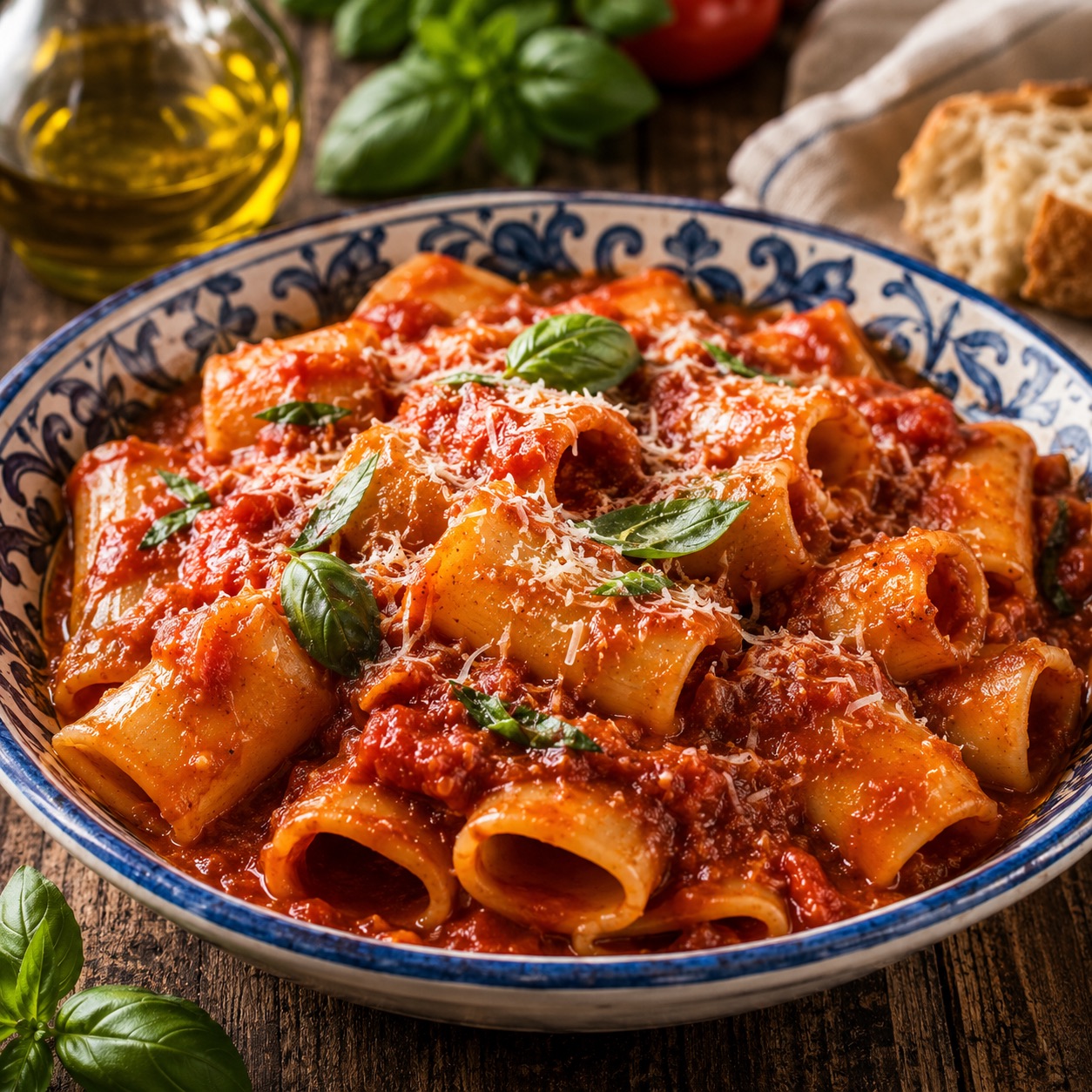
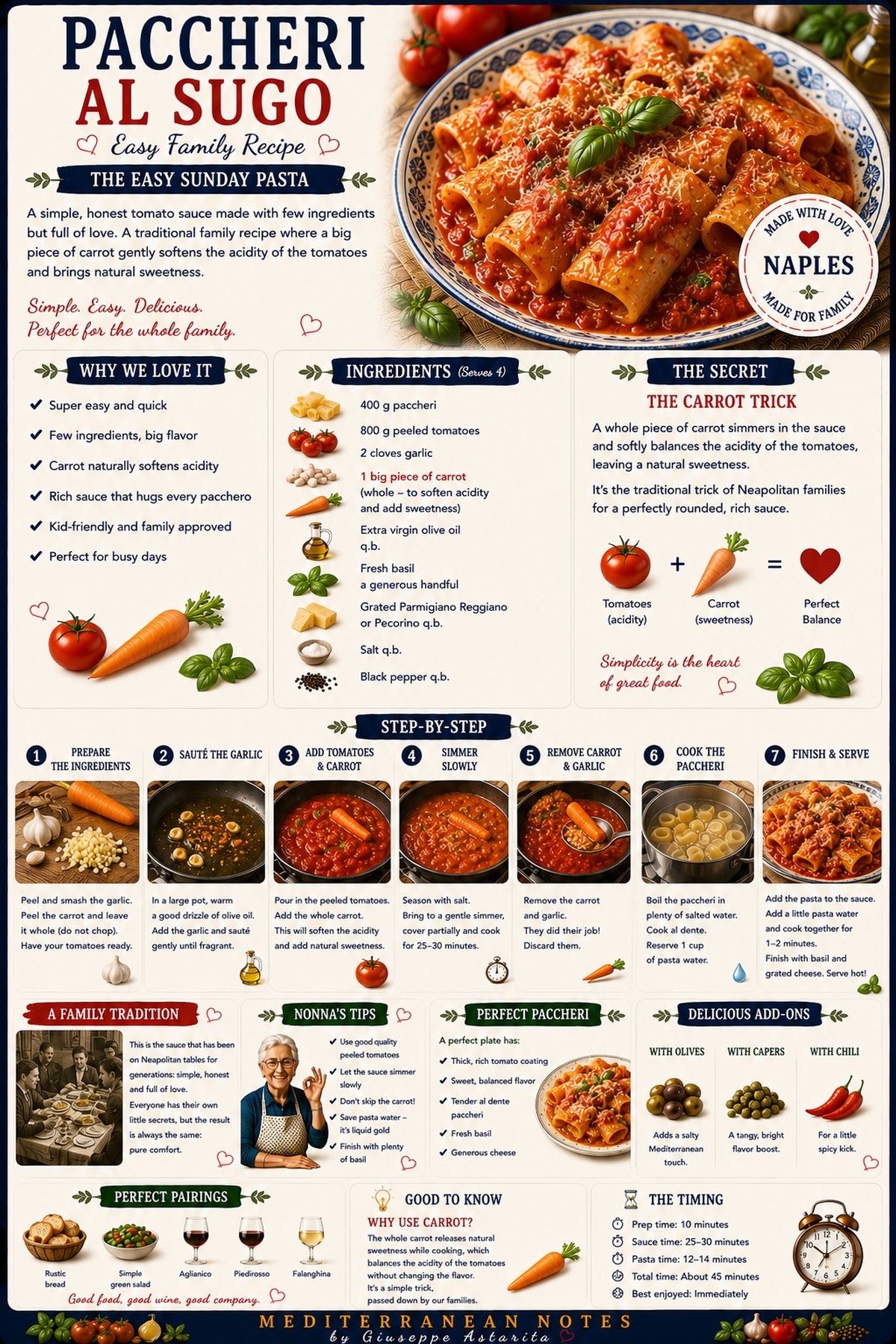
This is not the full traditional Neapolitan version of the sauce — I will write that one separately, and if you ever order paccheri alla napoletana at a trattoria in Campania and find a rich, slow-cooked sauce with soffritto and lard, that is the other tradition. My version is the family version: simpler, faster, the one I grew up eating and the one I make on Sunday mornings here when the cabinet still has a pack. Garlic in olive oil, the peeled tomatoes crushed by hand, one large carrot left whole in the sauce for the entire cooking time, basil off the heat, Parmigiano at the table. The carrot is the family secret — it absorbs the acidity of the tomatoes and contributes a faint sweetness without changing the flavor. You remove it before serving. It did its job.
Paccheri are not a quick pasta. The tubes are large — the name likely comes from the Neapolitan word for a slap, pacchero, which tells you something about the size — and they need time. Depending on the brand and the thickness, they can take fifteen to twenty minutes to cook properly. This is why I always bring them from Italy: the imported ones, made with harder durum wheat and extruded through bronze dies, have a rougher surface and a higher protein content, which means they cook more slowly, absorb sauce better, and stay al dente longer. The ones you find here for a reasonable price are made faster with softer flour and smooth extrusion, and they taste like a different pasta. The difference is worth twenty years of checked luggage.
I have thought, more than once, that a pacchero is the right size and shape for filling — that if you stuffed a pacchero you would get something that looks exactly like a piece of sushi, a pasta maki. I have not done this yet. One day I will, and we will call it something ridiculous and eat it at the kitchen table and take a photograph. For now, they go with the sauce. That is already more than enough.
Why paccheri take longer to cook — protein, bronze extrusion, and the carrot trick
Good paccheri imported from Campania are made from high-protein durum wheat semolina (typically 13–14% protein vs 10–11% for lower-quality pasta) and extruded through bronze dies rather than Teflon-coated ones. The bronze surface creates a rough, slightly porous exterior on each tube — visible to the touch — that slows moisture penetration during cooking and provides more surface area for sauce adhesion. The higher protein content means a stronger gluten network that requires more heat energy to denature, producing the longer cooking time (15–20 minutes) and the better al dente bite that holds through the eating time without turning soft. The carrot trick is genuine food chemistry: raw carrot contains sugars (mainly sucrose and glucose) that leach slowly into the acidic tomato sauce during simmering. The sugars reduce the perceived acidity by shifting the flavour balance without altering the pH significantly — the effect is a rounder, less sharp tomato flavor. The carrot is removed because its role is purely chemical; once cooked it is also waterlogged and flavourless itself. The pasta water added at the end contains dissolved starch from the paccheri's long cook — this starch thickens the sauce slightly and helps it adhere to the large tube surface, the same mantecatura principle that makes cacio e pepe cohere.
The recipe — our version
This is the family version — no soffritto, no lard, no celery. Garlic, tomatoes, one carrot, basil, Parmigiano. Serves 4.
Ingredients
Method
Make the sauce. Heat the olive oil in a large pan over medium heat. Add the crushed garlic cloves. Let them infuse for about 2 minutes until golden — do not brown. Crush the peeled tomatoes directly into the pan by hand (or cut the tin with scissors and squeeze). Add the whole carrot. Season with a pinch of salt. Simmer gently, partially covered, for 25–30 minutes until the sauce is thick and no longer watery.
The carrot goes in whole at the beginning and comes out whole at the end. It does not get eaten. It does its job quietly and then leaves.
Remove garlic and carrot. Add basil. When the sauce is ready, remove the garlic cloves and the whole carrot. Turn off the heat. Tear the basil leaves and stir them through the sauce. The basil goes in off the heat — it stays bright and fragrant this way.
Cook the paccheri. Bring a large pot of well-salted water to a boil. Add the paccheri. Cook according to the package instructions, checking two minutes early. The tubes should be cooked through but still have resistance when you bite the wall. Reserve one full cup of pasta water before draining. Drain and do not rinse.
A large pot matters — paccheri are big and need room to move. A small pot produces uneven cooking where some tubes are done and others aren't.
Finish in the sauce. Transfer the drained paccheri directly into the pan with the sauce over medium heat. Add a ladleful of the reserved pasta water. Toss gently — the starch from the pasta water thickens the sauce and helps it coat the tubes. Cook together for 1–2 minutes. Turn off the heat.
Serve with Parmigiano. Plate immediately. Grate Parmigiano Reggiano generously over each plate at the table. A drizzle of raw olive oil if you like. Eat while hot — paccheri do not wait.
We take a photograph first. This is not optional.
The traditional Neapolitan version — for reference
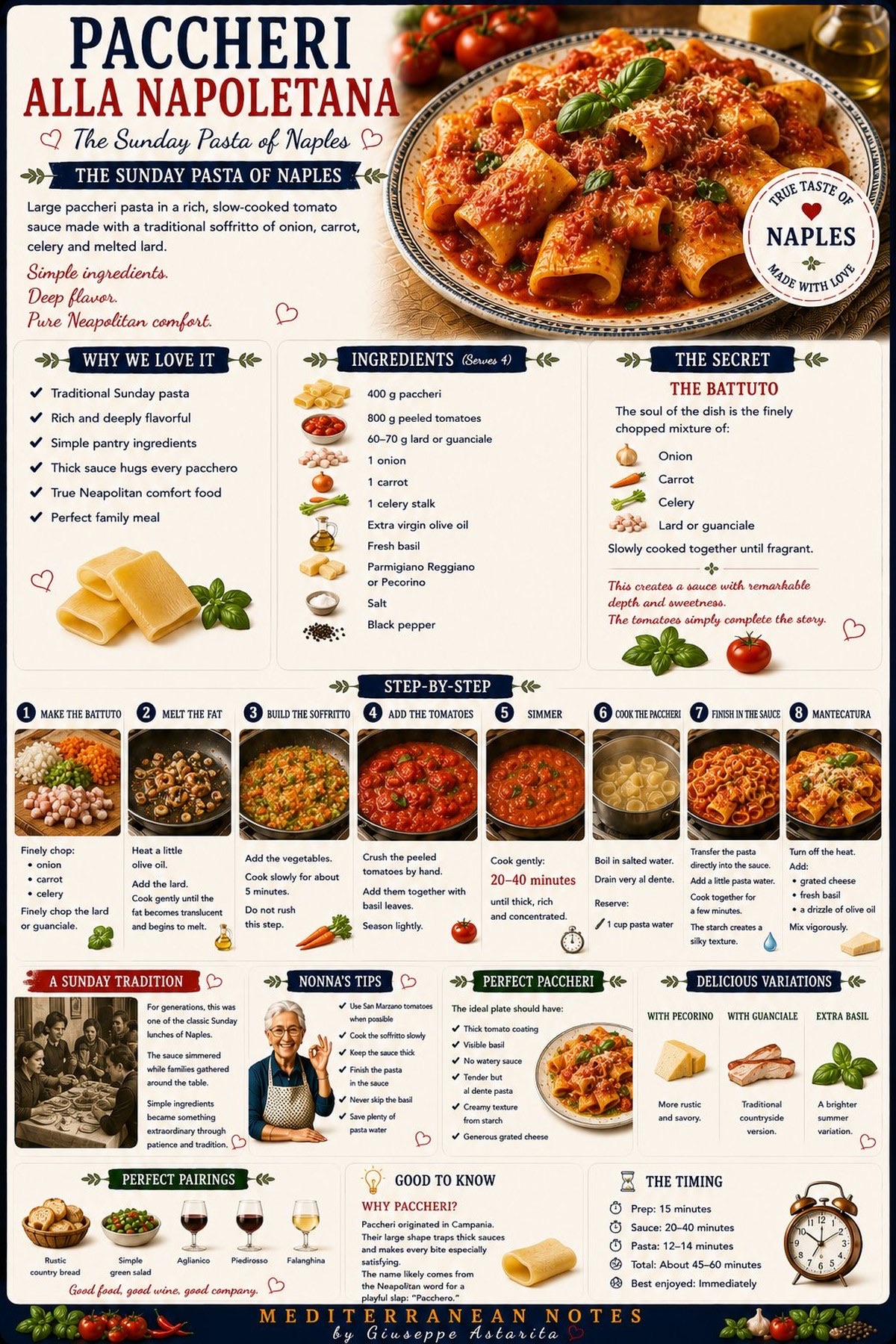
If you ever order paccheri at a trattoria in Campania and the sauce arrives darker, richer, and tasting nothing like this — that is the full Neapolitan version. It has a battuto: onion, carrot, and celery finely chopped and cooked slowly in lard or guanciale until completely soft and fragrant before the tomatoes ever go in. It is a slower, heavier, more complex sauce. It is excellent. It is also not what we make on Sundays here. Both are right. The infographic below shows the traditional version, in case you want to try it one day or in case you find yourself at a table in Naples wondering what you ordered.
The paccheri in the cabinet are from the last trip. There are four packs left. We will make one on Sunday and the cabinet will have three. This is how it goes. One day you will both know the recipe without needing to look at it, and you will make it for your own people on your own Sundays, and the cabinet wherever you are will have a few packs in it, and that will be fine. That is what traditions do — they find new cabinets.
Buon appetito, Anna e Carolina — e buona domenica.