Campanian kitchen · Seafood · Pasta · Sunday · Special occasion · The sea
Calamarata
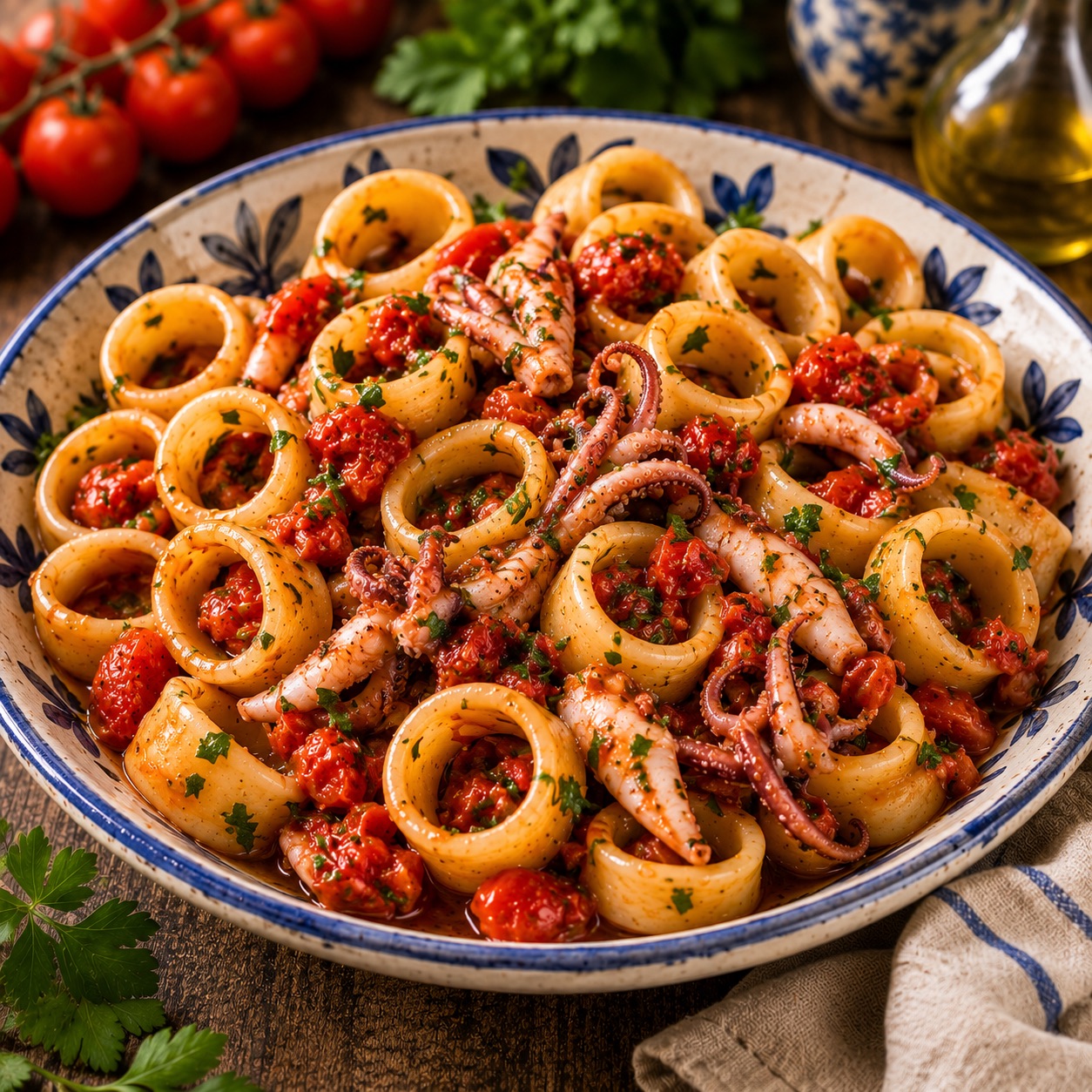
The ring pasta made to hold squid — same shape, same size, cut to fit inside each other. Fresh calamari cooked quickly on high heat, a quick tomato sauce, white wine, parsley. A dish we made a few times at home, not often. My father did not eat seafood. When my mother made the calamarata it was for herself, for me, for my sister. It was a pleasure she shared with us specifically.
My mother made almost everything the Campanian kitchen offered — including the less common dishes, the ones that required specific ingredients or a specific occasion. The calamarata was one of those. We had it a few times. Not regularly — it was a dish that required fresh calamari to be worth making, and fresh calamari is something you buy when the fishmonger has good ones, not something you plan around a calendar. But she made it, and she made it well, as she made everything.
Seafood, for my mother, was always a treat. Not in the sense of being expensive — though some of it was — but in the sense of being special, something she looked forward to cooking and eating with particular pleasure. My father was largely indifferent to seafood; on fish nights he ate something else, usually pasta with a simple tomato sauce, and the fish preparations at the table were effectively for the three of us: my mother, my sister, and me. This created a small world within the larger family meal — three people eating something the fourth did not want, which made the seafood feel like a private occasion, a pleasure shared among those who appreciated it. When she made the calamarata she was not cooking for the whole table. She was cooking for us.
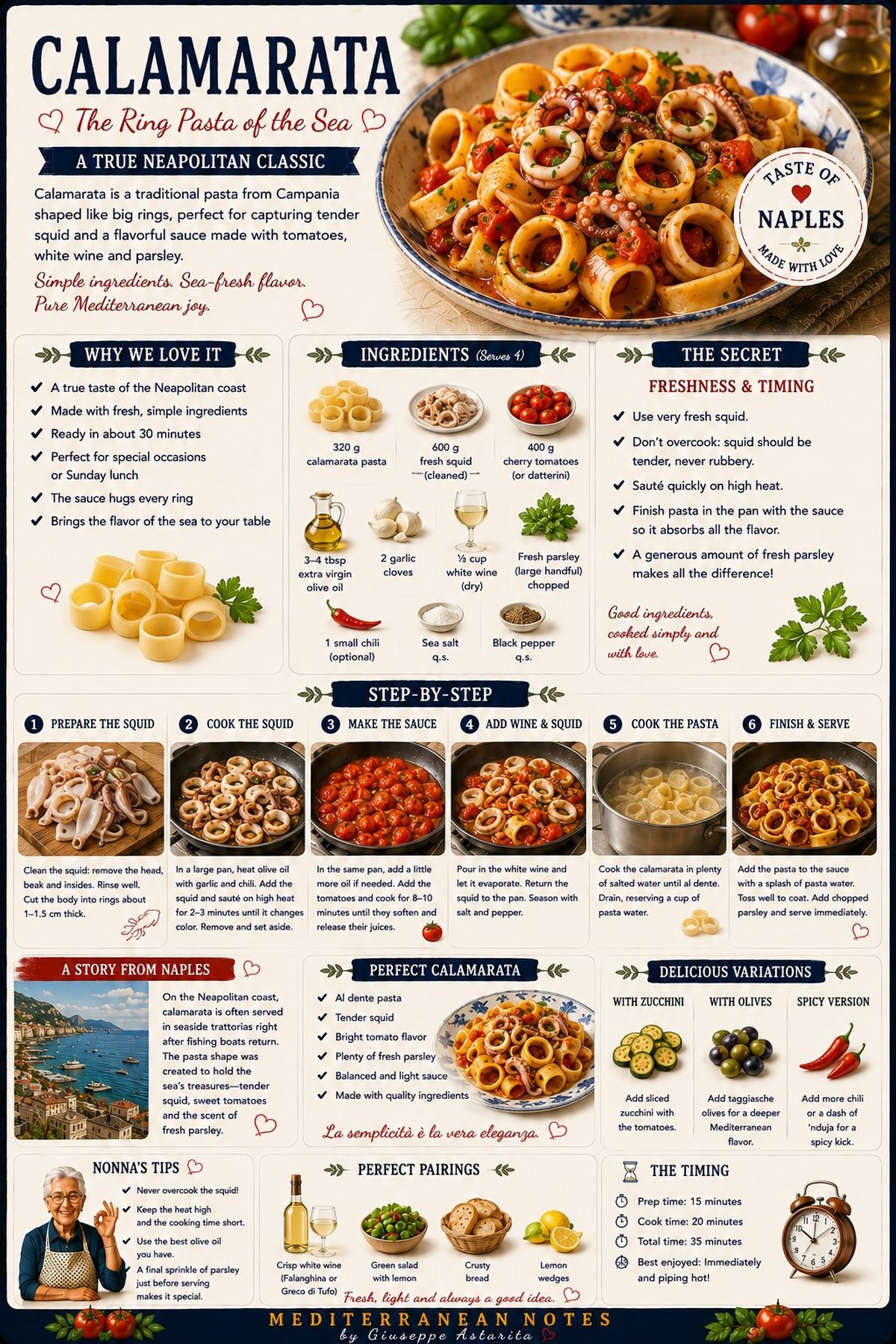
The pasta shape and the ingredient share the name and the geometry deliberately. Calamarata — from calamaro, squid — is a large tube pasta cut into rings approximately 1.5 cm wide, the same width as a properly cut squid ring. The intention is that the two should be indistinguishable in the dish at first glance: a bowl of rings, some pasta, some squid, the sauce coating both equally. In a well-made calamarata the pasta ring picks up sauce and sits alongside a squid ring that has absorbed the same sauce, and the two things together produce a bite with both the chew of the pasta and the slight resistance of the squid, the starch of one and the protein of the other, unified by the tomato and the white wine and the parsley. It is one of those pasta-and-ingredient combinations that makes sense structurally as well as culinarily — the shape was designed for this specific filling environment.
Why squid must cook fast — collagen, temperature, and the two-minute window
Squid muscle is composed primarily of cross-linked collagen fibers surrounding relatively little connective tissue compared to other seafood. When heated to between 60 and 75°C, the collagen contracts rapidly and the squid becomes tough and rubbery — the familiar result of overcooked calamari. There are two correct cooking windows: very fast at very high heat (2–3 minutes in a hot pan, before the collagen contracts fully and the moisture has time to be expelled), or very slow at low heat for 40–60 minutes (long enough for the contracted collagen to hydrolyse back into gelatin, producing tender braised squid). The calamarata uses the first method: the squid is sautéed on high heat for 2–3 minutes until it changes color and just begins to firm, then removed from the pan and returned only at the end when the heat is lower. This brief initial cook sets the surface; the second addition in the sauce completes the cooking gently without crossing into the rubbery zone. The white wine added after the initial sauté contributes ethanol, which accelerates the denaturation of surface proteins slightly and helps lift the fond from the pan; its volatile compounds carry flavor from the squid into the sauce as they evaporate. Fresh parsley added only at the end preserves the volatile aromatics that would be lost to heat.
Recipe — serves 4
Ingredients
Method
Prepare the squid. Clean: remove the head, beak, transparent quill, and innards. Rinse thoroughly. Cut the body into rings about 1–1.5 cm wide — the same width as the pasta rings. Keep the tentacles whole. Pat dry on kitchen paper.
Dry squid sautés; wet squid steams. The difference in the pan is immediate and irreversible.
Sauté the squid fast — then remove it. Heat olive oil in a wide pan over very high heat. Add the garlic and chili. After 1 minute, add the squid rings in a single layer. Sauté on high heat for 2–3 minutes until they change color and just begin to firm. Do not stir constantly — let the surface sear. Remove the squid from the pan and set aside. This is the step most people skip, and it is the most important one.
Make the sauce in the same pan. The pan retains the squid flavors. Add a little more oil if needed. Add the halved cherry tomatoes. Cook on medium-high heat for 8–10 minutes, pressing gently, until they soften and release their juices into a loose sauce.
Return the squid with the wine. Add the squid back to the pan. Pour in the white wine. Let it evaporate for 1–2 minutes. Season with salt and pepper. The sauce should be light and fragrant, not thick. Remove from heat.
Cook the pasta. Boil the calamarata in abundant salted water until al dente — check the package; calamarata typically needs 12–14 minutes. Reserve a full cup of pasta water. Drain two minutes early.
Calamarata is a large pasta and needs a generous pot. Undercrowded pasta cooks more evenly.
Finish in the sauce. Return the sauce to low heat. Add the drained pasta directly into the pan. Toss with a splash of pasta water for 1–2 minutes until the pasta is coated and the sauce clings to each ring. Turn off the heat. Add the chopped parsley generously. Serve immediately.
A note on the daily table — and what mangia che ti fa bene actually meant
Every day there was a full lunch. First course, second course, contorno. A dinner that had been thought about. This was not exceptional in Caserta in the 1980s and 1990s — it was how families ate — but I understand now that it required a continuous, largely invisible effort. My mother cooked with the confidence and efficiency of someone who had internalized the work so completely that it no longer registered as work. She was not following recipes. She was expressing something.
Mangia che ti fa bene — eat, it is good for you. The phrase came with specific claims. Lentils: iron, makes you strong. Spinach: same reason. Fish: phosphorus, good for the brain. Milk: calcium. Some of this was the nutritional folk wisdom of the era, not all of it scientifically exact. Fish contains phospholipids and omega-3 fatty acids that are genuinely important for brain function — the phosphorus claim was a simplified version of a more complex truth. Lentils do contain meaningful amounts of non-heme iron. The spinach-for-strength claim overstates the bioavailability considerably, but leafy greens are excellent for many other reasons. The calcium in milk is real and well-absorbed. She was not wrong, exactly. She was working from a simplified model of nutrition that was directionally correct even where it was not precisely accurate.
More importantly, the underlying practice was sound regardless of the specific claims. We ate a variety of things. We ate seasonally, because the market offered what the season had and my mother bought what the season had. We ate legumes regularly — the lentil soup, the pasta e fagioli, the fave in spring. We ate vegetables every day. We ate fish once or twice a week. We ate meat in moderate quantities, mostly as a component of a larger meal rather than as the meal itself. We ate bread at every meal. We drank wine with lunch, the adults — a small glass, southern red, diluted sometimes with water in the summer. We ate outside in summer, in the courtyard or on the terrace. We ate together, always, until the age when everyone started eating separately, which happened later in Italian families than in American ones and which I think made a difference.
This was the Mediterranean diet, lived rather than prescribed. I did not appreciate it fully until I left it. I have been trying to replicate it, partially, in a kitchen in Massachusetts ever since — with the paccheri from the suitcase, with the seafood from the better fishmonger, with the vegetables from the summer farmers market when they approach what the Campanian market offered. And on some Sundays, when everything comes together, with a dish like this one: the calamarata made for the people at the table who appreciate it, with the parsley added at the end, eaten immediately while the sauce is still fragrant.
Mangia che ti fa bene — e questo fa davvero bene.