I Carciofi a Napoli · Spring · Roman-Jewish Tradition
Carciofi alla Giudia
The whole artichoke flattened and double-fried until it opens like a crispy bronze flower. A Roman Jewish tradition from the 16th century, eaten from the ghetto to the tables of the nobility.
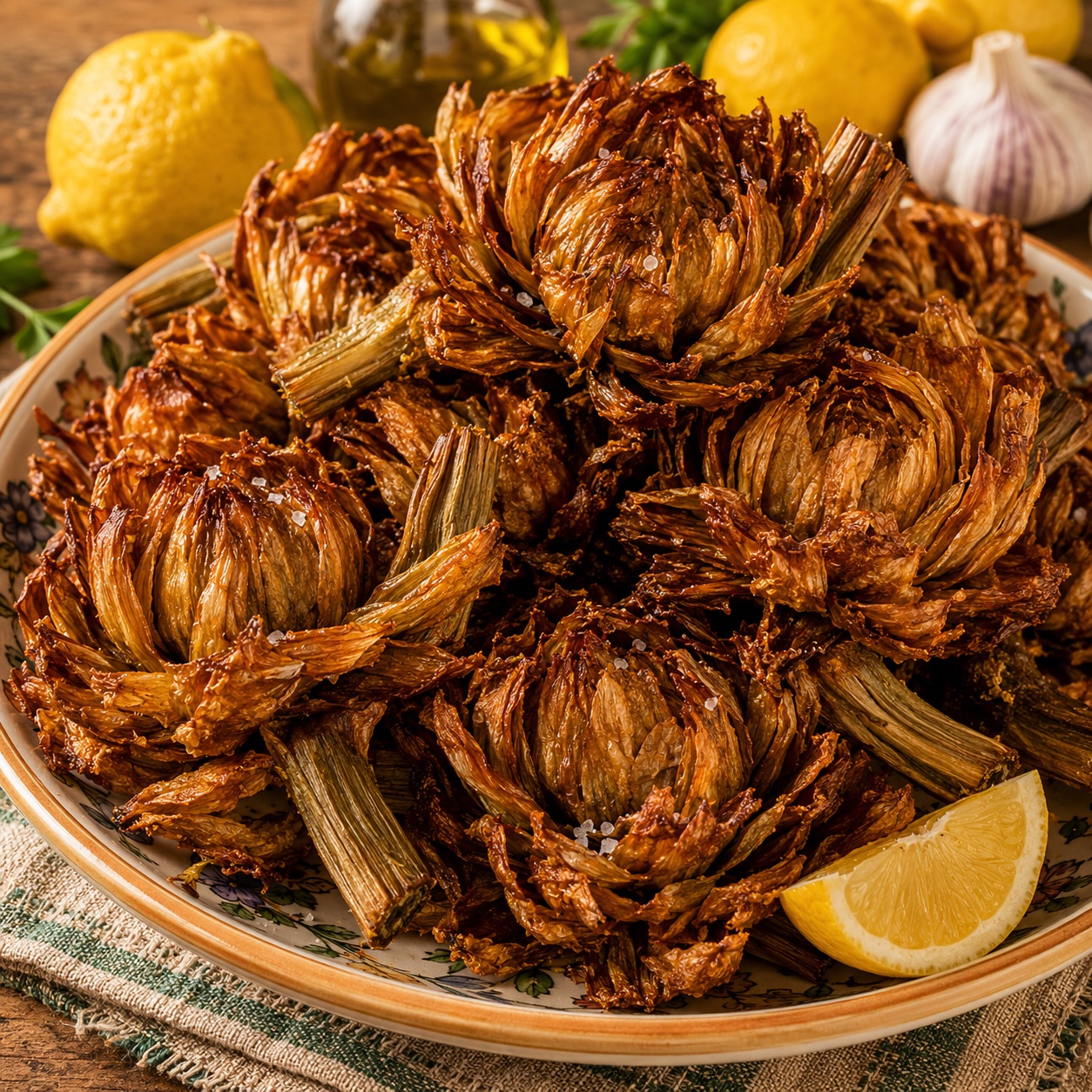
This is one of the oldest dishes in Italian cuisine that is still made essentially unchanged. Carciofi alla giudia originated in the Jewish ghetto of Rome — the Romanesco artichoke, the traditional variety of the Roman countryside, fried whole in olive oil until it opens into a flower and becomes crispy from the outermost leaf to the centre. The recipe contains nothing but artichoke, olive oil, and salt. It requires no coating, no batter, no eggs. The artichoke itself is the dish.
The technique is the thing. The artichoke is trimmed to its heart-and-stem shape, then fried in hot olive oil a first time until tender through, then removed, pressed flat (which opens the leaves outward like a chrysanthemum), and returned to hotter oil for a second fry that makes the opened leaves crispy and golden. The name comes from the Jewish Roman community of the portico d'Ottavia neighbourhood — the dish spread from there through the entire city and beyond. It is now so associated with Rome that it is considered one of the symbols of Roman cooking, but its origins are specifically in the Jewish Roman tradition.
I include it here not because it is Neapolitan but because Neapolitan cooks know it and love it, because the artichoke is central to the Southern Italian table in spring, and because it is worth making. My mother's version was the indorati e fritti — golden with egg and Pecorino. This version is simpler and older: just the artichoke and the oil.
The artichoke's leaves contain a relatively low water content compared to most vegetables, especially after the first fry drives off much of the remaining moisture. In the second fry at high temperature, the residual moisture in the leaf surfaces evaporates rapidly, and the leaf structure — made of cellulose and lignin — undergoes Maillard browning. The cells contract as they dry, which is part of what makes the leaves fan out and become rigid. This is the same principle as frying a tortilla or a grain cracker: starch and fibre in a thin structure, dried quickly at high heat, become brittle and crispy.
The double-fry technique is essential because high oil temperatures would char the outer leaves before the thick centre is cooked. The first gentle fry cooks everything through without browning. The pressing opens the leaves and exposes more surface area. The second high-temperature fry then has a thin, already-cooked leaf surface to work with, and can drive it to crispiness in minutes. This is the same logic as the double fry for Belgian fries: physics of heat transfer, applied over centuries of observation in the kitchen.
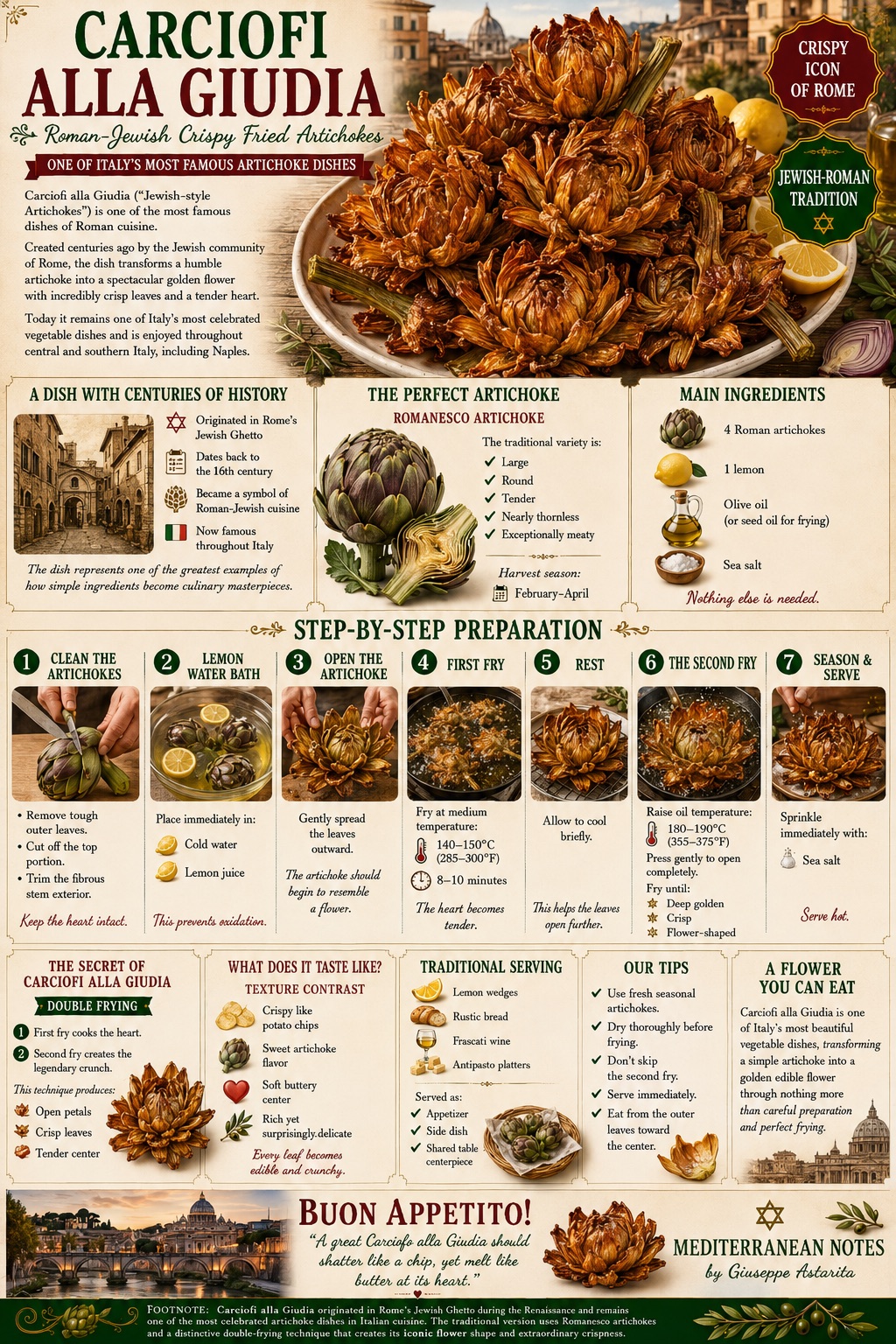
Tap to enlarge — Carciofi alla giudia: storia, tecnica, ingredienti
Recipe — Carciofi alla Giudia
Serves 4 · Ready in 35 minutes
- 4–6 Romanesco artichokes or round, nearly spineless artichokes — one per person
- 1 lemon for acidulated water
- Olive oil plenty — enough for deep frying
- Sea salt to taste
- Nothing else this is the whole recipe
Carciofi alla giudia are eaten by pulling each crispy leaf and eating it whole — unlike the slow leaf-pulling of carciofi alla romana, where the leaf is only partially edible. Here the whole leaf is crispy and tender enough to eat completely. The heart and stem at the centre are the richest part. This dish has been made in Rome for at least five centuries. The recipe has not needed to change.