Tarallo Napoletano
'Nzogna e pepe — the crumbly, peppery, almond-studded ring of Naples
Large and braided, made short with lard, fragrant with black pepper, topped with whole toasted almonds. The defining street snack of Naples since the late 1700s — and absolutely nothing like the Pugliese tarallo.
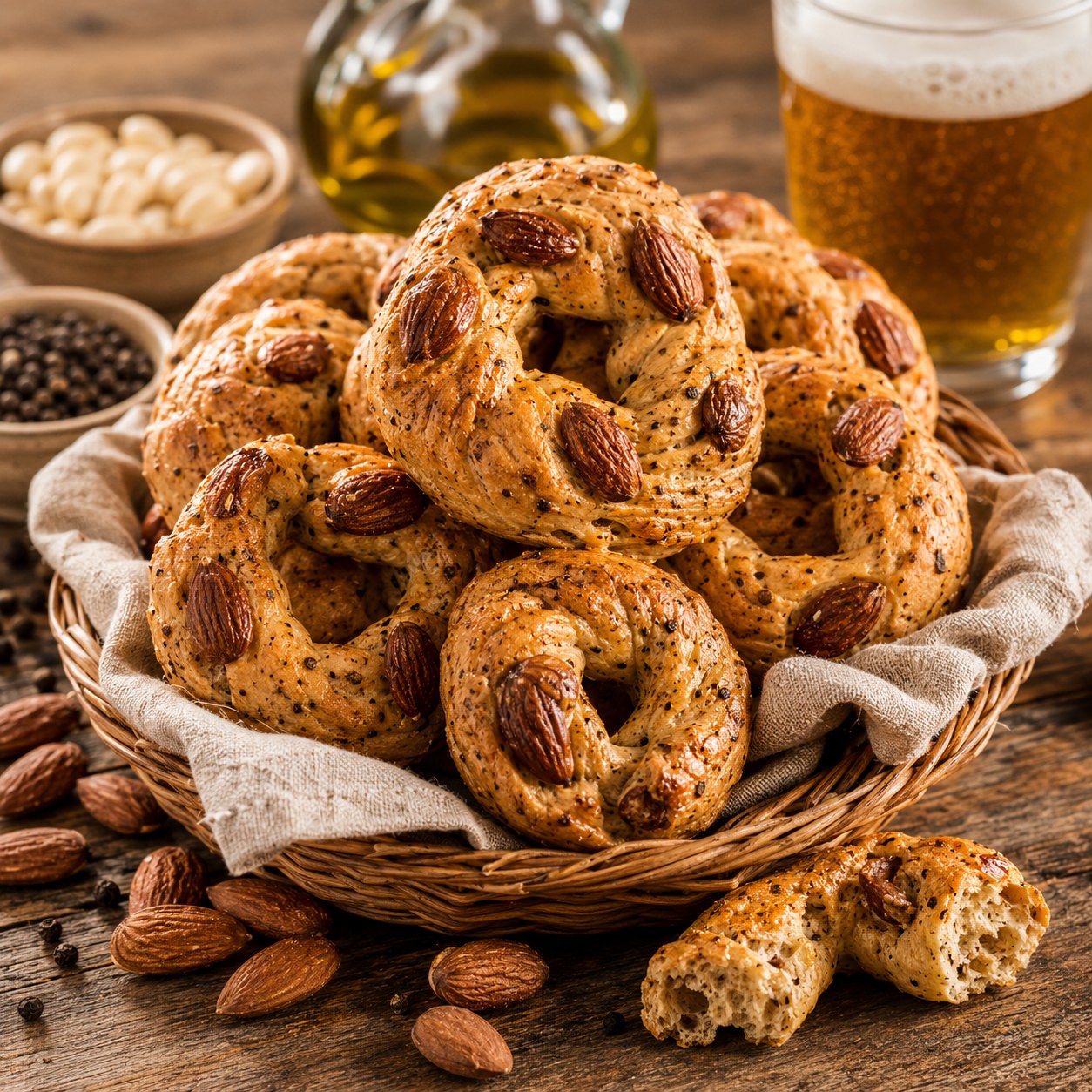
The tarallo napoletano is not a snack in any diminutive sense. It is a large, twisted ring of enriched dough — braided, studded with whole toasted almonds, made short and crumbly with a generous quantity of strutto (rendered pork lard), and perfumed throughout with coarsely ground black pepper. You hold it in one hand. It breaks apart when you bite it. The almonds crunch. The pepper registers on the back of the palate, warm and persistent. The texture is somewhere between a very good cracker and a very dry pastry. With a cold glass of beer, nothing else exists.
This is not the small, hard, oil-glazed tarallo that came to Naples from Puglia and spread across southern Italy. The Pugliese tarallo is bite-sized, boiled before baking, flavored with fennel seeds or chili, and built for endurance. The Neapolitan tarallo is a different object entirely — larger, hand-sized, built around lard rather than oil, and closer in spirit to a rustico than to a cracker. The two things share a name and a shape. Almost everything else differs. In Naples, when someone says tarallo, they mean this one, and when they want the Pugliese version they usually say tarallo pugliese to distinguish it.
My mother used to buy them sometimes. At home they came out with olives for the aperitivo — a bowl of black olives, a few taralli, something to drink while the actual meal was still assembling itself in the kitchen. But she also had the habit, which I watched more than once, of eating one on the way back from the shop, still warm, breaking off a piece and tasting it before she even got home. It was the same impulse that makes you tear into a loaf of bread while it is still warm from the oven — the thing is best right then, and you know it, and you act accordingly.
History — from the panificio to the lungomare
The tarallo napoletano was born in the popular bakeries of Naples in the late 1700s. It began, as many things in the tradition of cucina povera, as a solution to waste: the sfriddo, the scraps and trimmings left over from bread dough after loaves had been shaped, were mixed with lard and pepper and formed into rings rather than discarded. Nothing was thrown away. The rings went into the oven after the bread, using residual heat, and came out dry and crumbly and intensely flavored with the pepper and fat.
The almonds came later, in the early 1800s — added on the surface before baking, where they toasted to a deep color and gave the tarallo a bitter-sweet note that cut through the richness of the lard and the heat of the pepper. The three elements together — strutto, pepe nero, mandorle — have not changed since. They are what makes this specific thing rather than some other thing, and substituting any of them changes the character of the result.
The tarallari — the street sellers who specialized in taralli — became a fixture of the Neapolitan waterfront. Along the Mergellina and the lungomare they sold them from baskets, warm, to people walking, working, or simply standing at the water. The tarallo was not a restaurant food. It was a walking food, a counter food, something eaten quickly in the street or at a bar with a drink. It still is.
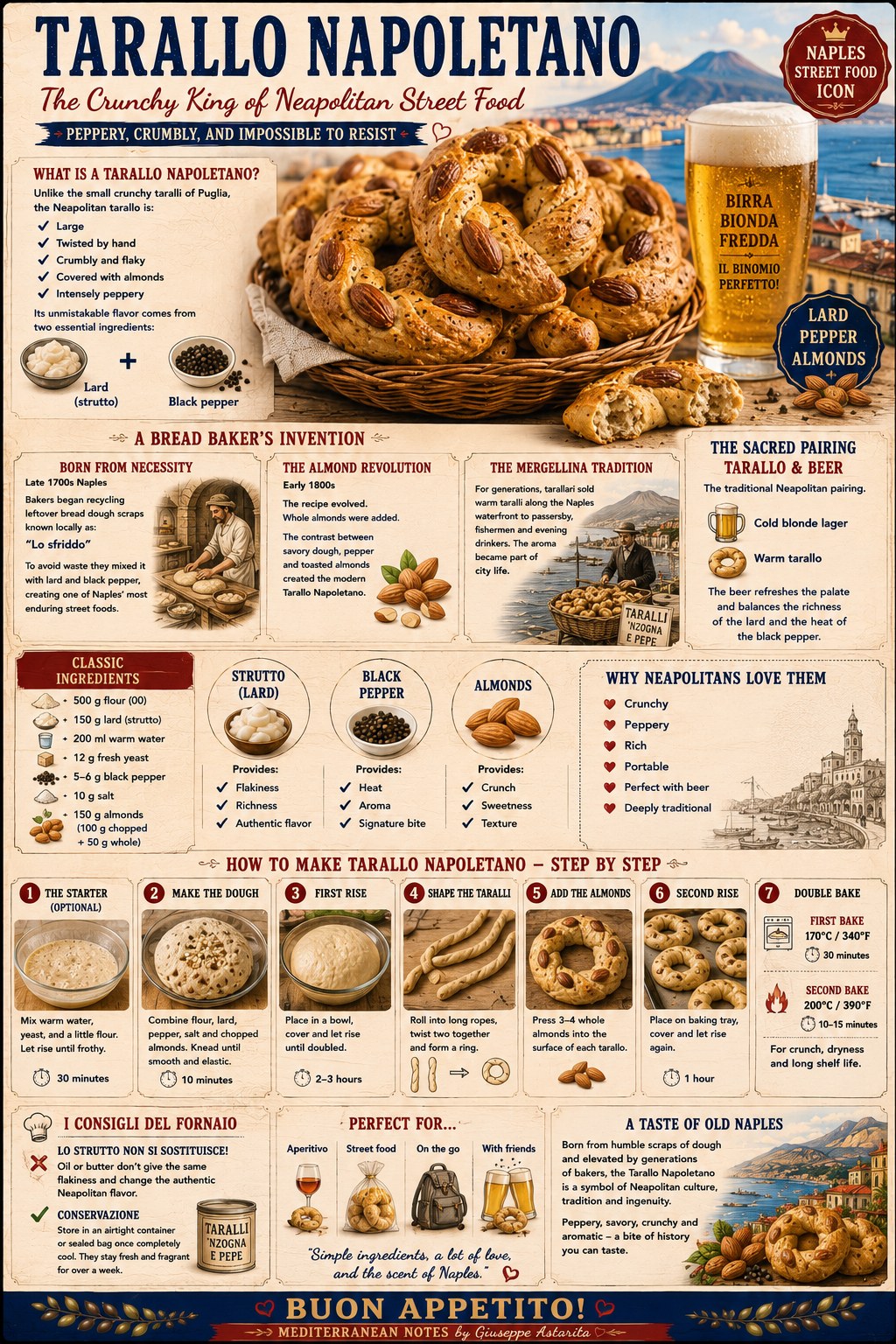
The Neapolitan tarallo is large, braided, enriched with lard, fragrant with black pepper, topped with whole almonds. The Pugliese tarallo is small, hard, boiled before baking, made with olive oil, typically flavored with fennel seeds or chili. They share a name and a ring shape. The fat, the size, the texture, the pairing, the occasion — all different. In Naples, ordering a tarallo means this one.
Recipe — about 10–12 taralli
Method