Spigola al cartoccio
The most elegant preparation and the most forgiving — sealed in parchment with cherry tomatoes, garlic, parsley, and olive oil, the fish cooks in its own steam. The moisture stays inside. The aroma builds inside. When the parcel opens at the table, everything that accumulated in that sealed environment comes out at once.
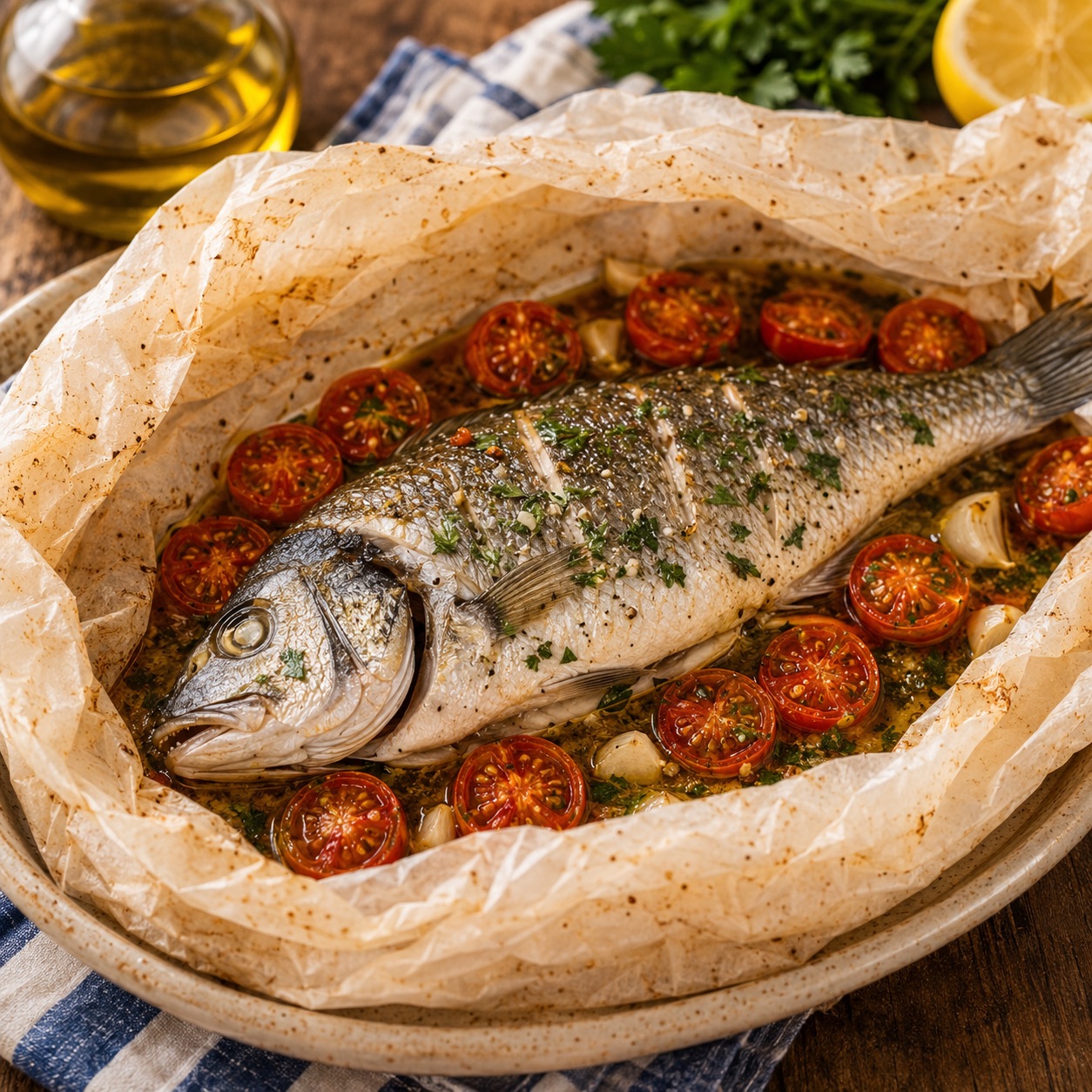
My mother said ho fatto la spigola al cartoccio with particular satisfaction, more than the other preparations. The cartoccio involves more assembly — the parchment, the careful folding, the sealed parcel — and it arrives at the table looking like something considered rather than thrown together. The parcel itself is the presentation. You bring it to the table sealed, the steam still pressing against the paper, and you open it there. The smell that comes out when the parcel breaks open is the accumulated steam of everything that cooked inside — olive oil, garlic, tomato, fish, parsley — and it arrives all at once rather than gradually the way a pan dish does. It is a small theatre, and it is entirely justified by the result.
The cartoccio method produces the moistest fish of the three preparations. The parchment creates an enclosed environment where the fish cooks entirely by steam rather than by direct oven heat. No moisture can escape. The liquid added before sealing — a splash of white wine, a drizzle of olive oil — turns to steam and circulates inside the parcel, bathing the fish continuously throughout the cooking time. The result is a fish that cannot dry out as long as the parcel stays sealed. This is also why you must not open the parcel while it cooks: the moment the seal breaks, the steam escapes and the cooking environment changes entirely.
The preparation takes about ten minutes to assemble and twenty to twenty-five minutes in the oven. It requires no monitoring, no basting, no turning. Once the parcel is sealed and in the oven, there is nothing to do. This makes it simultaneously the most elegant-looking and the most practical of the three preparations — a combination that explains why my mother chose it for the evenings she described as something special.
Why the cartoccio method keeps fish moist — steam cooking and aroma concentration
The parchment parcel creates a sealed humid environment that cooks the fish primarily by convection of steam rather than dry oven heat. At oven temperature, the water in the cherry tomatoes, the added wine, and the moisture on the fish surface evaporate and build pressure inside the sealed parcel. The fish is surrounded by this steam at approximately 95–100°C — lower than the oven air temperature — which means the protein denaturation happens more gently and over a longer effective window than direct heat would produce. The lower cooking temperature preserves more of the volatile aromatic compounds from the garlic, parsley, and tomato that would otherwise be lost to the oven air in an open preparation. These volatile compounds — limonene, linalool, various aldehydes and esters — are trapped inside the parcel and concentrate in the steam. When the parcel is opened, they are released simultaneously as a concentrated aromatic burst. This is the chemistry behind the theatrical aroma release that makes opening a cartoccio at the table such a distinct experience.
Recipe — serves 2 (one whole fish) or 4 (two smaller fish)
Ingredients
Method
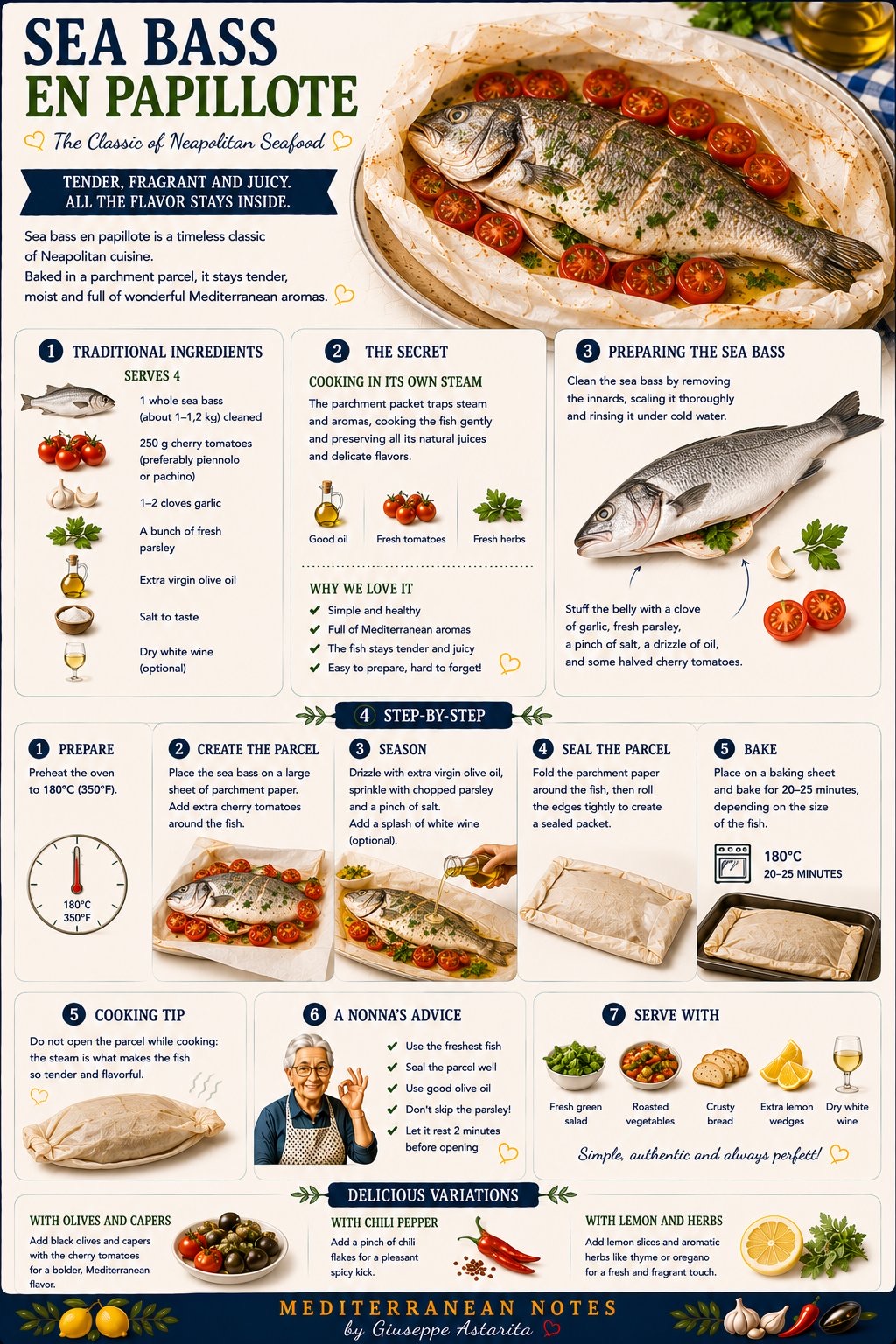
Preheat the oven to 180°C (350°F). Prepare a large sheet of parchment — it should be large enough to enclose the fish with several centimeters of overlap on all sides for sealing. Place it on a baking tray.
Prepare the fish. Clean and rinse the fish under cold water. Pat completely dry. Scale if the fishmonger has not done so. Season inside and out with salt. Stuff the belly cavity with a garlic clove, a few cherry tomato halves, and a few sprigs of parsley.
Build the parcel. Drizzle the centre of the parchment sheet with olive oil. Place the fish on the oiled area. Arrange the remaining cherry tomatoes around and over the fish. Add the sliced garlic and remaining parsley. Drizzle generously with olive oil — the oil will emulsify with the steam and baste the fish internally. Add a splash of white wine if using.
Seal the parcel tightly. Fold the parchment over the fish, bringing the top edge down to meet the bottom edge. Roll and fold the edges together tightly — the parcel should be fully sealed with no gaps. Twist and fold the two short ends tightly inward. The seal must hold through the cooking time to maintain the steam environment inside.
A tight seal is not optional. Any gap means escaping steam, falling pressure, and a drier fish. Take the extra thirty seconds to make sure the folds are secure.
Bake without opening. Place the sealed parcel on the baking tray in the preheated oven. Bake for 20–25 minutes for a 1–1.2 kg fish; 15–18 minutes for smaller ones. The parcel will inflate as steam builds inside. Do not open it.
Rest and open at the table. Remove from the oven and bring directly to the table — still sealed. Let it rest for 2 minutes. Then open the parcel at the table: cut or tear across the top with scissors or a knife. The steam and aroma will come out immediately. Serve the fish directly from the open parcel, spooning the collected juices over each portion.
Opening at the table is not ceremony for its own sake — the fish is hottest and the aroma most intense in the first minute after the seal breaks. The experience is substantially different from opening in the kitchen and carrying a plate.
The cartoccio is the easiest of the three preparations to get right and the hardest to get wrong. The sealed environment forgives minor timing errors — a fish that has been in the oven a minute or two longer than ideal is still moist inside the sealed parcel in a way it would not be in an open tray. It requires no skill except the assembly, and the assembly is just folding and rolling. My mother made it for guests partly because it looked impressive and partly because she could put it in the oven and forget it while she attended to other things. Both reasons are valid.
Al cartoccio — tutto il sapore dentro, fino al momento di aprirlo.